Zaner-Bloser Handwriting
Product by Zaner-Bloser
Facts checked: Not yet checked
Our take (not a Learning Standard rating). This label applies to learning-science judgments throughout this overview.
Our take (not a Learning Standard rating)
Zaner-Bloser Handwriting is pending a full evaluation by The Learning Standard, but its core methodology relies on proven direct instruction and motor skill repetition. It effectively builds automaticity in letter formation through structured practice, though digital translation of tactile handwriting skills lacks the physical feedback necessary for complete mastery without supplemental paper-based work.
Pros
- Breaks letter formation down into explicit, manageable steps using clear direct instruction.
- Employs spaced repetition to build muscle memory and automaticity in elementary students.
- Integrates game-based elements to sustain engagement during highly repetitive motor skill drills.
- Uses visual worked examples to model correct stroke sequence and direction before independent practice.
Cons
- Lacks the tactile friction of pencil on paper, which is critical for complete fine motor development.
- Requires constant adult supervision to correct pencil grip and posture, which the software cannot monitor.
- Pricing and access are primarily restricted to school implementations rather than direct consumer purchase.
What Do We Know About Zaner-Bloser Handwriting?
Zaner-Bloser Handwriting provides effective, structured direct instruction for letter formation, though it must be paired with traditional paper practice for your child to achieve true fine motor mastery. The Learning Standard has not yet evaluated this specific digital application, but the underlying Zaner-Bloser methodology is heavily grounded in cognitive science. The program focuses on teaching vertical manuscript and slanted cursive through explicit modeling. Your child will watch visual worked examples of stroke sequences and then replicate them on the screen. This digital tool successfully builds automaticity, meaning your child learns to write letters without conscious thought, freeing up their cognitive load for actual written expression and spelling. However, digital handwriting apps fundamentally lack physical friction. A plastic stylus on a glass tablet screen cannot replicate the sensory feedback of a real pencil on paper. You must physically monitor your child's posture, paper position, and pencil grip yourself, as the software only evaluates the final digital line drawn. While the game-based elements motivate students through repetitive drills, parents must view this application as a supplemental practice tool rather than a complete replacement for physical handwriting instruction.
How Does Zaner-Bloser Handwriting Work?
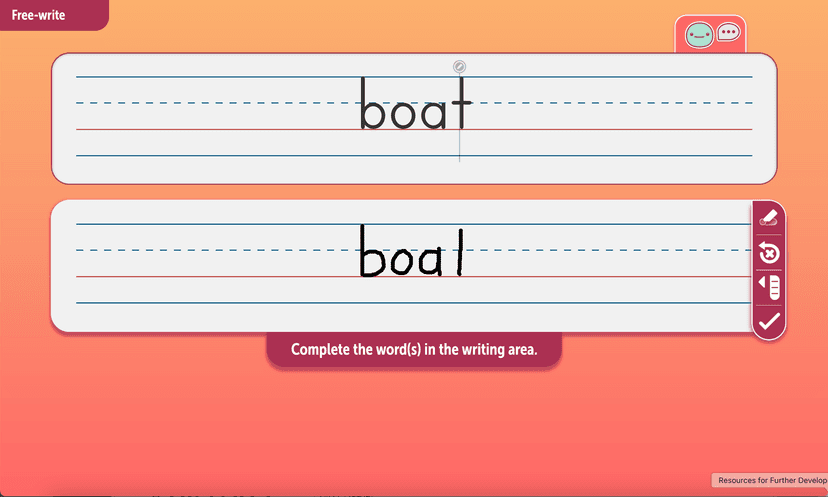
Zaner-Bloser Handwriting uses direct instruction combined with digital gamification to teach explicit stroke sequences for manuscript and cursive writing. The program introduces letters through visual worked examples, showing a clear, animated model of the proper starting point, direction, and stopping point for each stroke. Your child then attempts to trace and independently draw the letter on the screen, receiving immediate visual feedback on their accuracy. The application groups letters with similar stroke patterns together, a pedagogical strategy that reduces cognitive load and allows for immediate skill transfer. Once your child demonstrates basic proficiency, the app utilizes spaced practice to transition from slow, deliberate tracing to rapid, automatic letter production. Game-based rewards are interspersed between drill sets to maintain student focus during these highly repetitive tasks. Because it is designed fundamentally as a blended learning tool, it is typically used alongside direct classroom instruction and physical workbooks, effectively bridging the gap between digital modeling and physical output.
Strengths and tradeoffs of Zaner-Bloser Handwriting
The biggest strength of Zaner-Bloser Handwriting is its reliance on explicit visual modeling to teach stroke sequence, while its biggest weakness is the inherent lack of physical friction when writing on a digital screen. From a learning science perspective, the application excels at cognitive offloading. By systematically teaching standard letter formations until they reach complete automaticity, the program ensures your child does not waste working memory figuring out how to draw an 'A' when they should be focusing on spelling and sentence construction. The use of spaced repetition effectively cements these motor patterns in long-term memory over time. The app also heavily utilizes worked examples, demonstrating the exact path of the letter before asking the student to practice retrieval. However, fine motor skill acquisition requires distinct tactile feedback. The smooth surface of a tablet drastically alters the kinetic experience, meaning the digital practice may not perfectly transfer to physical paper. Furthermore, the software cannot correct poor pencil grip or incorrect hand posture. While the app correctly identifies if the digital stroke is accurate, it completely ignores the biomechanics of how your child achieved it.
Who Might Benefit From Zaner-Bloser Handwriting?
Best for kindergarten through sixth-grade students who need explicit, structured visual modeling to support their daily physical handwriting practice. Because the app utilizes a blended learning approach, it is ideal for classrooms or homeschool environments that pair digital instruction directly with physical workbooks. It is particularly helpful for visual learners who benefit from watching animated stroke sequences before attempting to write. However, it is not ideal as a standalone teaching tool for students struggling with fine motor delays or improper pencil grip.
Data Transparency
Does Not Meet Data Transparency Standard
Zaner-Bloser Handwriting does not meet our data transparency standard. Its privacy policy does not document basic protections, including parents' right to see their child's data and parents' right to delete their child's data.
21 of 35 checks passed
Evaluated September 2026
Zaner Bloser →Level 1 · Basic protections
Does not sell data or target ads at students, limits sharing, and lets parents see and delete their child's data.
Not documented: parents' right to see their child's data, parents' right to delete their child's data
Level 2 · Parent control (meets the standard)
Families can get their data out, know who processes it, and know how long it is kept.
Not documented: named service providers, self-service deletion
Level 3 · Direct data access
Families or schools can pull their own data through an API, in a stated format.
Not documented: an API for retrieving their own data, a named export format
View all 35 checks
Parent Access4/8
Does the policy mention parents specifically?
“Schools and districts choose whether to enable this feature and are responsible for obtaining any required parental or guardian consent prior to student use.”
Can parents view their child's data?
The policy sends student data-rights requests to the school and does not give parents a right to view their child's data.
Can parents modify their child's data?
The policy does not give parents a right to modify their child's data.
Can parents delete their child's account?
The policy gives deletion rights to schools and students through their school, but not to parents.
Is there a dedicated Children's Privacy section?
“Consent from Schools regarding Students’ Personal Information:”
Does it reference COPPA compliance?
“We provide the school with this privacy policy, to ensure that the school, in providing its COPPA consent, has full information and assurance that our policies comply with COPPA.”
Does it reference FERPA compliance?
“We comply with FERPA by relying on this form of consent.”
Is parental consent required for child accounts?
The policy relies on the school's COPPA consent, given in the role of parent, rather than requiring parental consent for student accounts; parental consent is mentioned only as a school responsibility for the optional voice-recording feature.
Data Portability2/5
Can users access their personal data?
“As a user of the portal, you have the rights to access, export, be informed about, rectify, object to the further processing of, restrict the processing of, withdraw consent to the processing of and erase your personal information.”
Can users download/export their data?
“As a user of the portal, you have the rights to access, export, be informed about, rectify, object to the further processing of, restrict the processing of, withdraw consent to the processing of and erase your personal information.”
Is there a self-service data access tool?
The policy has data access handled by request through the school or by contacting the company, with no self-service tool.
Is a specific data format mentioned for export?
The policy does not name any export format.
Is there an API for data access?
The policy does not mention an API for data access.
Data Minimization3/6
Is data collection itemized?
“MyZBPortal.com (“Portal”) collect the following student PII :”
Can the app be used without a real name?
The policy states that the portal collects student first and last names supplied by the school.
Can the app be used without an email?
“- Student first name (provided by district/school/institution) - Student last name (provided by district/school/institution) - Student ID (provided by district/school/institution) - IP address - Student score data (from completing online activities)”
Does it state collection is limited to what is necessary?
“We limit collection to the information necessary to fulfill those purposes.”
Is IP address anonymized or truncated?
The policy says IP logs are deleted regularly but does not say IP addresses are anonymized or truncated.
Is location tracking explicitly excluded?
The policy does not explicitly exclude location tracking.
Third-Party Protection6/7
Does it explicitly state no selling of data?
“We do not sell student information.”
Are third-party providers named?
The policy refers to an unnamed third-party hosting provider and does not name any providers.
Are providers contractually restricted?
“All third-party service providers must agree to protect student data in a manner no less stringent than Zaner-Bloser's.”
No-targeted-advertising commitment?
“cookies are never used for any targeted advertisements toward students.”
Is AI/ML data sharing addressed?
“recordings are not analyzed, processed, or scored by automated systems or artificial intelligence”
Child-specific sharing restriction?
“We do not share data with third parties for any other purpose (advertising, marketing, etc).”
Cookies/tracking limited or opt-out?
“The sole purpose of the use of cookies on the MYZBPortal is to track the user’s session and visit.”
Deletion & Retention4/5
Can users delete their account?
“If you are a student at an educational institution using the Portal, you should direct any requests to exercise your data rights to the appropriate representative at your educational institution.”
Self-service deletion mechanism?
The policy says a company representative carries out deletion on request, with no self-service option.
Specific data retention timeline?
“Recordings are permanently deleted no later than the end of the academic year in which they were made, unless the school or district requests earlier deletion.”
Auto-deletion of inactive accounts?
“Zaner-Bloser will permanently delete all Student Data if School maintains zero active or activatable licenses for Zaner-Bloser digital products for six (6) or more consecutive months.”
Post-deletion handling described?
“School information will remain on backup storage for disaster recovery purposes for another 15 days, but thereafter will be removed completely from all storage devices.”
Advertising2/4
Advertising model explicitly disclosed?
“We may also use cookies for the purpose of re-targeting ads to you.”
Free from third-party advertisements?
The policy says students are not targeted with ads but does not state that the product has no third-party advertising.
Children excluded from ad targeting?
“We do not target students with advertisements.”
Ad-free option available?
The policy does not state that the product is ad-free or offer an ad-free option.
What This Means
The policy review did not meet our data transparency standard. The checks above show the documented findings and unknowns. A missing statement does not establish how the app handles data in practice.
About this evaluation: Based on automated analysis of Zaner Bloser against 35 policy-disclosure questions, including questions adapted from the Common Sense Privacy Program's published evaluation questions. TLS is not affiliated with Common Sense Media, and this is not a Common Sense rating. Quoted text is copied from the policy; unquoted notes are our summary. Results describe what the policy documents, not the company's actual practices. Privacy policies can change: this review reflects the version we analyzed and does not determine legal compliance.
Sources and review method
TLS combines product information and editorial analysis to explain how Zaner-Bloser Handwriting works, its tradeoffs, and the questions to ask before choosing it. Product features, an instructional rationale and evidence of learning outcomes are different kinds of information.
Formal Learning Standard assessment: not yet completed. Data Transparency findings are reported separately and do not establish learning effectiveness. Read our methodology.
Frequently Asked Questions About Zaner-Bloser Handwriting
Is Zaner-Bloser Handwriting free?
No, Zaner-Bloser Handwriting is not free. Pricing is not publicly listed for individual consumers; educators and parents must contact the publisher directly to request a custom quote for licensing. It is primarily sold as an institutional tool for schools and districts, meaning individual parent access may be highly limited or bundled with a broader curriculum package. You should consult your child's school to see if home access is provided.
Is Zaner-Bloser Handwriting good for kindergarteners?
Yes, the program is specifically designed for early elementary students starting in kindergarten. It introduces basic vertical manuscript letter formation using large, clear visual models and interactive game-based elements. These features effectively keep young children engaged during highly repetitive motor skill practice, ensuring they build the necessary baseline automaticity required for more complex writing tasks and spelling retrieval in later grades.
What does Zaner-Bloser Handwriting teach?
Zaner-Bloser Handwriting teaches both vertical manuscript (print) and slanted cursive handwriting to elementary students. It focuses on developing highly efficient stroke sequences, legible letter formation, and long-term motor automaticity. By systematically teaching these foundational skills, the app ensures students can ultimately communicate their ideas in writing without consciously struggling with the physical mechanics of drawing individual letters, effectively freeing up their cognitive load for actual composition.
How does Zaner-Bloser Handwriting compare to Handwriting Without Tears?
Both programs are industry leaders, but they use fundamentally different pedagogical styles. Zaner-Bloser Handwriting focuses on traditional vertical manuscript and traditional slanted cursive with continuous strokes. Handwriting Without Tears uses a simplified, unslanted continuous stroke method designed specifically to reduce fine motor demands and cognitive load for struggling writers. The best choice depends entirely on your child's physical dexterity and school curriculum.
Does Zaner-Bloser Handwriting track student progress?
Yes, the digital platform provides immediate visual feedback on a student's letter formation accuracy and tracks their progress through the curriculum. However, parents and teachers must remember that the application only tracks the final digital output on the screen. Adults must still actively monitor the child's physical pencil grip, posture, and paper positioning manually, as the app cannot detect biomechanical errors.
Has The Learning Standard evaluated Zaner-Bloser Handwriting?
TLS has not yet completed a Learning Standard evaluation of how well Zaner-Bloser Handwriting teaches. Its privacy policy has been reviewed for Data Transparency and does not yet document the basic protections (Level 1).
Is Zaner-Bloser Handwriting COPPA compliant?
The reviewed privacy policy references COPPA. A policy reference alone does not establish COPPA compliance. Policy review note: The policy states that it complies with COPPA.
Is Zaner-Bloser Handwriting FERPA compliant?
The reviewed privacy policy references FERPA. A policy reference alone does not establish FERPA compliance. Policy review note: The policy states that it complies with FERPA.
Does Zaner-Bloser Handwriting have a children's privacy policy?
The reviewed policy includes a dedicated children's privacy section. Policy review note: The policy has a headed section on COPPA consent for students' personal information.
Does Zaner-Bloser Handwriting sell student data?
The reviewed policy states that the app does not sell data. This is a policy statement; actual data practices were not verified. Policy review note: The policy states that the company does not sell student information.
Can you delete your data from Zaner-Bloser Handwriting?
The reviewed privacy policy describes account deletion. We have not tested the deletion process. Policy review note: Users can request erasure, with students making the request through their school.
Follow TLS Research
Subscribe to future TLS research updates: app reviews, findings, and what the evidence shows.
Screenshots

Take Action
For Zaner-Bloser Handwriting
If you represent Zaner-Bloser and have a correction or new evidence, send the relevant source so we can review and update this page.
Submit a correctionDetails
- Pricing
- Contact Zaner-Bloser for pricing
- Platforms
- iPadOS (Apple tablet), Android (Google mobile), Windows (Microsoft), macOS (Apple), Chrome OS (Google)
- Grade Levels
- Kindergarten, 1st Grade, 2nd Grade, 3rd Grade, 4th Grade, 5th Grade, 6th Grade
- Website
- Visit site