Strawbees STEAM Classroom
Product by Strawbees
Facts checked: Not yet checked
Our take (not a Learning Standard rating). This label applies to learning-science judgments throughout this overview.
Our take (not a Learning Standard rating)
Strawbees STEAM Classroom effectively integrates tactile building with project-based learning, though its true efficacy depends heavily on teacher facilitation. While the physical manipulatives promote spatial reasoning and experiential learning, the digital platform primarily serves as a lesson repository rather than an interactive instructional tool providing real-time feedback.
Pros
- Engages students in experiential learning through tactile manipulatives that develop spatial reasoning skills.
- Supports project-based learning with open-ended engineering challenges that encourage collaborative problem-solving.
- Integrates cross-curricular connections by tying physical building tasks to math and science standards.
- Provides educators with a comprehensive digital library of structured lesson plans to guide classroom implementation.
Cons
- Lacks built-in adaptive learning mechanics or immediate digital feedback for individual students.
- Relies heavily on the teacher to assess mastery and correct misconceptions during the physical building process.
- Does not use spaced repetition or structured retrieval practice to ensure long-term retention of STEM concepts.
- Requires significant classroom management and physical storage space for over 4,000 physical pieces.
What Do We Know About Strawbees STEAM Classroom?
Strawbees STEAM Classroom functions effectively as an experiential learning toolkit rather than a standalone instructional app, making it highly dependent on educator guidance. Your child will not interact with a digital software program that teaches them directly or adapts to their learning pace. Instead, they will use physical plastic connectors and straws to build structures, while their teacher uses the digital platform to present challenges and guide the lesson. This hands-on approach leverages embodied cognition, which research shows can significantly improve spatial reasoning and understanding of abstract geometric concepts. The system excels at fostering collaborative problem-solving and open-ended exploration. However, it completely lacks the automated feedback loops, worked examples, and structured retrieval practice found in strictly digital learning tools. If your child struggles with a concept, the materials themselves cannot offer a hint or correct a misunderstanding. The burden of assessing comprehension and ensuring that your child actually grasps the underlying physics or engineering principles falls entirely on the classroom teacher. While we have not yet evaluated this program's outcomes in our lab, its reliance on physical manipulatives makes it a strong supplemental tool for physical classrooms, but parents should know it does not provide independent digital instruction.
How Does Strawbees STEAM Classroom Work?
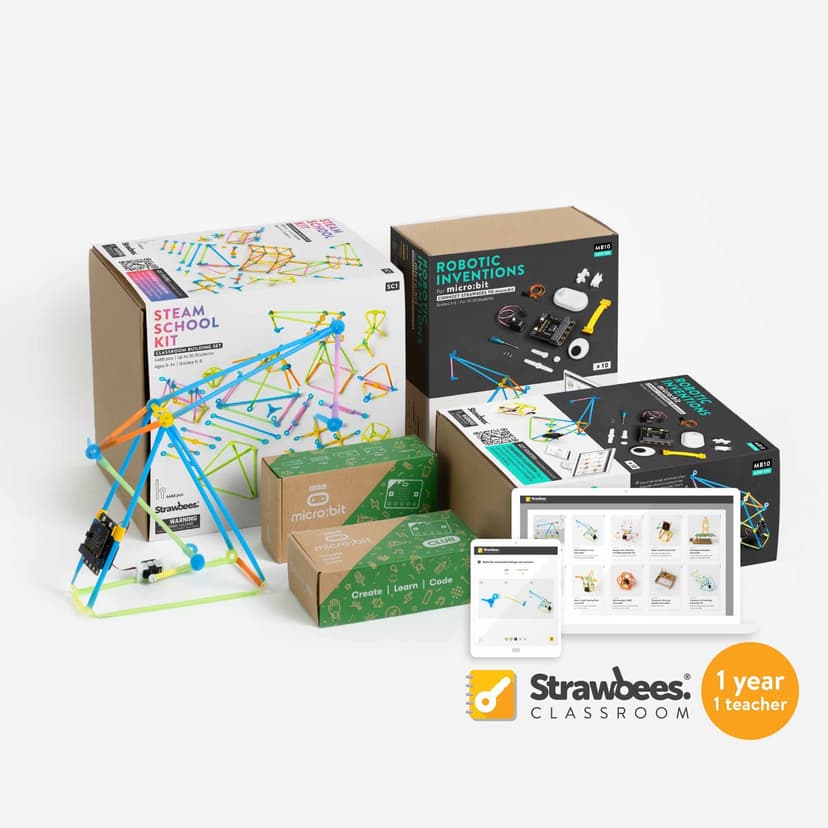
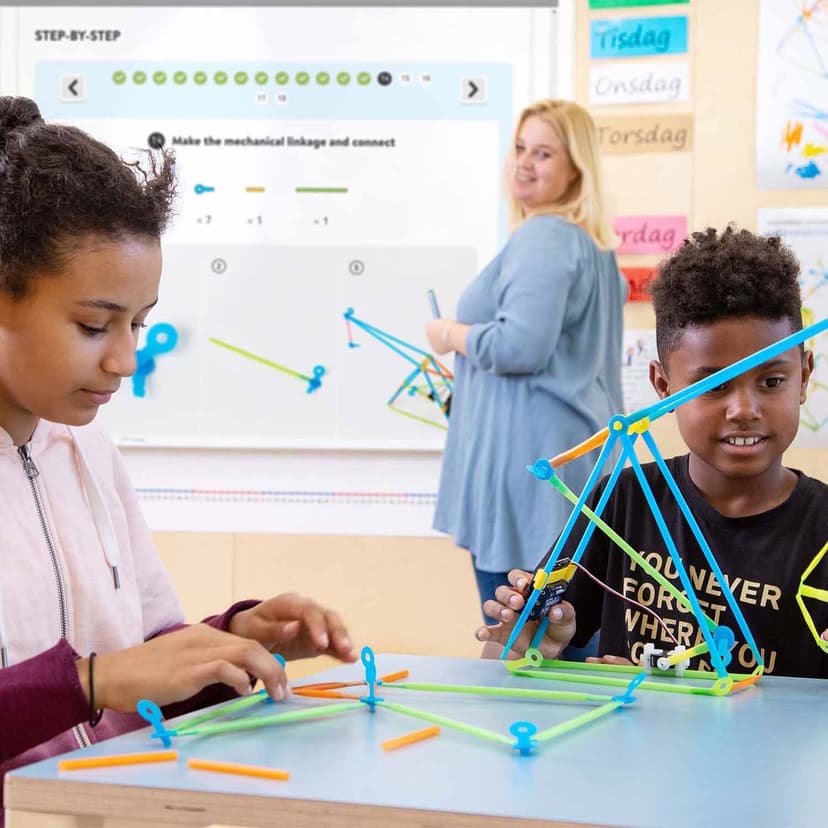
Strawbees STEAM Classroom uses project-based and experiential learning by pairing physical building materials with a digital library of educator-led challenges. The system provides a classroom kit of over 4,300 physical pieces, including flexible connectors and building straws. Teachers log into the digital platform to access lesson plans, instructional videos, and presentation slides. A typical session begins with the teacher introducing a real-world engineering problem or scientific concept using the digital materials. Students then work in small groups using the physical pieces to prototype and build physical solutions to the prompt. The digital platform serves strictly as a content delivery mechanism for the teacher, rather than a student-facing interface. Students do not log in, complete digital quizzes, or receive automated digital feedback. Learning occurs purely through the physical manipulation of materials, trial and error during the building process, and peer collaboration. Teachers guide the reflection process, helping students connect their physical creations to the targeted math, science, or humanities learning objectives outlined in the digital lesson plan.
Strengths and tradeoffs of Strawbees STEAM Classroom
The biggest strength of Strawbees STEAM Classroom is its robust support for spatial reasoning through tactile, experiential learning, while its biggest weakness is the complete absence of independent student feedback loops or adaptive digital instruction. Tactile Engagement: The physical building system forces students to test hypotheses in real-time, effectively demonstrating structural integrity and physics concepts through trial and error rather than abstract digital simulation. Collaborative Problem Solving: By requiring students to work together to assemble massive structures, the program naturally integrates peer teaching and collaborative project-based learning. Lack of Automated Feedback: Because the digital component is strictly a teacher resource, students receive no automated guidance, worked examples, or corrective feedback if they assemble a structure incorrectly or misunderstand the core scientific principle. No Spaced Retrieval: The platform does not incorporate spaced repetition or retrieval practice to ensure students retain the vocabulary or engineering concepts taught during the building activity. Teacher Dependency: The effectiveness of the learning experience relies entirely on the educator's ability to facilitate discussions, manage the physical pieces, and explicitly connect the hands-on activity to academic standards.
Who Might Benefit From Strawbees STEAM Classroom?
Best for K-8 classroom educators who want to integrate structured, hands-on engineering projects into their existing science and math curriculum. The platform serves teachers who are comfortable facilitating open-ended, collaborative group work and have the physical space to manage over 4,000 building pieces. It is ideal for schools looking to implement experiential learning and maker-space environments where the focus is on tactile problem-solving rather than screen time. It is not suitable for parents seeking independent, self-paced digital instruction for their child at home, as the digital platform is strictly a lesson-planning resource for educators.
Data Transparency
Does Not Meet Data Transparency Standard
Strawbees STEAM Classroom does not meet our data transparency standard. Its privacy policy does not document basic protections, including a statement that it does not sell data, limits on sharing children's data and parents' right to see their child's data.
20 of 35 checks passed
Evaluated September 2026
docs.google.com →Level 1 · Basic protections
Does not sell data or target ads at students, limits sharing, and lets parents see and delete their child's data.
Not documented: a statement that it does not sell data, limits on sharing children's data, parents' right to see their child's data, parents' right to delete their child's data
Level 2 · Parent control (meets the standard)
Families can get their data out, know who processes it, and know how long it is kept.
Level 3 · Direct data access
Families or schools can pull their own data through an API, in a stated format.
Not documented: an API for retrieving their own data, a named export format
View all 35 checks
Parent Access3/8
Does the policy mention parents specifically?
The policy does not mention parents.
Can parents view their child's data?
The policy does not say parents can view their child's data.
Can parents modify their child's data?
The policy does not say parents can change their child's data.
Can parents delete their child's account?
The policy does not say parents can delete their child's data or account.
Is there a dedicated Children's Privacy section?
“FERPA AND COPPA COMPLIANCE Our Services are compliant with Family Educational Rights and Privacy Act (FERPA) and Children’s Online Privacy Protection Rule (COPPA).”
Does it reference COPPA compliance?
“Our Services are compliant with Family Educational Rights and Privacy Act (FERPA) and Children’s Online Privacy Protection Rule (COPPA).”
Does it reference FERPA compliance?
“Our Services are compliant with Family Educational Rights and Privacy Act (FERPA) and Children’s Online Privacy Protection Rule (COPPA).”
Is parental consent required for child accounts?
The policy says students do not create accounts and does not mention parental consent.
Data Portability3/5
Can users access their personal data?
“You have the right to access, correct, port, or delete any of your Personal data collected by us.”
Can users download/export their data?
“You have the right to access, correct, port, or delete any of your Personal data collected by us.”
Is there a self-service data access tool?
“You can update the information associated with your Strawbees Classroom account directly by logging in to your account at classroom.strawbees.com.”
Is a specific data format mentioned for export?
The policy does not name a format for exported data.
Is there an API for data access?
The policy does not mention an API for data access.
Data Minimization3/6
Is data collection itemized?
“Account Information: When you register as a User or Administrator on our Services, we collect data you submit on the forms on our websites. This includes but is not limited to name, email address, country, school name, and what Strawbees products you have access to.”
Can the app be used without a real name?
“Students do not create accounts to access the content. When a student accesses a resource assigned by their teacher, they do so anonymously.”
Can the app be used without an email?
“Students do not create accounts to access the content. When a student accesses a resource assigned by their teacher, they do so anonymously.”
Does it state collection is limited to what is necessary?
The policy states an aim that processing be necessary for a specific purpose, but it never explicitly limits collection to what is necessary.
Is IP address anonymized or truncated?
The policy says IP addresses are collected in log data and does not mention anonymizing or truncating them.
Is location tracking explicitly excluded?
The policy does not explicitly rule out location tracking.
Third-Party Protection3/7
Does it explicitly state no selling of data?
The policy rules out sharing data for advertising or marketing, but it never explicitly says the company does not sell data.
Are third-party providers named?
“We may use third party services (such as but not limited to Plausible Analytics) to help with analyzing data to improve our services.”
Are providers contractually restricted?
“Third parties are contractually prohibited from using the Personal data for any other purpose than to provide the service requested by us, in for purposes described in this Privacy Policy.”
No-targeted-advertising commitment?
“No. We don’t display ads, allow third-party ads, share data for advertising or marketing purposes on our platforms.”
Is AI/ML data sharing addressed?
The policy does not address AI or machine learning.
Child-specific sharing restriction?
The policy has no sharing restriction specific to children beyond saying it does not collect student data.
Cookies/tracking limited or opt-out?
The policy says the platforms use cookies and points to a separate Cookie Policy, without describing limits or an opt-out.
Deletion & Retention4/5
Can users delete their account?
“If you wish to delete your Strawbees Classroom account, you can do so by logging in to your Strawbees Classroom account and clicking on "Delete account" on the Account Settings tab. You can also contact us directly at privacy@strawbees.com.”
Self-service deletion mechanism?
“If you wish to delete your Strawbees Classroom account, you can do so by logging in to your Strawbees Classroom account and clicking on "Delete account" on the Account Settings tab.”
Specific data retention timeline?
“Abandoned accounts and all content associated will be deleted automatically if the account has not been accessed for more than 7 years.”
Auto-deletion of inactive accounts?
“Abandoned accounts and all content associated will be deleted automatically if the account has not been accessed for more than 7 years.”
Post-deletion handling described?
The policy does not say what happens to data after deletion, such as backups or residual copies.
Advertising4/4
Advertising model explicitly disclosed?
“No. We don’t display ads, allow third-party ads, share data for advertising or marketing purposes on our platforms.”
Free from third-party advertisements?
“No. We don’t display ads, allow third-party ads, share data for advertising or marketing purposes on our platforms.”
Children excluded from ad targeting?
“No. We don’t display ads, allow third-party ads, share data for advertising or marketing purposes on our platforms. Neither do we allow data collection by third-party advertisers or data brokers, or share Personal Data with third parties for marketing purposes.”
Ad-free option available?
“No. We don’t display ads, allow third-party ads, share data for advertising or marketing purposes on our platforms.”
What This Means
The policy review did not meet our data transparency standard. The checks above show the documented findings and unknowns. A missing statement does not establish how the app handles data in practice.
About this evaluation: Based on automated analysis of docs.google.com against 35 policy-disclosure questions, including questions adapted from the Common Sense Privacy Program's published evaluation questions. TLS is not affiliated with Common Sense Media, and this is not a Common Sense rating. Quoted text is copied from the policy; unquoted notes are our summary. Results describe what the policy documents, not the company's actual practices. Privacy policies can change: this review reflects the version we analyzed and does not determine legal compliance.
Sources and review method
TLS combines product information and editorial analysis to explain how Strawbees STEAM Classroom works, its tradeoffs, and the questions to ask before choosing it. Product features, an instructional rationale and evidence of learning outcomes are different kinds of information.
Formal Learning Standard assessment: not yet completed. Data Transparency findings are reported separately and do not establish learning effectiveness. Read our methodology.
Frequently Asked Questions About Strawbees STEAM Classroom
Is Strawbees STEAM Classroom free?
No, Strawbees STEAM Classroom requires a paid purchase. The system is sold as a comprehensive physical and digital package for schools. The price includes the physical classroom kit, which contains over 4,300 reusable building pieces designed for collaborative group work. It also includes a one-year digital license for a single teacher account to access the complete Strawbees Classroom online library of lesson plans, student-facing presentation slides, and instructional videos.
Is Strawbees STEAM Classroom good for elementary students?
Yes, Strawbees STEAM Classroom supports students from Kindergarten through 8th grade. The physical pieces are lightweight and accessible for developing early childhood fine motor skills. Meanwhile, the digital lesson library scales the complexity of the engineering challenges up through middle school. Younger students might focus on basic shape recognition and simple structures, while older students tackle advanced applied science and math standards through complex structural engineering and physics challenges.
What does Strawbees STEAM Classroom teach?
Strawbees STEAM Classroom teaches foundational engineering, physics, and spatial reasoning through physical prototyping. The digital lessons tie these physical building activities to cross-curricular standards in math, science, humanities, and career and technical education. Students learn how to apply the engineering design process by building, testing, and iterating on their physical designs. The collaborative nature of the classroom kits also explicitly targets soft skills like peer communication, teamwork, and collective problem-solving.
Strawbees STEAM Classroom vs. Lego Education?
Both systems use physical manipulatives paired with digital teacher resources, but they target different mechanics. Strawbees STEAM Classroom focuses on large-scale, flexible, and lightweight structural engineering using straws and connectors, making it ideal for massive group builds. Lego Education typically emphasizes rigid structural building and integrates more heavily with digital coding and robotics platforms. Strawbees offers a more free-form, flexible approach to prototyping, while Lego provides a highly structured engineering ecosystem.
Has The Learning Standard evaluated Strawbees STEAM Classroom?
TLS has not yet completed a Learning Standard evaluation of how well Strawbees STEAM Classroom teaches. Its privacy policy has been reviewed for Data Transparency and does not yet document the basic protections (Level 1).
Is Strawbees STEAM Classroom COPPA compliant?
The reviewed privacy policy references COPPA. A policy reference alone does not establish COPPA compliance. Policy review note: The policy says the service complies with COPPA.
Is Strawbees STEAM Classroom FERPA compliant?
The reviewed privacy policy references FERPA. A policy reference alone does not establish FERPA compliance. Policy review note: The policy says the service complies with FERPA.
Does Strawbees STEAM Classroom have a children's privacy policy?
The reviewed policy includes a dedicated children's privacy section. Policy review note: The policy has its own section headed FERPA and COPPA compliance.
Does Strawbees STEAM Classroom sell student data?
A statement ruling out data selling was not found in the reviewed policy. This does not establish that the app sells student data. Policy review note: The policy rules out sharing data for advertising or marketing, but it never explicitly says the company does not sell data.
Can you delete your data from Strawbees STEAM Classroom?
The reviewed privacy policy describes account deletion. We have not tested the deletion process. Policy review note: Users can delete their account.
Follow TLS Research
Subscribe to future TLS research updates: app reviews, findings, and what the evidence shows.
Screenshots

Take Action
For Strawbees STEAM Classroom
If you represent Strawbees and have a correction or new evidence, send the relevant source so we can review and update this page.
Submit a correctionDetails
- Pricing
- Price includes a 1-year license for accessing the full library of Strawbees Classroom for one teacher account. This product includes over 4300 pieces for building marvelous machines and engineering massive structures made by group collaboration.
- Platforms
- Web Browser, iOS (Apple mobile), Android (Google mobile), Windows (Microsoft), macOS (Apple), Chrome OS (Google)
- Grade Levels
- Kindergarten, 1st Grade, 2nd Grade, 3rd Grade, 4th Grade, 5th Grade, 6th Grade, 7th Grade, 8th Grade
- Website
- Visit site