
Senaryon
Product by planpolitik
Facts checked: Not yet checked
Our take (not a Learning Standard rating). This label applies to learning-science judgments throughout this overview.
Our take (not a Learning Standard rating)
Senaryon effectively utilizes experiential learning through complex digital simulations, requiring students to apply humanities and social science concepts in realistic scenarios. However, because it relies entirely on educator facilitation for feedback and lacks built-in spaced retrieval practice, its instructional efficacy depends heavily on the teacher's implementation.
Pros
- Employs experiential learning by placing students in active, decision-making roles within realistic social science scenarios.
- Promotes high-level cognitive processing through complex, multi-variable problem solving and role-playing.
- Offers highly flexible simulation durations that allow educators to align the cognitive load with their specific classroom capabilities.
- Supports collaborative learning by requiring students to negotiate and interact to achieve simulation objectives.
Cons
- Lacks built-in, automated feedback mechanisms, relying entirely on the educator to correct misconceptions.
- Does not incorporate spaced repetition or retrieval practice to ensure long-term retention of the concepts explored.
- Requires significant educator preparation and active moderation to prevent students from reinforcing incorrect mental models.
- Provides no adaptive scaffolding for students who struggle with the reading comprehension required for complex scenarios.
What Do We Know About Senaryon?
Senaryon is effective for developing critical thinking and applied problem-solving skills in older students, provided it is actively facilitated by a skilled teacher. Unlike standard drill-and-practice apps, this platform hosts interactive simulation games where your child takes on specific roles to solve complex political, social, or technical problems. The platform does not explicitly teach foundational facts; instead, it relies on your child applying what they have already learned to new, dynamic situations. Because the app is designed primarily for high school and university classrooms, parents cannot simply hand this to a child for independent study. The effectiveness of the learning experience hinges on the classroom environment, peer interaction, and the teacher's ability to debrief the simulation afterward. Without a structured debriefing session to correct misconceptions, students may draw inaccurate conclusions from the game mechanics. However, when used as part of a blended learning curriculum, the active role-playing framework forces your child to engage deeply with the material, building empathy and a practical understanding of complex humanities and social science concepts.
How Does Senaryon Work?
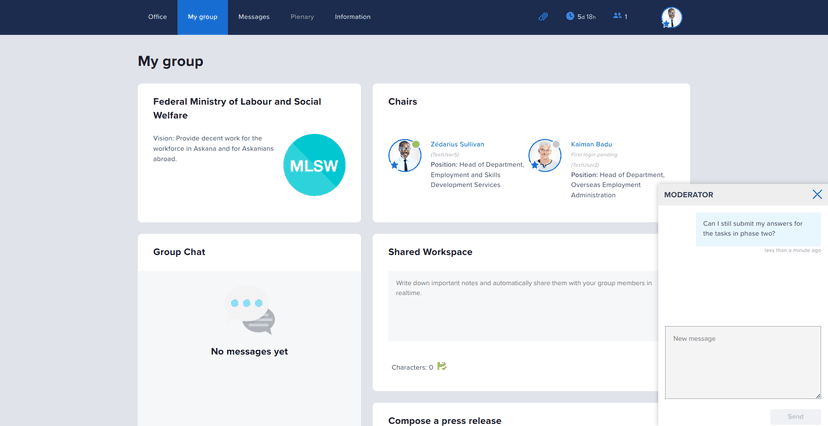
Senaryon uses an experiential, game-based learning approach where students participate in structured digital simulations. Educators select a game from the library or build their own, assigning distinct roles and objectives to each student or group. Once the simulation begins, students read through scenario briefings, analyze data, and interact with their peers to negotiate outcomes, draft policies, or manage crises. The platform tracks decisions and updates the scenario parameters in real-time, forcing participants to adapt their strategies based on the consequences of their actions. Educators monitor the entire process through a backend dashboard, intervening or injecting new variables as needed to maintain engagement. Because the platform is modular, sessions can last for a single afternoon or stretch across several weeks of instruction. The learning relies heavily on the final debriefing phase, where the teacher helps students connect their in-game experiences to theoretical concepts and curriculum standards.
Strengths and tradeoffs of Senaryon
Senaryon's biggest strength is its ability to facilitate deep, experiential learning through complex role-play, while its biggest weakness is the complete lack of automated instructional feedback. Strong experiential engagement is achieved by placing students directly into the problem-solving process, which naturally increases intrinsic motivation and requires high-level cognitive application. By navigating multi-variable social science scenarios, students move beyond rote memorization and practice critical thinking. Flexible implementation allows educators to scale the cognitive load, adjusting the simulation length and complexity to match the learners' prior knowledge. Heavy reliance on educator facilitation means the app itself does not guarantee learning; if the teacher fails to provide structured debriefings, students miss the essential reflection phase required to consolidate new mental models. Lack of foundational knowledge checks is a notable gap, as the platform assumes students already possess the requisite background knowledge to participate effectively. There are no built-in retrieval practice exercises or spaced repetition mechanics to ensure students retain the specific facts or vocabulary encountered during the simulation.
Who Might Benefit From Senaryon?
Best for high school and higher education educators who want to integrate complex, collaborative simulations into their social science, humanities, or career and technical education curriculum. It is ideal for mature students in tenth grade through adult education who already possess baseline knowledge of a topic and are ready to apply it in dynamic, real-world scenarios. Because the platform relies on peer negotiation and active teacher moderation, it is strictly designed for classroom or structured cohort environments. It is not suitable for independent learners, young children, or students who require direct, foundational instruction before engaging in complex problem-solving.
Data Transparency
Does Not Meet Data Transparency Standard
Senaryon does not meet our data transparency standard. Its privacy policy does not document basic protections, including a statement that it does not sell data, a commitment against targeted advertising and limits on sharing children's data.
10 of 35 checks passed
Evaluated September 2026
Privacy Statement →Level 1 · Basic protections
Does not sell data or target ads at students, limits sharing, and lets parents see and delete their child's data.
Not documented: a statement that it does not sell data, a commitment against targeted advertising, limits on sharing children's data, a COPPA or FERPA commitment, parents' right to see their child's data, parents' right to delete their child's data
Level 2 · Parent control (meets the standard)
Families can get their data out, know who processes it, and know how long it is kept.
Not documented: self-service deletion
Level 3 · Direct data access
Families or schools can pull their own data through an API, in a stated format.
Not documented: an API for retrieving their own data, a named export format
View all 35 checks
Parent Access0/8
Does the policy mention parents specifically?
The policy does not mention parents.
Can parents view their child's data?
The policy does not address parental access to a child's data.
Can parents modify their child's data?
The policy does not address parents modifying a child's data.
Can parents delete their child's account?
The policy does not address parents deleting a child's account or data.
Is there a dedicated Children's Privacy section?
The policy has no section dedicated to children's privacy.
Does it reference COPPA compliance?
The policy references GDPR and German law but not COPPA.
Does it reference FERPA compliance?
The policy does not reference FERPA.
Is parental consent required for child accounts?
The policy relies on user consent at registration and does not require parental consent.
Data Portability2/5
Can users access their personal data?
“You may request information regarding which of your personal data we process, for what purpose, for how long, and to whom it may be disclosed.”
Can users download/export their data?
“You have the right to receive your data in a commonly used, machine-readable format or to have it transferred to another controller, provided that the processing is based on consent or a contract and is carried out by automated means.”
Is there a self-service data access tool?
The policy says data subject rights are exercised by emailing datenschutz@planpolitik.de, not through a self-service tool.
Is a specific data format mentioned for export?
The policy only says 'commonly used, machine-readable format' and names no specific format.
Is there an API for data access?
The policy does not mention an API for data access.
Data Minimization2/6
Is data collection itemized?
“In some cases, registration is required to use Senaryon. The following data is collected: - Email address - Name - Password”
Can the app be used without a real name?
The policy lists name among the data collected at registration.
Can the app be used without an email?
The policy says an email address is collected at registration.
Does it state collection is limited to what is necessary?
The policy limits collection to the extent it describes but does not say collection is limited to what is necessary.
Is IP address anonymized or truncated?
“The IP address is stored for the duration of the session to enable the service to be provided. Log files are deleted or anonymised after one month at the latest.”
Is location tracking explicitly excluded?
The policy does not explicitly exclude location tracking.
Third-Party Protection3/7
Does it explicitly state no selling of data?
The policy limits disclosure but never explicitly states that data is not sold.
Are third-party providers named?
“Note: Sentry and Datadog are headquartered in the USA, but process user data relevant to Senaryon exclusively on servers in Germany.”
Are providers contractually restricted?
“Data processing agreements in accordance with Article 28 of the GDPR are in place with all service providers.”
No-targeted-advertising commitment?
The policy says log data is not analysed for marketing but makes no explicit commitment against targeted advertising.
Is AI/ML data sharing addressed?
The policy does not address AI or machine learning.
Child-specific sharing restriction?
The policy has no sharing restrictions specific to children.
Cookies/tracking limited or opt-out?
“Our website and our software offering use only technically necessary cookies.”
Deletion & Retention3/5
Can users delete their account?
“You may cancel your registration at any time and have your data amended or deleted. To do so, please send an email to datenschutz@planpolitik.de, stating the website visited and the email address used for registration.”
Self-service deletion mechanism?
The policy says deletion is requested by email, with no self-service mechanism.
Specific data retention timeline?
“Ordinary participants are anonymised by default four weeks after the completion of their last event.”
Auto-deletion of inactive accounts?
“Ordinary participants are anonymised by default four weeks after the completion of their last event.”
Post-deletion handling described?
The policy does not describe how data is handled after deletion, such as purging backups.
Advertising0/4
Advertising model explicitly disclosed?
The policy bans users from posting advertising but does not disclose the product's own advertising model.
Free from third-party advertisements?
The policy does not state that the product is free of third-party advertisements.
Children excluded from ad targeting?
The policy does not address excluding children from ad targeting.
Ad-free option available?
The policy does not state that the product has no advertising or offers an ad-free option.
What This Means
The policy review did not meet our data transparency standard. The checks above show the documented findings and unknowns. A missing statement does not establish how the app handles data in practice.
About this evaluation: Based on automated analysis of Privacy Statement against 35 policy-disclosure questions, including questions adapted from the Common Sense Privacy Program's published evaluation questions. TLS is not affiliated with Common Sense Media, and this is not a Common Sense rating. Quoted text is copied from the policy; unquoted notes are our summary. Results describe what the policy documents, not the company's actual practices. Privacy policies can change: this review reflects the version we analyzed and does not determine legal compliance.
Sources and review method
TLS combines product information and editorial analysis to explain how Senaryon works, its tradeoffs, and the questions to ask before choosing it. Product features, an instructional rationale and evidence of learning outcomes are different kinds of information.
Formal Learning Standard assessment: not yet completed. Data Transparency findings are reported separately and do not establish learning effectiveness. Read our methodology.
Frequently Asked Questions About Senaryon
Is Senaryon free?
No, Senaryon requires paid licensing based on the number of sessions or an unlimited flat rate. A standard K-12 package for five simulation keys costs 150 Euros, while ten keys cost 250 Euros. Each key accommodates a standard class size for a single session. They also offer customized flat-rate pricing for institutions requiring unlimited access over a specific timeframe, but there is no free tier available for individual educators or independent learners to test the platform.
Is Senaryon good for high school students?
Yes, Senaryon is highly effective for tenth through twelfth graders because the complex role-playing scenarios align well with the cognitive development and critical thinking requirements of older adolescents. High school students are developmentally ready to handle the multi-variable problem-solving and perspective-taking demanded by these digital simulations. However, the app assumes students have the necessary reading comprehension skills to parse scenario briefings, so teachers must provide appropriate scaffolding for struggling readers.
What does Senaryon teach?
Senaryon does not teach isolated facts or discrete skills, but rather provides an interactive environment for students to apply existing knowledge in humanities, social sciences, and career education. Through strategic decision-making and peer negotiation, students practice high-level cognitive skills like critical thinking, empathy, and complex problem-solving. The platform relies entirely on experiential learning, meaning students learn the consequences of policy decisions and social dynamics by directly experiencing the outcomes of their collaborative choices within the simulation.
How does Senaryon compare to standard quiz-based platforms?
Unlike standard quiz platforms that focus on retrieval practice and spaced repetition to build foundational recall, Senaryon focuses exclusively on experiential learning and high-level application. While a traditional quiz app ensures a student memorizes historical dates or political definitions, Senaryon asks the student to use those concepts to negotiate a mock treaty. Therefore, Senaryon should supplement rather than replace foundational instruction, serving as the capstone application of knowledge rather than the primary method of initial acquisition.
Has The Learning Standard evaluated Senaryon?
TLS has not yet completed a Learning Standard evaluation of how well Senaryon teaches. Its privacy policy has been reviewed for Data Transparency and does not yet document the basic protections (Level 1).
Is Senaryon COPPA compliant?
A COPPA reference was not found in the reviewed privacy policy. This does not determine whether the app complies with COPPA. Policy review note: The policy references GDPR and German law but not COPPA.
Is Senaryon FERPA compliant?
A FERPA reference was not found in the reviewed privacy policy. This does not determine whether the app complies with FERPA. Policy review note: The policy does not reference FERPA.
Does Senaryon have a children's privacy policy?
No dedicated children's privacy section was found in the reviewed policy. Policy review note: The policy has no section dedicated to children's privacy.
Does Senaryon sell student data?
A statement ruling out data selling was not found in the reviewed policy. This does not establish that the app sells student data. Policy review note: The policy limits disclosure but never explicitly states that data is not sold.
Can you delete your data from Senaryon?
The reviewed privacy policy describes account deletion. We have not tested the deletion process. Policy review note: Users can request deletion of their registration and data.
Follow TLS Research
Subscribe to future TLS research updates: app reviews, findings, and what the evidence shows.
Screenshots

Take Action
For Senaryon
If you represent planpolitik and have a correction or new evidence, send the relevant source so we can review and update this page.
Submit a correctionDetails
- Pricing
- For a straightforward K-12 level game selected from our library without an accompanying support plan, we offer tiered pricing based on the number of keys purchased. A single key grants access to one session, typically accommodating a standard class size. A package of five keys is priced at €150, while ten keys are available for €250. Additionally, we provide flat-rate pricing options, granting clients unlimited keys within a specified time frame. For those seeking a more tailored solution, we are committed to collaborating with clients to determine the most suitable pricing structure for their unique requirements.
- Platforms
- Web Browser
- Grade Levels
- 10th Grade, 11th Grade, 12th Grade, Associate's degree, Bachelor's degree, Post-baccalaureate certificate, Master's Degree, Adult Education
- Website
- Visit site