Riipen
Product by Riipen
Facts checked: Not yet checked
Our take (not a Learning Standard rating). This label applies to learning-science judgments throughout this overview.
Our take (not a Learning Standard rating)
Riipen effectively facilitates project-based experiential learning by connecting higher education students with real-world employers. However, because it functions primarily as a marketplace and management tool rather than a direct instructional platform, its teaching efficacy relies heavily on the quality of the employer project and the instructor's classroom integration.
Pros
- Facilitates authentic assessment by allowing students to apply classroom theory to actual business challenges.
- Promotes the transfer of learning through curriculum-embedded, project-based tasks.
- Provides educators with milestone tracking to monitor student progress during external projects.
- Builds employability skills through direct feedback from industry professionals rather than simulated grading.
Cons
- Lacks direct instructional content, relying entirely on external employers and classroom educators to provide academic scaffolding.
- Project quality and learning outcomes vary significantly depending on the specific employer and industry.
- Offers no built-in spaced repetition or retrieval practice mechanics for foundational knowledge retention.
- Requires substantial educator oversight to ensure business projects align tightly with course learning objectives.
What Do We Know About Riipen?
Riipen is highly effective at bridging the gap between academic theory and practical application, but it is not a standalone teaching tool. Instead, it is an experiential learning platform that connects college students and adult learners with real-world companies for project-based assignments. Your student will not watch video lectures or complete multiple-choice quizzes here. They will engage in authentic assessment, solving actual business problems for real organizations as part of their coursework. This approach strongly supports the transfer of learning, requiring students to adapt foundational knowledge to unpredictable, real-world scenarios. Because Riipen operates as a marketplace rather than an instructional curriculum, the actual educational value depends heavily on the university instructor guiding the course and the specific employer offering the project. Students receive feedback from industry professionals, which builds critical employability skills but may lack the academic rigor or targeted scaffolding found in traditional educational software. Parents and educators should understand that Riipen serves as a logistical bridge for internships and class projects rather than a primary source of instruction.
How Does Riipen Work?
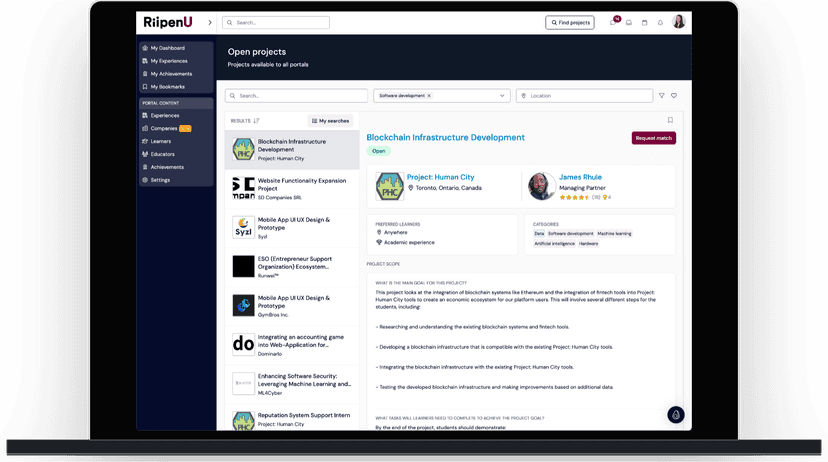
Riipen uses project-based and experiential learning by integrating short-term industry projects directly into higher education coursework. Educators browse a marketplace of business challenges posted by global organizations and select projects that align with their syllabus objectives. Once a match is made, students work individually or in teams to solve the employer's problem over a set period. The platform provides project management tools, allowing students to submit milestones, communicate directly with company representatives, and track deliverables. Employers provide real-world feedback on the final submissions, while educators evaluate the academic performance. This dual-feedback loop grounds the learning process in authentic assessment, forcing students to navigate complex, ill-defined problems rather than tightly controlled textbook scenarios. The platform itself does not deliver lessons or grade assignments; it strictly facilitates the connection and workflow between the university, the student, and the employer.
Strengths and tradeoffs of Riipen
Riipen's biggest strength is its ability to facilitate authentic assessment, while its biggest weakness is the inherent lack of standardized instructional quality control across employer projects. Real-World Application: By replacing simulated case studies with actual business challenges, Riipen forces students into high-level cognitive tasks that promote the transfer of learning. Students must synthesize information and apply theoretical concepts to messy, real-world variables. Industry Feedback: The platform allows students to receive direct critique from employers, which helps build practical competencies and career readiness. Variable Scaffolding: Because the projects are sourced from independent companies, students do not receive the carefully sequenced scaffolding typical of effective learning software. If a student lacks foundational knowledge, Riipen does not provide targeted remediation or worked examples to catch them up. Lack of Core Practice: The platform does not utilize spaced repetition or retrieval practice to solidify basic concepts. It assumes the student has already acquired the necessary knowledge in the classroom and is purely focused on the application phase of learning. Educators must provide significant support to ensure students are not overwhelmed by the cognitive load of a live business project.
Who Might Benefit From Riipen?
Riipen is best for higher education instructors and adult learners who want to integrate real-world, project-based learning into their existing curriculum. It is ideally suited for college students from associate to doctoral levels who already possess foundational knowledge in their field and are ready to apply it to authentic business challenges. Because it requires a high degree of self-direction and professional communication, it is not appropriate for K-12 students or learners who still need heavy instructional scaffolding. It serves well in capstone courses, career and technical education, and degree programs focused on immediate workforce readiness.
Data Transparency
Does Not Meet Data Transparency Standard
Riipen does not meet our data transparency standard. Its privacy policy does not document basic protections, including a statement that it does not sell data, limits on sharing children's data and a COPPA or FERPA commitment.
14 of 35 checks passed
Evaluated September 2026
Privacy Policy →Level 1 · Basic protections
Does not sell data or target ads at students, limits sharing, and lets parents see and delete their child's data.
Not documented: a statement that it does not sell data, limits on sharing children's data, a COPPA or FERPA commitment, parents' right to see their child's data, parents' right to delete their child's data
Level 2 · Parent control (meets the standard)
Families can get their data out, know who processes it, and know how long it is kept.
Not documented: a data retention timeline, self-service deletion
Level 3 · Direct data access
Families or schools can pull their own data through an API, in a stated format.
Not documented: an API for retrieving their own data, a named export format
View all 35 checks
Parent Access0/8
Does the policy mention parents specifically?
The policy does not mention parents.
Can parents view their child's data?
The policy does not address parental access to a child's data.
Can parents modify their child's data?
The policy does not address parental modification of a child's data.
Can parents delete their child's account?
The policy does not address parental deletion of a child's account or data.
Is there a dedicated Children's Privacy section?
The policy has no section dedicated to children's privacy.
Does it reference COPPA compliance?
The policy does not reference COPPA.
Does it reference FERPA compliance?
The policy does not reference FERPA.
Is parental consent required for child accounts?
The policy does not address parental consent for child accounts.
Data Portability3/5
Can users access their personal data?
“You may also send us an e-mail at help@riipen.com to request access to, correct or delete any personal information that you have provided to us.”
Can users download/export their data?
“You may request your Personal Information that you have provided to us and which is still retained by us, in a structured, commonly used and machine-readable format, and you have the right to request that we transmit it to other data controllers or processors without hindrance.”
Is there a self-service data access tool?
“You can review and change your personal information by logging into the Website and visiting your account profile page.”
Is a specific data format mentioned for export?
The policy only says a structured, commonly used and machine-readable format, without naming a specific format.
Is there an API for data access?
The policy does not describe an API for users to retrieve their own data.
Data Minimization1/6
Is data collection itemized?
“by which you may be personally identified, such as name, postal address, e-mail address or telephone number (“Personal Information”)”
Can the app be used without a real name?
The policy says it collects users' names.
Can the app be used without an email?
The policy says it collects users' e-mail addresses.
Does it state collection is limited to what is necessary?
The policy limits retention to what is necessary but does not state that collection is limited to what is necessary.
Is IP address anonymized or truncated?
The policy says it collects IP addresses and does not mention anonymizing or truncating them.
Is location tracking explicitly excluded?
The policy says it collects location data.
Third-Party Protection4/7
Does it explicitly state no selling of data?
The policy only states that it does not sell data to third-party advertising agencies or similar entities, not a general statement that it does not sell data.
Are third-party providers named?
“Riipen's use and transfer to any other app of information received from Google APIs will adhere to the [Google API Services User Data Policy](https://developers.google.com/terms/api-services-user-data-policy), including the Limited Use requirements.”
Are providers contractually restricted?
“To contractors, service providers and other third parties we use to support our business and who are bound by contractual obligations to keep personal information confidential and use it only for the purposes for which we disclose it to them.”
No-targeted-advertising commitment?
“Under no circumstances is any user data collected, processed, or utilized for the purpose of advertisement targeting.”
Is AI/ML data sharing addressed?
The policy does not address AI or machine learning data sharing.
Child-specific sharing restriction?
The policy has no sharing restrictions specific to children.
Cookies/tracking limited or opt-out?
“Tracking Technologies. You can set your browser to refuse all or some browser cookies, or to alert you when cookies are being sent.”
Deletion & Retention2/5
Can users delete their account?
“We cannot delete your personal information except by also deleting your user account.”
Self-service deletion mechanism?
The policy describes deletion only by e-mail request, not a self-service mechanism.
Specific data retention timeline?
The policy says data is kept as reasonably necessary, without a specific retention period.
Auto-deletion of inactive accounts?
The policy does not address auto-deletion of inactive accounts.
Post-deletion handling described?
“If you delete your User Contributions from the Website, copies of your User Contributions may remain viewable in cached and archived pages, or might have been copied or stored by other Website users”
Advertising4/4
Advertising model explicitly disclosed?
“No Advertisements.Riipen does not display advertisements on its website or within any of its services.”
Free from third-party advertisements?
“No Advertisements.Riipen does not display advertisements on its website or within any of its services. Our platform is designed to provide a seamless and focused experience for our users, free from distractions or third-party promotional content.”
Children excluded from ad targeting?
“Under no circumstances is any user data collected, processed, or utilized for the purpose of advertisement targeting.”
Ad-free option available?
“No Advertisements.Riipen does not display advertisements on its website or within any of its services.”
What This Means
The policy review did not meet our data transparency standard. The checks above show the documented findings and unknowns. A missing statement does not establish how the app handles data in practice.
About this evaluation: Based on automated analysis of Privacy Policy against 35 policy-disclosure questions, including questions adapted from the Common Sense Privacy Program's published evaluation questions. TLS is not affiliated with Common Sense Media, and this is not a Common Sense rating. Quoted text is copied from the policy; unquoted notes are our summary. Results describe what the policy documents, not the company's actual practices. Privacy policies can change: this review reflects the version we analyzed and does not determine legal compliance.
Sources and review method
TLS combines product information and editorial analysis to explain how Riipen works, its tradeoffs, and the questions to ask before choosing it. Product features, an instructional rationale and evidence of learning outcomes are different kinds of information.
Formal Learning Standard assessment: not yet completed. Data Transparency findings are reported separately and do not establish learning effectiveness. Read our methodology.
Frequently Asked Questions About Riipen
Is Riipen free?
Riipen is not free for institutions. It operates on a tiered licensing pricing model designed specifically for colleges, universities, and technical schools. Students do not typically pay out of pocket for individual access, as the platform is provided directly through their enrolled academic courses. The academic institution absorbs the subscription costs, allowing educators to seamlessly integrate these external business projects into their standard syllabus without passing on additional software fees to the adult learner.
Is Riipen good for elementary or high school students?
No, Riipen is not designed for elementary or high school students. It is specifically built for post-secondary education, including associate degrees, bachelor's degrees, graduate programs, and adult education. The platform requires students to engage professionally with real-world companies on complex business challenges. Younger learners require explicit instructional scaffolding, foundational knowledge building, and strictly controlled learning environments, making this open-ended, experiential marketplace entirely inappropriate for K-12 classrooms.
What does Riipen teach?
Riipen does not teach specific academic subjects directly through lessons or modules. Instead, it facilitates project-based learning across various disciplines like Business, Applied Science, Humanities, and Career and Tech Education by allowing students to complete actual workplace projects. The platform relies on the student having already learned foundational concepts from their university professor. Riipen simply provides the real-world venue for students to practice the transfer of learning by applying those classroom theories to active, unresolved employer challenges.
How does Riipen compare to a traditional internship?
Riipen offers curriculum-embedded micro-internships rather than traditional, full-time internships. This allows students to gain experiential learning and direct employer feedback within the structured timeline of a standard college semester. While a traditional internship removes the student from the classroom entirely, Riipen projects are actively monitored and graded by the university instructor. This ensures a stronger alignment with specific academic learning objectives while still providing the authentic assessment benefits of real-world corporate experience.
Has The Learning Standard evaluated Riipen?
TLS has not yet completed a Learning Standard evaluation of how well Riipen teaches. Its privacy policy has been reviewed for Data Transparency and does not yet document the basic protections (Level 1).
Is Riipen COPPA compliant?
A COPPA reference was not found in the reviewed privacy policy. This does not determine whether the app complies with COPPA. Policy review note: The policy does not reference COPPA.
Is Riipen FERPA compliant?
A FERPA reference was not found in the reviewed privacy policy. This does not determine whether the app complies with FERPA. Policy review note: The policy does not reference FERPA.
Does Riipen have a children's privacy policy?
No dedicated children's privacy section was found in the reviewed policy. Policy review note: The policy has no section dedicated to children's privacy.
Does Riipen sell student data?
A statement ruling out data selling was not found in the reviewed policy. This does not establish that the app sells student data. Policy review note: The policy only states that it does not sell data to third-party advertising agencies or similar entities, not a general statement that it does not sell data.
Can you delete your data from Riipen?
The reviewed privacy policy describes account deletion. We have not tested the deletion process. Policy review note: Users can request deletion of their personal information by deleting their account.
Follow TLS Research
Subscribe to future TLS research updates: app reviews, findings, and what the evidence shows.
Screenshots

Latest News
All Riipen NewsTake Action
For Riipen
If you represent Riipen and have a correction or new evidence, send the relevant source so we can review and update this page.
Submit a correctionDetails
- Pricing
- A tiered licensing pricing model with flexible options to suit the needs of post-secondary academic institutions.
- Platforms
- Web Browser, Windows (Microsoft), macOS (Apple), Chrome OS (Google)
- Grade Levels
- Associate's degree, Bachelor's degree, Post-baccalaureate certificate, Master's Degree, Post-master's certificate, Doctoral Degree, Post-doctoral certificate, Adult Education, Professional or Technical Credential
- Website
- Visit site