
Revas Business Simulation Games
Product by Revas
Facts checked: Not yet checked
Our take (not a Learning Standard rating). This label applies to learning-science judgments throughout this overview.
Our take (not a Learning Standard rating)
While The Learning Standard has not yet formally evaluated Revas Business Simulation Games, the platform's foundation in experiential learning suggests strong potential for teaching entrepreneurship. It forces students to apply abstract business concepts to concrete scenarios, though game-based simulations often risk high cognitive load if not properly scaffolded by an instructor.
Pros
- Requires students to engage in problem-based learning by making real-time financial and operational decisions.
- Uses experiential learning principles to bridge the gap between abstract business theory and practical application.
- Fosters situational interest through competitive, gamified marketplace scenarios.
Cons
- Open-ended simulations frequently overwhelm novices by imposing an excessively high intrinsic cognitive load.
- Lacks built-in, step-by-step worked examples to guide students before they make complex managerial choices.
- Relies heavily on external teacher facilitation to connect game outcomes to underlying academic standards.
What Do We Know About Revas Business Simulation Games?
Revas Business Simulation Games is an effective tool for older students to practice entrepreneurship, provided an educator actively guides the experience. Your student will not learn basic business vocabulary directly from this platform. Instead, they will apply what they already know to run a virtual company. The software uses experiential learning mechanics, forcing users to make decisions about pricing, staffing, and marketing, and then showing the financial consequences of those choices. This immediate feedback loop helps correct misconceptions about how markets operate. However, because the environment is highly complex, novices may experience cognitive overload. The simulation does not provide structured, direct instruction or worked examples to teach concepts from scratch. Your teen or young adult must analyze dashboards and read market reports, which builds critical thinking but demands a baseline understanding of economics. While The Learning Standard has not formally rated this tool, the underlying reliance on problem-based learning is scientifically sound for advanced career and technical education. Educators must debrief the gameplay to ensure students transfer their virtual skills to real-world business acumen.
How Does Revas Business Simulation Games Work?
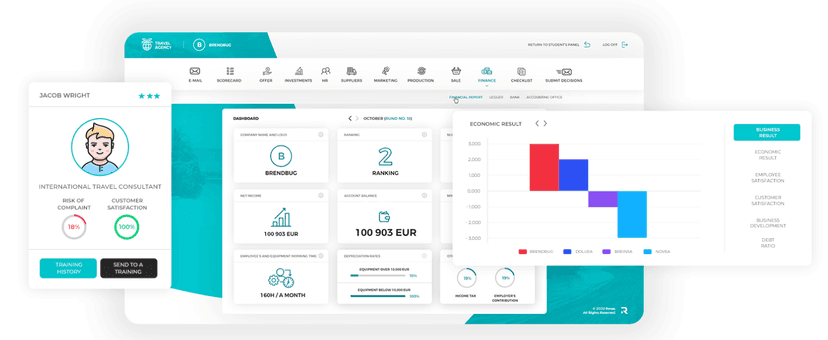
Revas Business Simulation Games uses problem-based experiential learning combined with marketplace gamification. Students take on the role of business owners and must navigate a series of managerial decisions over simulated financial periods. Your student will analyze data dashboards, set product prices, allocate marketing budgets, and manage staffing levels. Once all participants submit their decisions, the algorithm calculates the market response and generates financial reports. This cycle leverages the learning science principle of immediate feedback, allowing users to see the direct consequences of their resource allocation. The platform mimics a competitive economy where student companies compete for the same target audience. By forcing learners to interpret profit and loss statements to adjust their strategy for the next round, the system builds analytical skills. It does not teach through video lectures or flashcards, but entirely through active, scenario-based practice.
Strengths and tradeoffs of Revas Business Simulation Games
The biggest strength of Revas Business Simulation Games is its use of realistic, immediate feedback loops, while its biggest weakness is the risk of cognitive overload for beginners. Experiential learning thrives when students can test hypotheses and immediately see results. By showing how a pricing change impacts overall revenue in the next simulated month, the app effectively corrects flawed economic assumptions. It also uses situational interest, driving engagement through competitive gamification. However, open-ended business simulations lack worked examples. Learning science shows that novices learn best when complex tasks are broken down step-by-step. Because Revas drops students into a multi-variable environment handling HR, marketing, and finance simultaneously, a student without prior business knowledge will likely resort to guessing. The platform demands high intrinsic cognitive load, making it unsuitable for introductory self-study. To be effective, educators must actively bridge the gap between the simulation data and the underlying academic concepts using structured debriefing sessions.
Who Might Benefit From Revas Business Simulation Games?
Revas Business Simulation Games is best for high school upperclassmen and college students who are taking a structured business or entrepreneurship course. It is not designed for independent, at-home learners. Your student will get the most out of this software if they already possess a basic understanding of economics and accounting. It serves as an excellent capstone tool for career and technical education programs where older teens and adults need to practice synthesizing multiple business concepts in a safe, simulated environment.
Data Transparency
Does Not Meet Data Transparency Standard
Revas Business Simulation Games does not meet our data transparency standard. Its privacy policy does not document basic protections, including a commitment against targeted advertising, limits on sharing children's data and a COPPA or FERPA commitment.
10 of 35 checks passed
Evaluated September 2026
Privacy policy →Level 1 · Basic protections
Does not sell data or target ads at students, limits sharing, and lets parents see and delete their child's data.
Not documented: a commitment against targeted advertising, limits on sharing children's data, a COPPA or FERPA commitment, parents' right to see their child's data, parents' right to delete their child's data
Level 2 · Parent control (meets the standard)
Families can get their data out, know who processes it, and know how long it is kept.
Not documented: data export, self-service deletion
Level 3 · Direct data access
Families or schools can pull their own data through an API, in a stated format.
Not documented: an API for retrieving their own data, a named export format
View all 35 checks
Parent Access0/8
Does the policy mention parents specifically?
The policy does not mention parents.
Can parents view their child's data?
The policy does not address parental access to a child's data.
Can parents modify their child's data?
The policy does not address parents modifying a child's data.
Can parents delete their child's account?
The policy does not address parents deleting a child's data or account.
Is there a dedicated Children's Privacy section?
The policy has no section on children's privacy.
Does it reference COPPA compliance?
The policy does not reference COPPA.
Does it reference FERPA compliance?
The policy does not reference FERPA.
Is parental consent required for child accounts?
The policy does not address parental consent for child accounts.
Data Portability1/5
Can users access their personal data?
“We provide each user, who has completed the registration form or otherwise provided his personal data to us, with access to their data, for the purposes of verification, modification or deletion.”
Can users download/export their data?
The policy lists access, rectification, erasure, restriction and objection rights but no data export or portability.
Is there a self-service data access tool?
The policy says users are given access to their data but describes no self-service tool.
Is a specific data format mentioned for export?
The policy does not mention any export format.
Is there an API for data access?
The policy does not mention an API for data access.
Data Minimization2/6
Is data collection itemized?
“We process personal data, e-mail address, place of work/school of the student, telephone number.”
Can the app be used without a real name?
The policy says registration asks for the user's name.
Can the app be used without an email?
The policy says the simulation games process the user's e-mail address.
Does it state collection is limited to what is necessary?
The policy limits the use and sharing of data to what is necessary but does not say collection is limited to what is necessary.
Is IP address anonymized or truncated?
“Wir nutzen die Funktion “Aktivierung der IP-Anonymisierung” auf dieser Webseite. Dadurch wird Ihre IP-Adresse von Google jedoch innerhalb von Mitgliedstaaten der Europäischen Union oder in anderen Vertragsstaaten des Abkommens über den Europäischen Wirtschaftsraum zuvor gekürzt.”
Is location tracking explicitly excluded?
The policy does not exclude location tracking.
Third-Party Protection4/7
Does it explicitly state no selling of data?
“The collected personal data is not sold or lent to other persons or institutions, unless it is done with the express permission or at the request of the user or at the request of the lawful state authorities for the purposes of their proceedings.”
Are third-party providers named?
“Google Analytics – they are used to analyze and measure how users use our services.”
Are providers contractually restricted?
“The Controller represents that by commissioning other entities to provide services, he/she requires maintenance of adequately high standards for the protection of personal data, signing of relevant entrustment contracts, in which the partners confirm the application of the standards and the right to audit the compliance of their activities with these standards,”
No-targeted-advertising commitment?
The policy says user information is used to display ads matched to users' interests, both on and off the website.
Is AI/ML data sharing addressed?
The policy does not address AI or machine learning.
Child-specific sharing restriction?
The policy has no sharing restrictions specific to children.
Cookies/tracking limited or opt-out?
“You can change your browser’s settings, disable or delete cookies. In the “help” tab in your browser you will find instructions about how to do this.”
Deletion & Retention2/5
Can users delete their account?
“Right to erasure (“right to be forgotten”) (Article 17 of the GDPR)”
Self-service deletion mechanism?
The policy describes no self-service deletion mechanism.
Specific data retention timeline?
“for the duration of the license’s contract– in relation to personal data of Business Simulation Games’ users;”
Auto-deletion of inactive accounts?
The policy does not address auto-deletion of inactive accounts.
Post-deletion handling described?
The policy does not describe what happens to data after deletion.
Advertising1/4
Advertising model explicitly disclosed?
“We use the information we have available to improve our advertising and measuring systems which, in turn, is intended to display ads that are of interest to the User, both within and outside the website, as well as to measure the effectiveness and scope – of both ads and services.”
Free from third-party advertisements?
The policy describes advertising cookies used by advertisers and Google Remarketing ads shown on the site.
Children excluded from ad targeting?
The policy does not exclude children from ad targeting.
Ad-free option available?
The policy offers no ad-free option and describes advertising on the site.
What This Means
The policy review did not meet our data transparency standard. The checks above show the documented findings and unknowns. A missing statement does not establish how the app handles data in practice.
About this evaluation: Based on automated analysis of Privacy policy against 35 policy-disclosure questions, including questions adapted from the Common Sense Privacy Program's published evaluation questions. TLS is not affiliated with Common Sense Media, and this is not a Common Sense rating. Quoted text is copied from the policy; unquoted notes are our summary. Results describe what the policy documents, not the company's actual practices. Privacy policies can change: this review reflects the version we analyzed and does not determine legal compliance.
Sources and review method
TLS combines product information and editorial analysis to explain how Revas Business Simulation Games works, its tradeoffs, and the questions to ask before choosing it. Product features, an instructional rationale and evidence of learning outcomes are different kinds of information.
Formal Learning Standard assessment: not yet completed. Data Transparency findings are reported separately and do not establish learning effectiveness. Read our methodology.
Frequently Asked Questions About Revas Business Simulation Games
Is Revas Business Simulation Games free?
No. Revas Business Simulation Games is a paid platform designed primarily for institutional use. Schools and universities must purchase annual subscription packages or per-user licenses.
Is Revas Business Simulation Games good for high school students?
Yes, but specifically for 11th and 12th graders enrolled in business or career and technical education courses. The complexity of the financial dashboards requires maturity and foundational knowledge.
What does Revas Business Simulation Games teach?
It teaches applied entrepreneurship and business management. Students practice resource allocation, strategic planning, human resources, and financial analysis by running a virtual enterprise.
How does Revas Business Simulation Games compare to traditional business textbooks?
Textbooks provide direct instruction and foundational theory, whereas Revas provides experiential practice. The simulation requires students to apply textbook concepts to dynamic, multi-variable problems.
Has The Learning Standard evaluated Revas Business Simulation Games?
TLS has not yet completed a Learning Standard evaluation of how well Revas Business Simulation Games teaches. Its privacy policy has been reviewed for Data Transparency and does not yet document the basic protections (Level 1).
Is Revas Business Simulation Games COPPA compliant?
A COPPA reference was not found in the reviewed privacy policy. This does not determine whether the app complies with COPPA. Policy review note: The policy does not reference COPPA.
Is Revas Business Simulation Games FERPA compliant?
A FERPA reference was not found in the reviewed privacy policy. This does not determine whether the app complies with FERPA. Policy review note: The policy does not reference FERPA.
Does Revas Business Simulation Games have a children's privacy policy?
No dedicated children's privacy section was found in the reviewed policy. Policy review note: The policy has no section on children's privacy.
Does Revas Business Simulation Games sell student data?
The reviewed policy states that the app does not sell data. This is a policy statement; actual data practices were not verified. Policy review note: The policy states personal data is not sold.
Can you delete your data from Revas Business Simulation Games?
The reviewed privacy policy describes account deletion. We have not tested the deletion process. Policy review note: Users have a right to erasure of their data.
Follow TLS Research
Subscribe to future TLS research updates: app reviews, findings, and what the evidence shows.
Screenshots

Take Action
For Revas Business Simulation Games
If you represent Revas and have a correction or new evidence, send the relevant source so we can review and update this page.
Submit a correctionDetails
- Pricing
- Access to Revas Business Simulatiom Games platform can be purchased in 2 models in annual subscription packages and in per user model. The price of the subscription packages depend on: the number of students playing the game per year, number of games used, number of teachers to be trained for certified instructors and other modules (e.g. electronic certificates, report generation, multi-language platform).
- Platforms
- iOS (Apple mobile), Android (Google mobile), Windows (Microsoft), macOS (Apple), Chrome OS (Google), Other
- Grade Levels
- 11th Grade, 12th Grade, Bachelor's degree, Master's Degree, Adult Education
- Website
- Visit site