
Reading.com
Product by Reading.com
Facts checked: Not yet checked
Our take (not a Learning Standard rating). This label applies to learning-science judgments throughout this overview.
Our take (not a Learning Standard rating)
Reading.com provides structured, explicit phonics instruction through scripted lessons that guide parents and educators. However, because The Learning Standard has not yet evaluated the app, we cannot definitively verify its long-term efficacy. It relies heavily on direct instruction and decodable texts, which align well with established science of reading principles.
Pros
- Uses explicit, direct instruction through scripted phonics lessons to reduce adult cognitive load.
- Integrates decodable digital books that directly align with the phonics skills just taught.
- Requires adult co-play, ensuring children receive immediate, human-guided feedback during learning.
Cons
- Relies heavily on adult participation, meaning your child cannot use the app independently.
- Contains only four digital games, which may limit independent retrieval practice opportunities.
- Pricing is opaque and requires contacting support, making it difficult for individual parents to assess affordability.
What Do We Know About Reading.com?
Reading.com requires your active participation to teach your child reading effectively. Unlike apps designed to be digital babysitters, this platform is a co-play tool that scripts explicit phonics instruction for the adult to deliver. The app relies on the science of reading by breaking language down into letter recognition, phoneme blending, and decoding. You will guide your child through 99 specific lessons that tell you exactly what to say and do. This direct instruction model is highly effective for early literacy because it removes the guesswork for parents while ensuring the child receives immediate, accurate feedback. Following the lessons, your child practices the target skills using 60 decodable books. Decodable texts are crucial for early readers because they only contain phonetic patterns the child has already learned, reducing frustration and preventing unscientific guessing strategies. Because The Learning Standard has not yet evaluated this app, we cannot confirm the exact mastery rate it produces. However, the pedagogical structure strongly aligns with evidence-based reading instruction. Be prepared to invest your own time alongside your child to make this program work.
How Does Reading.com Work?
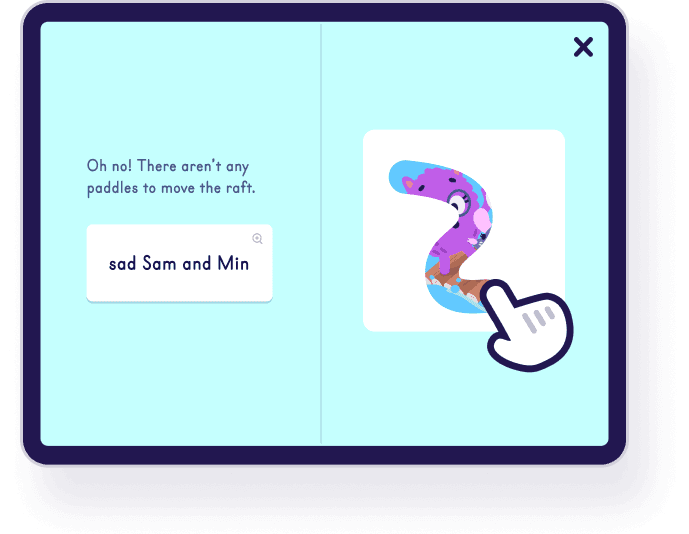
Reading.com utilizes explicit direct instruction delivered through an adult-child co-play model. The platform functions as a teaching script for the adult rather than an independent learning game for the child. You open the app and read the provided prompts aloud, guiding your child through systematic phonics exercises. The curriculum progresses linearly from basic letter recognition to advanced phoneme blending and decoding. After a direct instruction segment, the app transitions to applied practice using decodable digital books. These books act as worked examples and retrieval practice, demanding the child recall the specific sound-spelling correspondences just taught. The app also includes four digital games and various printable activities to reinforce skills through play-based repetition. Because the progression is scripted, the cognitive load on the adult instructor is minimized. The platform ensures that the phonics sequence follows a structured literacy approach, though your active guidance is the primary mechanism for the child's skill acquisition.
Strengths and tradeoffs of Reading.com
The biggest strength of Reading.com is its adherence to structured, explicit phonics instruction, while its biggest weakness is the heavy time demand it places on adults. Explicit Phonics Instruction: By providing a fully scripted curriculum, the app ensures that foundational reading skills are taught systematically. This mirrors the direct instruction model proven effective by literacy research, preventing children from relying on harmful cueing or guessing strategies. Decodable Texts: The inclusion of 60 decodable books allows for immediate retrieval practice. Children apply the exact phonetic rules they just learned, which builds automaticity and reading confidence. Lack of Independent Practice: Because the program centers on a co-play experience, it offers limited utility for a child working alone. With only four digital games available, independent spaced repetition is minimal. Unverified Mastery: As Reading.com is pending evaluation by The Learning Standard, we cannot yet confirm if the app's internal assessments accurately measure independent reading proficiency. The structured approach is scientifically sound, but the requirement for an adult to act as the primary instructor means the actual instructional quality will vary based on user implementation.
Who Might Benefit From Reading.com?
Best for parents and early childhood educators who want to actively teach early reading skills using a structured, evidence-based curriculum. Reading.com targets preschool through first-grade students, focusing on the critical window when children transition from letter recognition to decoding text. Because it requires active adult participation, it is ideal for homeschoolers or highly involved parents who have the time to sit with their child for every lesson. It is not recommended for parents seeking an independent, gamified app that a child can play alone.
Data Transparency
Does Not Meet Data Transparency Standard
Reading.com reaches Level 1 of 3 (Basic protections), below our data transparency standard. Reaching Level 2 needs the policy to document a data retention timeline and self-service deletion.
25 of 35 checks passed
Level 1 · Basic protections
Does not sell data or target ads at students, limits sharing, and lets parents see and delete their child's data.
Level 2 · Parent control (meets the standard)
Families can get their data out, know who processes it, and know how long it is kept.
Not documented: a data retention timeline, self-service deletion
Level 3 · Direct data access
Families or schools can pull their own data through an API, in a stated format.
Not documented: an API for retrieving their own data, a named export format
View all 35 checks
Parent Access8/8
Does the policy mention parents specifically?
“The Parent may review the information collected from the user of the child profile at any time by contacting Us.”
Can parents view their child's data?
“The Parent may review the information collected from the user of the child profile at any time by contacting Us.”
Can parents modify their child's data?
“Parents, legal guardians, or eligible pupils may review personally identifiable information in the pupil's records and correct erroneous information by contacting their LEA directly.”
Can parents delete their child's account?
“To request deletion of personal information of a user of a child profile at any time, please contact us at support@reading.com.”
Is there a dedicated Children's Privacy section?
“**10\. HOW DOES READING PROTECT CHILDREN'S PRIVACY?**”
Does it reference COPPA compliance?
“This Privacy Policy and our Service are designed to comply with COPPA.”
Does it reference FERPA compliance?
“This Privacy Policy and our Service are designed to meet our responsibilities to protect personal information from the students' educational records under FERPA.”
Is parental consent required for child accounts?
“Reading does not permit children under the age of 13 to create an account and does not knowingly collect personally identifying information from children under the age of 13 without the consent and at the direction of a Parent.”
Data Portability3/5
Can users access their personal data?
“Right of access and portability. The right to obtain access to your personal information, along with certain related information, and to receive that information in a commonly used format and to have it transferred to another data controller;”
Can users download/export their data?
“Right of access and portability. The right to obtain access to your personal information, along with certain related information, and to receive that information in a commonly used format and to have it transferred to another data controller;”
Is there a self-service data access tool?
“You may edit your account information at any time by signing in to the account on the “grownup” section of the mobile application.”
Is a specific data format mentioned for export?
The policy only says "a commonly used format" and names no specific format.
Is there an API for data access?
The policy does not mention an API for data access.
Data Minimization2/6
Is data collection itemized?
“When a teacher, or other authorized person associated with a School registers for an account on our Service or corresponds with us, we may collect personal information such as a name, e-mail address, payment information, username and password, and information about the School.”
Can the app be used without a real name?
The policy says schools may provide student names and parents provide the child's name.
Can the app be used without an email?
The policy does not say student email addresses are never collected, and it does collect parent and teacher emails.
Does it state collection is limited to what is necessary?
“We take special precautions to collect only as much information as is reasonably necessary for the child to use the Service”
Is IP address anonymized or truncated?
The policy says IP addresses are collected and does not mention anonymizing them.
Is location tracking explicitly excluded?
The policy says it collects city-level location data.
Third-Party Protection6/7
Does it explicitly state no selling of data?
“We never sell Student Data unless the sale is part of a corporate transaction, such as a merger, acquisition, bankruptcy, or other sale of assets”
Are third-party providers named?
“We may collect analytics data, or use third-party analytics tools, such as Google Analytics, to help us measure traffic and usage trends for the Service”
Are providers contractually restricted?
“Vendors and service providers who have access to Student Data, if any, shall be contractually bound to uphold privacy and confidentiality terms no less protective than those provided herein.”
No-targeted-advertising commitment?
“We do not use Student Data for targeted advertising purposes.”
Is AI/ML data sharing addressed?
The policy does not address sharing data with AI or machine learning systems.
Child-specific sharing restriction?
“We do not sell the personal information of consumers we know to be less than 16 years of age, unless we receive affirmative authorization (the "Right to Opt In") from either the minor who is between 13 and 16 years of age, or the parent or guardian of a minor less than 13 years of age.”
Cookies/tracking limited or opt-out?
“Most browsers are initially set up to accept cookies, but you can reset your browser to refuse all cookies or to indicate when a cookie is being sent.”
Deletion & Retention2/5
Can users delete their account?
“Please contact support@reading.com for further instructions about deleting or deactivating your account or deleting your personal information.”
Self-service deletion mechanism?
The policy only describes deletion by request through support or the school, not a tool users operate themselves.
Specific data retention timeline?
The policy keeps data for as long as needed and gives no specific timeline.
Auto-deletion of inactive accounts?
The policy mentions deletion after a subscription ends but does not mention deleting inactive accounts.
Post-deletion handling described?
“We may not be able to immediately or completely delete all data in all instances, such as information retained in technical support records, customer service records, backups, and other similar business records.”
Advertising4/4
Advertising model explicitly disclosed?
“Reading does not display any advertising on the Service.”
Free from third-party advertisements?
“Reading does not display any advertising on the Service.”
Children excluded from ad targeting?
“Reading does not display any targeted advertising on the Service.”
Ad-free option available?
“Reading does not display any advertising on the Service.”
What This Means
The policy review did not meet our data transparency standard. The checks above show the documented findings and unknowns. A missing statement does not establish how the app handles data in practice.
About this evaluation: Based on automated analysis of Privacy Policy and Children's Privacy Policy against 35 policy-disclosure questions, including questions adapted from the Common Sense Privacy Program's published evaluation questions. TLS is not affiliated with Common Sense Media, and this is not a Common Sense rating. Quoted text is copied from the policy; unquoted notes are our summary. Results describe what the policy documents, not the company's actual practices. Privacy policies can change: this review reflects the version we analyzed and does not determine legal compliance.
Sources and review method
TLS combines product information and editorial analysis to explain how Reading.com works, its tradeoffs, and the questions to ask before choosing it. Product features, an instructional rationale and evidence of learning outcomes are different kinds of information.
Formal Learning Standard assessment: not yet completed. Data Transparency findings are reported separately and do not establish learning effectiveness. Read our methodology.
Frequently Asked Questions About Reading.com
Is Reading.com free?
No, Reading.com is not free. The developer offers annual license subscriptions, and the cost per student depends on the number of licenses purchased. You must contact their support team for specific pricing details.
Is Reading.com good for preschoolers?
Yes, Reading.com is appropriate for preschoolers. The curriculum starts with basic letter recognition and gradually moves toward phoneme blending, making it suitable for early learners who are just beginning their literacy journey. However, an adult must facilitate the lessons.
What does Reading.com teach?
Reading.com teaches early literacy and phonics. The program covers foundational reading skills, transitioning children from learning alphabet letters to decoding words and reading full sentences using a structured sequence of decodable books.
Can my child use Reading.com independently?
No, your child cannot use Reading.com independently. The app is designed specifically as a co-play experience. It provides explicit scripts and prompts for parents or educators to read aloud and actively guide the child through each lesson.
Has The Learning Standard evaluated Reading.com?
TLS has not yet completed a Learning Standard evaluation of how well Reading.com teaches. Its privacy policy has been reviewed for Data Transparency and reaches Level 1, Basic protections.
Is Reading.com COPPA compliant?
The reviewed privacy policy references COPPA. A policy reference alone does not establish COPPA compliance. Policy review note: The policy says it is designed to comply with COPPA.
Is Reading.com FERPA compliant?
The reviewed privacy policy references FERPA. A policy reference alone does not establish FERPA compliance. Policy review note: The policy refers to its FERPA responsibilities.
Does Reading.com have a children's privacy policy?
The reviewed policy includes a dedicated children's privacy section. Policy review note: The policy has a section on children's privacy, plus a separate Children's Privacy Policy.
Does Reading.com sell student data?
The reviewed policy states that the app does not sell data. This is a policy statement; actual data practices were not verified. Policy review note: Reading says it never sells Student Data, except in a corporate transaction.
Can you delete your data from Reading.com?
The reviewed privacy policy describes account deletion. We have not tested the deletion process. Policy review note: Users can ask support to delete their account.
Follow TLS Research
Subscribe to future TLS research updates: app reviews, findings, and what the evidence shows.
Screenshots

Take Action
For Reading.com
If you represent Reading.com and have a correction or new evidence, send the relevant source so we can review and update this page.
Submit a correctionDetails
- Pricing
- We offer annual license subscriptions. Cost per student is dependent on the number of licenses purchased. Interested parties can contact support@reading.com for more information.
- Platforms
- iOS (Apple mobile), iPadOS (Apple tablet), Android (Google mobile)
- Grade Levels
- Preschool, Prekindergarten, Transitional Kindergarten, Kindergarten, 1st Grade
- Website
- Visit site