
pi-top CS and Robotics Kit
Product by pi-top
Facts checked: Not yet checked
Our take (not a Learning Standard rating). This label applies to learning-science judgments throughout this overview.
Our take (not a Learning Standard rating)
The pi-top CS and Robotics Kit provides hands-on, project-based learning that effectively bridges software coding with physical computing. While physical manipulatives successfully reduce cognitive load for abstract programming concepts, the platform requires significant teacher scaffolding to prevent students from merely copying code without achieving true conceptual mastery.
Pros
- Integrates physical manipulatives with digital coding to ground abstract computational concepts in observable reality.
- Utilizes project-based learning to increase student engagement and provide authentic contexts for problem-solving.
- Offers progressive scaffolding within the platform to transition learners from visual block coding to text-based Python.
- Provides immediate physical feedback when code is executed correctly, enabling continuous iterative debugging.
Cons
- Lacks automated, granular feedback when students write incorrect code, leaving them reliant on external teacher intervention.
- Demands high working memory from novice learners who must simultaneously manage hardware assembly and software syntax.
- Fails to implement spaced retrieval practice for core syntax rules, increasing the likelihood that students forget specific coding functions over time.
What Do We Know About pi-top CS and Robotics Kit?
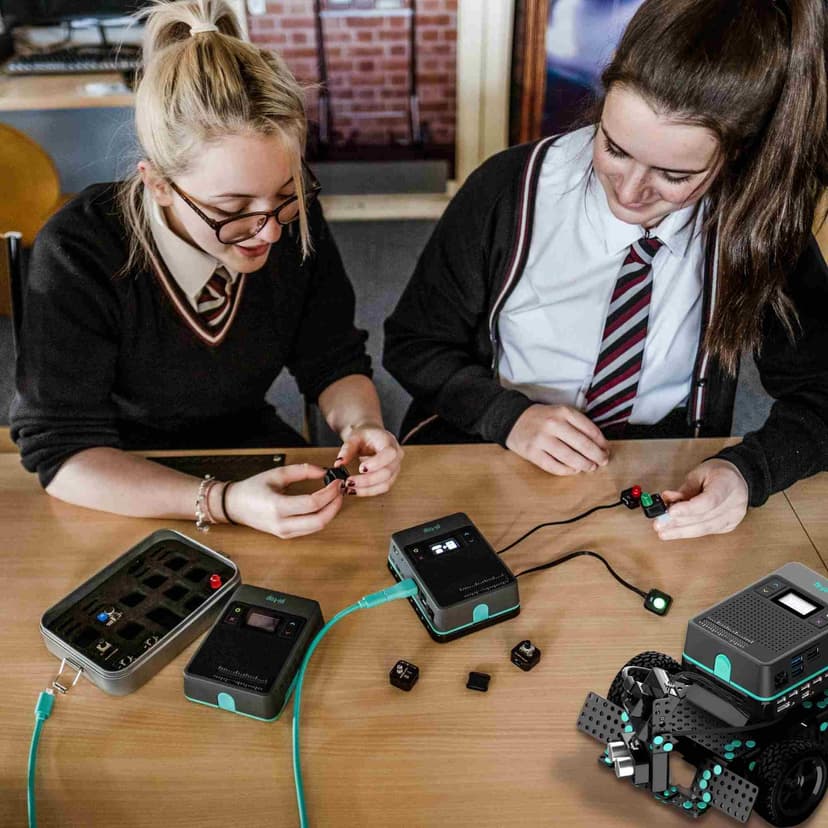
The pi-top CS and Robotics Kit is an effective tool for teaching your child physical computing and programming, provided they have adequate adult guidance. This hardware and software ecosystem combines a microcomputer with physical sensors and a digital lesson platform called Further. When your child builds a circuit and writes code to control it, they engage in experiential learning. This physical interaction helps cement abstract concepts into tangible outcomes, such as a blinking LED or a moving robot. However, the system relies heavily on project-based learning rather than mastery-based drilling. This means your child will build exciting projects like facial recognition cameras, but they might struggle to recall the exact Python syntax a week later without regular retrieval practice. The platform expects students to follow step-by-step instructions carefully. If your child makes a syntax error, the physical component simply will not work. The app does not provide granular digital hints to isolate the error, requiring you or a teacher to step in and troubleshoot. For self-directed learners, this can cause frustration. But for a structured environment where you can provide scaffolding, pi-top successfully makes complex computer science concepts accessible and engaging.
How Does pi-top CS and Robotics Kit Work?
The pi-top CS and Robotics Kit uses a project-based, experiential learning approach where students build physical hardware constructs and program them to solve specific challenges. The core of the system is a durable microcomputer that connects to various sensors, motors, and LEDs. Students log into the Further learning platform, which houses over 200 hours of curriculum. Lessons follow a standard sequence: an introduction to a real-world problem, a hardware build phase, and a coding phase. Students start by snapping together physical components, which grounds their learning in tactile reality. They then write code, beginning with visual blocks for younger students and progressing to text-based Python for older learners. When the code runs, the physical hardware executes the commands. This creates a powerful feedback loop. If the code is correct, the robot moves or the sensor triggers. If the code is flawed, the physical action fails. This immediate physical feedback forces students to iteratively debug their work and apply problem-based learning mechanics to achieve the lesson goal.
Strengths and tradeoffs of pi-top CS and Robotics Kit
The biggest strength of the pi-top CS and Robotics Kit is its use of tangible manipulatives to reduce cognitive load, while its biggest weakness is the absence of systematic retrieval practice to ensure long-term retention of coding syntax. Connecting physical hardware to digital code gives students a concrete mental model for abstract computer science concepts. When students physically wire a sensor and write a loop to read its data, they experience worked examples in a multimodal format. This experiential learning significantly boosts engagement and helps learners understand the underlying mechanics of their code. Progressive scaffolding within the Further platform effectively transitions students from visual block-based coding to advanced Python, managing the difficulty curve well. However, the instructional design falters in knowledge retention. Lack of spaced repetition means students frequently move from one project to the next without being forced to recall previously learned syntax from memory. Without retrieval practice, students often rely heavily on looking up code snippets rather than mastering the language. Additionally, troubleshooting requires high working memory. When a project fails, students must debug both the physical circuitry and the software logic simultaneously, which can easily overwhelm novice learners without direct teacher support.
Who Might Benefit From pi-top CS and Robotics Kit?
The pi-top CS and Robotics Kit is best for middle and high school classrooms or dedicated homeschool environments where an adult can facilitate complex, hands-on STEM projects. It targets students in grades 3 through 12, though learners in grades 6 and above will benefit most from the advanced Python and artificial intelligence curriculum. This kit is ideal for educators aiming to implement experiential learning in applied science courses. It is not suitable for young children working entirely independently, as the dual demands of hardware assembly and software debugging require structured adult scaffolding.
Data Transparency
Meets Data Transparency Standard
pi-top CS and Robotics Kit meets our data transparency standard at Level 2 of 3 (Parent control). Level 3 needs the policy to document an API for retrieving their own data and a named export format.
26 of 35 checks passed
Evaluated September 2026
Further →Level 1 · Basic protections
Does not sell data or target ads at students, limits sharing, and lets parents see and delete their child's data.
Level 2 · Parent control (meets the standard)
Families can get their data out, know who processes it, and know how long it is kept.
Level 3 · Direct data access
Families or schools can pull their own data through an API, in a stated format.
Not documented: an API for retrieving their own data, a named export format
View all 35 checks
Parent Access8/8
Does the policy mention parents specifically?
“Further respects the rights of parents or legal guardians to access and manage their child’s educational data, as outlined by applicable laws, including FERPA and SOPPA.”
Can parents view their child's data?
“Under these laws, parents or guardians have the right to review, correct, and request the deletion of their child’s data. To exercise these rights, parents or guardians can contact us at support@pi-top.com.”
Can parents modify their child's data?
“Under these laws, parents or guardians have the right to review, correct, and request the deletion of their child’s data. To exercise these rights, parents or guardians can contact us at support@pi-top.com.”
Can parents delete their child's account?
“Under these laws, parents or guardians have the right to review, correct, and request the deletion of their child’s data. To exercise these rights, parents or guardians can contact us at support@pi-top.com.”
Is there a dedicated Children's Privacy section?
“We require that Teachers or schools get parental consent before using Further with children who are under the age when they can grant consent on their own. This age may vary based on where you live. For example, in the US that age is younger than 13.”
Does it reference COPPA compliance?
“We are compliant with FERPA, COPPA, SOPPA, GDPR, and the Australian Privacy Act.”
Does it reference FERPA compliance?
“We are compliant with FERPA, COPPA, SOPPA, GDPR, and the Australian Privacy Act.”
Is parental consent required for child accounts?
“We require that Teachers or schools get parental consent before using Further with children who are under the age when they can grant consent on their own.”
Data Portability3/5
Can users access their personal data?
“You have the right to access, correct, or delete any of your personal information collected by Further.”
Can users download/export their data?
“If you are a parent and want to correct, edit, download, or update information about a student, please work directly with your Teacher or school, or you can contact us at support@pi-top.com.”
Is there a self-service data access tool?
“If you are a Teacher, you can update the information associated with your Further account directly by logging into your Further account and viewing the Account Settings tab on your profile.”
Is a specific data format mentioned for export?
The policy mentions downloading data and an archive copy but names no file format.
Is there an API for data access?
The policy does not describe an API for data access.
Data Minimization2/6
Is data collection itemized?
“The only personally identifiable information collected by Further about students is their full name, profile picture and email address.”
Can the app be used without a real name?
The policy states it collects students' full names.
Can the app be used without an email?
The policy states it collects students' email addresses.
Does it state collection is limited to what is necessary?
“We intentionally limit our data collection to only what we need to provide the Further service for you.”
Is IP address anonymized or truncated?
The policy says it collects IP addresses and does not mention anonymizing or truncating them.
Is location tracking explicitly excluded?
The policy does not explicitly rule out location tracking.
Third-Party Protection6/7
Does it explicitly state no selling of data?
“We never sell your data or student data.”
Are third-party providers named?
“We use Google for website hosting, infrastructure provision and analytics.”
Are providers contractually restricted?
“These services need access to your personally identifiable information in order to work (i.e. your email address is required to send you email), but are contractually prohibited from using that information for any other purpose other than to provide the Further service.”
No-targeted-advertising commitment?
“We never display third-party ads in Further, and we do not share data for advertising or marketing purposes, or allow data collection by third-party advertisers or data brokers.”
Is AI/ML data sharing addressed?
The policy does not address AI or machine learning.
Child-specific sharing restriction?
“No student responses to Lessons are ever shared with anyone other than the Teacher.”
Cookies/tracking limited or opt-out?
“You can choose to remove or disable cookies via your browser settings.”
Deletion & Retention4/5
Can users delete their account?
“If you would like to delete your Further account or any content submitted to Further, please send an email to support@pi-top.com.”
Self-service deletion mechanism?
The policy says accounts are deleted only by emailing support, not through a self-service tool.
Specific data retention timeline?
“Further will delete an account and all content associated with the account if the account has not been accessed for more than 2 years.”
Auto-deletion of inactive accounts?
“Further will delete an account and all content associated with the account if the account has not been accessed for more than 2 years.”
Post-deletion handling described?
“If you request that your account or any content submitted to Further be deleted, pi-top may still retain information for up to 60 days to provide customer support and prevent accidental deletion.”
Advertising3/4
Advertising model explicitly disclosed?
“We may promote products from pi-top and our business partners within Further. We never show these promotions to student accounts.”
Free from third-party advertisements?
“We never display third-party ads in Further, and we do not share data for advertising or marketing purposes, or allow data collection by third-party advertisers or data brokers.”
Children excluded from ad targeting?
“We never advertise to student accounts in Further, and we don't show third party ads to other users.”
Ad-free option available?
The policy says pi-top may show promotions for its own and its partners' products to non-student users and does not describe an ad-free option.
Meets Data Transparency Standard
The reviewed policy met our data transparency standard. This result describes the policy disclosures we assessed. Actual practices and legal compliance were not verified.
About this evaluation: Based on automated analysis of Further against 35 policy-disclosure questions, including questions adapted from the Common Sense Privacy Program's published evaluation questions. TLS is not affiliated with Common Sense Media, and this is not a Common Sense rating. Quoted text is copied from the policy; unquoted notes are our summary. Results describe what the policy documents, not the company's actual practices. Privacy policies can change: this review reflects the version we analyzed and does not determine legal compliance.
Sources and review method
TLS combines product information and editorial analysis to explain how pi-top CS and Robotics Kit works, its tradeoffs, and the questions to ask before choosing it. Product features, an instructional rationale and evidence of learning outcomes are different kinds of information.
Formal Learning Standard assessment: not yet completed. Data Transparency findings are reported separately and do not establish learning effectiveness. Read our methodology.
Frequently Asked Questions About pi-top CS and Robotics Kit
Is the pi-top CS and Robotics Kit free?
No, the pi-top CS and Robotics Kit is not free. It is a premium hardware and software package designed primarily for schools. A Lab Pack of 6 kits costs $599.00, which includes six computers, robotics kits, electronics kits, and a one-year site license for the Further learning platform. The pricing model heavily targets institutional purchasing rather than individual consumer use.
Is the pi-top CS and Robotics Kit good for middle schoolers?
Yes, the pi-top CS and Robotics Kit is highly effective for middle schoolers. Students in grades 6 through 8 possess the fine motor skills required for the hardware assembly and the cognitive maturity to transition from block-based coding to text-based Python. The project-based learning approach aligns well with middle school cognitive development, providing authentic, real-world problems that maintain high engagement levels.
What does the pi-top CS and Robotics Kit teach?
The pi-top CS and Robotics Kit teaches physical computing, electronics, and programming. The curriculum starts with foundational logic using block-based coding and advances into text-based Python programming. Through hands-on projects, students learn circuit building, sensor integration, robotics control, and advanced computer science concepts including artificial intelligence, computer vision, and facial recognition, actively integrating applied math and science standards.
Has the pi-top CS and Robotics Kit been evaluated by The Learning Standard?
No, the pi-top CS and Robotics Kit is currently pending evaluation. The Learning Standard has not yet formally rated this product. The analysis provided here is based on the platform's instructional design and alignment with established cognitive science principles. The Learning Standard's research shows that evaluating physical computing kits requires observing classroom implementation. You can learn more about our evaluation process on our methodology page.
pi-top CS and Robotics Kit vs Arduino: Which is better for beginners?
The pi-top CS and Robotics Kit offers a much more scaffolded, beginner-friendly experience than a raw Arduino kit. Pi-top uses a plug-and-play hardware ecosystem and a structured curriculum platform that guides students step-by-step. Arduino requires raw electronic wiring and uses complex syntax right away, imposing a higher cognitive load on beginners. Pi-top is better for structured classrooms, while Arduino suits independent advanced hobbyists.
Has The Learning Standard evaluated pi-top CS and Robotics Kit?
TLS has not yet completed a Learning Standard evaluation of how well pi-top CS and Robotics Kit teaches. Its privacy policy has been reviewed for Data Transparency and reaches Level 2, Parent control.
Is pi-top CS and Robotics Kit COPPA compliant?
The reviewed privacy policy references COPPA. A policy reference alone does not establish COPPA compliance. Policy review note: The policy states it complies with COPPA.
Is pi-top CS and Robotics Kit FERPA compliant?
The reviewed privacy policy references FERPA. A policy reference alone does not establish FERPA compliance. Policy review note: The policy states it complies with FERPA.
Does pi-top CS and Robotics Kit have a children's privacy policy?
The reviewed policy includes a dedicated children's privacy section. Policy review note: The policy has a dedicated "Parental Consent" section covering children under the age of consent.
Does pi-top CS and Robotics Kit sell student data?
The reviewed policy states that the app does not sell data. This is a policy statement; actual data practices were not verified. Policy review note: The policy states it never sells data.
Can you delete your data from pi-top CS and Robotics Kit?
The reviewed privacy policy describes account deletion. We have not tested the deletion process. Policy review note: Users can ask for their account to be deleted.
Follow TLS Research
Subscribe to future TLS research updates: app reviews, findings, and what the evidence shows.
Screenshots

Take Action
For pi-top CS and Robotics Kit
If you represent pi-top and have a correction or new evidence, send the relevant source so we can review and update this page.
Submit a correctionDetails
- Pricing
- $599.00 SRP for a Lab Pack of 6 kits. Includes 6 each of: pi-top 4, Robotics and Project Kit, Electronics Kit, and a one year license of Further, the CS learning platform (includes unlimited teachers and students at one school site).
- Platforms
- Web Browser, iOS (Apple mobile), Windows (Microsoft), macOS (Apple), Chrome OS (Google), Other
- Grade Levels
- 3rd Grade, 4th Grade, 5th Grade, 6th Grade, 7th Grade, 8th Grade, 9th Grade, 10th Grade, 11th Grade, 12th Grade
- Website
- Visit site