
MindPlay Reading
Product by MindPlay
Facts checked: Not yet checked
Our take (not a Learning Standard rating). This label applies to learning-science judgments throughout this overview.
Our take (not a Learning Standard rating)
While MindPlay Reading has not yet been formally evaluated by The Learning Standard, its reliance on direct instruction and structured literacy aligns with established reading science. It uses mastery-based progression to build phonics skills, though its clinical approach may struggle to maintain long-term student engagement without intrinsic motivation.
Pros
- Employs direct instruction through virtual speech pathologists to model proper phoneme pronunciation.
- Requires students to demonstrate mastery of foundational skills before advancing to more complex texts.
- Relies on the Orton-Gillingham method, a highly structured approach proven effective for decoding.
- Provides immediate, corrective feedback during phonics and reading fluency exercises.
Cons
- The clinical, assessment-heavy interface often causes cognitive fatigue in younger learners.
- Lacks gamified elements or narrative wrappers that sustain engagement for students without intrinsic motivation.
- District-focused pricing makes it difficult for individual parents to purchase or implement at home.
- Has not yet been formally evaluated by The Learning Standard for long-term efficacy.
What Do We Know About MindPlay Reading?
MindPlay Reading offers a scientifically grounded approach to literacy, but its effectiveness depends heavily on your child's tolerance for rigid, clinical instruction. Because The Learning Standard has not yet formally evaluated this program, we rely on its foundational pedagogy to assess its potential. The app is built on the Science of Reading, specifically utilizing the Orton-Gillingham methodology. This means your child will not be guessing words based on pictures. Instead, they receive explicit phonics instruction from recorded speech pathologists who demonstrate exact mouth placements for sound production. This direct instruction model is excellent for identifying and targeting specific reading deficits. The program uses continuous assessment to adapt the difficulty, ensuring your child spends time only on skills they have not yet mastered. However, parents should be aware that MindPlay prioritizes academic rigor over entertainment. There are no colorful mascots or mini-games to break up the lessons. The interface feels like schoolwork, which is highly effective for focused intervention but can lead to burnout if used for extended, unmonitored sessions. It functions best as a supplemental intervention tool rather than a casual educational game.
How Does MindPlay Reading Work?
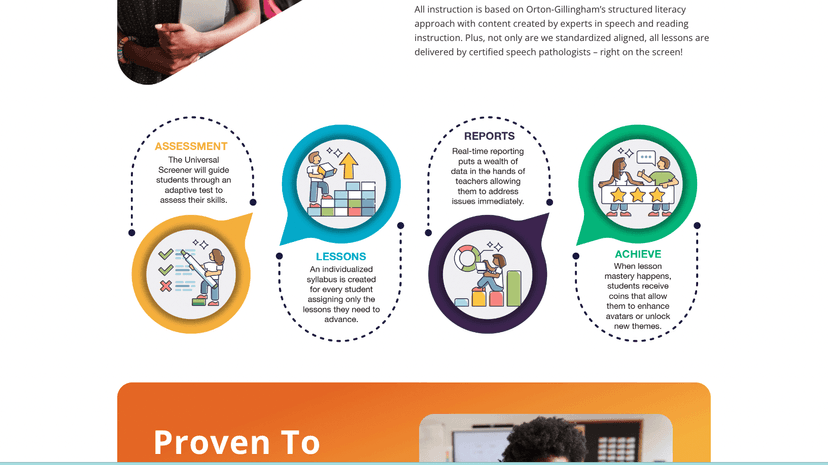
MindPlay Reading uses a mastery-based progression model heavily reliant on direct video instruction and continuous adaptive assessment. When your child first logs in, they take a comprehensive diagnostic test that pinpoints their exact grade-level proficiency in phonics, vocabulary, grammar, and reading comprehension. Based on these results, the system generates a personalized learning path. The core instructional loop involves watching a short, explicit video lesson delivered by a certified speech pathologist. These instructors demonstrate the physical articulation of sounds. After the instruction phase, your child enters a practice block where they apply the rule. They must achieve a specific accuracy threshold, usually 100 percent on targeted skill checks, before the system allows them to move forward. If they fail, the program remediates by presenting the information in a slightly different format or offering more scaffolded practice. This ensures gaps in foundational literacy are closed before introducing complex reading comprehension tasks.
Strengths and tradeoffs of MindPlay Reading
MindPlay Reading's biggest strength is its strict adherence to structured literacy and explicit phonics instruction, while its biggest weakness is a highly clinical interface that struggles to sustain student motivation. Strengths: The program excels in its application of the Orton-Gillingham method. By using virtual speech pathologists to explicitly teach phonemes, it leverages worked examples and models correct articulation clearly. The mastery-based progression ensures that your child relies on active retrieval practice rather than passive guessing. The app forces students to decode words systematically, which aligns perfectly with the cognitive science of reading. Weaknesses: Because the platform prioritizes direct instruction over engagement, it often feels like a standardized test. The lack of varied instructional modalities or gamification means students, particularly in early elementary grades, may experience cognitive fatigue quickly. Furthermore, the reliance on continuous assessment can induce anxiety in struggling readers. While the pedagogy is sound, the delivery mechanism requires strong external motivation, usually from a teacher or parent, to keep the child consistently engaged with the material over long periods.
Who Might Benefit From MindPlay Reading?
MindPlay Reading is best for struggling readers and students with dyslexia who require intensive, structured phonics intervention. It serves students from PreK through 12th grade, though its clinical presentation is most appropriate for late elementary and middle school students who have aged out of cartoon-based reading apps but still need foundational decoding skills. Because it strips away distractions and focuses on direct instruction, it works exceptionally well in school-based intervention blocks or for parents willing to actively monitor their child's daily practice to ensure compliance and prevent fatigue.
Data Transparency
Does Not Meet Data Transparency Standard
MindPlay Reading does not meet our data transparency standard. Its privacy policy does not document basic protections, including contractual limits on service providers and a COPPA or FERPA commitment.
18 of 35 checks passed
Evaluated September 2026
Privacy Policy →Level 1 · Basic protections
Does not sell data or target ads at students, limits sharing, and lets parents see and delete their child's data.
Not documented: contractual limits on service providers, a COPPA or FERPA commitment
Level 2 · Parent control (meets the standard)
Families can get their data out, know who processes it, and know how long it is kept.
Not documented: data export, a data retention timeline, self-service deletion
Level 3 · Direct data access
Families or schools can pull their own data through an API, in a stated format.
Not documented: an API for retrieving their own data, a named export format
View all 35 checks
Parent Access5/8
Does the policy mention parents specifically?
“The Service is only for use by children under 13 who have been provided with an account by their parent/legal guardian or teacher, or as to which we have otherwise received parental consent.”
Can parents view their child's data?
“As to children under 13, the parent or legal guardian (or an authorized teacher) shall have the right to receive a description of the types of personal information collected, the right to review that information, and the right to ask that the information be deleted.”
Can parents modify their child's data?
“If you have questions about this Privacy Policy, or if you would like to request that we update or correct any information that you have provided to us, please send an email to info@MindPlay.com or contact us by mail at:”
Can parents delete their child's account?
“As to children under 13, the parent or legal guardian (or an authorized teacher) shall have the right to receive a description of the types of personal information collected, the right to review that information, and the right to ask that the information be deleted.”
Is there a dedicated Children's Privacy section?
The policy covers children inside its introduction and its Privacy Rights section but has no separate heading for children's privacy.
Does it reference COPPA compliance?
The policy does not mention COPPA.
Does it reference FERPA compliance?
The policy does not mention FERPA.
Is parental consent required for child accounts?
“The Service is only for use by children under 13 who have been provided with an account by their parent/legal guardian or teacher, or as to which we have otherwise received parental consent. Such consent may be revoked at any time by calling us at 800-221-7911 or sending an email to info@MindPlay.com.”
Data Portability1/5
Can users access their personal data?
“For example, you may have the right to review, correct, and delete personal information we have about you, or to consent or withdraw consent to certain uses or sharing of personal information. If you seek to exercise your rights, please contact us by emailing info@MindPlay.com.”
Can users download/export their data?
The policy does not address downloading or exporting data.
Is there a self-service data access tool?
The policy offers access only by emailed request, not through a self-service tool.
Is a specific data format mentioned for export?
The policy does not name any export format.
Is there an API for data access?
The policy does not mention an API for accessing data.
Data Minimization1/6
Is data collection itemized?
“When you register for an account, we collect personal identifiers (such as your name, username, mailing address, email address, and telephone number), educational institution-related information (such as your title, the educational institution name, district, and address, and the administrator’s name, title, email, and telephone number)”
Can the app be used without a real name?
The policy says it collects students' names when a student is added to an account.
Can the app be used without an email?
The policy does not say that student email addresses are never collected.
Does it state collection is limited to what is necessary?
The policy limits how long data is kept but does not limit collection to what is necessary.
Is IP address anonymized or truncated?
The policy says it collects IP addresses and does not mention anonymizing them.
Is location tracking explicitly excluded?
The policy does not explicitly rule out location tracking.
Third-Party Protection5/7
Does it explicitly state no selling of data?
“We do not sell your personal information for money or other consideration.”
Are third-party providers named?
“When you use our Service, we and our third-party partners, such as advertising partners and analytics providers including Google Analytics, collect information by automated means.”
Are providers contractually restricted?
The policy says it shares data with vendors but does not describe contract limits on how they use it.
No-targeted-advertising commitment?
“MindPlay does not display or target users of the Service with third-party advertisements.”
Is AI/ML data sharing addressed?
The policy does not address AI or machine learning.
Child-specific sharing restriction?
“The personal information of children will be collected, used, or disclosed for the purposes of providing educational services via the Service and not for any other commercial purposes.”
Cookies/tracking limited or opt-out?
“As indicated above, we, like many other website operators, currently use Google Analytics to collect and process certain Service usage data. To learn more about Google Analytics and how to opt-out, please see our Cookie Policy.”
Deletion & Retention2/5
Can users delete their account?
“For example, you may have the right to review, correct, and delete personal information we have about you, or to consent or withdraw consent to certain uses or sharing of personal information. If you seek to exercise your rights, please contact us by emailing info@MindPlay.com.”
Self-service deletion mechanism?
The policy offers deletion only by request, not through a self-service tool.
Specific data retention timeline?
The policy keeps data only as long as necessary but gives no specific time period.
Auto-deletion of inactive accounts?
The policy does not address automatically deleting inactive accounts.
Post-deletion handling described?
“Residual copies of this information may remain within our backup files, databases, and other records, and such copies are handled in keeping with our record retention procedures.”
Advertising4/4
Advertising model explicitly disclosed?
“MindPlay does not display or target users of the Service with third-party advertisements.”
Free from third-party advertisements?
“MindPlay does not display or target users of the Service with third-party advertisements.”
Children excluded from ad targeting?
“MindPlay does not display or target users of the Service with third-party advertisements.”
Ad-free option available?
“MindPlay does not display or target users of the Service with third-party advertisements.”
What This Means
The policy review did not meet our data transparency standard. The checks above show the documented findings and unknowns. A missing statement does not establish how the app handles data in practice.
About this evaluation: Based on automated analysis of Privacy Policy against 35 policy-disclosure questions, including questions adapted from the Common Sense Privacy Program's published evaluation questions. TLS is not affiliated with Common Sense Media, and this is not a Common Sense rating. Quoted text is copied from the policy; unquoted notes are our summary. Results describe what the policy documents, not the company's actual practices. Privacy policies can change: this review reflects the version we analyzed and does not determine legal compliance.
Sources and review method
TLS combines product information and editorial analysis to explain how MindPlay Reading works, its tradeoffs, and the questions to ask before choosing it. Product features, an instructional rationale and evidence of learning outcomes are different kinds of information.
Formal Learning Standard assessment: not yet completed. Data Transparency findings are reported separately and do not establish learning effectiveness. Read our methodology.
Frequently Asked Questions About MindPlay Reading
Is MindPlay Reading free?
No, MindPlay Reading is not free. It uses a tiered pricing model primarily designed for school districts and educational institutions. Pricing varies significantly based on the specific reading modules required and the number of student licenses purchased. Individual parent subscriptions are occasionally available through third-party vendors, but it is primarily a business-to-business product.
Is MindPlay Reading good for early elementary students?
Yes, but with caveats. The underlying pedagogy is excellent for teaching Kindergartners and 1st graders how to read using explicit phonics. However, the interface is highly clinical and lacks the gamification typical of apps for this age group. Young children will likely need adult supervision to stay focused during the video lessons and rigorous assessments.
What does MindPlay Reading teach?
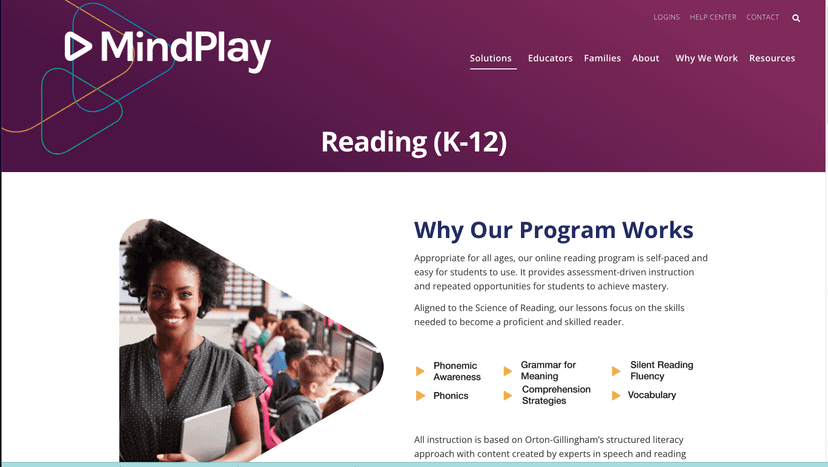
MindPlay Reading teaches comprehensive literacy skills based on the Science of Reading. It covers phonological awareness, phonics, vocabulary, grammar, fluency, and reading comprehension. The instruction heavily emphasizes decoding skills, utilizing virtual speech pathologists to teach students the exact physical mechanics of pronouncing different phonemes and words.
Has MindPlay Reading been evaluated by The Learning Standard?
Not yet. MindPlay Reading is currently pending evaluation by our team. While we have analyzed its stated pedagogical approach and underlying mechanics based on learning science, it has not yet gone through our rigorous, data-driven testing process. You can read more about how we rate apps in our methodology.
MindPlay Reading vs Lexia Core5: Which is better?
Both programs are grounded in the Science of Reading and use adaptive technology. Lexia Core5 offers a more engaging, gamified interface that tends to hold the attention of younger learners better than MindPlay's clinical video instruction. However, MindPlay's use of actual speech pathologists demonstrating mouth placement makes it a highly effective targeted intervention for students with specific articulation or severe decoding struggles.
Has The Learning Standard evaluated MindPlay Reading?
TLS has not yet completed a Learning Standard evaluation of how well MindPlay Reading teaches. Its privacy policy has been reviewed for Data Transparency and does not yet document the basic protections (Level 1).
Is MindPlay Reading COPPA compliant?
A COPPA reference was not found in the reviewed privacy policy. This does not determine whether the app complies with COPPA. Policy review note: The policy does not mention COPPA.
Is MindPlay Reading FERPA compliant?
A FERPA reference was not found in the reviewed privacy policy. This does not determine whether the app complies with FERPA. Policy review note: The policy does not mention FERPA.
Does MindPlay Reading have a children's privacy policy?
No dedicated children's privacy section was found in the reviewed policy. Policy review note: The policy covers children inside its introduction and its Privacy Rights section but has no separate heading for children's privacy.
Does MindPlay Reading sell student data?
The reviewed policy states that the app does not sell data. This is a policy statement; actual data practices were not verified. Policy review note: The policy explicitly says MindPlay does not sell personal information.
Can you delete your data from MindPlay Reading?
The reviewed privacy policy describes account deletion. We have not tested the deletion process. Policy review note: Users can ask by email for their personal information to be deleted.
Follow TLS Research
Subscribe to future TLS research updates: app reviews, findings, and what the evidence shows.
Screenshots

Take Action
For MindPlay Reading
If you represent MindPlay and have a correction or new evidence, send the relevant source so we can review and update this page.
Submit a correctionDetails
- Pricing
- Pricing is based on the various reading products needed by the district or school. There are various tiers based on the client's need.
- Platforms
- Web Browser, iPadOS (Apple tablet), Windows (Microsoft), macOS (Apple), Chrome OS (Google)
- Grade Levels
- Prekindergarten, Transitional Kindergarten, Kindergarten, 1st Grade, 2nd Grade, 3rd Grade, 4th Grade, 5th Grade, 6th Grade, 7th Grade, 8th Grade, 9th Grade, 10th Grade, 11th Grade, 12th Grade
- Website
- Visit site