
Lyfe Course 9-12 Curriculum
Product by Lyfe Course
Facts checked: Not yet checked
Our take (not a Learning Standard rating). This label applies to learning-science judgments throughout this overview.
Our take (not a Learning Standard rating)
While The Learning Standard has not yet formally evaluated Lyfe Course 9-12 Curriculum, its use of project-based learning and direct instruction aligns with established methods for teaching financial literacy. The curriculum targets concrete skills like budgeting and investing, but its actual efficacy remains pending verified classroom data.
Pros
- Incorporates project-based learning to connect abstract financial concepts like credit and investing to real-world scenarios.
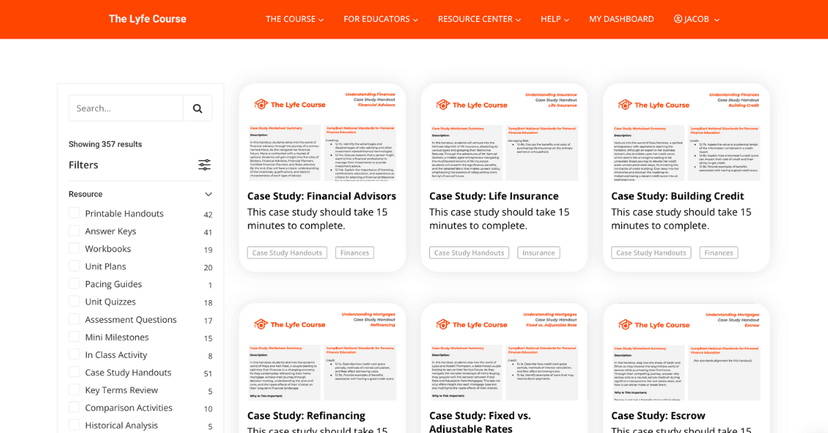
- Provides educators with full curriculum access, including assessments and state-specific compliance materials, to standardize instruction.
- Targets critical transition periods by focusing on career planning and budgeting for high school students.
Cons
- Lacks independent efficacy data verified by The Learning Standard to confirm knowledge retention.
- Requires a school or district license, making it inaccessible for individual parents or independent learners.
- Relies heavily on direct instruction, which may result in passive learning if not strictly balanced with active problem-solving.
What Do We Know About Lyfe Course 9-12 Curriculum?
Lyfe Course 9-12 Curriculum appears to offer a structured approach to high school financial literacy, but its overall effectiveness is still pending evaluation by The Learning Standard. Your child will interact with this curriculum through their school, as it is sold directly to districts rather than individual families. The program covers essential adulthood skills, including budgeting, understanding credit, investing, and career planning. By utilizing a mix of direct instruction and project-based learning, the curriculum aims to move students beyond memorizing financial terms to actually applying math and social science concepts to real-world problems. Parents should know that because this is a classroom-based tool, your child's success will depend heavily on how their teacher implements the provided lesson plans and assessments. While the integration of problem-based learning is a strong pedagogical choice for teaching financial literacy, we cannot definitively guarantee knowledge retention until we analyze classroom outcome data. If your child's school uses Lyfe Course, you should ask their teacher how often students engage in the active, project-based elements rather than just the direct instruction modules.
How Does Lyfe Course 9-12 Curriculum Work?
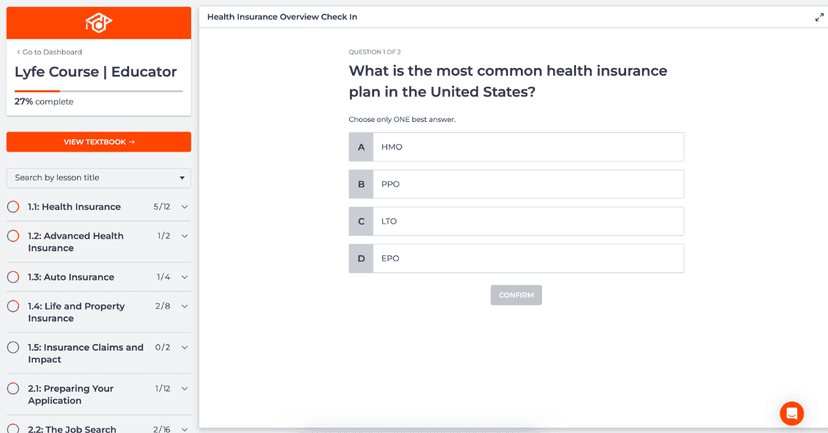
Lyfe Course 9-12 Curriculum uses direct instruction blended with project-based learning to teach high school students practical financial skills. The platform operates as a comprehensive classroom tool where teachers deliver lessons on subjects like credit, investing, and career planning, followed by student projects that apply these concepts. Students work through structured modules that integrate math and social science standards into real-world financial scenarios. The problem-based learning components require students to calculate budgets, analyze credit risks, and simulate investment strategies. This method aligns with the cognitive science principle of authentic application, which helps transfer abstract knowledge into practical skills. Teachers control the pacing and administer the built-in assessments to measure student comprehension. Because the curriculum includes comprehensive educator resources and state-compliance materials, the daily mechanics of how your child uses Lyfe Course will be heavily directed by their classroom teacher's specific lesson planning.
Strengths and tradeoffs of Lyfe Course 9-12 Curriculum
The biggest strength of Lyfe Course 9-12 Curriculum is its use of project-based learning to contextualize financial literacy, while its biggest weakness is the lack of independent evaluation data verifying its effectiveness. From a learning science perspective, project-based learning is highly effective for subjects like finance because it requires students to synthesize information and apply it to authentic, real-world problems. When students create actual budgets or simulate investment portfolios, they engage in active learning that typically yields better long-term retention than passive reading. However, the curriculum also relies on direct instruction, which carries the risk of reduced student engagement if teachers simply lecture without immediate, structured practice. Without verified data on how the program utilizes retrieval practice or spaced repetition within its assessments, it is difficult to determine if students will remember these financial concepts after graduation. Additionally, the platform's accessibility is limited exclusively to school district adoptions, meaning parents cannot independently verify the content or supplement their child's learning at home without school facilitation.
Who Might Benefit From Lyfe Course 9-12 Curriculum?
Lyfe Course 9-12 Curriculum is best for high school educators and districts looking for a standardized, project-based financial literacy program to implement in their classrooms. It is specifically targeted at students in grades 9 through 12 who need structured preparation for the financial realities of adulthood, including career planning, credit management, and investing. Since it requires a site or per-student license purchased by a school, it is not an option for homeschoolers or parents seeking an independent at-home learning app.
Data Transparency
Does Not Meet Data Transparency Standard
Lyfe Course 9-12 Curriculum does not meet our data transparency standard. Its privacy policy does not document basic protections, including a statement that it does not sell data, a commitment against targeted advertising and contractual limits on service providers.
16 of 35 checks passed
Evaluated September 2026
Privacy Policy of www.lyfecourse.com →Level 1 · Basic protections
Does not sell data or target ads at students, limits sharing, and lets parents see and delete their child's data.
Not documented: a statement that it does not sell data, a commitment against targeted advertising, contractual limits on service providers, a COPPA or FERPA commitment
Level 2 · Parent control (meets the standard)
Families can get their data out, know who processes it, and know how long it is kept.
Not documented: a data retention timeline, self-service deletion
Level 3 · Direct data access
Families or schools can pull their own data through an API, in a stated format.
Not documented: an API for retrieving their own data, a named export format
View all 35 checks
Parent Access5/8
Does the policy mention parents specifically?
“Parents may review the personal information about their child collected by www.lyfecourse.com - if any - outlined in the rest of this policy, ask for its deletion and request any further collection or use to be omitted by contacting the Owner.”
Can parents view their child's data?
“Parents may review the personal information about their child collected by www.lyfecourse.com - if any - outlined in the rest of this policy, ask for its deletion and request any further collection or use to be omitted by contacting the Owner.”
Can parents modify their child's data?
“If you are an adult, you can make a request on behalf of a child under your parental authority.”
Can parents delete their child's account?
“Parents may review the personal information about their child collected by www.lyfecourse.com - if any - outlined in the rest of this policy, ask for its deletion and request any further collection or use to be omitted by contacting the Owner.”
Is there a dedicated Children's Privacy section?
“Www.lyfecourse.com is directed to children under the age of 13. It doesn't require the child to disclose any more information than is reasonably necessary to participate in its activity.”
Does it reference COPPA compliance?
The policy does not mention COPPA.
Does it reference FERPA compliance?
The policy does not mention FERPA.
Is parental consent required for child accounts?
The policy says parents may agree to the collection of their child's data, but it does not say parental consent is required for child accounts.
Data Portability2/5
Can users access their personal data?
“Access their Data.** Users have the right to learn if Data is being processed by the Owner, obtain disclosure regarding certain aspects of the processing and obtain a copy of the Data undergoing processing.”
Can users download/export their data?
“Users have the right to receive their Data in a structured, commonly used and machine readable format and, if technically feasible, to have it transmitted to another controller without any hindrance.”
Is there a self-service data access tool?
The policy says rights requests are made by contacting the Owner and does not describe a self-service access tool.
Is a specific data format mentioned for export?
The policy only says data is provided in a "structured, commonly used and machine readable format" and names no specific format.
Is there an API for data access?
The policy does not describe an API for users to retrieve their data.
Data Minimization3/6
Is data collection itemized?
“first name; last name; phone number; email address; Cookies; Usage Data; unique device identifiers for advertising (Google Advertiser ID or IDFA, for example); Data communicated while using the service; various types of Data; address; username; password; ZIP/Postal code;”
Can the app be used without a real name?
The policy says it collects first and last names.
Can the app be used without an email?
The policy says it collects email addresses.
Does it state collection is limited to what is necessary?
“It doesn't require the child to disclose any more information than is reasonably necessary to participate in its activity.”
Is IP address anonymized or truncated?
“This integration of Google Analytics anonymizes your IP address. It works by shortening Users' IP addresses within member states of the European Union or in other contracting states to the Agreement on the European Economic Area.”
Is location tracking explicitly excluded?
The policy does not explicitly rule out location tracking.
Third-Party Protection3/7
Does it explicitly state no selling of data?
The policy says many types of processing count as a "Sale" and marks personal information as "Sold or Shared: Yes".
Are third-party providers named?
“**Third-parties:** Facebook, Inc., Google LLC, Asana, Inc., ActiveCampaign, Inc., HubSpot, Inc., Intercom Inc., Zapier, Inc., Zoho Corporation Pvt. Ltd., The Rocket Science Group LLC, Constant Contact, Inc., Campaign Monitor Pty Ltd”
Are providers contractually restricted?
The policy does not say providers are contractually restricted in how they use data; written contracts come up only in the definitions of Sale and Sharing.
No-targeted-advertising commitment?
The policy says data is used for advertising, remarketing and behavioral targeting, and it marks Targeted Advertising as "Yes".
Is AI/ML data sharing addressed?
The policy does not address sharing data for AI or machine learning.
Child-specific sharing restriction?
“Parents may also agree to the collection and use of their child’s information, but still not allow disclosure to third parties, unless disclosure is integral to the Service.”
Cookies/tracking limited or opt-out?
“If you want to submit requests to opt out of Sale or Sharing and Targeted Advertising activities via a user-enabled **global privacy control**, such as for example the Global Privacy Control (“ [GPC](https://globalprivacycontrol.org/)”), you are free to do so and we will abide by such request in a frictionless manner.”
Deletion & Retention2/5
Can users delete their account?
“**Have their Personal Data deleted or otherwise removed.** Users have the right to obtain the erasure of their Data from the Owner.”
Self-service deletion mechanism?
The policy says deletion is done by request to the Owner and describes no self-service deletion tool.
Specific data retention timeline?
The policy says data is kept as long as its purpose requires and gives no specific retention period.
Auto-deletion of inactive accounts?
The policy does not address automatic deletion of inactive accounts.
Post-deletion handling described?
“Any rectification or erasure of Personal Data or restriction of processing will be communicated by the Owner to each recipient, if any, to whom the Personal Data has been disclosed unless this proves impossible or involves disproportionate effort.”
Advertising1/4
Advertising model explicitly disclosed?
“This type of service allows User Data to be utilized for advertising communication purposes. These communications are displayed in the form of banners and other advertisements on www.lyfecourse.com, possibly based on User interests.”
Free from third-party advertisements?
The policy says ads are displayed through third-party ad services such as Facebook Audience Network.
Children excluded from ad targeting?
The policy does not exclude children from ad targeting, even though it says the service is directed to children under 13.
Ad-free option available?
The policy does not describe an ad-free option.
What This Means
The policy review did not meet our data transparency standard. The checks above show the documented findings and unknowns. A missing statement does not establish how the app handles data in practice.
About this evaluation: Based on automated analysis of Privacy Policy of www.lyfecourse.com against 35 policy-disclosure questions, including questions adapted from the Common Sense Privacy Program's published evaluation questions. TLS is not affiliated with Common Sense Media, and this is not a Common Sense rating. Quoted text is copied from the policy; unquoted notes are our summary. Results describe what the policy documents, not the company's actual practices. Privacy policies can change: this review reflects the version we analyzed and does not determine legal compliance.
Sources and review method
TLS combines product information and editorial analysis to explain how Lyfe Course 9-12 Curriculum works, its tradeoffs, and the questions to ask before choosing it. Product features, an instructional rationale and evidence of learning outcomes are different kinds of information.
Formal Learning Standard assessment: not yet completed. Data Transparency findings are reported separately and do not establish learning effectiveness. Read our methodology.
Frequently Asked Questions About Lyfe Course 9-12 Curriculum
Is Lyfe Course 9-12 Curriculum free?
No, Lyfe Course 9-12 Curriculum is not free. It is a paid curriculum that schools or districts must purchase through an annual site license or a per-student pricing model. Parents cannot purchase individual access.
Is Lyfe Course 9-12 Curriculum good for high schoolers?
Yes, the curriculum is specifically designed for 9th through 12th graders. The content targets age-appropriate milestones like career planning, understanding credit, and early investing, which align perfectly with the cognitive development and upcoming life transitions of teenagers.
What does Lyfe Course 9-12 Curriculum teach?
The curriculum teaches financial literacy, focusing heavily on math, social science, and Career and Technical Education (CTE) standards. Specific topics include budgeting, credit management, investing strategies, and long-term career planning.
How does Lyfe Course 9-12 Curriculum vs Dave Ramsey's Foundations in Personal Finance compare?
Both programs target high school financial literacy, but they differ in ideology and delivery. Lyfe Course 9-12 Curriculum focuses heavily on project-based learning and state-specific compliance. Dave Ramsey's curriculum relies strongly on video-based direct instruction and follows a specific, proprietary debt-free philosophy.
Has The Learning Standard evaluated Lyfe Course 9-12 Curriculum?
TLS has not yet completed a Learning Standard evaluation of how well Lyfe Course 9-12 Curriculum teaches. Its privacy policy has been reviewed for Data Transparency and does not yet document the basic protections (Level 1).
Is Lyfe Course 9-12 Curriculum COPPA compliant?
A COPPA reference was not found in the reviewed privacy policy. This does not determine whether the app complies with COPPA. Policy review note: The policy does not mention COPPA.
Is Lyfe Course 9-12 Curriculum FERPA compliant?
A FERPA reference was not found in the reviewed privacy policy. This does not determine whether the app complies with FERPA. Policy review note: The policy does not mention FERPA.
Does Lyfe Course 9-12 Curriculum have a children's privacy policy?
The reviewed policy includes a dedicated children's privacy section. Policy review note: The policy has a section headed "The Service is directed to children under the age of 13".
Does Lyfe Course 9-12 Curriculum sell student data?
A statement ruling out data selling was not found in the reviewed policy. This does not establish that the app sells student data. Policy review note: The policy says many types of processing count as a "Sale" and marks personal information as "Sold or Shared: Yes".
Can you delete your data from Lyfe Course 9-12 Curriculum?
The reviewed privacy policy describes account deletion. We have not tested the deletion process. Policy review note: Users can request deletion of their data.
Follow TLS Research
Subscribe to future TLS research updates: app reviews, findings, and what the evidence shows.
Screenshots
Take Action
For Lyfe Course 9-12 Curriculum
If you represent Lyfe Course and have a correction or new evidence, send the relevant source so we can review and update this page.
Submit a correctionDetails
- Pricing
- Lyfe Course offers flexible licensing to meet the needs of schools and districts. The most common model is a site license at a flat annual rate which provides unlimited access for all students and educators at that site. Alternatively, schools may choose a per-student model which is ideal for smaller programs or pilot implementations. Discounts are available for multi-year agreements and district-wide adoptions with multiple schools. All licenses include access to the full curriculum, assessments, teacher resources, professional development, and state-specific compliance materials at no additional cost.
- Platforms
- Web Browser, iOS (Apple mobile), iPadOS (Apple tablet), Android (Google mobile), Tizen (Samsung mobile), Windows (Microsoft), macOS (Apple), Chrome OS (Google), Other
- Grade Levels
- 9th Grade, 10th Grade, 11th Grade, 12th Grade
- Website
- Visit site