
Lt
Product by ADInstruments
Facts checked: Not yet checked
Our take (not a Learning Standard rating). This label applies to learning-science judgments throughout this overview.
Our take (not a Learning Standard rating)
While The Learning Standard has not yet formally evaluated Lt, its integration of real-time physiological data acquisition strongly aligns with experiential learning principles. By allowing university students to record and analyze their own biological signals, it grounds abstract life science concepts in concrete, observable phenomena, though its effectiveness depends heavily on instructor implementation.
Pros
- Grounds theoretical physiological concepts in concrete, experiential learning by using students' own biological data.
- Reduces extraneous cognitive load by integrating data acquisition directly into the lesson interface.
- Provides instructors with customizable lesson structures to adapt inquiry-based learning to their specific syllabi.
- Scaffolds scientific methodology by guiding students through real-time data collection and analysis steps.
Cons
- Requires significant hardware investment in specialized sensors to unlock the platform's core experiential benefits.
- Lacks built-in spaced repetition features to ensure long-term retention of theoretical concepts.
- Places a heavy burden on educators to curate and customize the massive library of 900 lessons.
What Do We Know About Lt?
Lt is an effective platform for facilitating experiential learning in higher education, provided institutions can afford the necessary hardware. The platform allows university students in nursing, medicine, and life sciences to record and analyze their own physiological signals directly within their coursework. This hands-on approach leverages the generation effect, a learning science principle where active generation of data leads to better conceptual retention than passive reading. Rather than looking at textbook diagrams of electrocardiograms or muscle activity, students analyze their own real-time data. The software integrates seamlessly with hardware sensors to remove the friction often found in complex university labs. This reduces extraneous cognitive load, allowing students to focus on scientific analysis rather than troubleshooting multiple disjointed software programs. However, because Lt is highly customizable, the actual learning outcomes will vary drastically based on how professors sequence the material. It does not automatically adapt to individual student knowledge gaps. Institutions must carefully align the pre-built lesson packs with their specific curricular goals to maximize the platform's value.
How Does Lt Work?
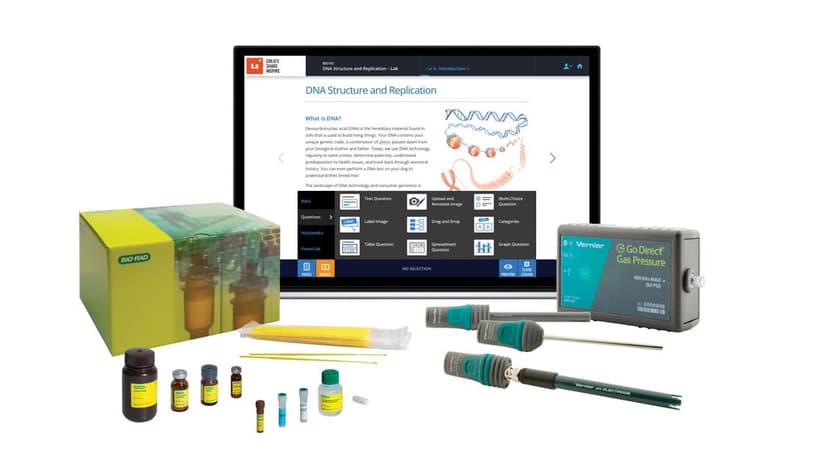
Lt uses experiential, inquiry-based learning by integrating live data acquisition directly into digital lesson modules. Students log into the cloud-based platform during a lab or blended learning session and connect hardware sensors to their bodies. The platform guides them through a structured protocol to record physiological data, such as heart rate, muscle electrical activity, or respiratory rates. Once the data is captured, the software prompts students to annotate, measure, and analyze their specific results within the same interface. This seamless workflow connects data collection directly to analytical questioning. Instructors manage this process through a backend dashboard where they can assign pre-built lessons from a library of over 900 templates. Educators can edit text, insert specific assessment questions, and monitor student completion. The platform requires a subscription and often relies on companion hardware to function as intended.
Strengths and tradeoffs of Lt
Lt's biggest strength is its ability to turn abstract biological concepts into concrete, self-generated data, while its biggest weakness is its reliance on expensive external hardware to achieve this effect. From a learning science perspective, the platform excels at experiential learning and reducing extraneous cognitive load. Traditionally, university students manage separate manuals, recording software, and analysis tools during labs. Lt combines these into a single interface, freeing up working memory for actual scientific inquiry. The use of students' own physiological data also enhances personal relevance, which increases engagement and attention. However, the platform lacks sophisticated adaptive learning mechanics. It does not use spaced repetition or algorithmic retrieval practice to ensure students remember the terminology or procedures long-term. The assessment tools are standard and rely on the instructor to provide meaningful feedback on incorrect answers. Additionally, the sheer volume of customizable content requires educators to possess strong instructional design skills to prevent overwhelming students with poorly structured modules.
Who Might Benefit From Lt?
Lt is best for university life science, nursing, and medical programs that want to modernize their laboratory instruction with integrated data collection. It serves associate and bachelor degree students who need hands-on experience with physiological data analysis to prepare for clinical or research careers. The platform is highly effective for blended learning environments where instructors want students to review theoretical protocols at home and maximize active data collection time in the lab. It is not designed for individual, independent learners or younger K-12 students.
Data Transparency
Does Not Meet Data Transparency Standard
Lt does not meet our data transparency standard. Its privacy policy does not document basic protections, including a statement that it does not sell data, a commitment against targeted advertising and limits on sharing children's data.
7 of 35 checks passed
Evaluated September 2026
Lt Privacy Policy (Non-US Version) →Level 1 · Basic protections
Does not sell data or target ads at students, limits sharing, and lets parents see and delete their child's data.
Not documented: a statement that it does not sell data, a commitment against targeted advertising, limits on sharing children's data, contractual limits on service providers, a COPPA or FERPA commitment, parents' right to see their child's data, parents' right to delete their child's data
Level 2 · Parent control (meets the standard)
Families can get their data out, know who processes it, and know how long it is kept.
Not documented: named service providers, self-service deletion
Level 3 · Direct data access
Families or schools can pull their own data through an API, in a stated format.
Not documented: an API for retrieving their own data, a named export format
View all 35 checks
Parent Access1/8
Does the policy mention parents specifically?
The policy does not mention parents.
Can parents view their child's data?
The policy does not give parents any right to view their child's data.
Can parents modify their child's data?
The policy does not give parents any right to modify their child's data.
Can parents delete their child's account?
The policy does not give parents any right to delete their child's data or account.
Is there a dedicated Children's Privacy section?
“9\. CHILDREN'S RIGHTS 9.1 The Service and Apps are intended for users who are 18 years old or older”
Does it reference COPPA compliance?
The policy does not reference COPPA.
Does it reference FERPA compliance?
The policy does not reference FERPA.
Is parental consent required for child accounts?
The policy says the service is for users 18 or older and does not require parental consent for child accounts.
Data Portability2/5
Can users access their personal data?
“Your right of access - You have the right to ask us for copies of your personal information.”
Can users download/export their data?
“Your right to data portability - You have the right to ask that we transfer the personal information you gave us to another organisation, or to you, in certain circumstances.”
Is there a self-service data access tool?
The policy handles data access only through email requests and describes no self-service tool.
Is a specific data format mentioned for export?
The policy does not name an export format.
Is there an API for data access?
The policy does not mention an API for data access.
Data Minimization1/6
Is data collection itemized?
“1.2.1 log-in information, technical information, including the Internet protocol ( **"IP"**) address used to connect your computer to the Internet, browser type and version, time zone setting, browser plug-in types and versions, operating system and platform;”
Can the app be used without a real name?
The policy says the information collected may include the user's name.
Can the app be used without an email?
The policy says the information collected may include the user's email address.
Does it state collection is limited to what is necessary?
The policy limits retention to what is necessary but does not say collection is limited to what is necessary.
Is IP address anonymized or truncated?
The policy says it collects IP addresses and does not say they are anonymized or truncated.
Is location tracking explicitly excluded?
The policy does not explicitly rule out location tracking.
Third-Party Protection0/7
Does it explicitly state no selling of data?
The policy does not say that the vendor does not sell data.
Are third-party providers named?
The policy describes third parties only by category (IT, hosting, marketing) and names none.
Are providers contractually restricted?
The policy mentions contractual controls only for cross-border transfers and does not say all providers are contractually restricted.
No-targeted-advertising commitment?
The policy makes no commitment against targeted advertising.
Is AI/ML data sharing addressed?
The policy does not address sharing data with AI or ML services.
Child-specific sharing restriction?
The policy only says it deletes data received by mistake from children under 13 and has no child-specific sharing restriction.
Cookies/tracking limited or opt-out?
The policy says the service uses essential and other cookies and describes no opt-out.
Deletion & Retention3/5
Can users delete their account?
“Your right to erasure - You have the right to ask us to erase your personal information in certain circumstances.”
Self-service deletion mechanism?
The policy handles deletion only by request and describes no self-service mechanism.
Specific data retention timeline?
“6.1 We will delete your User Content within three years after you terminate your account or earlier upon request.”
Auto-deletion of inactive accounts?
The policy does not mention automatic deletion of inactive accounts.
Post-deletion handling described?
“6.3 The retention period of your personal data may need to be extended where we require this to bring or defend legal claims. We may also retain data for longer periods for statistical purposes, and if so we will anonymise or pseudonymise this.”
Advertising0/4
Advertising model explicitly disclosed?
The policy does not address advertising in the product.
Free from third-party advertisements?
The policy does not say the product is free of third-party ads.
Children excluded from ad targeting?
The policy does not address excluding children from ad targeting.
Ad-free option available?
The policy does not mention an ad-free option or state that the product has no ads.
What This Means
The policy review did not meet our data transparency standard. The checks above show the documented findings and unknowns. A missing statement does not establish how the app handles data in practice.
About this evaluation: Based on automated analysis of Lt Privacy Policy (Non-US Version) against 35 policy-disclosure questions, including questions adapted from the Common Sense Privacy Program's published evaluation questions. TLS is not affiliated with Common Sense Media, and this is not a Common Sense rating. Quoted text is copied from the policy; unquoted notes are our summary. Results describe what the policy documents, not the company's actual practices. Privacy policies can change: this review reflects the version we analyzed and does not determine legal compliance.
Sources and review method
TLS combines product information and editorial analysis to explain how Lt works, its tradeoffs, and the questions to ask before choosing it. Product features, an instructional rationale and evidence of learning outcomes are different kinds of information.
Formal Learning Standard assessment: not yet completed. Data Transparency findings are reported separately and do not establish learning effectiveness. Read our methodology.
Frequently Asked Questions About Lt
Is Lt free?
No. Lt is a paid subscription platform marketed to higher education institutions. Universities must purchase licenses for the software platform and often buy additional content packs or hardware sensors to utilize the full data-acquisition features.
Is Lt good for university students?
Yes. It is explicitly designed for associate and bachelor degree levels. The content aligns with rigorous higher education standards for nursing, medicine, chemistry, and life sciences, providing professional-grade data analysis tools.
What does Lt teach?
Lt teaches scientific methodology, data acquisition, and physiological concepts. Students learn how to record, interpret, and analyze biological signals like heart rates and muscle activity through guided laboratory modules.
Does Lt require specialized hardware?
Yes, to utilize its experiential data-collection features. While educators can use the platform for standard digital lessons, recording live physiological signals requires companion hardware like Lt Sensors or PowerLab systems.
How does Lt handle student assessments?
Lt includes built-in formative assessments like multiple-choice and short-answer questions. However, it relies heavily on instructors to review complex data analysis submissions and provide individualized feedback, as it lacks automated adaptive tutoring.
Has The Learning Standard evaluated Lt?
TLS has not yet completed a Learning Standard evaluation of how well Lt teaches. Its privacy policy has been reviewed for Data Transparency and does not yet document the basic protections (Level 1).
Is Lt COPPA compliant?
A COPPA reference was not found in the reviewed privacy policy. This does not determine whether the app complies with COPPA. Policy review note: The policy does not reference COPPA.
Is Lt FERPA compliant?
A FERPA reference was not found in the reviewed privacy policy. This does not determine whether the app complies with FERPA. Policy review note: The policy does not reference FERPA.
Does Lt have a children's privacy policy?
The reviewed policy includes a dedicated children's privacy section. Policy review note: Section 9, headed Children's Rights, covers children's data.
Does Lt sell student data?
A statement ruling out data selling was not found in the reviewed policy. This does not establish that the app sells student data. Policy review note: The policy does not say that the vendor does not sell data.
Can you delete your data from Lt?
The reviewed privacy policy describes account deletion. We have not tested the deletion process. Policy review note: Users can ask for their personal information to be erased.
Follow TLS Research
Subscribe to future TLS research updates: app reviews, findings, and what the evidence shows.
Screenshots
Take Action
For Lt
If you represent ADInstruments and have a correction or new evidence, send the relevant source so we can review and update this page.
Submit a correctionDetails
- Pricing
- Lt is purchased via a subscription to the platform. Users can also purchase additional content packs, which contain pre-built, editable content to use with their students.
- Platforms
- Web Browser, iOS (Apple mobile), iPadOS (Apple tablet), Android (Google mobile), Windows (Microsoft), macOS (Apple), Chrome OS (Google), Other
- Grade Levels
- Associate's degree, Bachelor's degree
- Website
- Visit site