Lalilo Review
Product by Renaissance
Facts checked: Not yet checked
Our take (not a Learning Standard rating). This label applies to learning-science judgments throughout this overview.
Our take (not a Learning Standard rating)
Renaissance describes Lalilo as supplemental foundational-literacy practice for early readers, with exercises and teacher reporting. Its place in a reading plan is alongside instruction. Ask which skills the learner is practicing and how the teacher uses the reports to decide what to teach or revisit.
Product information: Renaissance Lalilo product overview and FAQ
Research review. About this review
StandardLalilo / The progress brief
For your next conversation with the teacher
Is Lalilo progress showing up in reading?
Ask for the skill, the recent answers, and an example beyond the app. A progress display is the start of that conversation.
TLS illustration,
not a screenshot
Reviewed does not always mean a successful review.
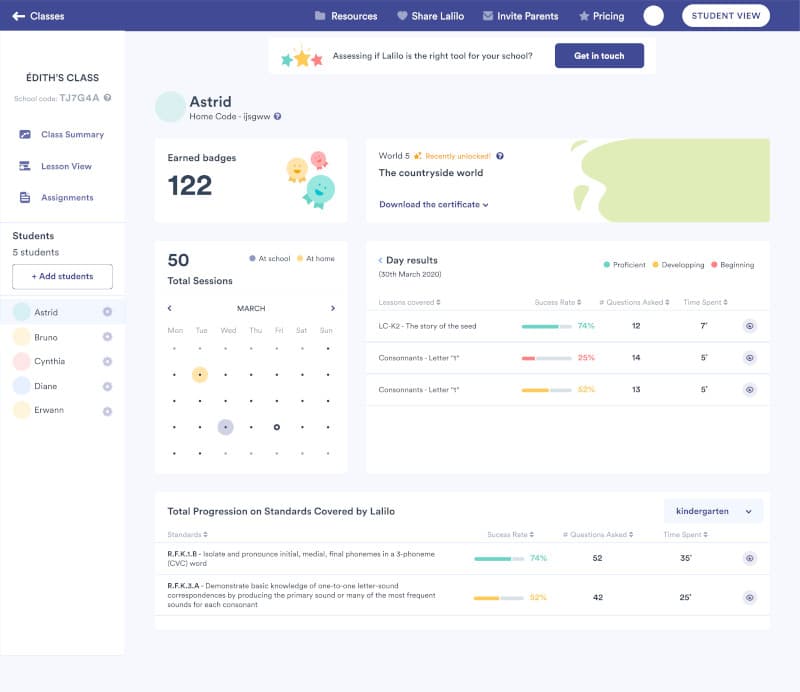
In the teacher's Lesson View, R marks an automatically reviewed lesson. Lalilo says the tile stays green even after an unsuccessful review. It is not a verdict on your child's reading.1
What is being practised?
Name the specific skill, not just the lesson count or time spent.
What is happening now?
Ask the teacher to look at recent answers, not only the tile color.1
Where else does it show?
Ask for an example of that skill in your child's classroom reading.
Aim for one clear next step. A skill to practise, an example of suitable work, and agreed support. Not a larger homework list.
Considering another resource? Compare the jobs reading apps can do.
Keep the Lalilo progress brief
Save the report explanation and a ready-to-use teacher message. Subscribe to future TLS research updates and download the one-page PDF here immediately.
Pros
- Applies systematic phonics instruction to build phonemic awareness and letter recognition.
- Uses active retrieval practice by requiring students to frequently match sounds to letters.
- Adapts question difficulty in real-time to keep students in their zone of proximal development.
- Provides granular data dashboards that allow educators to identify specific literacy gaps.
Cons
- Heavy reliance on gamification elements can distract younger students from the core learning objectives.
- Writing instruction components are limited by the constraints of a digital interface.
- Lacks explicit corrective feedback that explains to a child why an answer is wrong.
What Do We Know About Lalilo?
Lalilo is an effective supplemental tool for building early phonics and decoding skills, provided it is used alongside direct reading instruction. The app focuses heavily on foundational literacy, drilling phonemic awareness and word recognition through repetitive exercises. For your child, this means frequent exposure to letter sounds and sight words, which strengthens memory retrieval. The platform uses a gamified interface where students earn rewards for completing reading paths. While this maintains engagement, you should monitor your child to ensure they are actually reading rather than simply clicking through to get digital badges. Because the program is designed heavily around teacher reporting, parents using the home version may not get the full benefit of the diagnostic data. However, the core phonics engine is solid. It breaks down reading into discrete, manageable skills, which aligns well with the science of reading. Just remember that no app can replace the value of reading physical books with your child to develop true fluency and deep comprehension.
How Does Lalilo Work?
Lalilo uses an adaptive, gamified progression model that automatically adjusts reading exercises based on student performance. When your child logs in, they embark on a visual journey through various animated worlds. The core learning mechanic relies on repetitive retrieval practice, where students listen to audio prompts and select the corresponding letters, syllables, or words. As they answer correctly, the algorithm introduces more complex phonics rules and longer texts, keeping them in their optimal learning zone. If your child struggles, the app provides easier prompts to build confidence before scaling up the difficulty. The reading comprehension modules require students to read short, decodable passages and answer multiple-choice questions. Progress is tracked internally, generating detailed reports on phonological awareness, fluency, and vocabulary acquisition. This data allows educators to pinpoint exact areas where a student might need targeted intervention in the classroom.
Strengths and tradeoffs of Lalilo
Lalilo's biggest strength is its systematic approach to phonemic awareness, while its biggest weakness is the potential for its gamification mechanics to overshadow deeper reading comprehension. The app aligns well with the science of reading by emphasizing explicit phonics instruction. By breaking words down into individual phonemes and requiring frequent retrieval practice, the app helps solidify the neural pathways necessary for fluent decoding. The adaptive algorithm ensures that students receive spaced repetition of letters and sounds they previously struggled with, which significantly improves long-term retention. However, the heavy use of digital rewards can lead to passive clicking. Young children may learn to game the system by guessing multiple-choice answers rather than engaging in the cognitive effort required for true comprehension. Furthermore, while the app claims to teach writing, the constraints of a tablet or computer screen mean that physical letter formation and authentic expressive writing are largely absent. Despite these limitations, it remains a strong supplementary tool for drilling the mechanical aspects of early literacy.
Who Might Benefit From Lalilo?
Best for kindergarten through second-grade students who need engaging, repetitive practice with foundational phonics and decoding skills. The app serves as an excellent classroom supplement for early readers who benefit from gamified motivation to complete literacy drills. It is particularly useful for teachers who need detailed diagnostic data to track phonological awareness across a diverse group of students. While it can be used at home, it functions best when an educator is actively monitoring the backend reports to guide offline, direct instruction. Students who already possess strong decoding skills but need to work on deep reading comprehension will likely age out of its usefulness quickly.
What does Lalilo cost?
With multiple pricing tiers available, Lalilo provides flexibility for schools and districts of any size. This program includes a freemium and premium version.
Pricing and included features can change. Confirm the plan, renewal terms and any school-provided access on Lalilo's website.
Questions to ask before choosing Lalilo
Use these with a teacher, during a trial, or when comparing another option.
- Which foundational reading skills need practice, and how were they identified?
- How does the teacher connect Lalilo activities with explicit reading instruction?
- Can the learner read a new word or short text outside the practiced activity?
- What home access and progress information are available through the school account?
Sources and review method
TLS combines product information and editorial analysis to explain how Lalilo works, its tradeoffs, and the questions to ask before choosing it. Product features, an instructional rationale and evidence of learning outcomes are different kinds of information.
Formal Learning Standard assessment: not yet completed. Data Transparency findings are reported separately and do not establish learning effectiveness. Read our methodology.
The sources below support the opening take and decision questions. Provider descriptions establish advertised features, not independently measured learning outcomes.
- Renaissance Lalilo product overview and FAQProduct information · Source checked 2026-09-04
Source-check dates apply to these links, not to every statement in the existing editorial or to a new formal assessment.
Earlier research findings and their sources
These published research records are separate from the opening source check. Consult each source for the product version, population and date it covers.
Lalilo is built on Science of Reading research and provides explicit systematic instruction in phonemic awareness, phonics, fluency, vocabulary, and comprehension.
Educators reported that Lalilo's placement test is far more accurate than their existing classroom assessments of early literacy skills.
Treatment group students had a weekly growth rate 1.2 standard deviations higher than comparison group on FastBridge CBMreading subtest.
- Impact and Implementation Evaluation of Lalilo: Phase II Executive SummaryIndependent Research
Students using Lalilo experienced higher levels of growth in general literacy achievement than non-users in a study of over 15,000 K-2 students.
Struggling readers who use Lalilo with fidelity achieve growth equivalent to six additional weeks of classroom instruction.
Students used Lalilo an average of 3.5 days per week for 40 minutes total or 11 minutes per day.
- Impact and Implementation Evaluation of Lalilo: Phase II Executive SummaryIndependent Research
Frequently Asked Questions About Lalilo
Is Lalilo free?
Lalilo operates on a freemium model. The basic version is free and provides access to standard phonics exercises, while the premium tier unlocks comprehensive data reporting and advanced administrative tools for schools and districts.
Is Lalilo good for kindergarteners?
Yes, the app is specifically designed for students in kindergarten through second grade. The interface is highly visual and relies heavily on audio instructions, making it accessible for early learners who cannot yet read independently.
What does Lalilo teach?
Lalilo teaches foundational literacy skills, focusing heavily on phonological awareness, letter recognition, phonics, and sight words. It also includes basic reading comprehension and vocabulary exercises as students progress to more advanced levels.
Lalilo vs. Starfall: Which is better for early reading?
Lalilo provides a more structured, adaptive learning path with robust teacher data, making it better for targeted skill-building. Starfall is more exploratory and play-based, which works well for younger preschoolers but lacks the sophisticated diagnostic reporting found in Lalilo.
Has The Learning Standard evaluated Lalilo?
TLS has not yet completed a Learning Standard evaluation of how well Lalilo teaches. TLS has not published a Data Transparency result for its privacy policy.
Keep the Lalilo progress brief
Save the report explanation and a ready-to-use teacher message. Subscribe to future TLS research updates and download the one-page PDF here immediately.
Screenshots

Take Action
For Lalilo
If you represent Renaissance and have a correction or new evidence, send the relevant source so we can review and update this page.
Submit a correctionDetails
- Pricing
- With multiple pricing tiers available, Lalilo provides flexibility for schools and districts of any size. This program includes a freemium and premium version.
- Platforms
- Web Browser, iPadOS (Apple tablet), Android (Google mobile), Windows (Microsoft), macOS (Apple), Chrome OS (Google)
- Grade Levels
- Kindergarten, 1st Grade, 2nd Grade
- Website
- Visit site