
Kwizie
Product by Kwizie
Facts checked: Not yet checked
Our take (not a Learning Standard rating). This label applies to learning-science judgments throughout this overview.
Our take (not a Learning Standard rating)
Kwizie transforms passive video watching into active retrieval practice, a proven learning science method. While it effectively forces recall of information, the reliance on AI-generated questions means it often tests shallow facts rather than deep conceptual understanding, requiring careful educator oversight.
Pros
- Transforms passive video consumption into active retrieval practice to strengthen memory.
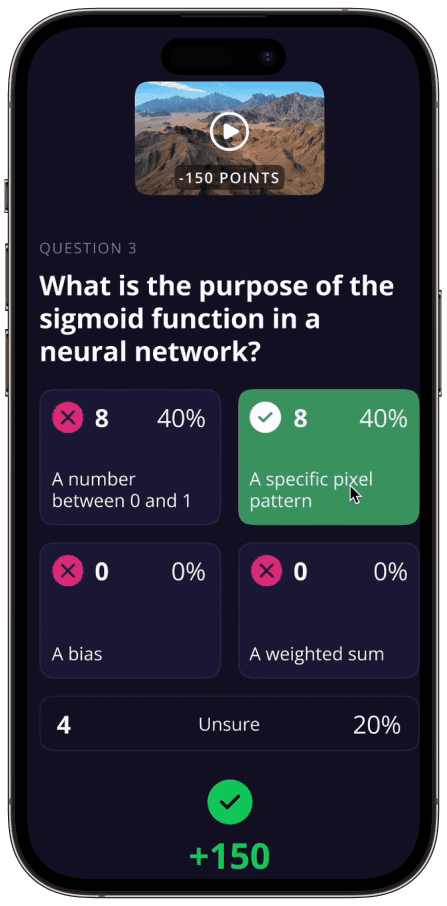
- Generates immediate formative assessments from existing YouTube or uploaded media files.
- Provides quick feedback loops to learners immediately after content exposure.
Cons
- AI-generated questions often default to shallow factual recall rather than higher-order thinking.
- Relies heavily on extrinsic rewards like certificates, which can diminish intrinsic motivation over time.
- Does not teach new concepts independently but relies entirely on the quality of the uploaded video.
What Do We Know About Kwizie?
Kwizie is an effective tool for boosting memory retention of video content, but it requires high-quality source material to be truly educational. Your child will not learn from Kwizie alone; rather, they learn from the videos you or their teacher provide, while Kwizie acts as the testing mechanism. The platform leverages a core principle of learning science called retrieval practice. By forcing your child to answer questions immediately after watching a video, it interrupts the passive viewing experience and moves information from short-term to long-term memory. However, parents and educators should be aware that AI-generated quizzes frequently focus on surface-level facts, such as specific dates or vocabulary words, rather than deep, conceptual understanding. You will need to review the questions it creates to ensure they align with your actual learning goals and challenge your child appropriately. Additionally, the app uses gamification features like prizes and certificates. While these offer a short-term boost in engagement, heavily relying on extrinsic rewards can sometimes undermine a student's natural curiosity over the long term. Use Kwizie as a supplementary tool to check comprehension, not as a primary instructor or a substitute for meaningful dialogue about the material.
How Does Kwizie Work?
Kwizie uses AI-assisted retrieval practice and gamified assessment to test comprehension of multimedia content. Educators or parents input a link from YouTube, Vimeo, or upload their own video, audio, or document files directly into the platform. The platform's artificial intelligence then scans the transcript and automatically generates a series of quiz questions based on the source material. Students watch the media and subsequently take the quiz, earning points, certificates, or predetermined prizes based on their performance accuracy. The system supports over ninety-five percent of spoken languages, making it highly adaptable for diverse classrooms. From a cognitive standpoint, the app forces active engagement by establishing clear expectations. Instead of passively letting a video play in the background, the learner knows an assessment is imminent, which naturally increases attention and focus during the video. After completion, the immediate feedback loop helps learners identify what specific facts they missed, allowing them to review targeted segments of the media for better comprehension.
Strengths and tradeoffs of Kwizie
Kwizie's biggest strength is its ability to instantly generate retrieval practice opportunities, while its biggest weakness is the AI's tendency to produce shallow recall questions. From a learning science perspective, frequent, low-stakes testing is highly effective for long-term memory retention. Kwizie capitalizes on this by allowing educators to easily attach assessments to any video, transforming a traditionally passive activity into an active cognitive task. This immediate quizzing helps combat the illusion of competence, where a student falsely feels they understand a video simply by watching it. On the downside, AI algorithms typically struggle to evaluate complex, higher-order thinking. The generated questions almost exclusively focus on recognizing basic facts mentioned in the video rather than requiring the student to synthesize, analyze, or apply the knowledge to new situations. Furthermore, the platform's heavy emphasis on gamification and extrinsic rewards, such as issuing prizes for high scores, can be a double-edged sword. While it creates an immediate burst of engagement, cognitive science indicates that over-reliance on external rewards can diminish a learner's intrinsic motivation for the subject matter over time.
Who Might Benefit From Kwizie?
Best for middle school through adult learners who need structured comprehension checks alongside video-based instruction. Kwizie is an excellent supplementary tool for teachers utilizing a flipped classroom model, or for parents who want to ensure their older child is actively paying attention to educational YouTube videos. Because the tool relies heavily on reading and responding to AI-generated text without visual scaffolding, it is not suitable for early elementary students who are still mastering basic literacy. It thrives in blended learning environments where the primary goal is ensuring basic factual retention before moving on to deeper classroom discussions.
Data Transparency
Does Not Meet Data Transparency Standard
Kwizie does not meet our data transparency standard. Its privacy policy does not document basic protections, including limits on sharing children's data, parents' right to see their child's data and parents' right to delete their child's data.
22 of 35 checks passed
Evaluated September 2026
Privacy Policy →Level 1 · Basic protections
Does not sell data or target ads at students, limits sharing, and lets parents see and delete their child's data.
Not documented: limits on sharing children's data, parents' right to see their child's data, parents' right to delete their child's data
Level 2 · Parent control (meets the standard)
Families can get their data out, know who processes it, and know how long it is kept.
Not documented: self-service deletion
Level 3 · Direct data access
Families or schools can pull their own data through an API, in a stated format.
Not documented: an API for retrieving their own data, a named export format
View all 35 checks
Parent Access4/8
Does the policy mention parents specifically?
“If you are under the applicable age, you may only use the Service with verifiable parental or guardian consent or under a school-managed institutional account.”
Can parents view their child's data?
The policy gives access rights to data subjects but does not give parents a right to view their child's data.
Can parents modify their child's data?
The policy gives rectification rights to data subjects but does not give parents a right to change their child's data.
Can parents delete their child's account?
The policy gives erasure rights to data subjects but does not give parents a right to delete their child's data or account.
Is there a dedicated Children's Privacy section?
“## 4\. Eligibility and Children’s Privacy”
Does it reference COPPA compliance?
“Kwizie is not directed to children under 16 in the EEA or UK (or the lower age permitted by local law, never below 13), and under 13 elsewhere, in line with YouTube and COPPA requirements.”
Does it reference FERPA compliance?
The policy does not mention FERPA.
Is parental consent required for child accounts?
“If you are under the applicable age, you may only use the Service with verifiable parental or guardian consent or under a school-managed institutional account.”
Data Portability2/5
Can users access their personal data?
“Obtain confirmation and a copy of your personal data.”
Can users download/export their data?
“Receive your data in a structured, machine-readable format.”
Is there a self-service data access tool?
The policy says users exercise their rights by emailing support, and it describes no self-service access tool.
Is a specific data format mentioned for export?
The policy says only "structured, machine-readable format" and does not name a specific file format.
Is there an API for data access?
The policy does not describe an API for users to access their data.
Data Minimization2/6
Is data collection itemized?
“- **Account data:** name, email address, password (hashed), organization, and role. - **Usage data:** IP address, device type, browser, access times, and interactions with the Service.”
Can the app be used without a real name?
The policy says account data includes the user's name.
Can the app be used without an email?
The policy says account data includes the user's email address.
Does it state collection is limited to what is necessary?
“We process personal data only when necessary and on one or more of the following legal bases:”
Is IP address anonymized or truncated?
The policy says it collects IP addresses and does not say they are anonymized or truncated.
Is location tracking explicitly excluded?
The policy does not explicitly rule out location tracking.
Third-Party Protection6/7
Does it explicitly state no selling of data?
“We never sell your data or learner data.”
Are third-party providers named?
“- Amazon Web Services Oy, Hirsalantie 11, 02420 Jorvas, Finland — Hosting. - Stripe Payments Europe Ltd, 1 Grand Canal Street Lower, Dublin 2, Ireland — Payments.”
Are providers contractually restricted?
“These providers act as data processors under written agreements ensuring adequate protection.”
No-targeted-advertising commitment?
“We never advertise in Kwizie.”
Is AI/ML data sharing addressed?
“We only share the specific content you choose to process with third-party AI model providers to generate outputs at your request.”
Child-specific sharing restriction?
The policy does not have any sharing restriction specific to children's data.
Cookies/tracking limited or opt-out?
“With your permission, we use Google Analytics to understand how people use this website. Analytics stays off until you accept, and we do not enable advertising features.”
Deletion & Retention4/5
Can users delete their account?
“**Educational / user data** — stored while the account is active and deleted after 12 months of inactivity or upon user request.”
Self-service deletion mechanism?
The policy says deletion is done by emailing a request, and it describes no self-service deletion tool.
Specific data retention timeline?
“**Educational / user data** — stored while the account is active and deleted after 12 months of inactivity or upon user request.”
Auto-deletion of inactive accounts?
“**Educational / user data** — stored while the account is active and deleted after 12 months of inactivity or upon user request.”
Post-deletion handling described?
“**Backups** — limited backup copies are retained for up to 90 days after deletion for disaster-recovery purposes.”
Advertising4/4
Advertising model explicitly disclosed?
“We never advertise in Kwizie.”
Free from third-party advertisements?
“We never advertise in Kwizie.”
Children excluded from ad targeting?
“We never advertise in Kwizie.”
Ad-free option available?
“We never advertise in Kwizie.”
What This Means
The policy review did not meet our data transparency standard. The checks above show the documented findings and unknowns. A missing statement does not establish how the app handles data in practice.
About this evaluation: Based on automated analysis of Privacy Policy against 35 policy-disclosure questions, including questions adapted from the Common Sense Privacy Program's published evaluation questions. TLS is not affiliated with Common Sense Media, and this is not a Common Sense rating. Quoted text is copied from the policy; unquoted notes are our summary. Results describe what the policy documents, not the company's actual practices. Privacy policies can change: this review reflects the version we analyzed and does not determine legal compliance.
Sources and review method
TLS combines product information and editorial analysis to explain how Kwizie works, its tradeoffs, and the questions to ask before choosing it. Product features, an instructional rationale and evidence of learning outcomes are different kinds of information.
Formal Learning Standard assessment: not yet completed. Data Transparency findings are reported separately and do not establish learning effectiveness. Read our methodology.
Frequently Asked Questions About Kwizie
Is Kwizie free?
Kwizie offers a limited free trial, but ongoing use requires a paid subscription. Prices start at $1 for the first month, with business and institution licenses available for custom hosting options.
Is Kwizie good for middle and high school students?
Yes, Kwizie is highly appropriate for students from 6th grade through high school, as well as adult learners. The tool requires strong independent reading skills to navigate the AI-generated quizzes effectively, making it better suited for older students rather than early elementary age.
What does Kwizie teach?
Kwizie does not teach its own curriculum; instead, it tests comprehension on whatever content you provide. It generates quizzes based on videos, audio files, or documents across any subject, including humanities, STEM, and career technical education.
How does Kwizie compare to Edpuzzle?
While both tools add interactivity to videos, Edpuzzle focuses on embedding teacher-created questions directly into the video timeline. Kwizie relies primarily on AI to automatically generate post-video quizzes and leans more heavily into gamified reward structures.
Has The Learning Standard evaluated Kwizie?
TLS has not yet completed a Learning Standard evaluation of how well Kwizie teaches. Its privacy policy has been reviewed for Data Transparency and does not yet document the basic protections (Level 1).
Is Kwizie COPPA compliant?
The reviewed privacy policy references COPPA. A policy reference alone does not establish COPPA compliance. Policy review note: The policy says its age limits follow COPPA requirements.
Is Kwizie FERPA compliant?
A FERPA reference was not found in the reviewed privacy policy. This does not determine whether the app complies with FERPA. Policy review note: The policy does not mention FERPA.
Does Kwizie have a children's privacy policy?
The reviewed policy includes a dedicated children's privacy section. Policy review note: The policy has a section titled "Eligibility and Children's Privacy".
Does Kwizie sell student data?
The reviewed policy states that the app does not sell data. This is a policy statement; actual data practices were not verified. Policy review note: Kwizie states it never sells user or learner data.
Can you delete your data from Kwizie?
The reviewed privacy policy describes account deletion. We have not tested the deletion process. Policy review note: User data is deleted when the user asks.
Follow TLS Research
Subscribe to future TLS research updates: app reviews, findings, and what the evidence shows.
Screenshots

Take Action
For Kwizie
If you represent Kwizie and have a correction or new evidence, send the relevant source so we can review and update this page.
Submit a correctionDetails
- Pricing
- Try it for free! Subscription prices start at only $1 for the first month.
- Platforms
- Web Browser, iOS (Apple mobile), iPadOS (Apple tablet), Android (Google mobile), Tizen (Samsung mobile), Windows (Microsoft), macOS (Apple), Chrome OS (Google)
- Grade Levels
- 6th Grade, 7th Grade, 8th Grade, 9th Grade, 10th Grade, 11th Grade, 12th Grade, Associate's degree, Bachelor's degree, Post-baccalaureate certificate, Master's Degree, Post-master's certificate, Doctoral Degree, Post-doctoral certificate, Adult Education, Professional or Technical Credential
- Website
- Visit site