
Curipod
Product by Curipod AS
Facts checked: Not yet checked
Our take (not a Learning Standard rating). This label applies to learning-science judgments throughout this overview.
Our take (not a Learning Standard rating)
Curipod functions as an instructional design tool rather than a direct-to-student teaching app. It effectively leverages AI to generate interactive lesson components like polls and open-ended questions that prompt active retrieval practice. However, its effectiveness relies entirely on the quality of the teacher's facilitation and the accuracy of the AI-generated content.
Pros
- Generates interactive questions that force students to use active recall rather than passive listening.
- Enables real-time formative assessment through drawing and text-based response features.
- Reduces teacher planning time by using AI to structure baseline lesson frameworks.
- Supports collaborative learning by allowing students to see and vote on peer responses.
Cons
- Relies on generative AI that can hallucinate or produce factually incorrect lesson content.
- Lacks built-in spaced repetition algorithms to ensure long-term retention of the material taught.
- Offers no independent feedback to the student beyond what the teacher manually provides during the lesson.
What Do We Know About Curipod?
Curipod is only effective for learning if a skilled teacher guides the AI-generated lessons and corrects any factual errors. Your child will not use this app independently to learn math or science; instead, they will interact with it in a classroom setting through a join code provided by their teacher. The platform uses artificial intelligence to help educators rapidly build slide decks containing interactive elements like polls, word clouds, and drawing tasks. From a learning science perspective, these interactive elements are highly beneficial because they require active retrieval. Rather than passively listening to a lecture, your child must actively recall information and submit an answer. This process strengthens memory pathways. However, because Curipod relies on generative AI to create its initial content, parents and educators must be aware that the system can produce inaccurate information. The app provides no direct instruction or feedback loop on its own. If your child submits an incorrect answer during a lesson, they will only know they are wrong if the teacher addresses it. Therefore, Curipod is best viewed as a presentation tool that increases classroom engagement, rather than a standalone educational curriculum. The Learning Standard has not yet evaluated this app's long-term impact on student outcomes.
How Does Curipod Work?
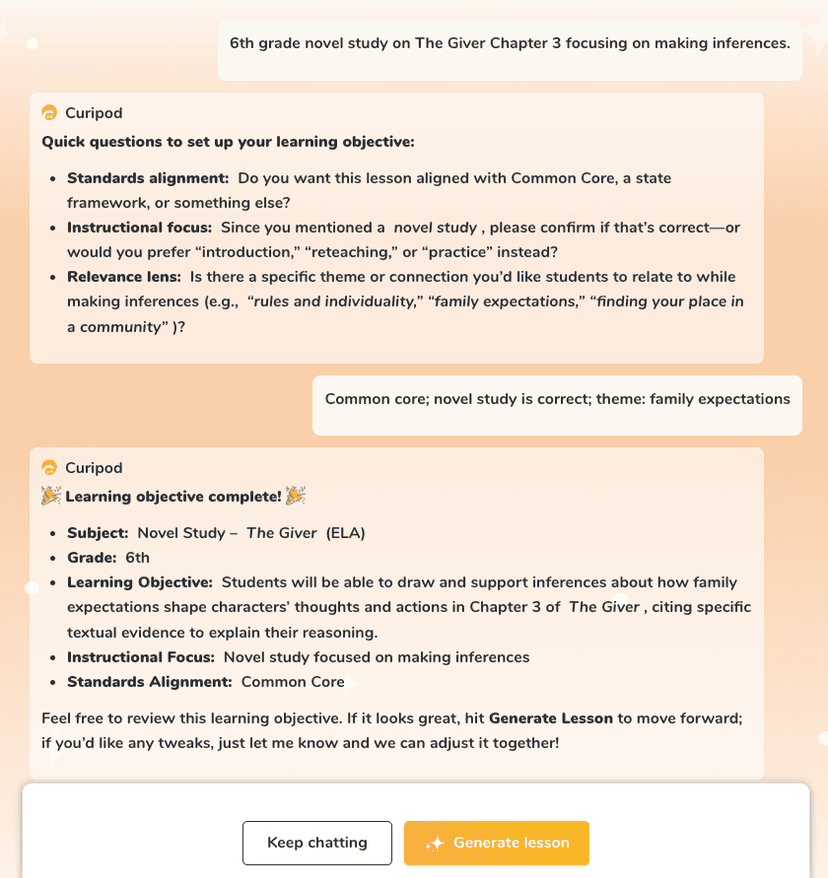
Curipod uses a teacher-facilitated direct instruction model integrated with active classroom polling. An educator types a topic into the platform, and the artificial intelligence generates a slide deck complete with text, images, and interactive questions. The teacher reviews and edits this material before presenting it to the class. Students join the live session on their own devices using a specific code. As the teacher advances the slides, students are prompted to participate in various activities. These include open-ended text responses, drawing tasks, and multiple-choice questions. This mechanic employs the learning science principle of active retrieval practice, forcing students to pull information from memory rather than just recognizing it on a screen. Once students submit their answers, the platform aggregates the responses anonymously on the main presentation board. The class can then discuss the results, and students can vote on the best peer responses. This creates a cooperative learning environment where students evaluate other perspectives, though the app itself does not adapt to individual student performance or alter the difficulty of future questions.
Strengths and tradeoffs of Curipod
Curipod's biggest strength is its ability to seamlessly integrate active retrieval practice into traditional lectures, while its biggest weakness is the inherent unreliability of AI-generated educational content. On the positive side, the platform excels at breaking up direct instruction with frequent formative assessments. By forcing students to answer open-ended questions or draw concepts every few slides, Curipod prevents cognitive overload and ensures students remain actively engaged in the learning process. This regular retrieval practice is proven to improve long-term memory retention compared to passive listening. Furthermore, the peer-voting mechanics encourage collaborative learning and allow students to see worked examples produced by their classmates. Conversely, the reliance on artificial intelligence introduces significant risks regarding factual accuracy. Teachers must rigorously fact-check every AI-generated slide, as presenting incorrect information can lead to deep-seated misconceptions. Additionally, the platform lacks any spaced repetition or individual adaptive pathways. The software does not track what a student gets wrong and re-test them later; the learning experience begins and ends with the live presentation. Without explicit, individualized feedback generated by the app, learning gaps may persist unless the human teacher intervenes.
Who Might Benefit From Curipod?
Curipod is best for classroom educators who need a fast, interactive way to deliver direct instruction and conduct formative assessments. It is designed for teachers of all grade levels across multiple subjects, from humanities to STEM. The platform is ideal for teachers who want to shift away from passive slideshows and incorporate active student participation without spending hours designing custom interactive activities. It is not suitable for parents looking for an independent tutoring app, nor is it meant for self-paced student study. It requires a live, synchronous environment where an instructor can facilitate discussion and verify the AI-generated facts.
Data Transparency
Does Not Meet Data Transparency Standard
Curipod does not meet our data transparency standard. Its privacy policy does not document basic protections, including parents' right to see their child's data and parents' right to delete their child's data.
22 of 35 checks passed
Evaluated October 2026
Privacy Policy →Level 1 · Basic protections
Does not sell data or target ads at students, limits sharing, and lets parents see and delete their child's data.
Not documented: parents' right to see their child's data, parents' right to delete their child's data
Level 2 · Parent control (meets the standard)
Families can get their data out, know who processes it, and know how long it is kept.
Level 3 · Direct data access
Families or schools can pull their own data through an API, in a stated format.
Not documented: an API for retrieving their own data, a named export format
View all 35 checks
Parent Access5/8
Does the policy mention parents specifically?
“To the extent COPPA applies, the school or district provides us with any necessary consent on behalf of students' parents or guardians to permit use of Curipod in the classroom.”
Can parents view their child's data?
The policy gives parents no right to view their child's data, directly or through the school.
Can parents modify their child's data?
The policy gives parents no right to change their child's data.
Can parents delete their child's account?
The policy gives parents no right to delete their child's data; student data is deleted only when the teacher deletes it or asks for deletion, or when a DPA requires it.
Is there a dedicated Children's Privacy section?
“## FERPA and COPPA Compliance”
Does it reference COPPA compliance?
“We comply with FERPA and COPPA and when applicable to us.”
Does it reference FERPA compliance?
“When FERPA applies, we act as a "school official" to our school or school district customer, which means that we are under the direct control of the school or district and use students' personal information only to provide our services to the school or district.”
Is parental consent required for child accounts?
“To the extent COPPA applies, the school or district provides us with any necessary consent on behalf of students' parents or guardians to permit use of Curipod in the classroom.”
Data Portability2/5
Can users access their personal data?
“You are, at any time and free of charge, entitled to receive a copy of the personal data that we hold about You and information about the processing thereof.”
Can users download/export their data?
“You are, at any time and free of charge, entitled to receive a copy of the personal data that we hold about You and information about the processing thereof.”
Is there a self-service data access tool?
The policy only offers data access by request and describes no self-service access tool.
Is a specific data format mentioned for export?
The policy names no format for data copies.
Is there an API for data access?
The policy does not mention an API for retrieving data.
Data Minimization3/6
Is data collection itemized?
“| IP address | To prevent abuse and hacking. | Stored a maximum of 3 weeks. |”
Can the app be used without a real name?
The policy says it may process student names, which are optional, so names can be collected.
Can the app be used without an email?
“## Students Using Curipod (Note That Students Don't Have Accounts)”
Does it state collection is limited to what is necessary?
“Depending on the manner in which you use our Services, we collect information about you that we deem necessary for providing Services and features that optimize, secure, and ease your user experience.”
Is IP address anonymized or truncated?
The policy says IP addresses are stored temporarily but does not say they are anonymized or truncated.
Is location tracking explicitly excluded?
The policy does not address location tracking.
Third-Party Protection7/7
Does it explicitly state no selling of data?
“Personal information is not sold or rented to third parties.”
Are third-party providers named?
“We may use email address to create lookalike audiences on third-party platforms (such as Meta, Google, or TikTok).”
Are providers contractually restricted?
“We do not attempt to re-identify this data, and we contractually prohibit any third party we share it with from doing so.”
No-targeted-advertising commitment?
“Personalised advertising is not displayed.”
Is AI/ML data sharing addressed?
“We do not use teacher or student data to train artificial intelligence models. The third party AI model providers we use do not use teacher or student data provided by Curipod users to train their artificial intelligence models.”
Child-specific sharing restriction?
“Curipod will never use student data for commercial purposes, nor will we let any third parties use student data for commercial purposes.”
Cookies/tracking limited or opt-out?
“If you want to opt out, please email [compliance@curipod.com](mailto:compliance@curipod.com). Users in the EU are opted out by default.”
Deletion & Retention4/5
Can users delete their account?
“You have the right to have Your personal data deleted on request, as soon as possible, and no later than 180 days after Your request.”
Self-service deletion mechanism?
“Until you delete your account, or reach out to us and ask for your data to be deleted”
Specific data retention timeline?
“| IP address | To prevent abuse and hacking. | Stored a maximum of 3 weeks. |”
Auto-deletion of inactive accounts?
The policy does not say inactive accounts are deleted automatically.
Post-deletion handling described?
“You have the right to have Your personal data deleted on request, as soon as possible, and no later than 180 days after Your request. Please note that Curipod is not obliged to delete the personal data if Curipod can show that the processing is necessary, for example, for the establishment, exercise, or defense of a legal claim.”
Advertising1/4
Advertising model explicitly disclosed?
The policy says only that personalised advertising is not displayed; it does not say whether the product has any advertising at all.
Free from third-party advertisements?
The policy rules out personalised advertising but does not say the product is free of third-party ads.
Children excluded from ad targeting?
“Curipod will **never** use student data for commercial purposes.”
Ad-free option available?
The policy does not say the product has no ads and does not describe an ad-free option.
What This Means
The policy review did not meet our data transparency standard. The checks above show the documented findings and unknowns. A missing statement does not establish how the app handles data in practice.
About this evaluation: Based on automated analysis of Privacy Policy against 35 policy-disclosure questions, including questions adapted from the Common Sense Privacy Program's published evaluation questions. TLS is not affiliated with Common Sense Media, and this is not a Common Sense rating. Quoted text is copied from the policy; unquoted notes are our summary. Results describe what the policy documents, not the company's actual practices. Privacy policies can change: this review reflects the version we analyzed and does not determine legal compliance.
Sources and review method
TLS combines product information and editorial analysis to explain how Curipod works, its tradeoffs, and the questions to ask before choosing it. Product features, an instructional rationale and evidence of learning outcomes are different kinds of information.
Formal Learning Standard assessment: not yet completed. Data Transparency findings are reported separately and do not establish learning effectiveness. Read our methodology.
Frequently Asked Questions About Curipod
Is Curipod free?
Yes, the basic version is free for individual use. Curipod offers a Free Plan that allows educators to generate and present interactive lessons with core features. For advanced capabilities, expanded AI generation limits, and broader administrative controls, a School & District plan is available. Pricing for these premium tiers requires contacting the developer for a custom quote, as costs vary based on implementation size.
Is Curipod good for elementary students?
Yes, provided the teacher tailors the content appropriately for their specific classroom. Because educators completely control the generated slides and interactions, the vocabulary, pacing, and concepts can be easily adjusted for younger learners. However, primary school students must possess basic digital literacy skills to type or draw their responses on their individual devices. Teachers must also closely monitor the AI outputs to ensure they align with elementary learning standards.
What does Curipod teach?
Curipod does not have a fixed curriculum; it teaches whatever the educator inputs into the artificial intelligence prompt. The platform can generate interactive lessons across all academic subjects, including humanities, social science, math, applied science, and career technical education. The actual educational value depends entirely on the accuracy of the AI-generated material and the instructional design choices made by the teacher before presenting the lesson to the class.
How does Curipod compare to Nearpod?
Both tools offer interactive presentation slides to increase classroom engagement, but Curipod relies specifically on artificial intelligence to build the lesson frameworks from a simple text prompt. Nearpod offers a massive library of pre-made, human-vetted curriculum and requires more manual lesson construction from the teacher. Curipod prioritizes the rapid creation of polling and drawing tasks, while Nearpod functions as a more comprehensive, established ecosystem for student-paced and teacher-led digital instruction.
Has The Learning Standard evaluated Curipod?
TLS has not yet completed a Learning Standard evaluation of how well Curipod teaches. Its privacy policy has been reviewed for Data Transparency and does not yet document the basic protections (Level 1).
Is Curipod COPPA compliant?
The reviewed privacy policy references COPPA. A policy reference alone does not establish COPPA compliance. Policy review note: The policy says it complies with COPPA.
Is Curipod FERPA compliant?
The reviewed privacy policy references FERPA. A policy reference alone does not establish FERPA compliance. Policy review note: The policy says it complies with FERPA and acts as a school official.
Does Curipod have a children's privacy policy?
The reviewed policy includes a dedicated children's privacy section. Policy review note: The policy has its own section headed FERPA and COPPA Compliance.
Does Curipod sell student data?
The reviewed policy states that the app does not sell data. This is a policy statement; actual data practices were not verified. Policy review note: The policy says personal information is not sold.
Can you delete your data from Curipod?
The reviewed privacy policy describes account deletion. We have not tested the deletion process. Policy review note: Users can ask for their personal data to be deleted.
Follow TLS Research
Subscribe to future TLS research updates: app reviews, findings, and what the evidence shows.
Screenshots
Take Action
For Curipod
If you represent Curipod AS and have a correction or new evidence, send the relevant source so we can review and update this page.
Submit a correctionDetails
- Pricing
- Free Plan: Free; School & District plan: Contact Curipod for a quote
- Platforms
- Web Browser
- Website
- Visit site