CS-STEM Network
Product by Carnegie Mellon Robotics Academy
Facts checked: Not yet checked
Our take (not a Learning Standard rating). This label applies to learning-science judgments throughout this overview.
Our take (not a Learning Standard rating)
CS-STEM Network provides rigorous, project-based instruction for robotics and computer science, though The Learning Standard has not formally evaluated its efficacy. It heavily utilizes direct instruction and worked examples to guide students through complex programming concepts, but functions more as a traditional learning management system than an interactive tutor.
Pros
- Scaffolds complex coding concepts through worked examples before asking students to build independent solutions.
- Supports project-based learning by integrating directly with physical and virtual robotics platforms like VEX and LEGO SPIKE.
- Provides structured certification pathways that give learners clear learning targets and mastery goals.
Cons
- Operates primarily as a static content delivery system rather than an adaptive platform that responds to student mistakes.
- Requires significant teacher intervention to provide feedback when students fail to compile or execute code correctly.
- Lacks embedded retrieval practice or spaced repetition features to ensure long-term retention of programming syntax.
What Do We Know About CS-STEM Network?
CS-STEM Network is a highly structured, effective tool for teaching computer science and robotics when used alongside active teacher support. Your child will not find a game-like environment here; instead, they will encounter a rigorous learning management system designed by Carnegie Mellon Robotics Academy. The platform delivers instruction primarily through video lessons, text-based tutorials, and project prompts. It excels at breaking down complex programming concepts using worked examples, which reduces cognitive load as your child learns new coding languages for VEX or LEGO robots. However, because it relies heavily on direct instruction and independent project-based learning, your child must be highly motivated to push through difficult technical challenges. The system does not adapt its difficulty based on real-time performance. If your child struggles with a loop or sensor command, the platform will not automatically generate prerequisite practice to fill the gap. Parents and educators must step in to provide the feedback loop. While The Learning Standard has not yet formally evaluated the platform's learning data, the instructional design aligns well with standard direct instruction principles for technical education.
How Does CS-STEM Network Work?
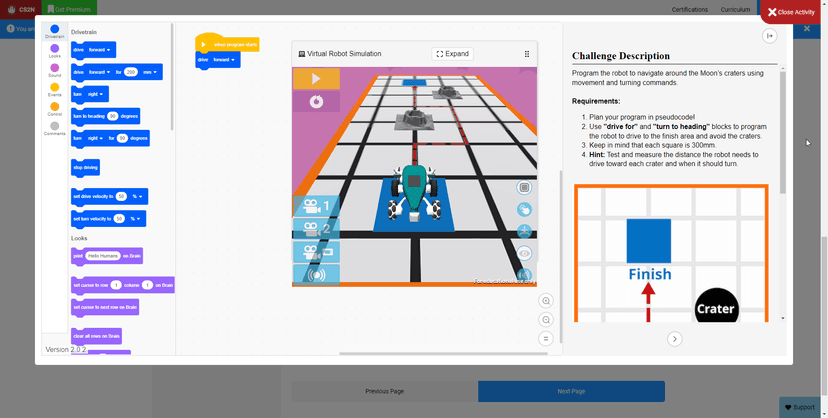
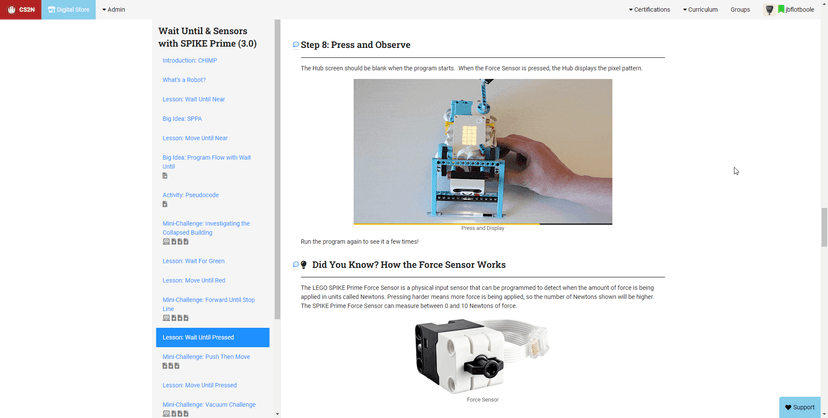
CS-STEM Network uses direct instruction combined with project-based learning to teach robotics and computer science. Educators assign specific modules based on their available hardware, such as LEGO EV3, VEX V5, or virtual environments. Students progress through linear modules that typically begin with a video or text explanation of a concept, followed by a worked example showing the code in action. After reviewing the instruction, students are tasked with replicating the code or modifying it to solve a specific physical or virtual challenge. They write and test their code, observing the robot's behavior to determine success. The platform tracks progress through these modules, allowing teachers to monitor which lessons a student has completed. Quizzes are embedded at the end of modules to check basic comprehension, but the primary assessment mechanism is the successful execution of the required robotic tasks. Educators can then use the system to issue Carnegie Mellon Robotics Academy certifications once students demonstrate mastery of the required competencies.
Strengths and tradeoffs of CS-STEM Network
CS-STEM Network's biggest strength is its rigorous application of worked examples for complex robotics concepts, while its biggest weakness is the lack of adaptive feedback when students make coding errors. The platform effectively reduces cognitive load by presenting students with fully functional code segments before asking them to build their own programs from scratch. This use of worked examples is a proven learning science strategy that helps novices understand underlying structure without becoming overwhelmed by syntax errors. Students can see exactly how a sensor command operates in a virtual or physical environment. Conversely, the platform operates mostly as a static learning management system. It lacks adaptive learning mechanics that adjust to student struggles. If a student fails a comprehension quiz or cannot get their robot to navigate a maze, the system does not dynamically serve remedial content or employ spaced retrieval practice to strengthen weak areas. The burden of identifying learning gaps and providing immediate, corrective feedback falls entirely on the classroom teacher. While the integration of physical and virtual robotics supports excellent project-based learning, the software itself is a delivery vehicle rather than an active, intelligent tutor.
Who Might Benefit From CS-STEM Network?
CS-STEM Network is best for middle and high school educators who need a structured, comprehensive curriculum for their robotics classrooms. The platform provides a highly organized sequence of lessons for specific hardware like LEGO SPIKE Prime and VEX V5, making it an excellent backbone for a semester-long course. It is also suitable for motivated older students participating in competitive robotics who want to earn formal certifications. Because it requires significant self-direction and lacks gamified elements, it is not ideal for young children or casual learners seeking a quick introduction to basic coding concepts.
Data Transparency
Does Not Meet Data Transparency Standard
CS-STEM Network does not meet our data transparency standard. Its privacy policy does not document basic protections, including a commitment against targeted advertising, limits on sharing children's data and contractual limits on service providers.
9 of 35 checks passed
Evaluated September 2026
CS-STEM Network →Level 1 · Basic protections
Does not sell data or target ads at students, limits sharing, and lets parents see and delete their child's data.
Not documented: a commitment against targeted advertising, limits on sharing children's data, contractual limits on service providers, a COPPA or FERPA commitment, parents' right to see their child's data, parents' right to delete their child's data
Level 2 · Parent control (meets the standard)
Families can get their data out, know who processes it, and know how long it is kept.
Not documented: data export, a data retention timeline, self-service deletion
Level 3 · Direct data access
Families or schools can pull their own data through an API, in a stated format.
Not documented: an API for retrieving their own data, a named export format
View all 35 checks
Parent Access3/8
Does the policy mention parents specifically?
“Users under age 13 may only disclose personal information through CS2N with the consent or authorization required by applicable law, including consent obtained by a parent, guardian, school, district, or teacher when permitted by law.”
Can parents view their child's data?
The policy gives no parent-specific right to view a child's data; it only asks people with concerns about a child's information to contact support.
Can parents modify their child's data?
The policy does not give parents a right to modify their child's data.
Can parents delete their child's account?
The policy only says CS2N will remove a child's information provided without required consent, and gives parents no deletion right.
Is there a dedicated Children's Privacy section?
“Children's Personal Information”
Does it reference COPPA compliance?
The policy refers to consent "required by applicable law" but never names COPPA.
Does it reference FERPA compliance?
The policy does not mention FERPA.
Is parental consent required for child accounts?
“Users under age 13 may only disclose personal information through CS2N with the consent or authorization required by applicable law, including consent obtained by a parent, guardian, school, district, or teacher when permitted by law.”
Data Portability1/5
Can users access their personal data?
“You may contact us to ask what information we have about you, request corrections, request deletion where applicable, or express concerns about our use of your information.”
Can users download/export their data?
The policy does not address downloading or exporting data.
Is there a self-service data access tool?
The policy offers data access only by contacting CS2N, not through a self-service tool.
Is a specific data format mentioned for export?
The policy does not mention an export format.
Is there an API for data access?
The policy does not describe an API for data access.
Data Minimization1/6
Is data collection itemized?
“Depending on how you use CS2N, this may include your name, email address, username, account settings, course activity, group membership, and other information needed to provide CS2N features.”
Can the app be used without a real name?
The policy says CS2N collects names, including first and last names from Google or the organization's sign-on.
Can the app be used without an email?
The policy says CS2N collects email addresses, including through Google and organization sign-on.
Does it state collection is limited to what is necessary?
The policy does not state that collection is limited to what is necessary.
Is IP address anonymized or truncated?
The policy does not address anonymizing IP addresses.
Is location tracking explicitly excluded?
The policy does not address location tracking.
Third-Party Protection3/7
Does it explicitly state no selling of data?
“We do not sell or rent your personal information.”
Are third-party providers named?
“With your permission, CS2N also uses Google Analytics through Google Tag Manager to understand how the site is used and to improve CS2N.”
Are providers contractually restricted?
The policy does not describe contractual restrictions on providers.
No-targeted-advertising commitment?
The policy does not address targeted advertising.
Is AI/ML data sharing addressed?
The policy does not address AI or machine learning.
Child-specific sharing restriction?
The policy requires consent before children disclose information but has no child-specific limit on CS2N sharing it.
Cookies/tracking limited or opt-out?
“Analytics is not loaded until you choose to accept analytics. You may decline analytics and continue using CS2N.”
Deletion & Retention1/5
Can users delete their account?
“You may contact us to ask what information we have about you, request corrections, request deletion where applicable, or express concerns about our use of your information.”
Self-service deletion mechanism?
The policy offers deletion only by contacting CS2N, not through a self-service tool.
Specific data retention timeline?
The policy does not give a retention timeline.
Auto-deletion of inactive accounts?
The policy does not address auto-deleting inactive accounts.
Post-deletion handling described?
The policy does not describe what happens to data after deletion.
Advertising0/4
Advertising model explicitly disclosed?
The policy does not address advertising.
Free from third-party advertisements?
The policy does not address third-party advertisements.
Children excluded from ad targeting?
The policy does not address ad targeting of children.
Ad-free option available?
The policy does not address advertising or an ad-free option.
What This Means
The policy review did not meet our data transparency standard. The checks above show the documented findings and unknowns. A missing statement does not establish how the app handles data in practice.
About this evaluation: Based on automated analysis of CS-STEM Network against 35 policy-disclosure questions, including questions adapted from the Common Sense Privacy Program's published evaluation questions. TLS is not affiliated with Common Sense Media, and this is not a Common Sense rating. Quoted text is copied from the policy; unquoted notes are our summary. Results describe what the policy documents, not the company's actual practices. Privacy policies can change: this review reflects the version we analyzed and does not determine legal compliance.
Sources and review method
TLS combines product information and editorial analysis to explain how CS-STEM Network works, its tradeoffs, and the questions to ask before choosing it. Product features, an instructional rationale and evidence of learning outcomes are different kinds of information.
Formal Learning Standard assessment: not yet completed. Data Transparency findings are reported separately and do not establish learning effectiveness. Read our methodology.
Frequently Asked Questions About CS-STEM Network
Is CS-STEM Network free?
Yes, the platform offers a substantial free tier. Educators can use the platform entirely for free for up to three groups of thirty students, which covers the needs of many standard classrooms or robotics clubs. For larger implementations, unlimited groups and students, along with Google Classroom integration, cost $300 annually.
Is CS-STEM Network good for high school students?
Yes, it is highly appropriate for high school students. The platform offers rigorous content covering advanced robotics platforms like VEX V5 and Arduino. It prepares older students for technical careers by offering formal certifications from the Carnegie Mellon Robotics Academy, focusing on real-world programming languages rather than simplified drag-and-drop interfaces.
What does CS-STEM Network teach?
CS-STEM Network teaches computer science, applied science, and robotics programming. The curriculum covers foundational coding logic, sensor integration, autonomous navigation, and mechanical design principles. Courses are highly specific to hardware platforms, teaching students exactly how to program LEGO, VEX, and Arduino microcontrollers to execute complex physical tasks.
How does CS-STEM Network compare to typical coding apps?
CS-STEM Network requires significantly more focus and teacher support than consumer-facing coding apps. While consumer apps rely heavily on gamification and immediate, automated feedback to keep users engaged, this platform acts as a traditional curriculum delivery system. It uses direct instruction and project-based assignments, demanding higher intrinsic motivation from the learner.
Has The Learning Standard evaluated CS-STEM Network?
TLS has not yet completed a Learning Standard evaluation of how well CS-STEM Network teaches. Its privacy policy has been reviewed for Data Transparency and does not yet document the basic protections (Level 1).
Is CS-STEM Network COPPA compliant?
A COPPA reference was not found in the reviewed privacy policy. This does not determine whether the app complies with COPPA. Policy review note: The policy refers to consent "required by applicable law" but never names COPPA.
Is CS-STEM Network FERPA compliant?
A FERPA reference was not found in the reviewed privacy policy. This does not determine whether the app complies with FERPA. Policy review note: The policy does not mention FERPA.
Does CS-STEM Network have a children's privacy policy?
The reviewed policy includes a dedicated children's privacy section. Policy review note: The policy has a dedicated section headed "Children's Personal Information".
Does CS-STEM Network sell student data?
The reviewed policy states that the app does not sell data. This is a policy statement; actual data practices were not verified. Policy review note: The policy explicitly says CS2N does not sell personal information.
Can you delete your data from CS-STEM Network?
The reviewed privacy policy describes account deletion. We have not tested the deletion process. Policy review note: Users can request deletion by contacting CS2N.
Follow TLS Research
Subscribe to future TLS research updates: app reviews, findings, and what the evidence shows.
Screenshots

Take Action
For CS-STEM Network
If you represent Carnegie Mellon Robotics Academy and have a correction or new evidence, send the relevant source so we can review and update this page.
Submit a correctionDetails
- Pricing
- Free for up to 3 Groups of 30 students; $300 Annually for unlimited Groups, unlimited students and Google Classroom Integration
- Platforms
- Web Browser
- Grade Levels
- 3rd Grade, 4th Grade, 5th Grade, 6th Grade, 7th Grade, 8th Grade, 9th Grade, 10th Grade, 11th Grade, 12th Grade, Associate's degree, Adult Education, Professional or Technical Credential
- Website
- Visit site