Classtime
Product by Classtime
Facts checked: Not yet checked
Our take (not a Learning Standard rating). This label applies to learning-science judgments throughout this overview.
Our take (not a Learning Standard rating)
Classtime is a highly effective assessment tool that uses retrieval practice to consolidate memory, but it does not teach new concepts independently. It provides educators with immediate data on your child's understanding, allowing teachers to adjust instruction. However, learning outcomes depend entirely on the quality of teacher-created questions.
Pros
- Utilizes retrieval practice to strengthen memory recall and long-term retention of classroom material.
- Provides immediate feedback on student answers to correct misconceptions quickly before they set in.
- Offers teachers real-time analytical data to identify knowledge gaps and adapt instruction instantly.
- Supports cooperative learning through team-based puzzle mechanics rather than high-stress leaderboards.
Cons
- Functions strictly as an assessment tool and cannot teach new concepts independently.
- Relies entirely on the pedagogical skill of the classroom teacher to create high-quality questions.
- Does not provide automated worked examples or instructional scaffolding for incorrect answers.
- Lacks adaptive difficulty, meaning students cannot automatically progress to harder material based on performance.
What Do We Know About Classtime?
Classtime is an effective tool for checking your child's understanding, but it does not teach new material on its own. It functions as a formative and summative assessment platform designed specifically for classroom environments. Teachers use it to build quizzes, assignments, and interactive challenges that test what your child has already learned. The platform leverages retrieval practice, a heavily researched learning science principle demonstrating that actively recalling information strengthens memory more than simply restudying it. When your child answers questions on Classtime, they receive immediate feedback. This instant correction prevents them from cementing incorrect knowledge. Because Classtime requires a teacher to drive the experience, your child will not use this app independently for self-study. Its effectiveness relies entirely on the quality of the questions the teacher inputs into the system. If a teacher uses well-designed, challenging questions, Classtime serves as a powerful review tool. If the questions rely strictly on low-level rote memorization, the learning benefits diminish. The Learning Standard has not yet formally evaluated Classtime's classroom impact, but its core mechanics align with established formative assessment practices.
How Does Classtime Work?
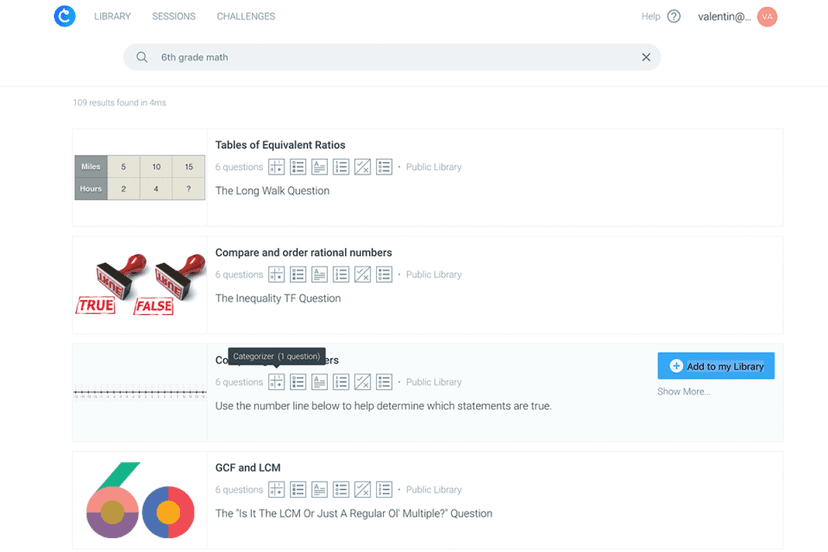
Classtime utilizes a formative assessment approach, relying on low-stakes retrieval practice to test student knowledge and guide teacher instruction. Teachers create question sets or select pre-made questions covering various subjects. They then launch a session, providing your child with a unique code to access the assessment on their school device. As your child answers questions, the platform grades responses instantly. Teachers view a real-time dashboard displaying individual and class-wide performance. This data allows educators to identify widespread misconceptions and pause the lesson to re-teach specific concepts immediately. Classtime also features Collaborative Challenges. Instead of competing against one another, students answer questions to collectively build a digital narrative or solve a puzzle. This cooperative learning mechanic reduces the anxiety often associated with timed, competitive quiz platforms while maintaining the cognitive benefits of active recall.
Strengths and tradeoffs of Classtime
Classtime's biggest strength is its use of real-time data to drive immediate feedback, while its biggest weakness is its complete reliance on teacher-generated content to provide pedagogical value. Strengths in Learning Science Classtime excels at facilitating retrieval practice. By forcing students to pull information from memory, the platform helps consolidate knowledge into long-term memory. The platform also provides immediate feedback, which learning science identifies as critical for correcting misconceptions before they become ingrained. Its collaborative modes foster cooperative learning, motivating students to participate without the high-stress, winner-take-all mechanics found in similar quiz apps. Weaknesses in Instructional Design Because Classtime is an empty vessel for assessment, it lacks built-in instructional scaffolding. It does not generate worked examples when a student struggles, nor does it automatically adjust difficulty based on performance. The platform tells your child exactly what they got wrong, but explaining why requires teacher intervention. If an educator writes poor multiple-choice questions with obvious distractors, the platform cannot elevate the rigor of the assessment.
Who Might Benefit From Classtime?
Best for classroom teachers who need a reliable formative assessment tool to gauge student understanding in real time. Classtime serves students from elementary school through higher education, adapting seamlessly across subjects like math, science, and the humanities. It is ideal for blended learning environments where educators want to quickly identify knowledge gaps and adjust their daily instruction. Parents should note this is not a supplementary tutoring app for home use; it is strictly a classroom utility designed to support teacher-led instruction.
Data Transparency
Does Not Meet Data Transparency Standard
Classtime does not meet our data transparency standard. Its privacy policy does not document basic protections, including a commitment against targeted advertising and contractual limits on service providers.
17 of 35 checks passed
Level 1 · Basic protections
Does not sell data or target ads at students, limits sharing, and lets parents see and delete their child's data.
Not documented: a commitment against targeted advertising, contractual limits on service providers
Level 2 · Parent control (meets the standard)
Families can get their data out, know who processes it, and know how long it is kept.
Not documented: named service providers, self-service deletion
Level 3 · Direct data access
Families or schools can pull their own data through an API, in a stated format.
Not documented: an API for retrieving their own data, a named export format
View all 35 checks
Parent Access6/8
Does the policy mention parents specifically?
“If you are a parent of a student who is using the Software and is less than 13 years of age, you have the right under COPPA to review or have deleted your child‘s personal data and to refuse the further collection or use of your child‘s personal data.”
Can parents view their child's data?
“If you are a parent of a student who is using the Software and is less than 13 years of age, you have the right under COPPA to review or have deleted your child‘s personal data and to refuse the further collection or use of your child‘s personal data.”
Can parents modify their child's data?
The policy gives parents the right to review, delete or refuse collection of their child's data, but does not give them a right to correct it.
Can parents delete their child's account?
“If you are a parent of a student who is using the Software and is less than 13 years of age, you have the right under COPPA to review or have deleted your child‘s personal data and to refuse the further collection or use of your child‘s personal data.”
Is there a dedicated Children's Privacy section?
“## Children’s Personal Information & COPPA”
Does it reference COPPA compliance?
“Under the United States’ Children’s Online Privacy Protection Act (“ **COPPA**”), online service providers such as Classtime Inc. (“ **Classtime**”) must obtain verifiable parental consent before collecting, using, or disclosing personal information from children under the age of 13, except in limited situations.”
Does it reference FERPA compliance?
The policy does not mention FERPA.
Is parental consent required for child accounts?
“Classtime will not collect, use, or disclose personal information from a child under the age of 13 unless that child's Local Education Provider, acting as the parent’s agent, has agreed to Classtime’s collection of personal information from that child.”
Data Portability2/5
Can users access their personal data?
“Right to Know: The right to request that we disclose to you the personal data we collect, use, disclose, and information about our data practices.”
Can users download/export their data?
“Right to Portability: The right to request that we provide you with your personal information in a common file format.”
Is there a self-service data access tool?
The policy says rights are exercised by emailing support and describes no self-service access tool.
Is a specific data format mentioned for export?
The policy mentions only a "common file format" and names no specific format.
Is there an API for data access?
The policy does not describe an API for users or schools to retrieve their data.
Data Minimization2/6
Is data collection itemized?
“Profile information, either provided directly by the student or imported from third-party services that the student’s teacher chooses to integrate into the Classtime platform (like Google Classroom, Clever, or Microsoft Teams): username (which may be a pseudonym), and, if applicable, name, email, student picture, preferred language”
Can the app be used without a real name?
The policy allows logging in with only a pseudonym, but says students' names may be collected from them or supplied by teachers.
Can the app be used without an email?
The policy says student email addresses may be collected from students or supplied by teachers.
Does it state collection is limited to what is necessary?
“We will not require your child to disclose more information than is reasonably necessary to use our Services.”
Is IP address anonymized or truncated?
The policy says IP addresses are collected and does not say they are anonymized or truncated.
Is location tracking explicitly excluded?
The policy does not explicitly rule out location tracking.
Third-Party Protection3/7
Does it explicitly state no selling of data?
“We do not rent or sell your personal information to third parties.”
Are third-party providers named?
The policy names its affiliate and integrated services, but links to a separate list of vendors instead of naming them.
Are providers contractually restricted?
The policy says vendors receive only the information needed for their function and mentions standard contractual clauses only for certain international transfers, but does not state that providers in general are contractually restricted.
No-targeted-advertising commitment?
The policy says it uses no marketing cookies, but makes no explicit promise against targeted advertising.
Is AI/ML data sharing addressed?
The policy mentions opting out of automated decision-making, but does not address sharing data for AI/ML.
Child-specific sharing restriction?
“In addition, you can refuse our disclosure of your child’s personal data to third parties in situations where the disclosure is not an inherent part of our Services.”
Cookies/tracking limited or opt-out?
“We use essential cookies to ensure that our Website and Services function properly (for example, cookies to remember your language preferences and for user authentication when logging in). We do not use any non-essential cookies (e.g. for marketing purposes).”
Deletion & Retention4/5
Can users delete their account?
“Right to Request Deletion: The right to request that we delete your personal data that we have collected from or about you.”
Self-service deletion mechanism?
The policy says deletion is requested by email and describes no self-service deletion tool.
Specific data retention timeline?
“These backups may retain data for up to 9 months before it is permanently deleted. Free user accounts are deleted if they have not been used for 3 years.”
Auto-deletion of inactive accounts?
“Free user accounts are deleted if they have not been used for 3 years.”
Post-deletion handling described?
“Personal data stored in user accounts in the Software can be restored up to 30 days (or as otherwise agreed) after deletion or after the corresponding account has been deleted. After this period, it is automatically removed from active systems.”
Advertising0/4
Advertising model explicitly disclosed?
The policy does not describe any advertising model or say the product has no ads.
Free from third-party advertisements?
The policy does not say whether the product shows third-party ads.
Children excluded from ad targeting?
The policy does not address ad targeting of children.
Ad-free option available?
The policy does not mention advertising or an ad-free option.
What This Means
The policy review did not meet our data transparency standard. The checks above show the documented findings and unknowns. A missing statement does not establish how the app handles data in practice.
About this evaluation: Based on automated analysis of Privacy Policy, COPPA Direct Notice and Privacy Policy against 35 policy-disclosure questions, including questions adapted from the Common Sense Privacy Program's published evaluation questions. TLS is not affiliated with Common Sense Media, and this is not a Common Sense rating. Quoted text is copied from the policy; unquoted notes are our summary. Results describe what the policy documents, not the company's actual practices. Privacy policies can change: this review reflects the version we analyzed and does not determine legal compliance.
Sources and review method
TLS combines product information and editorial analysis to explain how Classtime works, its tradeoffs, and the questions to ask before choosing it. Product features, an instructional rationale and evidence of learning outcomes are different kinds of information.
Formal Learning Standard assessment: not yet completed. Data Transparency findings are reported separately and do not establish learning effectiveness. Read our methodology.
Frequently Asked Questions About Classtime
Is Classtime free?
Classtime offers a Basic plan that is completely free for teachers to use in their classrooms. This entry-level tier includes standard question types and limited features. However, advanced functionalities, unlimited session data, and access to premium question libraries require a paid Premium or School license. Because this is a classroom tool, parents will never be asked to pay for Classtime; any associated costs are handled directly by your child's school district or teacher.
Is Classtime good for elementary students?
Yes, Classtime is an excellent tool for elementary students when guided by a teacher. The interface is clean, distraction-free, and easy for young learners to navigate on a tablet or Chromebook. The platform's Collaborative Challenges are particularly engaging for this age group, as students work together to solve a visual puzzle rather than competing on a stressful leaderboard. However, the reading level and difficulty of the assessments depend entirely on the teacher creating the content.
What does Classtime teach?
Classtime does not teach specific subjects independently. Instead, it operates as a flexible assessment platform that allows educators to build quizzes and formative checks for any academic subject. Teachers use it for everything from kindergarten phonics to high school calculus and postgraduate sciences. Because it is a blank slate, the actual content your child interacts with is written or selected entirely by their teacher to match their current classroom curriculum.
Classtime vs Kahoot: Which is better?
Classtime focuses on rigorous formative assessment and cooperative learning, making it superior for serious academic review. Kahoot, conversely, emphasizes gamified, fast-paced competition. Classtime provides deeper analytical data for teachers to identify specific learning gaps, while Kahoot is generally used as a high-energy classroom reward or engagement tool. If a teacher wants to measure actual student understanding without the anxiety of a ticking clock, Classtime is the more effective choice.
Has The Learning Standard evaluated Classtime?
TLS has not yet completed a Learning Standard evaluation of how well Classtime teaches. Its privacy policy has been reviewed for Data Transparency and does not yet document the basic protections (Level 1).
Is Classtime COPPA compliant?
The reviewed privacy policy references COPPA. A policy reference alone does not establish COPPA compliance. Policy review note: The policy refers to COPPA and how Classtime complies with it.
Is Classtime FERPA compliant?
A FERPA reference was not found in the reviewed privacy policy. This does not determine whether the app complies with FERPA. Policy review note: The policy does not mention FERPA.
Does Classtime have a children's privacy policy?
The reviewed policy includes a dedicated children's privacy section. Policy review note: The policy has a section with its own heading on children's data and COPPA.
Does Classtime sell student data?
The reviewed policy states that the app does not sell data. This is a policy statement; actual data practices were not verified. Policy review note: The policy says Classtime does not sell personal information.
Can you delete your data from Classtime?
The reviewed privacy policy describes account deletion. We have not tested the deletion process. Policy review note: Users can request deletion of their personal data.
Follow TLS Research
Subscribe to future TLS research updates: app reviews, findings, and what the evidence shows.
Screenshots


Take Action
For Classtime
If you represent Classtime and have a correction or new evidence, send the relevant source so we can review and update this page.
Submit a correctionDetails
- Pricing
- Basic plan (free), Premium, and School licenses.
- Platforms
- Web Browser
- Grade Levels
- Transitional Kindergarten, Kindergarten, 1st Grade, 2nd Grade, 3rd Grade, 4th Grade, 5th Grade, 6th Grade, 7th Grade, 8th Grade, 9th Grade, 10th Grade, 11th Grade, 12th Grade, Associate's degree, Bachelor's degree, Post-baccalaureate certificate, Master's Degree, Post-master's certificate, Doctoral Degree, Post-doctoral certificate, Adult Education, Professional or Technical Credential
- Website
- Visit site