Adventure 2 Learning
Product by Sunburst Digital
Facts checked: Not yet checked
Our take (not a Learning Standard rating). This label applies to learning-science judgments throughout this overview.
Our take (not a Learning Standard rating)
While The Learning Standard has not yet evaluated Adventure 2 Learning, its core design leverages embodied cognition by pairing physical movement with direct instruction. Integrating kinesthetic activity with math and literacy practice theoretically boosts focus and memory, but effectiveness depends entirely on how actively your child participates in the video prompts.
Pros
- Uses embodied cognition to link physical movements with specific math and literacy concepts.
- Provides cross-curricular instruction that prevents sedentary screen time during academic practice.
- Curates content into specific targeted series to align physical education with core classroom curriculum.
Cons
- Relies entirely on one-way video instruction without adaptive feedback for incorrect academic answers.
- Lacks mechanisms to verify if a student is actually performing the physical movements or answering questions correctly.
- Requires a paid subscription through school purchasing channels rather than offering straightforward parent subscriptions.
What Do We Know About Adventure 2 Learning?
Adventure 2 Learning is theoretically effective for younger students because it utilizes embodied learning to link physical movement with academic repetition, though The Learning Standard has not yet formally evaluated its outcomes. By requiring your child to perform specific physical actions while answering math or literacy questions, the platform taps into kinesthetic memory pathways. Learning science shows that moderate physical activity can increase blood flow to the brain, improving executive function and attention during academic tasks. However, parents must understand that this is primarily a video broadcasting platform rather than an adaptive learning software. There is no spaced repetition algorithm or diagnostic assessment to track your child's mastery of specific skills. Instead, it relies on direct instruction where the presenter models a concept and asks the viewer to physically act out the answer. Because the platform cannot observe the user, there is no corrective feedback if your child performs the wrong movement or calls out the wrong answer. This makes it an excellent supplement for getting kids moving during screen time, but it should not replace core academic instruction or interactive practice where errors are explicitly corrected.
How Does Adventure 2 Learning Work?
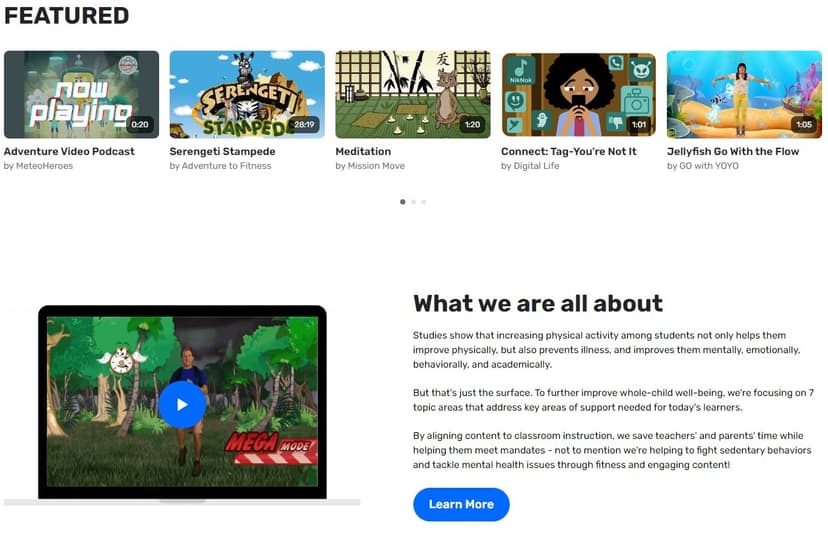
Adventure 2 Learning utilizes an embodied cognition and direct instruction approach, delivering K-5 cross-curricular content through structured video modules. The platform functions as a curated streaming service where educators and parents select videos from specific series like Active Math, Active Literacy, or purely physical programs like Mission Move. During a typical session, your child watches a presenter explain an academic concept, such as skip counting or phonics, and is then prompted to perform a specific physical exercise, like jumping jacks or squats, that corresponds to the correct answer. This mechanism physically engages the student while drilling rote knowledge. Because it relies on video delivery, the pacing is predetermined by the media rather than adapting to the learner's individual speed. The instructional design leans heavily on observational learning and physical mimicry, requiring students to mirror the actions and repeat the verbal answers modeled on screen to gain any academic benefit.
Strengths and tradeoffs of Adventure 2 Learning
Adventure 2 Learning's biggest strength is its application of embodied learning to reduce sedentary screen time, while its biggest weakness is the complete lack of adaptive feedback or performance tracking. Embodied Cognition is the platform's primary pedagogical lever. By associating physical gestures with vocabulary words or math facts, the app attempts to encode knowledge through multiple sensory pathways, which cognitive science suggests can improve short-term retrieval. Cross-Curricular Integration ensures that time spent on physical education also reinforces core academic standards in literacy and math. However, the platform struggles with Corrective Feedback. Because it delivers content via pre-recorded video, it cannot detect if your child misinterprets a concept or performs an exercise incorrectly. Without this feedback loop, students risk practicing and internalizing errors. Furthermore, the app lacks Spaced Repetition or mastery-based progression. Videos play from start to finish regardless of whether the student understands the material, meaning parents and teachers must manually determine when a child needs to rewatch a lesson or move on to more advanced content.
Who Might Benefit From Adventure 2 Learning?
Adventure 2 Learning is best for early elementary students who struggle to sit still during traditional instruction and benefit from kinesthetic learning. The platform targets children from prekindergarten through fifth grade, making it ideal for educators or parents looking to inject brain breaks into the day without sacrificing academic time. It serves as an excellent supplementary tool for reviewing foundational math and literacy facts through physical repetition. However, because it lacks adaptive difficulty, it is best utilized by adults who can actively supervise the child, ensure they are participating in the physical prompts, and provide manual correction if the child misunderstands the academic content being presented.
Data Transparency
Does Not Meet Data Transparency Standard
Adventure 2 Learning does not meet our data transparency standard. Its privacy policy does not document basic protections, including a commitment against targeted advertising, limits on sharing children's data and parents' right to see their child's data.
10 of 35 checks passed
Evaluated September 2026
Sunburst Digital's Privacy Policy →Level 1 · Basic protections
Does not sell data or target ads at students, limits sharing, and lets parents see and delete their child's data.
Not documented: a commitment against targeted advertising, limits on sharing children's data, parents' right to see their child's data, parents' right to delete their child's data, account deletion
Level 2 · Parent control (meets the standard)
Families can get their data out, know who processes it, and know how long it is kept.
Not documented: users' right to access their data, data export, a data retention timeline, named service providers, self-service deletion
Level 3 · Direct data access
Families or schools can pull their own data through an API, in a stated format.
Not documented: an API for retrieving their own data, a named export format
View all 35 checks
Parent Access5/8
Does the policy mention parents specifically?
“We do not collect personally identifiable information from teachers, administrators, parents or other adults who may use this site, unless they voluntarily provide such information to us.”
Can parents view their child's data?
The policy does not give parents a right to view their child's data.
Can parents modify their child's data?
The policy does not give parents a right to modify their child's data.
Can parents delete their child's account?
The policy does not give parents a right to delete their child's data or account; it only says data collected without consent will be deleted.
Is there a dedicated Children's Privacy section?
“COPPA Sunburst Digital adheres to the Children’s Online Privacy Protection Act (COPPA).”
Does it reference COPPA compliance?
“Sunburst Digital adheres to the Children’s Online Privacy Protection Act (COPPA).”
Does it reference FERPA compliance?
“Sunburst Digital operates in compliance with FERPA and takes every measure to ensure the confidentiality of students attending our subscribing schools.”
Is parental consent required for child accounts?
“If the Site staff becomes aware that personal information has been collected from a child under 13 without such child’s parent or guardian’s consent, we will use reasonable efforts to delete such information from our database.”
Data Portability0/5
Can users access their personal data?
The policy does not give users a right to access their personal data.
Can users download/export their data?
The policy does not address data download or export.
Is there a self-service data access tool?
The policy does not describe a self-service data access tool.
Is a specific data format mentioned for export?
The policy does not mention an export format.
Is there an API for data access?
The policy does not mention an API for data access.
Data Minimization2/6
Is data collection itemized?
“Rather, the subscribing school may need to provide Sunburst Digital with a student’s full name, grade, and the address and telephone number of the school in which the student is enrolled for proper functionality or our solutions.”
Can the app be used without a real name?
The policy says the school may provide the student's full name; a fictitious name is optional, so a name is still collected.
Can the app be used without an email?
The policy does not explicitly state that student email addresses are never collected.
Does it state collection is limited to what is necessary?
“We collect and use only as much personal information as necessary for the solution being used, and do not condition participation in any on-line activity on the disclosure of more personal information than is reasonable necessary.”
Is IP address anonymized or truncated?
The policy says it may collect IP addresses but does not say they are anonymized or truncated.
Is location tracking explicitly excluded?
The policy does not address location tracking.
Third-Party Protection3/7
Does it explicitly state no selling of data?
“We do not sell any personally identifying information collected on the Site or through the Program to third parties or mass marketers.”
Are third-party providers named?
The policy refers to third parties only by type (consultants, auditors) and does not name any providers.
Are providers contractually restricted?
“only we and our affiliates, our technical consultants, third party auditors and other third parties who make our Site available, or enhance its functionality, have access to this information, and we require them to agree that they are covered by this policy.”
No-targeted-advertising commitment?
The policy does not address targeted advertising.
Is AI/ML data sharing addressed?
The policy does not address AI or machine learning.
Child-specific sharing restriction?
The policy does not include a sharing restriction specific to children.
Cookies/tracking limited or opt-out?
“Sunburst Digital uses cookies solely for the purpose of holding information during on-line sessions (for example, to hold answers to on-line quizzes for short-term storage, or to create an ID for use in a multiple-session assessment).”
Deletion & Retention0/5
Can users delete their account?
The policy does not give users a right to request account or data deletion.
Self-service deletion mechanism?
The policy does not describe a self-service deletion mechanism.
Specific data retention timeline?
The policy does not give a specific retention timeline.
Auto-deletion of inactive accounts?
The policy does not address automatic deletion of inactive accounts.
Post-deletion handling described?
The policy does not describe how data is handled after deletion.
Advertising0/4
Advertising model explicitly disclosed?
The policy does not address advertising.
Free from third-party advertisements?
The policy does not address third-party advertisements.
Children excluded from ad targeting?
The policy does not address ad targeting of children.
Ad-free option available?
The policy does not address advertising or an ad-free option.
What This Means
The policy review did not meet our data transparency standard. The checks above show the documented findings and unknowns. A missing statement does not establish how the app handles data in practice.
About this evaluation: Based on automated analysis of Sunburst Digital's Privacy Policy against 35 policy-disclosure questions, including questions adapted from the Common Sense Privacy Program's published evaluation questions. TLS is not affiliated with Common Sense Media, and this is not a Common Sense rating. Quoted text is copied from the policy; unquoted notes are our summary. Results describe what the policy documents, not the company's actual practices. Privacy policies can change: this review reflects the version we analyzed and does not determine legal compliance.
Sources and review method
TLS combines product information and editorial analysis to explain how Adventure 2 Learning works, its tradeoffs, and the questions to ask before choosing it. Product features, an instructional rationale and evidence of learning outcomes are different kinds of information.
Formal Learning Standard assessment: not yet completed. Data Transparency findings are reported separately and do not establish learning effectiveness. Read our methodology.
Frequently Asked Questions About Adventure 2 Learning
Is Adventure 2 Learning free?
No, Adventure 2 Learning is not free. The platform operates on a paid subscription model aimed primarily at schools and districts, with pricing starting at $1 per student. Purchasing requires contacting Sunburst Digital directly for a custom quote.
Is Adventure 2 Learning good for kindergarteners?
Yes, Adventure 2 Learning is highly appropriate for kindergarteners. The direct instruction paired with physical movement aligns well with early childhood development, as younger students naturally benefit from kinesthetic learning and require frequent physical activity to maintain focus on academic tasks.
What does Adventure 2 Learning teach?
Adventure 2 Learning teaches physical fitness alongside core elementary subjects like math and literacy. Specific video series focus on integrating physical exercises with academic drills, such as counting, phonics, and basic problem-solving, to create a cross-curricular learning experience.
How does Adventure 2 Learning compare to GoNoodle?
Both platforms provide active screen time, but Adventure 2 Learning places a heavier emphasis on integrating direct academic instruction into the exercises. While GoNoodle focuses heavily on mindfulness and general brain breaks, Adventure 2 Learning explicitly targets math and literacy standards during movement.
Has The Learning Standard evaluated Adventure 2 Learning?
TLS has not yet completed a Learning Standard evaluation of how well Adventure 2 Learning teaches. Its privacy policy has been reviewed for Data Transparency and does not yet document the basic protections (Level 1).
Is Adventure 2 Learning COPPA compliant?
The reviewed privacy policy references COPPA. A policy reference alone does not establish COPPA compliance. Policy review note: The policy states it adheres to COPPA.
Is Adventure 2 Learning FERPA compliant?
The reviewed privacy policy references FERPA. A policy reference alone does not establish FERPA compliance. Policy review note: The policy states it complies with FERPA.
Does Adventure 2 Learning have a children's privacy policy?
The reviewed policy includes a dedicated children's privacy section. Policy review note: The policy has a section with its own COPPA heading.
Does Adventure 2 Learning sell student data?
The reviewed policy states that the app does not sell data. This is a policy statement; actual data practices were not verified. Policy review note: The policy states the company does not sell personal information.
Can you delete your data from Adventure 2 Learning?
Account deletion was not documented in the reviewed privacy policy. This does not establish whether deletion is available. Policy review note: The policy does not give users a right to request account or data deletion.
Follow TLS Research
Subscribe to future TLS research updates: app reviews, findings, and what the evidence shows.
Screenshots


Take Action
For Adventure 2 Learning
If you represent Sunburst Digital and have a correction or new evidence, send the relevant source so we can review and update this page.
Submit a correctionDetails
- Pricing
- Pricing as low as $1 per student. Request a quote: Sales@sunburst.com (800) 321-7511
- Platforms
- Web Browser, Windows (Microsoft), macOS (Apple), Chrome OS (Google), Other
- Grade Levels
- Infant/Toddler, Preschool, Prekindergarten, Transitional Kindergarten, Kindergarten, 1st Grade, 2nd Grade, 3rd Grade, 4th Grade, 5th Grade
- Website
- Visit site