
Wayground (formerly Quizizz)
Product by Quizizz
Facts checked: Not yet checked
Our take (not a Learning Standard rating). This label applies to learning-science judgments throughout this overview.
Our take (not a Learning Standard rating)
Wayground facilitates retrieval practice through gamified quizzes, which helps students recall previously learned facts. However, it functions primarily as an assessment and review tool rather than a primary instructional platform. Its effectiveness relies entirely on the quality of the teacher-created content rather than built-in pedagogical sequences.
Pros
- Utilizes frequent low-stakes testing to leverage the testing effect for better long-term retention.
- Allows customization of pacing so students can answer questions at their own speed rather than racing a universal countdown timer.
- Provides teachers with real-time performance dashboards to identify class-wide knowledge gaps and adjust instruction immediately.
Cons
- Relies heavily on multiple-choice formats, which primarily test recognition rather than deeper conceptual recall.
- Lacks built-in instructional scaffolding, meaning students cannot learn new concepts if they do not already possess foundational knowledge.
- Provides no elaborative feedback or worked examples for incorrect answers beyond displaying the correct choice.
What Do We Know About Wayground (formerly Quizizz)?
Wayground is effective for helping your child review material they have already learned, but it will not teach them new concepts from scratch. The platform uses a gamified quiz format to test knowledge across various subjects. Because the content is primarily generated by teachers and other users, the quality of the questions your child encounters depends heavily on who created the assignment. When your child uses Wayground, they are engaging in retrieval practice: a proven learning science strategy where pulling information from memory strengthens future recall. The app makes this process engaging through points, leaderboards, and interactive power-ups. However, if your child gets a question wrong, the app typically only shows the correct answer without explaining why it is correct. This lack of worked examples means your child may struggle to correct fundamental misunderstandings without a teacher or parent stepping in to explain the underlying concept. Parents should view this as a digital flashcard and assessment tool rather than an independent tutor. It is excellent for cementing vocabulary, math facts, or historical dates before a test. Yet, because the gamification elements are so prominent, you should monitor whether your child is rushing through questions just to earn points or genuinely processing the material.
How Does Wayground (formerly Quizizz) Work?
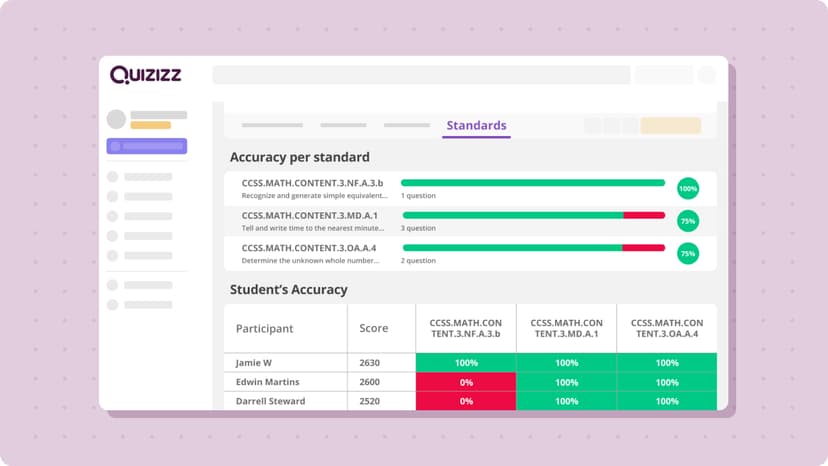
Wayground relies on gamified retrieval practice and competency-based assessments to reinforce prior instruction. Teachers create or select digital quizzes from a massive user-generated library and assign them to students either live in the classroom or asynchronously for homework. Students progress through multiple-choice, fill-in-the-blank, or open-ended questions on their own devices. Unlike traditional whole-class trivia games, Wayground allows for self-paced progression. This means students are not penalized by a universal timer and can process questions at a speed that suits their cognitive load. As students answer correctly, they earn points, unlock temporary power-ups, and view humorous memes between questions. On the back end, the platform aggregates student performance data. This provides educators with an immediate, macro-level view of which specific standards or concepts require reteaching. Premium versions include adaptive learning paths that adjust question difficulty based on student responses, further personalizing the review experience.
Strengths and tradeoffs of Wayground (formerly Quizizz)
Wayground's biggest strength is its ability to turn routine retrieval practice into a highly engaging activity, while its biggest weakness is the frequent lack of explanatory feedback when a student makes an error. Gamified Retrieval Practice: By framing assessments as a game, Wayground successfully lowers the affective filter: the emotional anxiety often associated with testing. Students frequently engage in low-stakes testing, which learning science demonstrates is one of the most effective methods for transferring knowledge into long-term memory. Self-Paced Mechanics: Unlike some competitors, Wayground allows students to answer questions at their own speed. This reduces cognitive overload and impulsive guessing, allowing learners to actually read and process the prompts. Variable Content Quality: Because the platform relies heavily on crowdsourced, teacher-created quizzes, the pedagogical rigor is inconsistent. Quizzes often lean heavily on recognition tasks (like multiple-choice) rather than demanding deep conceptual understanding. Lack of Elaborative Feedback: When a student answers incorrectly, the app generally displays a red X and highlights the correct choice. It rarely provides worked examples or step-by-step explanations, making it difficult for a student to course-correct without external intervention.
Who Might Benefit From Wayground (formerly Quizizz)?
Wayground is best for K-12 students who need an engaging way to drill foundational facts and review for upcoming assessments. It is particularly effective for middle and high school classrooms where teachers want to conduct quick, formative assessments to gauge student understanding before moving on to new material. Because it relies on prior instruction, it is best utilized by learners who already have baseline knowledge of a topic and simply need to strengthen their recall speed and accuracy. It is not an independent learning tool, so it serves best as a classroom supplement or structured homework assignment rather than a standalone homeschooling curriculum.
Data Transparency
Meets Data Transparency Standard
Wayground (formerly Quizizz) meets our data transparency standard at Level 2 of 3 (Parent control). Level 3 needs the policy to document an API for retrieving their own data and a named export format.
29 of 35 checks passed
Evaluated October 2026
Privacy Policy →Level 1 · Basic protections
Does not sell data or target ads at students, limits sharing, and lets parents see and delete their child's data.
Level 2 · Parent control (meets the standard)
Families can get their data out, know who processes it, and know how long it is kept.
Level 3 · Direct data access
Families or schools can pull their own data through an API, in a stated format.
Not documented: an API for retrieving their own data, a named export format
View all 35 checks
Parent Access8/8
Does the policy mention parents specifically?
“Wayground empowers parents and legal guardians of children younger than the age of consent (in the U.S., this means under 13), who have registered accounts, to exercise their legal rights pursuant to legislation, such as US federal statute COPPA.”
Can parents view their child's data?
“Parents/guardians may delete, modify, and review PI their children shared with Wayground by accessing their child's account.”
Can parents modify their child's data?
“Parents/guardians may delete, modify, and review PI their children shared with Wayground by accessing their child's account.”
Can parents delete their child's account?
“Parents may remove, delete or update an account or any information concerning their child that is posted on Wayground by visiting their child’s settings page, working with their child’s teacher, or by contacting us at support@quizizz.com.”
Is there a dedicated Children's Privacy section?
“Wayground empowers parents and legal guardians of children younger than the age of consent (in the U.S., this means under 13), who have registered accounts, to exercise their legal rights pursuant to legislation, such as US federal statute COPPA.”
Does it reference COPPA compliance?
“In the U.S, the Children’s Online Privacy Protection Act (“COPPA”), the general consumer data privacy and student advertising limitation laws of US states”
Does it reference FERPA compliance?
“This includes but is not limited to the Children’s Online Privacy Protection Act (COPPA), the Family Educational Rights and Privacy Act (FERPA),”
Is parental consent required for child accounts?
“As necessary, Wayground ensures that there is verifiable parental consent for children younger than the age of consent in any jurisdiction.”
Data Portability3/5
Can users access their personal data?
“You have the right to delete, access, update, correct errors in, and export for transfer any of your personal information.”
Can users download/export their data?
“You have the right to delete, access, update, correct errors in, and export for transfer any of your personal information.”
Is there a self-service data access tool?
“If your personally identifiable information changes, or if you no longer want to use Wayground, you may review, edit, or delete it by visiting Wayground's Settings page, found at https://www.wayground.com/settings.”
Is a specific data format mentioned for export?
The policy mentions only a "digital format of current use and automatic reading" and names no specific format.
Is there an API for data access?
The policy mentions APIs only for Google, YouTube and AI integrations, not for users to retrieve their own data.
Data Minimization3/6
Is data collection itemized?
“If you create an account, Wayground saves the account information you provide. This information may include: an email address, a parent or guardian email address, first name, last name, profile photo, or organization name.”
Can the app be used without a real name?
The policy says account information may include first and last name, and that names may be received through Google Classroom.
Can the app be used without an email?
The policy says account information may include an email address, and that emails may come from Google or from teachers.
Does it state collection is limited to what is necessary?
“Wayground collects only the personal information required to operate its classroom web apps, software and services.”
Is IP address anonymized or truncated?
The policy says it collects IP addresses and uses them to approximate location, with no mention of anonymizing or truncating them.
Is location tracking explicitly excluded?
“Wayground does not collect fine location data such as GPS or bluetooth beacons.”
Third-Party Protection7/7
Does it explicitly state no selling of data?
“Wayground does not rent, sell or exchange any data, including but not limited to, personally identifying information or potentially personally identifying information to any third party.”
Are third-party providers named?
“Our main cloud provider, Amazon Web Services (AWS), is the largest data hosting company and has leading practices in security standards and personnel in place to constantly monitor this area.”
Are providers contractually restricted?
“Third-party services are contractually prohibited from using your information except to provide the service.”
No-targeted-advertising commitment?
“Wayground does not allow or run personalized ads in its platform, make use of any third party trackers, or otherwise attempt to collect personal information from minors or on content sets as made for children.”
Is AI/ML data sharing addressed?
“With all of our AI providers, we have disabled their use of any Wayground user data for training their own large language models (LLMs), and our AI providers do not use our data to train their LLMs.”
Child-specific sharing restriction?
“Parents/guardians can consent to collection and use of a child's personally identifiable information (“PII”) by Wayground without consenting to the disclosure of that information to third parties.”
Cookies/tracking limited or opt-out?
“You can opt out of Google Analytics at any time and continue to use Wayground.”
Deletion & Retention4/5
Can users delete their account?
“You may delete your account or update your information at any time by visiting www.wayground.com/settings”
Self-service deletion mechanism?
“You may delete your account or update your information at any time by visiting www.wayground.com/settings”
Specific data retention timeline?
The policy keeps data while the account is active or as needed and says inactive accounts are normally kept at least one year, but gives no fixed retention period.
Auto-deletion of inactive accounts?
“We conduct periodic reviews of accounts and may delete accounts that have been inactive for extended periods of time, normally not sooner than one year.”
Post-deletion handling described?
“If you wish to prevent Wayground from using your information in any way whatsoever, you always retain your right to delete your account at any time. With the exceptions explained below for information you shared with other Wayground users, this allows you to eliminate any subsequent use and disclosure of your personal information.”
Advertising4/4
Advertising model explicitly disclosed?
“Wayground does not allow or display any third party advertising or marketing on its website or within our services.”
Free from third-party advertisements?
“Wayground does not allow or display any third party advertising or marketing on its website or within our services.”
Children excluded from ad targeting?
“Students do not receive behaviorally targeted advertising.”
Ad-free option available?
“Wayground does not allow or display any third party advertising or marketing on its website or within our services.”
Meets Data Transparency Standard
The reviewed policy met our data transparency standard. This result describes the policy disclosures we assessed. Actual practices and legal compliance were not verified.
About this evaluation: Based on automated analysis of Privacy Policy against 35 policy-disclosure questions, including questions adapted from the Common Sense Privacy Program's published evaluation questions. TLS is not affiliated with Common Sense Media, and this is not a Common Sense rating. Quoted text is copied from the policy; unquoted notes are our summary. Results describe what the policy documents, not the company's actual practices. Privacy policies can change: this review reflects the version we analyzed and does not determine legal compliance.
Sources and review method
TLS combines product information and editorial analysis to explain how Wayground (formerly Quizizz) works, its tradeoffs, and the questions to ask before choosing it. Product features, an instructional rationale and evidence of learning outcomes are different kinds of information.
Formal Learning Standard assessment: not yet completed. Data Transparency findings are reported separately and do not establish learning effectiveness. Read our methodology.
Frequently Asked Questions About Wayground (formerly Quizizz)
Is Wayground free?
Yes, Wayground offers a free basic tier for teachers to create and assign quizzes. However, the platform also sells School and District Plans that unlock unlimited library access, adaptive learning features, standards tagging, and advanced data integrations. Students do not pay to play; they simply join sessions initiated by an educator.
Is Wayground good for elementary students?
Yes, Wayground is highly engaging for elementary students due to its bright interface, gamification, and meme rewards. However, younger children may get distracted by the power-ups and focus more on the game mechanics than the learning objectives. It works best for this age group when used in short, supervised bursts.
What does Wayground teach?
Wayground does not teach specific subjects natively; it is an assessment shell. Teachers use it to cover everything from Early Childhood ELA to Advanced Calculus. Its effectiveness depends entirely on the accuracy and depth of the content that the teacher inputs or selects from the community library.
Wayground vs. Kahoot!: Which is better?
Both platforms use gamified quizzes, but Wayground is often better for actual learning because it is self-paced. While Kahoot! relies on a central classroom screen and universal timers that encourage rushed guessing, Wayground displays questions on the student's own device, allowing them the time they need to read and process the information.
Has The Learning Standard evaluated Wayground (formerly Quizizz)?
TLS has not yet completed a Learning Standard evaluation of how well Wayground (formerly Quizizz) teaches. Its privacy policy has been reviewed for Data Transparency and reaches Level 2, Parent control.
Is Wayground (formerly Quizizz) COPPA compliant?
The reviewed privacy policy references COPPA. A policy reference alone does not establish COPPA compliance. Policy review note: The policy says it complies with COPPA.
Is Wayground (formerly Quizizz) FERPA compliant?
The reviewed privacy policy references FERPA. A policy reference alone does not establish FERPA compliance. Policy review note: The policy says it complies with FERPA.
Does Wayground (formerly Quizizz) have a children's privacy policy?
The reviewed policy includes a dedicated children's privacy section. Policy review note: Section 2, "Parental Rights and Consents," is a dedicated section on children's data under COPPA.
Does Wayground (formerly Quizizz) sell student data?
The reviewed policy states that the app does not sell data. This is a policy statement; actual data practices were not verified. Policy review note: The vendor states it does not sell data.
Can you delete your data from Wayground (formerly Quizizz)?
The reviewed privacy policy describes account deletion. We have not tested the deletion process. Policy review note: Users can delete their account.
Follow TLS Research
Subscribe to future TLS research updates: app reviews, findings, and what the evidence shows.
Screenshots

Latest News
All Wayground (formerly Quizizz) NewsCuemath Makes K-12 Math App Free to Combat AI Chatbot Fatigue
Cuemath makes its K-12 math app free, combining AI personalization with human coaching. Learn how this model aims to solve edtech's student retention problem.
Beyond Blooket: How to Choose the Right Classroom Review Tool
Discover how schools are shifting from speed-based games to tools like Wayground, and what research says about using gamified tools to boost student recall.
Take Action
For Wayground (formerly Quizizz)
If you represent Quizizz and have a correction or new evidence, send the relevant source so we can review and update this page.
Submit a correctionDetails
- Pricing
- Teachers can sign up and start creating on Wayground for free, with limited access to question types and a library of interactive assessment, instruction, and practice activities. Wayground also offers School and District Plans for unlimited library access and storage for all teachers, practice and test prep upgrades like adaptive learning and standards tagging, and partner-level data privacy and security. Get a quote tailored to your organization’s size and needs at wayground.com.
- Platforms
- Web Browser, iOS (Apple mobile), iPadOS (Apple tablet), Android (Google mobile), Windows (Microsoft), macOS (Apple), Chrome OS (Google)
- Grade Levels
- Preschool, Prekindergarten, Transitional Kindergarten, Kindergarten, 1st Grade, 2nd Grade, 3rd Grade, 4th Grade, 5th Grade, 6th Grade, 7th Grade, 8th Grade, 9th Grade, 10th Grade, 11th Grade, 12th Grade, Bachelor's degree, Adult Education
- Website
- Visit site