
Vocabulary A-Z
Product by Learning A-Z
Facts checked: Not yet checked
Our take (not a Learning Standard rating). This label applies to learning-science judgments throughout this overview.
Our take (not a Learning Standard rating)
Vocabulary A-Z effectively builds basic word recognition through gamified repetition, but its reliance on drill-and-practice mechanics limits deep semantic understanding. While it provides strong alignment with K-5 phonics and spelling standards, the platform is currently pending formal evaluation by The Learning Standard to verify long-term retention outcomes.
Pros
- Utilizes gamified retrieval practice to reinforce basic phonics and spelling conventions.
- Allows educators to customize word lists to align directly with current classroom curriculum.
- Provides immediate corrective feedback during spelling and vocabulary games.
- Integrates reading, spelling, and vocabulary practice into a single unified platform.
Cons
- Relies heavily on rote memorization rather than teaching morphology or root-word analysis.
- Lacks sophisticated adaptive logic to target specific phonetic misconceptions.
- Gamification elements occasionally distract from the core cognitive tasks.
- Formal evaluation by The Learning Standard is still pending to confirm long-term efficacy.
What Do We Know About Vocabulary A-Z?
Vocabulary A-Z is effective for reinforcing basic spelling and word recognition, but it functions more as a digital workbook than a comprehensive literacy tutor. The platform excels at providing your child with structured, repetitive practice on targeted word lists. By turning vocabulary drills into interactive games, it motivates students to engage in necessary retrieval practice. However, learning science indicates that rote memorization is insufficient for deep reading comprehension. Vocabulary A-Z relies heavily on simple recall tasks matching words to definitions or spelling them out. It does not actively teach your child how to decode unknown words using morphological strategies like prefixes, suffixes, and Latin roots. Parents should view this tool as a supplement to classroom instruction rather than a standalone literacy solution. Because the app requires customized word lists for maximum effectiveness, it heavily depends on active teacher or parent management. The Learning Standard has not yet rated this app, so independent data on its long-term impact remains pending. If your child needs extra repetitions to master weekly spelling lists, this platform delivers. If they struggle with reading comprehension or decoding complex texts, they will need targeted intervention beyond what these gamified drills provide.
How Does Vocabulary A-Z Work?
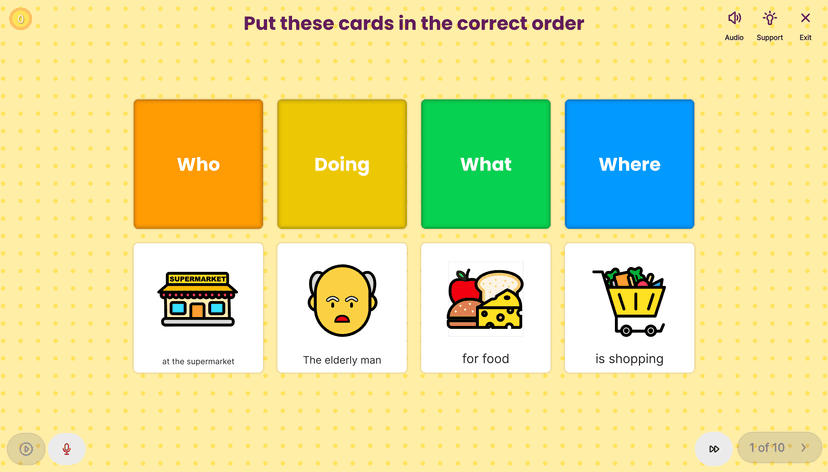
Vocabulary A-Z uses a blended, competency-based learning approach that combines teacher-managed word lists with gamified student practice. Educators or parents log into a dashboard to select vocabulary, spelling, and phonics lists aligned with their specific lesson plans or state standards. These lists are then pushed to the student application. Your child logs in and completes a series of interactive games designed to drill the assigned words. Activities range from simple spelling tests to definition-matching exercises. The system uses basic retrieval practice, prompting the student to recall spelling conventions and meanings repeatedly until mastery is achieved. As students complete tasks, they earn digital stars and rewards, employing gamification to sustain engagement. The platform tracks accuracy and completion rates, feeding this data back to the adult dashboard. Because the learning paths are manually assigned rather than dynamically generated by an AI, the pacing and content relevance depend entirely on the adult administrator.
Strengths and tradeoffs of Vocabulary A-Z
Vocabulary A-Z's biggest strength is its seamless integration of customizable word lists with engaging retrieval practice, while its biggest weakness is a reliance on shallow rote memorization over deep morphological instruction. Customization and alignment are excellent, allowing teachers to match digital games exactly to weekly classroom targets. This ensures that the time your child spends on a screen directly supports their current schoolwork. Gamified engagement successfully masks repetitive drills, encouraging students to complete necessary repetitions without fatigue. However, looking at learning science, the platform falls short in teaching deep cognitive strategies. Instead of guiding students to break down words into roots and affixes, the games mostly reward simple matching and sequence memorization. Feedback mechanisms are another area of weakness. When your child makes an error, the system provides immediate correction but lacks explicit instruction on why the error occurred or how to apply a phonics rule to fix it. While formal evaluation by The Learning Standard is pending, early analysis suggests that Vocabulary A-Z is a highly efficient tool for spelling drill management but lacks the pedagogical depth required to remediate struggling readers.
Who Might Benefit From Vocabulary A-Z?
Best for K-5 students who need structured, gamified drill practice to master weekly classroom spelling and vocabulary lists. It serves as an excellent supplementary tool for teachers and dedicated parents willing to manually assign and manage custom word sets. Because it relies on basic retrieval and matching games, it is ideal for early elementary students building foundational phonics skills or upper elementary students memorizing subject-specific academic vocabulary. It is not recommended as a primary intervention tool for students with dyslexia or significant decoding difficulties, as it lacks explicit, systematic phonetic instruction.
Data Transparency
Meets Data Transparency Standard
Vocabulary A-Z meets our data transparency standard at Level 2 of 3 (Parent control). Level 3 needs the policy to document an API for retrieving their own data and a named export format.
25 of 35 checks passed
Level 1 · Basic protections
Does not sell data or target ads at students, limits sharing, and lets parents see and delete their child's data.
Level 2 · Parent control (meets the standard)
Families can get their data out, know who processes it, and know how long it is kept.
Level 3 · Direct data access
Families or schools can pull their own data through an API, in a stated format.
Not documented: an API for retrieving their own data, a named export format
View all 35 checks
Parent Access7/8
Does the policy mention parents specifically?
“If you are an adult with parent access to the Services, you can view similar reports regarding only your child’s activity through the parent portal.”
Can parents view their child's data?
“If you are an adult with parent access to the Services, you can view similar reports regarding only your child’s activity through the parent portal.”
Can parents modify their child's data?
“For _Enterprise Platform Services_ and _Direct Platform Services,_ we support access to, correction, and deletion of Student Data by our educational institution customer and/or teachers by cooperating and assisting the school and teachers to meet their requirements for access, correction, and deletion, or by responding to requests we receive from schools. If we receive such a request directly from a student or parent, we will advise the corresponding educational institution or teacher customer of the request and we will follow all lawful instructions from the institutions and teachers.”
Can parents delete their child's account?
“Adults with parent access may do this by contacting the account holder, such as the school, to request deletion of their child’s information.”
Is there a dedicated Children's Privacy section?
The policy covers COPPA and children under 13 in its introductory paragraphs but has no separate section headed for children's privacy.
Does it reference COPPA compliance?
“This Privacy Policy and our Services are designed to comply with COPPA.”
Does it reference FERPA compliance?
“We provide the Learning Application Services as a “School Official” under the provisions of the Family Educational Rights and Privacy Act (“FERPA”).”
Is parental consent required for child accounts?
“When a parent or guardian signs up to provide our _Learning Platform Services at Home_ to a child under 13, we will seek the appropriate consent directly from the parent or guardian before collecting any personal information from the child.”
Data Portability3/5
Can users access their personal data?
“You have the right to access, update and correct factual inaccuracies in the Personal Information that we collect through our Services, subject to certain exceptions.”
Can users download/export their data?
“Where required by applicable law, you may have the right to obtain confirmation that we maintain certain Personal Information relating to you, to verify its content, origin, and accuracy, as well as the right to access your Personal Information, request its update, integration, or completion, and request deletion or portability of your Personal Information.”
Is there a self-service data access tool?
“If you want to access, update, or correct your Personal Information, simply edit your profile by logging into your account.”
Is a specific data format mentioned for export?
The policy mentions portability but does not name any export format.
Is there an API for data access?
The policy lists "Student API Calls" as data it collects but does not describe any API that lets users access their data.
Data Minimization2/6
Is data collection itemized?
“We may collect and process the following types of student personal information as part of theServices:”
Can the app be used without a real name?
The policy lists student first and last name as collected, and required for autorostered students.
Can the app be used without an email?
Student email is missing from the list of student data, but the policy never explicitly says student email is not collected.
Does it state collection is limited to what is necessary?
“In providing our Serviceswe strive to only collect and process data elements which are reasonably necessary, proportionate, and not excessive for the uses for which we need to process that data.”
Is IP address anonymized or truncated?
The policy says it collects IP addresses and does not say they are anonymized or truncated.
Is location tracking explicitly excluded?
The policy says it collects location information, including precise GPS-based location in its mobile apps.
Third-Party Protection6/7
Does it explicitly state no selling of data?
“We do not sell or process personal information of students arising from the use of ourServices to target marketing or advertising to them.”
Are third-party providers named?
“Google Analytics – We use Google Analytics to obtain information about your use of the Site and for targeted advertising.”
Are providers contractually restricted?
“Depending upon the Services in which you participate, we may also have to send personal information to other third parties who are not service providers of ours, and whose information practices are not governed by agreements we have with them where they must process information in accordance with our directives.”
No-targeted-advertising commitment?
“We do not sell or process personal information of students arising from the use of ourServices to target marketing or advertising to them.”
Is AI/ML data sharing addressed?
The policy does not address AI or machine learning.
Child-specific sharing restriction?
“We will not provide Student Data to these third parties without express consent of the educational institution, parent, or guardian.”
Cookies/tracking limited or opt-out?
“You may accept all cookies, reject all cookies, or select which types of cookies you wish to allow.”
Deletion & Retention5/5
Can users delete their account?
“If you no longer wish to use our Services, you may close your account by contacting us.”
Self-service deletion mechanism?
“Adults with teacher access may remove a student account by deleting the student from their classroom roster.”
Specific data retention timeline?
“For _Direct Platform Services_, student data is processed during the term an active licensing agreement is in place and is deleted within 45 days after the end of that licensing agreement; however, depending upon our back-up systems retention times such information may be maintained in backups for up to 180 days after termination of the _Learning Platform Services_.”
Auto-deletion of inactive accounts?
“If educational institutions do not instruct us to delete data, or our contracts do not specify time periods for retention, we reserve the right to delete inactive account information, including Student Data, in a reasonable period of time, which will not exceed one year from the last activity in an account.”
Post-deletion handling described?
“For _Direct Platform Services_, student data is processed during the term an active licensing agreement is in place and is deleted within 45 days after the end of that licensing agreement; however, depending upon our back-up systems retention times such information may be maintained in backups for up to 180 days after termination of the _Learning Platform Services_.”
Advertising2/4
Advertising model explicitly disclosed?
“Targeting and social media cookies are shared with other third parties and used to track you across sites and over time for advertising purposes, such as to display online ads to you.”
Free from third-party advertisements?
The policy does not say the product is free of third-party ads, and it discloses advertising cookies on its website.
Children excluded from ad targeting?
“We do not sell or process personal information of students arising from the use of ourServices to target marketing or advertising to them.”
Ad-free option available?
The policy does not describe an ad-free option or state that the product has no advertising.
Meets Data Transparency Standard
The reviewed policy met our data transparency standard. This result describes the policy disclosures we assessed. Actual practices and legal compliance were not verified.
About this evaluation: Based on automated analysis of Privacy Policy, Privacy Policy and Application Privacy Policy against 35 policy-disclosure questions, including questions adapted from the Common Sense Privacy Program's published evaluation questions. TLS is not affiliated with Common Sense Media, and this is not a Common Sense rating. Quoted text is copied from the policy; unquoted notes are our summary. Results describe what the policy documents, not the company's actual practices. Privacy policies can change: this review reflects the version we analyzed and does not determine legal compliance.
Sources and review method
TLS combines product information and editorial analysis to explain how Vocabulary A-Z works, its tradeoffs, and the questions to ask before choosing it. Product features, an instructional rationale and evidence of learning outcomes are different kinds of information.
Formal Learning Standard assessment: not yet completed. Data Transparency findings are reported separately and do not establish learning effectiveness. Read our methodology.
Frequently Asked Questions About Vocabulary A-Z
Is Vocabulary A-Z free?
No. Vocabulary A-Z requires a paid subscription to access its core features. The retail price is currently set at $114 for a one-year subscription, which typically covers a classroom or family account. There is no free tier available for individual consumer use. However, many school districts purchase institutional licenses for their elementary schools, which makes the platform completely free for individual students to access from their home devices using a school-provided login.
Is Vocabulary A-Z good for Kindergarten students?
Yes, it provides appropriate foundational phonics practice for Kindergarteners. The platform includes early childhood word lists specifically aligned to early literacy standards. It utilizes audio-visual matching games that do not require advanced reading skills, making it accessible for pre-readers. However, because the interface requires some navigation and the learning paths must be manually assigned by an adult, young children will need active parent or teacher assistance to set up the software and navigate to their assigned daily tasks.
What does Vocabulary A-Z teach?
Vocabulary A-Z teaches K-5 foundational literacy, specifically targeting phonics, spelling conventions, and vocabulary definitions. It provides structured repetition to help students recognize sight words, master weekly classroom spelling lists, and memorize academic vocabulary across various humanities and science subjects. The platform emphasizes retrieval practice to ensure students can recall spelling sequences and match words to their correct meanings, though it does not provide comprehensive instruction on reading comprehension or complex grammar rules.
How does Vocabulary A-Z compare vs Spelling City?
Both platforms offer gamified spelling and vocabulary practice based on custom word lists assigned by teachers. Vocabulary A-Z integrates seamlessly with the broader Learning A-Z ecosystem, making it the superior choice for classrooms already utilizing Reading A-Z or Raz-Kids. Conversely, Spelling City often features a slightly wider variety of specialized interactive games. Ultimately, both serve as digital workbooks for drill practice rather than primary instructional tools. The Learning Standard has not yet formally rated either application.
Has The Learning Standard evaluated Vocabulary A-Z?
TLS has not yet completed a Learning Standard evaluation of how well Vocabulary A-Z teaches. Its privacy policy has been reviewed for Data Transparency and reaches Level 2, Parent control.
Is Vocabulary A-Z COPPA compliant?
The reviewed privacy policy references COPPA. A policy reference alone does not establish COPPA compliance. Policy review note: The policy states it is designed to comply with COPPA.
Is Vocabulary A-Z FERPA compliant?
The reviewed privacy policy references FERPA. A policy reference alone does not establish FERPA compliance. Policy review note: The policy says the company acts as a School Official under FERPA.
Does Vocabulary A-Z have a children's privacy policy?
No dedicated children's privacy section was found in the reviewed policy. Policy review note: The policy covers COPPA and children under 13 in its introductory paragraphs but has no separate section headed for children's privacy.
Does Vocabulary A-Z sell student data?
The reviewed policy states that the app does not sell data. This is a policy statement; actual data practices were not verified. Policy review note: The policy states the company does not sell students' personal information.
Can you delete your data from Vocabulary A-Z?
The reviewed privacy policy describes account deletion. We have not tested the deletion process. Policy review note: Users can close their account by contacting the company.
Follow TLS Research
Subscribe to future TLS research updates: app reviews, findings, and what the evidence shows.
Screenshots

Take Action
For Vocabulary A-Z
If you represent Learning A-Z and have a correction or new evidence, send the relevant source so we can review and update this page.
Submit a correctionDetails
- Pricing
- Retail price is $114 for a 1-year subscription.
- Platforms
- Web Browser, iOS (Apple mobile), Android (Google mobile), Windows (Microsoft), macOS (Apple), Chrome OS (Google)
- Grade Levels
- Kindergarten, 1st Grade, 2nd Grade, 3rd Grade, 4th Grade, 5th Grade
- Website
- Visit site