
TutorFlow
Product by Geek Haus
Facts checked: Not yet checked
Our take (not a Learning Standard rating). This label applies to learning-science judgments throughout this overview.
Our take (not a Learning Standard rating)
TutorFlow is a course creation platform rather than a standalone teaching app, meaning its effectiveness depends entirely on how educators design the materials. It accelerates course authoring using AI, but does not inherently enforce evidence-based practices like spaced repetition or interleaved practice without direct instructor intervention.
Pros
- Automates the generation of formative assessments to enable frequent retrieval practice.
- Allows instructional designers to quickly build interactive modules across diverse subject areas.
- Reduces administrative burden for educators by generating baseline course structures.
- Supports adult learning contexts including higher education and corporate training environments.
Cons
- Lacks built-in safeguards to ensure AI-generated content aligns with established cognitive load limits.
- Does not automatically implement spaced repetition algorithms for learner retention.
- Relies entirely on the instructor's pedagogical expertise to create effective learning sequences.
- Requires a paid subscription for AI credits without a clear baseline of free features.
What Do We Know About TutorFlow?
TutorFlow relies entirely on the pedagogical skill of the educator using it, meaning its learning effectiveness varies completely based on course design. This platform functions as an artificial intelligence assistant for teachers, instructional designers, and corporate learning teams rather than a direct-to-learner tutoring application. When you use this tool to build courses for your adult learners, the platform accelerates the creation of practice tests, study guides, and interactive modules. However, generating content quickly does not automatically equate to effective instruction. To maximize learning outcomes, educators must actively guide the AI to utilize proven cognitive science principles. For example, you must intentionally structure the generated quizzes to support retrieval practice and ensure the pacing of information minimizes extraneous cognitive load. Because The Learning Standard has not yet fully evaluated this application, we cannot verify the accuracy of its AI-generated subject matter. Educators must independently verify all generated text to prevent instructional errors. Ultimately, this tool works best as a drafting assistant to help you scale your existing curriculum rather than a replacement for evidence-based instructional design.
How Does TutorFlow Work?
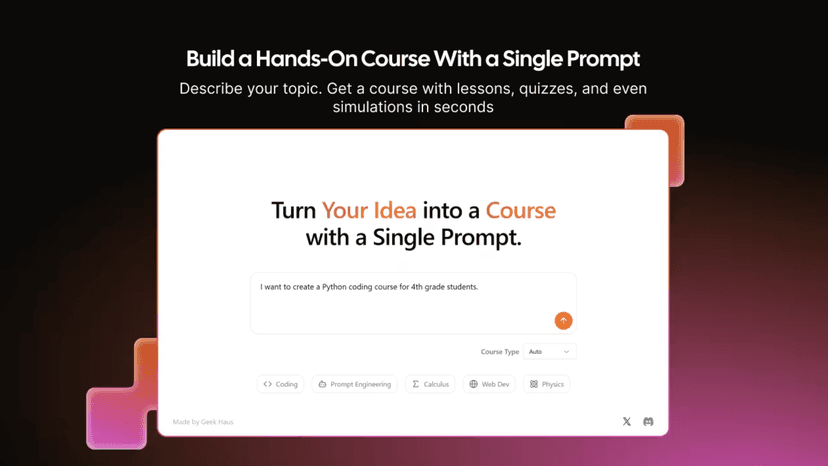
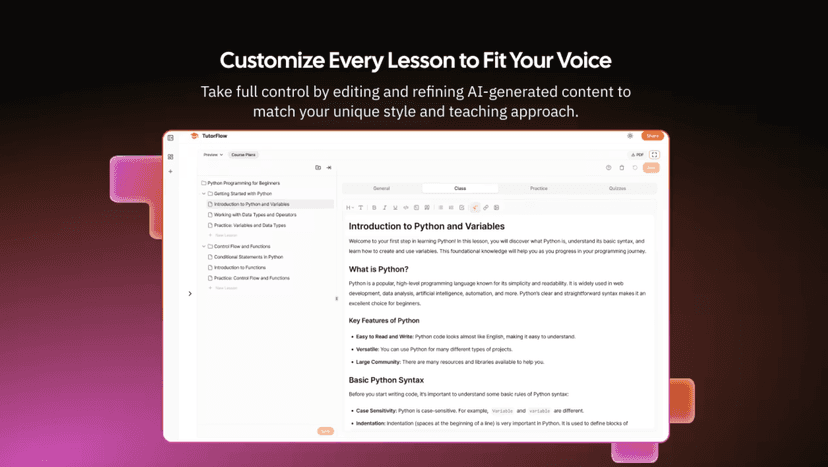
TutorFlow uses an instructor-directed course authoring model driven by generative artificial intelligence. Educators input their target learning objectives, subject matter parameters, and desired formats, and the platform generates functional course components like quizzes, reading modules, and assignments. The core learning mechanic depends on how these components are deployed to the end user. If a teacher uses the tool to generate weekly low-stakes quizzes, learners engage in retrieval practice that strengthens long-term memory consolidation. If used to build sequential modules, the system facilitates self-paced content consumption. The platform operates on a credit-based subscription model where instructors spend credits to generate specific materials across disciplines ranging from the humanities to applied sciences. Because it is a blank-slate authoring tool, it does not inherently force mastery-based progression or adaptive learning paths. The instructor must manually construct the logic and flow of the curriculum. The generated materials can then be distributed to students in higher education, professional credentialing programs, or corporate learning environments.
Strengths and tradeoffs of TutorFlow
TutorFlow's biggest strength is its ability to rapidly generate formative assessment materials, while its biggest weakness is the lack of built-in instructional guardrails to prevent poor pedagogical design. Content generation speed allows educators to easily create multiple versions of practice tests, which directly supports the evidence-based practice of frequent, low-stakes retrieval practice. When learners are tested often, their memory retention improves significantly compared to simply rereading material. Subject versatility is another notable asset, as the AI can process technical content for advanced degrees just as easily as basic foundational concepts. However, the system's lack of cognitive scaffolding means it can easily generate massive walls of text that overwhelm a learner's working memory. Without built-in spacing effects or interleaved practice algorithms, the platform relies on the human instructor to manually schedule reviews of older material. Furthermore, AI hallucination risks require educators to painstakingly review all generated worked examples for factual accuracy, particularly in complex applied sciences or doctoral-level subjects. While it excels at administrative efficiency, it demands strong oversight to align with the science of learning.
Who Might Benefit From TutorFlow?
TutorFlow is best for instructional designers and higher-education faculty who possess a strong understanding of pedagogy and need to scale their course creation process. It is specifically designed for adult education contexts, including associate through doctoral degree programs, professional technical credentialing, and corporate learning and development. Because it functions as an authoring assistant rather than an independent learning environment, it is not suitable for self-directed learners or K-12 students. It serves effectively as a productivity multiplier for educators who already know how to implement evidence-based teaching strategies and simply need faster ways to generate the raw materials.
Data Transparency
Does Not Meet Data Transparency Standard
TutorFlow reaches Level 1 of 3 (Basic protections), below our data transparency standard. Reaching Level 2 needs the policy to document data export, a data retention timeline and self-service deletion.
14 of 35 checks passed
Evaluated September 2026
Privacy Policy →Level 1 · Basic protections
Does not sell data or target ads at students, limits sharing, and lets parents see and delete their child's data.
Level 2 · Parent control (meets the standard)
Families can get their data out, know who processes it, and know how long it is kept.
Not documented: data export, a data retention timeline, self-service deletion
Level 3 · Direct data access
Families or schools can pull their own data through an API, in a stated format.
Not documented: an API for retrieving their own data, a named export format
View all 35 checks
Parent Access2/8
Does the policy mention parents specifically?
The policy does not mention parents.
Can parents view their child's data?
“Request inspection and correction of student records (for FERPA)”
Can parents modify their child's data?
The policy does not give parents any right to modify their child's data.
Can parents delete their child's account?
The policy does not give parents any right to delete their child's data or account.
Is there a dedicated Children's Privacy section?
The policy has no dedicated section on children's privacy.
Does it reference COPPA compliance?
The policy does not mention COPPA.
Does it reference FERPA compliance?
“Data is shared under strict agreements ensuring GDPR and FERPA compliance.”
Is parental consent required for child accounts?
The policy does not address parental consent.
Data Portability1/5
Can users access their personal data?
“Access and review the personal information we hold about you”
Can users download/export their data?
The policy does not mention downloading or exporting data.
Is there a self-service data access tool?
The policy says users exercise their rights by contacting the company, not through a self-service tool.
Is a specific data format mentioned for export?
The policy does not mention any export format.
Is there an API for data access?
The policy does not mention an API for accessing data.
Data Minimization3/6
Is data collection itemized?
“We only collect email addresses to create and manage your account.”
Can the app be used without a real name?
“We only collect email addresses to create and manage your account.”
Can the app be used without an email?
The policy says email addresses are collected to create accounts and may be required for students in private courses.
Does it state collection is limited to what is necessary?
“We only collect email addresses to create and manage your account.”
Is IP address anonymized or truncated?
The policy does not address anonymizing or truncating IP addresses.
Is location tracking explicitly excluded?
The policy does not explicitly rule out location tracking.
Third-Party Protection6/7
Does it explicitly state no selling of data?
“We do not sell your personal data.”
Are third-party providers named?
“Trusted service providers who help us operate our platform (e.g., Google Analytics)”
Are providers contractually restricted?
“Data is shared under strict agreements ensuring GDPR and FERPA compliance.”
No-targeted-advertising commitment?
“For educational institutions, student data remains under institutional control and is never used for advertising or profiling.”
Is AI/ML data sharing addressed?
The policy does not address sharing data with AI or machine-learning systems.
Child-specific sharing restriction?
“For educational institutions, student data remains under institutional control and is never used for advertising or profiling.”
Cookies/tracking limited or opt-out?
“You may disable cookies through your browser settings, but some features may be limited.”
Deletion & Retention1/5
Can users delete their account?
“Request corrections or deletions of your data”
Self-service deletion mechanism?
The policy says deletion is done by contacting the company, not through a self-service tool.
Specific data retention timeline?
The policy says data is kept only as long as necessary or as the institution specifies, without giving a specific timeline.
Auto-deletion of inactive accounts?
The policy does not address deleting inactive accounts automatically.
Post-deletion handling described?
The policy says only that data is securely deleted or anonymized when no longer needed, without describing what happens after deletion (for example, to backups).
Advertising1/4
Advertising model explicitly disclosed?
The policy does not describe the product's advertising model or say the product has no ads.
Free from third-party advertisements?
The policy does not say the product is free of third-party ads.
Children excluded from ad targeting?
“For educational institutions, student data remains under institutional control and is never used for advertising or profiling.”
Ad-free option available?
The policy does not mention an ad-free option or say the product has no ads.
What This Means
The policy review did not meet our data transparency standard. The checks above show the documented findings and unknowns. A missing statement does not establish how the app handles data in practice.
About this evaluation: Based on automated analysis of Privacy Policy against 35 policy-disclosure questions, including questions adapted from the Common Sense Privacy Program's published evaluation questions. TLS is not affiliated with Common Sense Media, and this is not a Common Sense rating. Quoted text is copied from the policy; unquoted notes are our summary. Results describe what the policy documents, not the company's actual practices. Privacy policies can change: this review reflects the version we analyzed and does not determine legal compliance.
Sources and review method
TLS combines product information and editorial analysis to explain how TutorFlow works, its tradeoffs, and the questions to ask before choosing it. Product features, an instructional rationale and evidence of learning outcomes are different kinds of information.
Formal Learning Standard assessment: not yet completed. Data Transparency findings are reported separately and do not establish learning effectiveness. Read our methodology.
Frequently Asked Questions About TutorFlow
Is TutorFlow free?
No, TutorFlow requires a monthly or yearly subscription to access its features. The pricing model is based on an AI credit system, where educators purchase credits that are consumed as they generate new courses, practice tests, and learning modules. Institutions and instructional teams must budget for ongoing credit purchases to maintain continuous access to the generative tools. This differs from standard flat-rate software, meaning your costs will scale directly with the volume of course materials you need to produce.
Is TutorFlow good for adult learners?
Yes, the platform is specifically designed to support adult education, higher education, and corporate training. However, its effectiveness for adult learners depends entirely on how the instructor designs the AI-generated courses and implements adult learning principles. The tool itself is just an authoring mechanism, so educators must intentionally build relevance and immediate real-world application into the generated curriculum to keep adult students actively engaged.
What does TutorFlow teach?
TutorFlow does not teach a specific curriculum on its own. It is a content generation platform that allows educators to build courses across nearly any subject, including humanities, science, mathematics, applied sciences, and career and technical education. The software provides the structural framework and generative AI capabilities, but the actual subject matter expertise and learning objectives must be directed by the instructional designer.
How does TutorFlow compare to standard learning management systems?
TutorFlow acts as an AI-driven content creator rather than a traditional learning management system. While a standard LMS hosts student data, tracks completion progress, and manages grading, TutorFlow generates the actual learning materials, quizzes, and reading modules. Educators typically use TutorFlow to author the raw instructional content, which they must then export and upload into their institution's primary LMS for student distribution.
Has The Learning Standard evaluated TutorFlow?
TLS has not yet completed a Learning Standard evaluation of how well TutorFlow teaches. Its privacy policy has been reviewed for Data Transparency and reaches Level 1, Basic protections.
Is TutorFlow COPPA compliant?
A COPPA reference was not found in the reviewed privacy policy. This does not determine whether the app complies with COPPA. Policy review note: The policy does not mention COPPA.
Is TutorFlow FERPA compliant?
The reviewed privacy policy references FERPA. A policy reference alone does not establish FERPA compliance. Policy review note: The policy says it complies with FERPA.
Does TutorFlow have a children's privacy policy?
No dedicated children's privacy section was found in the reviewed policy. Policy review note: The policy has no dedicated section on children's privacy.
Does TutorFlow sell student data?
The reviewed policy states that the app does not sell data. This is a policy statement; actual data practices were not verified. Policy review note: The policy says the company does not sell personal data.
Can you delete your data from TutorFlow?
The reviewed privacy policy describes account deletion. We have not tested the deletion process. Policy review note: Users can ask for their data to be deleted.
Follow TLS Research
Subscribe to future TLS research updates: app reviews, findings, and what the evidence shows.
Screenshots
Take Action
For TutorFlow
If you represent Geek Haus and have a correction or new evidence, send the relevant source so we can review and update this page.
Submit a correctionDetails
- Pricing
- Monthly or yearly subscription for AI credits
- Platforms
- Web Browser, iOS (Apple mobile), Android (Google mobile)
- Grade Levels
- Associate's degree, Bachelor's degree, Post-master's certificate, Doctoral Degree, Post-doctoral certificate, Adult Education, Professional or Technical Credential
- Website
- Visit site