Thinkverse
Product by Thinkverse
Facts checked: Not yet checked
Our take (not a Learning Standard rating). This label applies to learning-science judgments throughout this overview.
Our take (not a Learning Standard rating)
While Thinkverse claims to provide personalized mathematics support through artificial intelligence, The Learning Standard has not yet evaluated its instructional effectiveness. The use of immediate, in-the-moment tutoring aligns well with worked example effects and scaffolding, but AI-generated curriculum requires careful monitoring to ensure alignment with structured, mastery-based progression.
Pros
- Provides immediate corrective feedback during problem-solving to prevent the consolidation of mathematical errors.
- Generates customized practice sessions that adapt to your child's current mastery level.
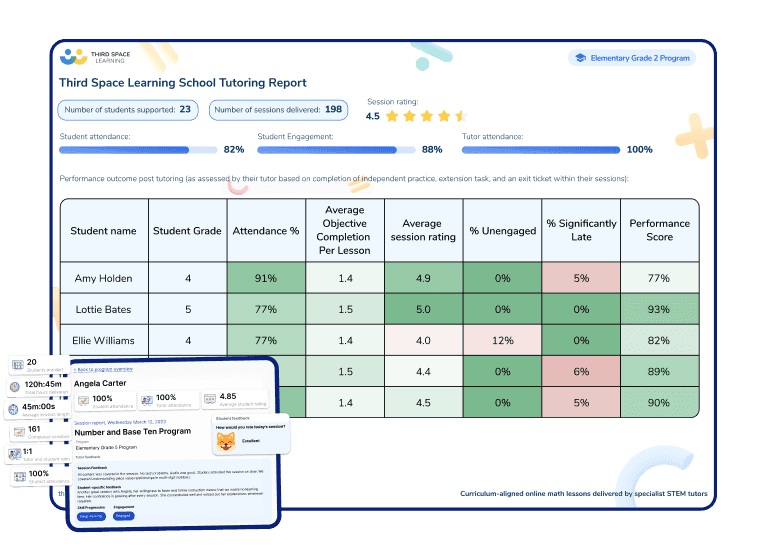
- Offers a centralized dashboard that helps educators and parents monitor skill acquisition and retrieval practice success.
- Covers a broad K-12 scope allowing for continuous vertical progression through diverse mathematical concepts.
Cons
- Lacks independent efficacy research verifying the pedagogical accuracy of its AI-generated tutoring interventions.
- May over-rely on algorithmic generation which can occasionally introduce poorly scaffolded math problems.
- Pricing is completely opaque and requires contacting the vendor directly to access the platform.
- Relies heavily on screen-based text interactions which may frustrate younger readers or students with learning differences.
What Do We Know About Thinkverse?
Thinkverse holds potential as an effective supplemental math tool, but its reliance on unproven AI tutoring means parents must monitor its use closely. Because the platform generates lessons and practice sessions using artificial intelligence, the quality of instruction hinges entirely on the underlying algorithm's ability to scaffold complex concepts. Learning science shows that immediate, personalized feedback, which this platform promises, can significantly accelerate math acquisition by preventing students from internalizing incorrect procedures. However, AI models can sometimes hallucinate or skip crucial foundational steps when teaching mathematics. Your child will interact with an automated tutor that attempts to provide in-the-moment support when they get stuck. This mimics the benefits of a human tutor using the zone of proximal development, guiding the student just enough to solve the problem without giving away the answer. You can track your child's progress through a unified dashboard, which provides data on their performance across various K-12 math topics. Until The Learning Standard officially evaluates this tool, we recommend using it alongside established classroom instruction rather than as a primary curriculum replacement.
How Does Thinkverse Work?
Thinkverse utilizes an adaptive, AI-driven instructional approach that relies on dynamic problem generation and immediate feedback. Your child logs into the platform and engages with math concepts spanning from kindergarten through twelfth grade. As they solve problems, an artificial intelligence tutor monitors their inputs and provides in-the-moment support if they struggle. This mechanic leverages the concept of scaffolding, offering hints or explaining missteps to help the student arrive at the correct answer. Instead of a static textbook, the platform generates sessions on the fly, tailoring the difficulty and topic focus based on past performance data. This continuous adjustment aims to keep students in their optimal learning zone, ensuring they are neither bored by overly simple tasks nor overwhelmed by advanced equations. Parents and teachers access a unified performance dashboard that aggregates this interaction data, highlighting areas of mastery and pinpointing specific procedural weaknesses that require additional targeted practice.
Strengths and tradeoffs of Thinkverse
The biggest strength of Thinkverse is its ability to deliver immediate, personalized feedback, while its biggest weakness is the inherent unreliability of AI-generated curriculum compared to expertly sequenced instructional design. Immediate corrective feedback is a cornerstone of effective learning science because it stops a student from practicing and memorizing incorrect mathematical procedures. When your child makes a mistake, the AI tutor intervenes right away, mimicking the highly effective one-on-one tutoring model. Additionally, the comprehensive K-12 coverage allows students to review foundational concepts from previous grades or accelerate into advanced material without needing to switch platforms. Conversely, the reliance on AI-generated sessions poses a significant risk to structured learning. Mathematics requires carefully sequenced instruction where each concept builds predictably on the last. Algorithmic generation can sometimes fail to provide sufficient worked examples before asking a student to perform independent retrieval practice. Furthermore, the lack of transparent pricing and the fact that The Learning Standard has not yet rated its pedagogical accuracy means educators and parents must use caution. Performance dashboards are helpful, but they are only as valuable as the assessments generating the data.
Who Might Benefit From Thinkverse?
Thinkverse is best for middle and high school students who need on-demand, supplementary math support to clarify specific homework concepts. While it covers K-12, younger elementary students typically benefit more from tactile math manipulatives and human-guided instruction rather than text-heavy AI interactions. It serves well as a digital homework assistant for older learners aiming to bridge knowledge gaps outside of classroom hours. School districts or homeschooling parents looking for a data-driven dashboard to track broad mathematical skill acquisition across multiple grade levels will also find the platform's unified reporting features useful, provided they can secure favorable pricing.
Data Transparency
Does Not Meet Data Transparency Standard
Thinkverse does not meet our data transparency standard. Its privacy policy does not document basic protections, including a COPPA or FERPA commitment, parents' right to see their child's data and parents' right to delete their child's data.
12 of 35 checks passed
Evaluated September 2026
Privacy Policy · Thinkverse →Level 1 · Basic protections
Does not sell data or target ads at students, limits sharing, and lets parents see and delete their child's data.
Not documented: a COPPA or FERPA commitment, parents' right to see their child's data, parents' right to delete their child's data
Level 2 · Parent control (meets the standard)
Families can get their data out, know who processes it, and know how long it is kept.
Not documented: a data retention timeline, named service providers, self-service deletion
Level 3 · Direct data access
Families or schools can pull their own data through an API, in a stated format.
Not documented: an API for retrieving their own data, a named export format
View all 35 checks
Parent Access0/8
Does the policy mention parents specifically?
The policy refers to "your student" but never mentions parents.
Can parents view their child's data?
The policy does not give parents any right to view their child's data.
Can parents modify their child's data?
The policy does not give parents any right to change their child's data.
Can parents delete their child's account?
The policy does not give parents any right to delete their child's data or account.
Is there a dedicated Children's Privacy section?
The policy has no section dedicated to children's privacy or COPPA.
Does it reference COPPA compliance?
The policy does not mention COPPA.
Does it reference FERPA compliance?
The policy does not mention FERPA.
Is parental consent required for child accounts?
The policy does not say parental consent is required for child accounts.
Data Portability2/5
Can users access their personal data?
“Access your Personal Information and information relating to how it is processed.”
Can users download/export their data?
“Transfer your Personal Information to a third party (right to data portability).”
Is there a self-service data access tool?
The policy says only that "some of these rights" can be exercised through the account and does not name a data access tool.
Is a specific data format mentioned for export?
The policy does not name an export format.
Is there an API for data access?
The policy does not mention an API for data access.
Data Minimization2/6
Is data collection itemized?
“Log Data: Information that your browser automatically sends when you use our Services. Log data includes your Internet Protocol address, browser type and settings, the date and time of your request, and how you interact with our website.”
Can the app be used without a real name?
The policy says it collects the student's first and last name.
Can the app be used without an email?
The policy says account contact information is collected and does not say student email addresses are never collected.
Does it state collection is limited to what is necessary?
The policy does not say collection is limited to what is necessary.
Is IP address anonymized or truncated?
“Data collected may include a device's IP address (processed during your session and stored in a de-identified form)”
Is location tracking explicitly excluded?
The policy collects country-level location and lists Geolocation Data among the data it discloses, rather than excluding location tracking.
Third-Party Protection6/7
Does it explicitly state no selling of data?
“We do not sell or share student personal information for advertising, profiling, or other commercial purposes.”
Are third-party providers named?
The policy describes types of providers and links to a separate subprocessor list but names none in the text.
Are providers contractually restricted?
“they process the data on our behalf, under contracts that prohibit them from using it for their own purposes, including training their models.”
No-targeted-advertising commitment?
“We don't “sell” Personal Information or “share” Personal Information for cross-contextual behavioral advertising (as those terms are defined under applicable local law).”
Is AI/ML data sharing addressed?
“We do not use student Personal Information or student-provided Content to train the AI models that power Thinkverse.”
Child-specific sharing restriction?
“We do not sell or share student personal information for advertising, profiling, or other commercial purposes.”
Cookies/tracking limited or opt-out?
“You can set your browser to accept all cookies, to reject all cookies, or to notify you whenever a cookie is offered so that you can decide each time whether to accept it.”
Deletion & Retention1/5
Can users delete their account?
“Delete your Personal Information from our records.”
Self-service deletion mechanism?
The policy says only that some rights can be exercised through the account and does not describe a self-service deletion feature.
Specific data retention timeline?
The policy keeps data as long as needed and gives no specific time period.
Auto-deletion of inactive accounts?
The policy does not mention deleting inactive accounts automatically.
Post-deletion handling described?
The policy does not say what happens to data after deletion.
Advertising1/4
Advertising model explicitly disclosed?
The policy does not describe the product's advertising model or say it has no ads.
Free from third-party advertisements?
The policy does not say the product is free of third-party ads.
Children excluded from ad targeting?
“We do not sell or share student personal information for advertising, profiling, or other commercial purposes.”
Ad-free option available?
The policy does not mention an ad-free option or say the product has no ads.
What This Means
The policy review did not meet our data transparency standard. The checks above show the documented findings and unknowns. A missing statement does not establish how the app handles data in practice.
About this evaluation: Based on automated analysis of Privacy Policy · Thinkverse against 35 policy-disclosure questions, including questions adapted from the Common Sense Privacy Program's published evaluation questions. TLS is not affiliated with Common Sense Media, and this is not a Common Sense rating. Quoted text is copied from the policy; unquoted notes are our summary. Results describe what the policy documents, not the company's actual practices. Privacy policies can change: this review reflects the version we analyzed and does not determine legal compliance.
Sources and review method
TLS combines product information and editorial analysis to explain how Thinkverse works, its tradeoffs, and the questions to ask before choosing it. Product features, an instructional rationale and evidence of learning outcomes are different kinds of information.
Formal Learning Standard assessment: not yet completed. Data Transparency findings are reported separately and do not establish learning effectiveness. Read our methodology.
Frequently Asked Questions About Thinkverse
Is Thinkverse free?
No, Thinkverse is not free and does not publish its pricing structure online. Parents and educators must contact the vendor directly to request a quote or negotiate licensing for home or school use.
Is Thinkverse good for elementary students?
Thinkverse is designed for K-12, but it may not be the optimal primary tool for young elementary children. Early math learners require concrete, visual-spatial representations and manipulatives, whereas AI chat interfaces are generally more effective for older students with stronger reading comprehension.
What does Thinkverse teach?
Thinkverse teaches a comprehensive range of mathematics concepts aligned with standard K-12 curricula. It covers everything from basic arithmetic and fractions in the early grades to advanced algebra, geometry, and calculus in high school.
Has Thinkverse been evaluated by The Learning Standard?
Thinkverse is currently pending evaluation by our team of learning scientists. We have not yet tested its instructional efficacy against our official rubric. You can read more about our rigorous testing process in our methodology section.
How does Thinkverse compare to Khan Academy?
Khan Academy relies on a static, mastery-based progression with pre-recorded video instruction and structured practice sets. Thinkverse takes a different approach by using artificial intelligence to dynamically generate custom sessions and provide conversational, in-the-moment tutoring.
Has The Learning Standard evaluated Thinkverse?
TLS has not yet completed a Learning Standard evaluation of how well Thinkverse teaches. Its privacy policy has been reviewed for Data Transparency and does not yet document the basic protections (Level 1).
Is Thinkverse COPPA compliant?
A COPPA reference was not found in the reviewed privacy policy. This does not determine whether the app complies with COPPA. Policy review note: The policy does not mention COPPA.
Is Thinkverse FERPA compliant?
A FERPA reference was not found in the reviewed privacy policy. This does not determine whether the app complies with FERPA. Policy review note: The policy does not mention FERPA.
Does Thinkverse have a children's privacy policy?
No dedicated children's privacy section was found in the reviewed policy. Policy review note: The policy has no section dedicated to children's privacy or COPPA.
Does Thinkverse sell student data?
The reviewed policy states that the app does not sell data. This is a policy statement; actual data practices were not verified. Policy review note: The policy explicitly says the company does not sell student personal information.
Can you delete your data from Thinkverse?
The reviewed privacy policy describes account deletion. We have not tested the deletion process. Policy review note: The policy lists a right to have your personal information deleted.
Follow TLS Research
Subscribe to future TLS research updates: app reviews, findings, and what the evidence shows.
Screenshots
Take Action
For Thinkverse
If you represent Thinkverse and have a correction or new evidence, send the relevant source so we can review and update this page.
Submit a correction