
Tarphi
Product by Tarphi
Facts checked: Not yet checked
Our take (not a Learning Standard rating). This label applies to learning-science judgments throughout this overview.
Our take (not a Learning Standard rating)
Tarphi offers a robust suite of game-based assessment tools that support active retrieval practice, but its effectiveness depends entirely on how the teacher designs the content. While the platform facilitates engagement through live quizzes, we have not yet evaluated its AI-generated curriculum for pedagogical rigor or alignment.
Pros
- Supports active retrieval practice through live, gamified quizzes and assignments.
- Provides teachers with immediate performance analytics to identify knowledge gaps.
- Enables blended learning by allowing educators to transition between direct instruction and interactive assessment.
Cons
- Relies entirely on teacher input or untested AI generation for content accuracy and pedagogical quality.
- Game-based mechanics can induce cognitive overload and distract students from actual learning objectives.
- Lacks built-in spaced repetition algorithms to ensure long-term retention of material.
What Do We Know About Tarphi?
Tarphi is an effective tool for classroom engagement and retrieval practice, but its ultimate educational value depends entirely on the quality of the materials your child's teacher creates. This platform acts as a digital delivery system rather than a standalone curriculum. Educators use it to build quizzes, present lessons, and assign homework across all K-12 subjects. For your child, this means interacting with lesson material through gamified challenges and live classroom polling. This format leverages retrieval practice, a well-documented learning science principle where actively recalling information strengthens memory. However, the game-based elements can sometimes prioritize speed over comprehension. If your child struggles with timed assessments, the competitive nature of live sessions might increase anxiety and hinder performance. Because Tarphi uses AI to help teachers generate content, the accuracy and alignment of the quizzes rely on careful educator oversight. Parents should view Tarphi as a modern classroom participation tool rather than a comprehensive tutoring application.
How Does Tarphi Work?
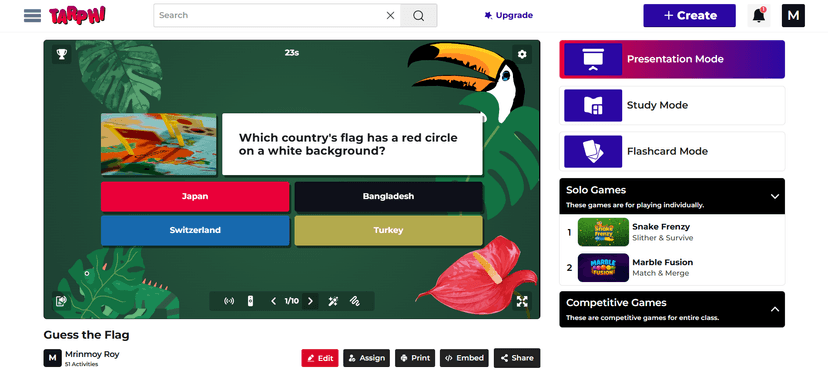
Tarphi uses a blended learning approach that combines direct teacher instruction with game-based retrieval practice. Educators log into the platform to design interactive lessons or generate quizzes using built-in AI tools. During a live class, teachers present the material while students join the session via their own devices to answer questions in real-time. This format forces active participation and provides immediate feedback to both the student and the teacher. Outside of live sessions, educators can assign quizzes as asynchronous homework. The platform tracks student responses, completion rates, and accuracy, feeding this data into an analytics dashboard. Teachers then use these metrics to identify struggling students and adjust future instruction. The mechanics focus heavily on low-stakes testing, which strengthens neural pathways associated with the recalled information.
Strengths and tradeoffs of Tarphi
Tarphi's biggest strength is its ability to facilitate frequent, low-stakes retrieval practice, while its biggest weakness is the potential for its game-based mechanics to cause cognitive overload. Retrieval Practice: By replacing passive lectures with interactive quizzes, the platform forces students to actively pull information from memory, which is proven to increase long-term retention. Immediate Feedback: The platform delivers real-time performance data, allowing teachers to correct misconceptions instantly before they take root. Engagement vs. Distraction: While gamification increases student participation, the competitive elements can distract from the learning objectives. When students focus on leaderboards rather than understanding the material, surface-level learning occurs. Content Quality: The platform relies heavily on AI-assisted content creation. Without built-in, peer-reviewed curriculum standards, the pedagogical rigor of the lessons varies wildly depending on the teacher's expertise and oversight. Missing Spacing Effects: The platform currently lacks automated spaced repetition algorithms, meaning teachers must manually reintroduce older concepts to prevent the natural forgetting curve.
Who Might Benefit From Tarphi?
Best for K-12 educators who want to integrate interactive, low-stakes assessments into their daily classroom routines. The platform serves the entire K-12 spectrum, adapting its interface for early childhood education through high school advanced placement courses. It is ideal for teachers looking to streamline lesson creation using AI while maintaining an active, blended learning environment. Parents will not use this app independently at home; rather, it is best suited for students whose schools have adopted it for homework delivery and live classroom engagement.
Data Transparency
Meets Data Transparency Standard
Tarphi meets our data transparency standard at Level 2 of 3 (Parent control). Level 3 needs the policy to document an API for retrieving their own data and a named export format.
30 of 35 checks passed
Level 1 · Basic protections
Does not sell data or target ads at students, limits sharing, and lets parents see and delete their child's data.
Level 2 · Parent control (meets the standard)
Families can get their data out, know who processes it, and know how long it is kept.
Level 3 · Direct data access
Families or schools can pull their own data through an API, in a stated format.
Not documented: an API for retrieving their own data, a named export format
View all 35 checks
Parent Access6/8
Does the policy mention parents specifically?
“Parents may review / request deletion via their child’s school; Tarphi completes verified requests within 30 days.”
Can parents view their child's data?
“Parents may review / request deletion via their child’s school; Tarphi completes verified requests within 30 days.”
Can parents modify their child's data?
The policy gives parents the right to review, delete and withdraw consent, but not to correct or modify their child's data.
Can parents delete their child's account?
“Parents may review / request deletion via their child’s school; Tarphi completes verified requests within 30 days.”
Is there a dedicated Children's Privacy section?
“Children’s Privacy & School Consent”
Does it reference COPPA compliance?
“allowing teachers and schools to authorize student participation consistent with FERPA and COPPA.”
Does it reference FERPA compliance?
“allowing teachers and schools to authorize student participation consistent with FERPA and COPPA.”
Is parental consent required for child accounts?
The policy uses a school-consent model, where teachers or schools authorize use on the parent's behalf, instead of requiring parental consent.
Data Portability3/5
Can users access their personal data?
“Access, correct, delete their data via dashboard or privacy@tarphi.com.”
Can users download/export their data?
“Rights (where applicable): access, deletion, correction, portability, limit sensitive use, and opt-out signals (GPC recognized).”
Is there a self-service data access tool?
“Access, correct, delete their data via dashboard or privacy@tarphi.com.”
Is a specific data format mentioned for export?
The policy says export is available but does not name a file format.
Is there an API for data access?
The policy mentions no API that lets users get their own data.
Data Minimization6/6
Is data collection itemized?
“Student data = nickname, avatar, responses, session logs (only for education).”
Can the app be used without a real name?
“We do not collect home address, real name, age, gender, or location”
Can the app be used without an email?
“Chosen nickname / username (no email required)”
Does it state collection is limited to what is necessary?
“Tarphi collects the minimum information necessary to support learning:”
Is IP address anonymized or truncated?
“Google Analytics 4 | Usage analytics | U.S. | Pseudonymized / IP anonymization”
Is location tracking explicitly excluded?
“We do not collect home address, real name, age, gender, or location”
Third-Party Protection7/7
Does it explicitly state no selling of data?
“No sale or rental of personal information”
Are third-party providers named?
“OpenAI | AI content generation for teachers | U.S. | No student data; DPA / no-training mode”
Are providers contractually restricted?
“All vendors are bound by Data Processing Agreements limiting use to educational services.”
No-targeted-advertising commitment?
“All analytics are configured for minors-safe use: no ads, remarketing, or cross-site tracking.”
Is AI/ML data sharing addressed?
“teacher-entered prompts processed via OpenAI API to generate content (no student data shared).”
Child-specific sharing restriction?
“Tarphi shares student information only with trusted service providers necessary to operate the platform. Each provider is bound by contract to protect privacy and use the information only to support Tarphi’s services.”
Cookies/tracking limited or opt-out?
“Tarphi uses cookies strictly for functionality and performance analytics.”
Deletion & Retention4/5
Can users delete their account?
“Access, correct, delete their data via dashboard or privacy@tarphi.com.”
Self-service deletion mechanism?
“Access, correct, delete their data via dashboard or privacy@tarphi.com.”
Specific data retention timeline?
“Analytics telemetry | 90 days (rolling) | Automatic rotation | Aggregate only”
Auto-deletion of inactive accounts?
The policy keeps data while the teacher account is active and does not describe deleting inactive accounts automatically.
Post-deletion handling described?
“Educator accounts | Active lifetime | Account closure → immediate | Backups purged ≤ 30 days”
Advertising4/4
Advertising model explicitly disclosed?
“No advertising networks, data brokers, or social media trackers are used on student interfaces.”
Free from third-party advertisements?
“No ads, no profiles, no external sharing.”
Children excluded from ad targeting?
“No ads or marketing to students”
Ad-free option available?
“No ads, no profiles, no external sharing.”
Meets Data Transparency Standard
The reviewed policy met our data transparency standard. This result describes the policy disclosures we assessed. Actual practices and legal compliance were not verified.
About this evaluation: Based on automated analysis of Tarphi Privacy Policy and Tarphi Children’s Privacy Notice against 35 policy-disclosure questions, including questions adapted from the Common Sense Privacy Program's published evaluation questions. TLS is not affiliated with Common Sense Media, and this is not a Common Sense rating. Quoted text is copied from the policy; unquoted notes are our summary. Results describe what the policy documents, not the company's actual practices. Privacy policies can change: this review reflects the version we analyzed and does not determine legal compliance.
Sources and review method
TLS combines product information and editorial analysis to explain how Tarphi works, its tradeoffs, and the questions to ask before choosing it. Product features, an instructional rationale and evidence of learning outcomes are different kinds of information.
Formal Learning Standard assessment: not yet completed. Data Transparency findings are reported separately and do not establish learning effectiveness. Read our methodology.
Frequently Asked Questions About Tarphi
Is Tarphi free?
Tarphi does not offer a permanent free tier. It operates on a subscription model, with a Standard plan starting at $5 per month billed yearly, and a Pro plan at $8 per month billed yearly.
Is Tarphi good for elementary students?
Yes, Tarphi supports early childhood and elementary education. The game-based interface is engaging for younger learners, though teachers must ensure the timed elements do not cause unnecessary stress for early readers.
What does Tarphi teach?
Tarphi does not teach a specific subject. It is a content-agnostic platform that teachers use to deliver instruction across all K-12 subjects, including math, science, humanities, and career and technical education.
How does Tarphi compare to Kahoot?
Like Kahoot, Tarphi relies on game-based live quizzes. However, Tarphi emphasizes a broader teaching workflow by integrating AI lesson creation, presentation tools, and asynchronous homework assignments into a single platform.
Has The Learning Standard evaluated Tarphi?
TLS has not yet completed a Learning Standard evaluation of how well Tarphi teaches. Its privacy policy has been reviewed for Data Transparency and reaches Level 2, Parent control.
Is Tarphi COPPA compliant?
The reviewed privacy policy references COPPA. A policy reference alone does not establish COPPA compliance. Policy review note: The policy refers to COPPA compliance.
Is Tarphi FERPA compliant?
The reviewed privacy policy references FERPA. A policy reference alone does not establish FERPA compliance. Policy review note: The policy refers to FERPA compliance.
Does Tarphi have a children's privacy policy?
The reviewed policy includes a dedicated children's privacy section. Policy review note: Section 12 has its own heading on children's privacy, and there is also a separate Children's Privacy Notice.
Does Tarphi sell student data?
The reviewed policy states that the app does not sell data. This is a policy statement; actual data practices were not verified. Policy review note: The policy states that Tarphi does not sell personal information.
Can you delete your data from Tarphi?
The reviewed privacy policy describes account deletion. We have not tested the deletion process. Policy review note: Educators can delete their data, and schools can request deletion.
Follow TLS Research
Subscribe to future TLS research updates: app reviews, findings, and what the evidence shows.
Screenshots

Take Action
For Tarphi
If you represent Tarphi and have a correction or new evidence, send the relevant source so we can review and update this page.
Submit a correctionDetails
- Pricing
- Standard ($7/month or $5/month billed yearly), and Pro ($10/month or $8/month billed yearly).
- Platforms
- Web Browser, iOS (Apple mobile), iPadOS (Apple tablet), Android (Google mobile), Tizen (Samsung mobile), Windows (Microsoft), macOS (Apple), Chrome OS (Google)
- Grade Levels
- Kindergarten, 1st Grade, 2nd Grade, 3rd Grade, 4th Grade, 5th Grade, 6th Grade, 7th Grade, 8th Grade, 9th Grade, 10th Grade, 11th Grade, 12th Grade
- Website
- Visit site