StrADDegy
Product by StrADDegy
Facts checked: Not yet checked
Our take (not a Learning Standard rating). This label applies to learning-science judgments throughout this overview.
Our take (not a Learning Standard rating)
While StrADDegy relies on visual tools and story contexts that align well with cognitive science principles for building conceptual math understanding, its overall effectiveness depends heavily on teacher implementation. The Learning Standard has not yet evaluated its specific outcomes, and its school-focused design limits independent home utility.
Pros
- Uses visual tools to build conceptual understanding of math facts rather than relying on rote memorization.
- Embeds addition and subtraction problems in story contexts to promote real-world application.
- Provides differentiated learning paths to adapt to individual student performance levels.
Cons
- Requires a paid school or district subscription rather than offering direct-to-consumer family plans.
- Relies heavily on teacher facilitation, making it largely ineffective for unsupervised independent home use.
- Lacks independent efficacy data as it is pending formal evaluation by The Learning Standard.
What Do We Know About StrADDegy?
StrADDegy shows potential for effective conceptual math instruction, but it is currently pending formal evaluation by The Learning Standard. This platform moves away from rote memorization of addition and subtraction facts. Instead, it relies on visual models and story-based contexts to help your child understand the "why" behind the math. Cognitive science supports this approach, as connecting abstract numbers to concrete visual representations improves long-term retention and flexibility in problem-solving. Because the app is designed primarily as a school or district solution, your child will likely use it in a classroom setting rather than as an independent home tool. It requires teacher direction to guide the investigations and facilitate the digital games. Parents should know that while the platform uses personalized learning to adjust difficulty, independent home access requires a teacher or school license. If your child uses this at school, you can expect them to engage with math concepts deeply rather than simply drilling timed flashcards.
How Does StrADDegy Work?
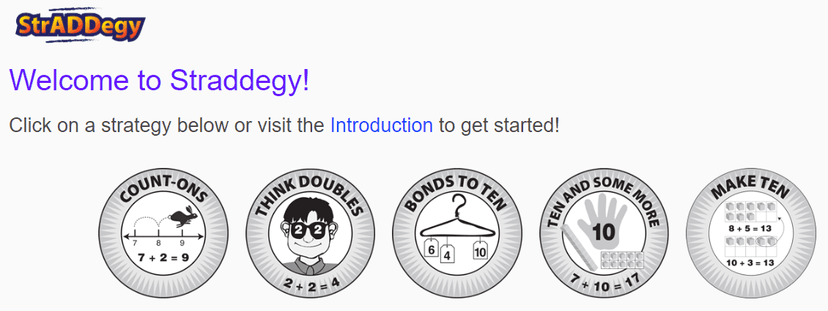
StrADDegy uses a blended pedagogical approach combining digital games, story contexts, and teacher-led investigations to build mathematical fluency. The platform introduces addition and subtraction facts through visual representations that anchor abstract numbers to concrete concepts. Students progress through a series of games and interactive scenarios that adapt to their current skill level based on performance. When your child interacts with a story context, they must apply mathematical reasoning rather than just retrieving a memorized answer. This method aligns with the cognitive principle of elaborative encoding, where new information is connected to existing knowledge for deeper memory storage. The system tracks student choices and adjusts the learning path to provide targeted practice where needed. Teachers use the platform's investigations to guide classroom discussions, making the digital component just one part of a broader instructional strategy.
Strengths and tradeoffs of StrADDegy
The biggest strength of StrADDegy is its reliance on visual tools to build conceptual math understanding, while its biggest weakness is its heavy dependence on teacher facilitation for independent home learning. Visual modeling is a highly effective instructional strategy. By forcing students to map abstract addition and subtraction facts onto visual representations, the app supports dual-coding theory, which improves memory retention. Contextual learning through stories also prevents students from applying math procedures blindly. On the downside, the platform requires a structured environment. Teacher dependency means the app is not a standalone tutor. If a student struggles, the digital games alone may not provide enough explicit instruction without intervention from an educator. Furthermore, the pricing model restricts access, as it is sold primarily via institutional licenses. The Learning Standard has not yet evaluated the specific feedback mechanisms within the app, but its foundational reliance on meaningful math investigations represents a strong theoretical framework for long-term learning.
Who Might Benefit From StrADDegy?
StrADDegy is best for elementary school students whose teachers use it as a supplemental tool for structured classroom math instruction. While the developer states it is for all ages, the direct focus on basic addition and subtraction makes it most appropriate for early elementary learners building foundational math fluency. It serves classrooms well by providing differentiated games and investigations that align with conceptual math frameworks. It is not ideal for parents seeking a standalone tutoring app, as its licensing heavily favors school-based implementation.
Data Transparency
Does Not Meet Data Transparency Standard
StrADDegy does not meet our data transparency standard. Its privacy policy does not document basic protections, including a commitment against targeted advertising, limits on sharing children's data and a COPPA or FERPA commitment.
4 of 35 checks passed
Evaluated September 2026
Privacy policy →Level 1 · Basic protections
Does not sell data or target ads at students, limits sharing, and lets parents see and delete their child's data.
Not documented: a commitment against targeted advertising, limits on sharing children's data, a COPPA or FERPA commitment, parents' right to see their child's data, parents' right to delete their child's data, account deletion
Level 2 · Parent control (meets the standard)
Families can get their data out, know who processes it, and know how long it is kept.
Not documented: users' right to access their data, data export, a data retention timeline, self-service deletion
Level 3 · Direct data access
Families or schools can pull their own data through an API, in a stated format.
Not documented: an API for retrieving their own data, a named export format
View all 35 checks
Parent Access0/8
Does the policy mention parents specifically?
The policy does not mention parents.
Can parents view their child's data?
The policy does not address parents viewing their child's data.
Can parents modify their child's data?
The policy does not address parents modifying their child's data.
Can parents delete their child's account?
The policy does not address parents deleting their child's data or account.
Is there a dedicated Children's Privacy section?
The policy has no section on children's privacy.
Does it reference COPPA compliance?
The policy does not reference COPPA.
Does it reference FERPA compliance?
The policy does not reference FERPA.
Is parental consent required for child accounts?
The policy says consent is obtained when a customer places an order and does not address parental consent for child accounts.
Data Portability0/5
Can users access their personal data?
The policy does not describe a right for users to access their personal data.
Can users download/export their data?
The policy does not address data download or export.
Is there a self-service data access tool?
The policy does not describe a self-service data access tool.
Is a specific data format mentioned for export?
The policy does not mention an export format.
Is there an API for data access?
The policy does not mention an API for data access.
Data Minimization1/6
Is data collection itemized?
“GPS Learning retains the names and email addresses of customers, including individual clients and organizational clients. GPS Learning does not retain any payment or credit card information, billing address information, or telephone contact information.”
Can the app be used without a real name?
The policy states it retains customers' names.
Can the app be used without an email?
The policy states it retains customers' email addresses.
Does it state collection is limited to what is necessary?
The policy limits how long data is kept and what is shared with third parties to what is necessary, but does not say collection is limited to what is necessary.
Is IP address anonymized or truncated?
The policy does not address IP address anonymization.
Is location tracking explicitly excluded?
The policy does not address location tracking.
Third-Party Protection3/7
Does it explicitly state no selling of data?
“We do not sell client lists or other personal information.”
Are third-party providers named?
“All information associated with payments made is stored on Shopify’s platform. Shopify is an e-commerce company which assists us in processing customer payments.”
Are providers contractually restricted?
“Such third-party service providers are only provided with such information as is necessary in the circumstances. Information provided to third parties may be used only for the purpose stipulated and is subject to strict terms of confidentiality.”
No-targeted-advertising commitment?
The policy does not address targeted advertising.
Is AI/ML data sharing addressed?
The policy does not address AI or machine learning.
Child-specific sharing restriction?
The policy has no sharing restriction specific to children.
Cookies/tracking limited or opt-out?
The policy does not address cookies or tracking.
Deletion & Retention0/5
Can users delete their account?
The policy does not describe a way for users to delete their account or data.
Self-service deletion mechanism?
The policy does not describe a self-service deletion mechanism.
Specific data retention timeline?
The policy says information is kept only as long as necessary and required, with no specific timeline.
Auto-deletion of inactive accounts?
The policy does not address automatic deletion of inactive accounts.
Post-deletion handling described?
The policy does not describe how data is handled after deletion.
Advertising0/4
Advertising model explicitly disclosed?
The policy does not address advertising.
Free from third-party advertisements?
The policy does not address third-party advertisements.
Children excluded from ad targeting?
The policy does not address ad targeting of children.
Ad-free option available?
The policy does not address advertising or an ad-free option.
What This Means
The policy review did not meet our data transparency standard. The checks above show the documented findings and unknowns. A missing statement does not establish how the app handles data in practice.
About this evaluation: Based on automated analysis of Privacy policy against 35 policy-disclosure questions, including questions adapted from the Common Sense Privacy Program's published evaluation questions. TLS is not affiliated with Common Sense Media, and this is not a Common Sense rating. Quoted text is copied from the policy; unquoted notes are our summary. Results describe what the policy documents, not the company's actual practices. Privacy policies can change: this review reflects the version we analyzed and does not determine legal compliance.
Sources and review method
TLS combines product information and editorial analysis to explain how StrADDegy works, its tradeoffs, and the questions to ask before choosing it. Product features, an instructional rationale and evidence of learning outcomes are different kinds of information.
Formal Learning Standard assessment: not yet completed. Data Transparency findings are reported separately and do not establish learning effectiveness. Read our methodology.
Frequently Asked Questions About StrADDegy
Is StrADDegy free?
No, StrADDegy is not free. It requires an annual subscription. Licenses are sold primarily to individual teachers, schools, or districts, meaning parents cannot easily purchase a standalone home version for their children.
Is StrADDegy good for elementary students?
Yes, the app focuses entirely on foundational addition and subtraction facts. This makes it highly relevant for early elementary students who are just beginning to build their core mathematical fluency.
What does StrADDegy teach?
StrADDegy teaches foundational mathematics, specifically focusing on addition and subtraction. It emphasizes deep conceptual understanding through visual tools and narratives rather than speed-based rote memorization.
How does StrADDegy compare to traditional flashcards?
Traditional flashcards rely on rote memorization, which often fails to build deep mathematical understanding. StrADDegy uses visual models and contextual stories to help students understand the mathematical reasoning behind addition and subtraction facts.
Has The Learning Standard evaluated StrADDegy?
TLS has not yet completed a Learning Standard evaluation of how well StrADDegy teaches. Its privacy policy has been reviewed for Data Transparency and does not yet document the basic protections (Level 1).
Is StrADDegy COPPA compliant?
A COPPA reference was not found in the reviewed privacy policy. This does not determine whether the app complies with COPPA. Policy review note: The policy does not reference COPPA.
Is StrADDegy FERPA compliant?
A FERPA reference was not found in the reviewed privacy policy. This does not determine whether the app complies with FERPA. Policy review note: The policy does not reference FERPA.
Does StrADDegy have a children's privacy policy?
No dedicated children's privacy section was found in the reviewed policy. Policy review note: The policy has no section on children's privacy.
Does StrADDegy sell student data?
The reviewed policy states that the app does not sell data. This is a policy statement; actual data practices were not verified. Policy review note: The policy states the company does not sell personal information.
Can you delete your data from StrADDegy?
Account deletion was not documented in the reviewed privacy policy. This does not establish whether deletion is available. Policy review note: The policy does not describe a way for users to delete their account or data.
Follow TLS Research
Subscribe to future TLS research updates: app reviews, findings, and what the evidence shows.
Screenshots

Take Action
For StrADDegy
If you represent StrADDegy and have a correction or new evidence, send the relevant source so we can review and update this page.
Submit a correctionDetails
- Pricing
- StrADDegy is an annual subscription sold to individual teachers, as a school site-based solution or most economically as a district solution. Please visit the website for current pricing - https://www.straddegy.com/products/straddegy-license
- Platforms
- Web Browser
- Website
- Visit site