Story Mii
Product by MiiApps Inc.
Facts checked: Not yet checked
Our take (not a Learning Standard rating). This label applies to learning-science judgments throughout this overview.
Our take (not a Learning Standard rating)
Story Mii engages reluctant readers by using AI to generate highly personalized narratives based on their interests. However, because it relies on generative AI rather than structured phonics or explicit vocabulary instruction, it serves better as a supplementary reading engagement tool than a foundational literacy curriculum.
Pros
- Leverages student interest to increase reading volume through highly personalized narrative generation.
- Provides translated texts to support dual-language learners and build cross-linguistic connections.
- Offers adjustable reading levels to ensure appropriate text complexity for different stages of literacy development.
- Encourages active participation by allowing children to select story elements and themes before reading.
Cons
- Lacks explicit and systematic phonics instruction required for foundational reading acquisition.
- Does not include comprehension checks or retrieval practice to verify understanding of the generated texts.
- Quality and pedagogical alignment of AI-generated stories can vary significantly depending on the prompts used.
- Community sharing features may distract from actual reading practice by encouraging passive browsing and scrolling.
What Do We Know About Story Mii?
Story Mii is an engaging supplementary tool for building reading fluency and motivation, but it is not a replacement for a structured, evidence-based literacy curriculum. Your child will interact with an AI engine to create custom stories featuring their specific interests, cultural backgrounds, and chosen themes. This high degree of personalization effectively reduces resistance in reluctant readers by leveraging their existing passions. The app allows you to adjust the text complexity, ensuring your child reads at an appropriate level. This aligns with the learning science principle of the zone of proximal development, keeping the text challenging but accessible. The inclusion of translation tools also makes it a viable option for bilingual families or children acquiring English as a second language. However, parents should note that Story Mii lacks the explicit, systematic instruction necessary to teach a child how to read from scratch. There are no phonics drills, phonemic awareness exercises, or structured vocabulary progressions. Furthermore, because the app relies on generative AI, the narrative quality and vocabulary choices can be inconsistent. While The Learning Standard has not yet formally evaluated Story Mii, early observations indicate it is best utilized alongside formal classroom instruction to boost reading volume and foster a general love of stories.
How Does Story Mii Work?
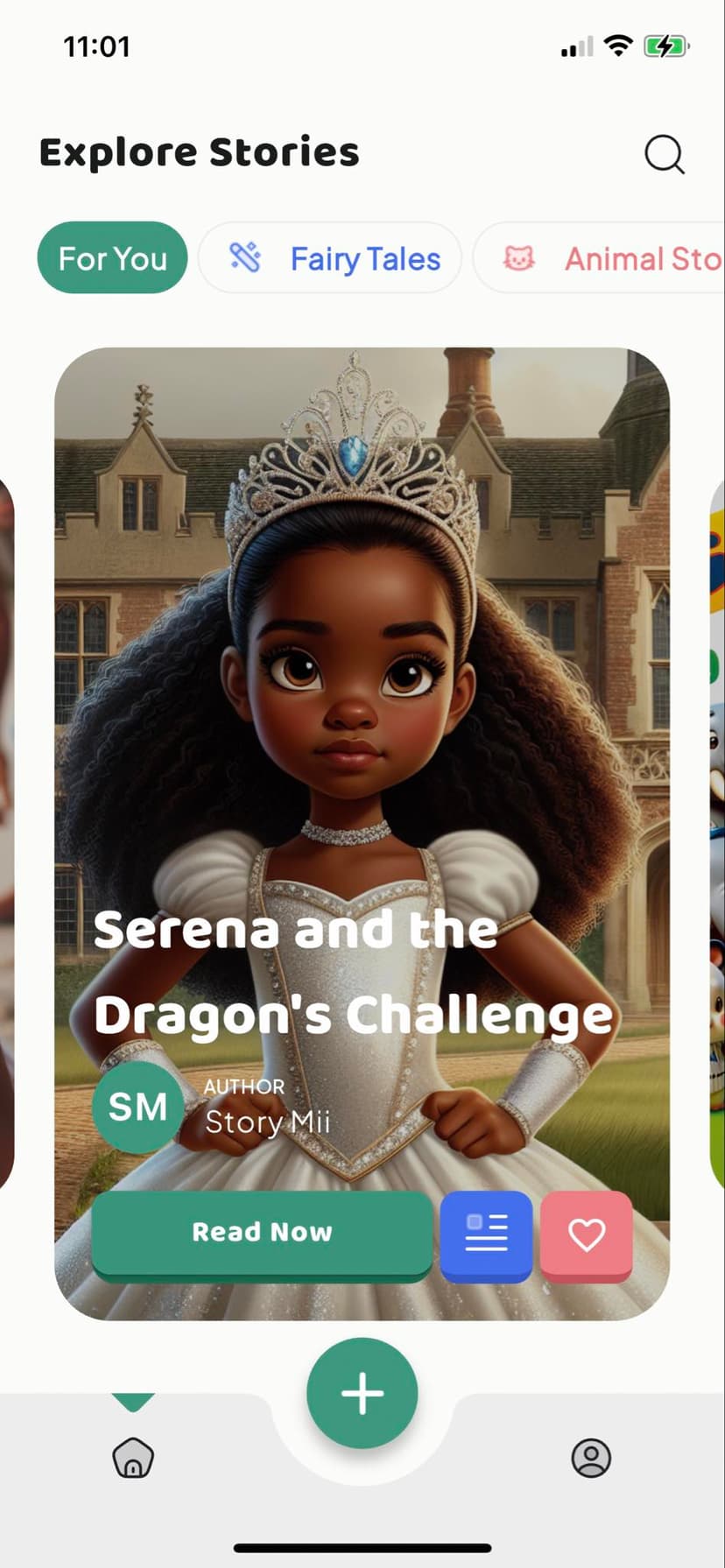
Story Mii uses personalized learning and gamification by leveraging generative AI to build customized reading materials around a child's specific inputs. Your child begins by selecting characters, settings, and themes that appeal to them. The AI then synthesizes these elements into a unique narrative formatted at their designated reading level. Once a story is generated, your child reads through the text on the screen. The app includes accessibility features such as text-to-speech and visual aids to support decoding. Children can also translate the text into different languages, which supports cross-linguistic transfer for dual-language learners. Beyond individual story creation, the app features a community platform where users publish and read stories generated by other children. This operates on a token economy. While reading published stories is free, generating new stories or translating texts costs tokens. You purchase these tokens individually or through a monthly or annual subscription. The platform emphasizes volume and engagement over targeted skills assessment, providing a constantly refreshing library of high-interest texts.
Strengths and tradeoffs of Story Mii
Story Mii's biggest strength is its ability to drive reading motivation through deep personalization, while its biggest weakness is the complete absence of explicit literacy instruction and comprehension checks. Motivation and Engagement are critical precursors to reading volume, and Story Mii excels here. By allowing your child to inject their own culture, names, and interests into the text, the app creates high intrinsic motivation. This increases the likelihood that a child will spend more time reading, which naturally builds fluency through repeated exposure to words. Language Flexibility is another strong point. The ability to toggle between languages supports vocabulary acquisition for English Language Learners by utilizing their home language as a bridge. Conversely, the app fails to incorporate Retrieval Practice or Comprehension Assessment. After your child reads a story, there are no questions to test if they understood the plot, inferred meaning, or acquired new vocabulary. Without feedback on their reading, children may simply skim texts without processing the meaning. Additionally, because it lacks a structured Phonics Progression, it cannot teach early decoding skills. Children who struggle with phonemic awareness will not find the targeted remediation they need here. The app relies entirely on exposure rather than systematic, explicit instruction.
Who Might Benefit From Story Mii?
Story Mii is best for elementary students who already possess basic decoding skills but need highly engaging texts to build reading fluency and volume. The app serves children aged 3 to 12, but its lack of explicit phonics instruction makes it unsuitable as a primary teaching tool for toddlers and kindergarteners just learning to read. It is an excellent choice for reluctant readers who resist standard books but will engage with stories featuring their own hyper-specific interests. It is also highly beneficial for bilingual families utilizing the translation features to practice reading in multiple languages.
Data Transparency
Does Not Meet Data Transparency Standard
Story Mii does not meet our data transparency standard. Its privacy policy does not document basic protections, including a statement that it does not sell data, a commitment against targeted advertising and limits on sharing children's data.
6 of 35 checks passed
Evaluated September 2026
StoryMii →Level 1 · Basic protections
Does not sell data or target ads at students, limits sharing, and lets parents see and delete their child's data.
Not documented: a statement that it does not sell data, a commitment against targeted advertising, limits on sharing children's data, contractual limits on service providers, a COPPA or FERPA commitment, parents' right to see their child's data, parents' right to delete their child's data
Level 2 · Parent control (meets the standard)
Families can get their data out, know who processes it, and know how long it is kept.
Not documented: users' right to access their data, data export, a data retention timeline, named service providers
Level 3 · Direct data access
Families or schools can pull their own data through an API, in a stated format.
Not documented: an API for retrieving their own data, a named export format
View all 35 checks
Parent Access3/8
Does the policy mention parents specifically?
“We only collect information about children as provided by the parent or guardian. We do not collect personal information from children directly.”
Can parents view their child's data?
The policy does not state that parents can view their child's data.
Can parents modify their child's data?
The policy lets users update information about themselves but does not address parents modifying their child's data.
Can parents delete their child's account?
The policy lets users delete information about themselves but does not address parents deleting their child's data or account.
Is there a dedicated Children's Privacy section?
“## 5\. Children's Privacy We take extra precautions to protect the privacy of users under 13.”
Does it reference COPPA compliance?
The policy mentions parental consent for children under 13 but does not reference COPPA.
Does it reference FERPA compliance?
The policy does not reference FERPA.
Is parental consent required for child accounts?
“We do not knowingly collect or solicit personal information from children under 13 without obtaining verifiable consent from their parents.”
Data Portability0/5
Can users access their personal data?
The policy lets users update, correct or delete their information but does not explicitly give them a right to access it.
Can users download/export their data?
The policy does not address downloading or exporting data.
Is there a self-service data access tool?
The policy does not describe a self-service tool for accessing data.
Is a specific data format mentioned for export?
The policy does not mention an export format.
Is there an API for data access?
The policy does not mention an API for data access.
Data Minimization1/6
Is data collection itemized?
“We may collect certain non-identifying information from your device, including but not limited to your IP address, geolocation information, unique device identifiers, browser type, browser language, and other transactional information.”
Can the app be used without a real name?
The policy states that it collects users' names.
Can the app be used without an email?
The policy states that it collects email addresses.
Does it state collection is limited to what is necessary?
The policy does not state that collection is limited to what is necessary.
Is IP address anonymized or truncated?
The policy states that it collects IP addresses and does not mention anonymizing or truncating them.
Is location tracking explicitly excluded?
The policy states that it may collect geolocation information.
Third-Party Protection0/7
Does it explicitly state no selling of data?
The policy does not explicitly state that it does not sell data.
Are third-party providers named?
The policy refers to third-party vendors and service providers in general terms without naming any.
Are providers contractually restricted?
The policy says providers work on its behalf but does not describe contractual restrictions.
No-targeted-advertising commitment?
The policy does not address targeted advertising.
Is AI/ML data sharing addressed?
The policy does not address sharing data for AI or machine learning.
Child-specific sharing restriction?
The policy does not include a sharing restriction specific to children's data.
Cookies/tracking limited or opt-out?
The policy does not address limiting or opting out of cookies or tracking.
Deletion & Retention2/5
Can users delete their account?
“You may update, correct, or delete information about you at any time by logging into your account and modifying your information or by emailing us.”
Self-service deletion mechanism?
“You may update, correct, or delete information about you at any time by logging into your account and modifying your information or by emailing us.”
Specific data retention timeline?
The policy does not give a data retention timeline.
Auto-deletion of inactive accounts?
The policy does not address automatic deletion of inactive accounts.
Post-deletion handling described?
The policy does not describe what happens to data after deletion.
Advertising0/4
Advertising model explicitly disclosed?
The policy does not address advertising.
Free from third-party advertisements?
The policy does not address third-party advertisements.
Children excluded from ad targeting?
The policy does not address ad targeting of children.
Ad-free option available?
The policy does not address advertising or an ad-free option.
What This Means
The policy review did not meet our data transparency standard. The checks above show the documented findings and unknowns. A missing statement does not establish how the app handles data in practice.
About this evaluation: Based on automated analysis of StoryMii against 35 policy-disclosure questions, including questions adapted from the Common Sense Privacy Program's published evaluation questions. TLS is not affiliated with Common Sense Media, and this is not a Common Sense rating. Quoted text is copied from the policy; unquoted notes are our summary. Results describe what the policy documents, not the company's actual practices. Privacy policies can change: this review reflects the version we analyzed and does not determine legal compliance.
Sources and review method
TLS combines product information and editorial analysis to explain how Story Mii works, its tradeoffs, and the questions to ask before choosing it. Product features, an instructional rationale and evidence of learning outcomes are different kinds of information.
Formal Learning Standard assessment: not yet completed. Data Transparency findings are reported separately and do not establish learning effectiveness. Read our methodology.
Frequently Asked Questions About Story Mii
Is Story Mii free?
Reading stories published by other users on Story Mii is completely free. However, generating custom stories or translating texts requires tokens. You can buy token packs starting at $1.99 or subscribe for $5.99 per month to receive a regular allotment of creation tokens.
Is Story Mii good for toddlers and preschoolers?
While marketed for ages 3-12, Story Mii is not ideal for teaching foundational reading to toddlers. Young children will enjoy having the custom stories read to them, but the app does not teach the phonics, letter recognition, or phonemic awareness required for early literacy acquisition.
What does Story Mii teach?
Story Mii primarily builds reading fluency and vocabulary through exposure to varied, high-interest texts. It does not teach decoding or phonics. By increasing reading volume through personalized engagement, it helps children practice the mechanics of reading and discover narrative structures.
Story Mii vs Epic! - which is better?
Epic! provides a massive library of professionally published, highly curated books with structured reading levels and comprehension quizzes. Story Mii focuses entirely on AI-generated, custom narratives. Epic! is better for diverse, reliable reading practice, while Story Mii is better for targeting a child's highly specific, niche interests.
Has The Learning Standard evaluated Story Mii?
TLS has not yet completed a Learning Standard evaluation of how well Story Mii teaches. Its privacy policy has been reviewed for Data Transparency and does not yet document the basic protections (Level 1).
Is Story Mii COPPA compliant?
A COPPA reference was not found in the reviewed privacy policy. This does not determine whether the app complies with COPPA. Policy review note: The policy mentions parental consent for children under 13 but does not reference COPPA.
Is Story Mii FERPA compliant?
A FERPA reference was not found in the reviewed privacy policy. This does not determine whether the app complies with FERPA. Policy review note: The policy does not reference FERPA.
Does Story Mii have a children's privacy policy?
The reviewed policy includes a dedicated children's privacy section. Policy review note: The policy has a dedicated Children's Privacy section.
Does Story Mii sell student data?
A statement ruling out data selling was not found in the reviewed policy. This does not establish that the app sells student data. Policy review note: The policy does not explicitly state that it does not sell data.
Can you delete your data from Story Mii?
The reviewed privacy policy describes account deletion. We have not tested the deletion process. Policy review note: Users can delete their information by logging in or by emailing the company.
Follow TLS Research
Subscribe to future TLS research updates: app reviews, findings, and what the evidence shows.
Screenshots

Take Action
For Story Mii
If you represent MiiApps Inc. and have a correction or new evidence, send the relevant source so we can review and update this page.
Submit a correctionDetails
- Pricing
- All Published stories are free to read: 15 tokens (2 Stories or 5 translations) for $1.99 USD. Monthly subscriptions (100 tokens - equivalent to 20 stories) for $5.99 USD/month. Yearly subscription (100 Tokens every 30 days) for $59.00 USD/Year.
- Platforms
- iOS (Apple mobile), iPadOS (Apple tablet), Android (Google mobile), Tizen (Samsung mobile), macOS (Apple)
- Grade Levels
- Infant/Toddler, Preschool, Prekindergarten, Transitional Kindergarten, Kindergarten, 1st Grade, 2nd Grade, 3rd Grade, 4th Grade, 5th Grade, 6th Grade
- Website
- Visit site