
Short Answer
Product by Short Answer
Facts checked: Not yet checked
Our take (not a Learning Standard rating). This label applies to learning-science judgments throughout this overview.
Our take (not a Learning Standard rating)
While The Learning Standard has not yet formally evaluated Short Answer, its use of active recall and gamified writing practice aligns with established learning science. It forces students to articulate understanding across subjects, which strengthens memory retention, though its reliance on gamification may distract from deeper mastery without teacher guidance.
Pros
- Promotes active recall by requiring students to generate written responses rather than selecting multiple-choice answers.
- Integrates writing practice across STEM and humanities subjects to support cross-curricular literacy.
- Utilizes mastery-based progression to allow students to work through writing tasks at an individualized pace.
- Requires active cognitive effort to synthesize concepts into original text, which strengthens long-term memory retention.
Cons
- Relies heavily on gamification elements that can sometimes distract students from the core learning objectives.
- Depends entirely on the quality of teacher-created prompts and feedback, meaning the app itself does not teach writing mechanics.
- Lacks independent empirical validation by The Learning Standard to confirm its long-term impact on student writing outcomes.
- May encourage shallow processing if students figure out how to game the system just to earn points without deep comprehension.
What Do We Know About Short Answer?
Short Answer is an effective tool for building your child's writing stamina through active recall, though its ultimate success depends heavily on how their teacher uses it. Because the platform spans multiple subjects from math to social studies, it forces your child to explain concepts in their own words rather than simply guessing on multiple-choice tests. This generation effect is a proven learning science principle that solidifies memory retention and deepens conceptual understanding. The platform uses gamification to make these writing exercises feel less tedious, which can keep your child engaged during otherwise difficult cognitive tasks. However, parents should be aware that educational games can sometimes prioritize points and leaderboards over actual comprehension. Since The Learning Standard has not yet fully evaluated this app, we cannot definitively rate its long-term impact on standardized writing scores or literacy development. Your child will benefit most if their teacher provides specific, actionable feedback on the short answers submitted through the platform, rather than relying solely on the software's automated progression mechanics to guide their learning.
How Does Short Answer Work?
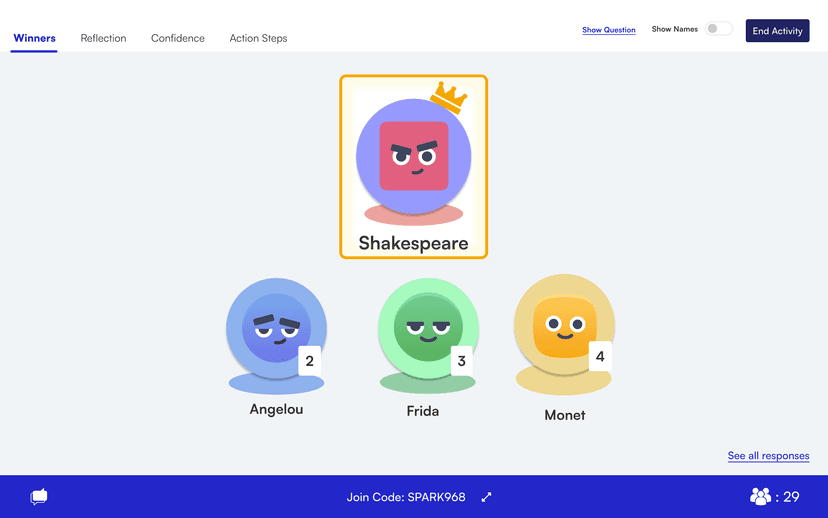
Short Answer uses a mastery-based gamification approach to facilitate frequent, low-stakes writing practice across all academic subjects. Teachers input custom writing prompts related to their current curriculum, and students respond using their individual classroom devices. By requiring students to generate original text, the platform leverages retrieval practice, forcing the brain to pull information from memory and organize it logically. Once students submit their work, the platform utilizes game-like mechanics to motivate continued practice and peer interaction. Students progress through personalized learning pathways based on their demonstrated competency with the writing tasks. The software acts as a digital facilitator, but the pedagogical heavy lifting still requires the teacher to design clear prompts and monitor the quality of the written output. The combination of cross-curricular writing and immediate interaction aims to build writing fluency through consistent repetition and high engagement.
Strengths and tradeoffs of Short Answer
Short Answer's biggest strength is its application of the generation effect across all subjects, while its biggest weakness is the potential for gamification to overshadow deep cognitive work. Active recall and generation are core to how the human brain learns, and by forcing students to write out answers in math, science, and humanities, the platform prevents the illusion of competence often created by simple multiple-choice questions. Cross-curricular integration ensures that writing is treated as a universal thinking tool rather than an isolated subject confined to English class. On the downside, gamified learning environments can sometimes lead to shallow processing, where students write just enough to earn points rather than truly mastering the material. Furthermore, feedback loops are entirely dependent on the teacher's implementation. Without high-quality, corrective feedback, students may inadvertently reinforce poor writing habits. Because this platform is pending evaluation by The Learning Standard, we cannot yet confirm whether its specific blend of gamification and mastery-based progression effectively mitigates these common instructional design risks.
Who Might Benefit From Short Answer?
Short Answer is best for middle and high school teachers who want to integrate low-stakes writing practice into non-traditional writing subjects like STEM and career technical education. While it is accessible for students from third through twelfth grade, older students who need to articulate complex concepts in science and social studies will benefit most from the platform's retrieval practice framework. It is an excellent fit for classrooms that utilize mastery-based learning and need a structured, engaging way to collect formative assessment data through student-generated text.
Data Transparency
Meets Data Transparency Standard
Short Answer meets our data transparency standard at Level 2 of 3 (Parent control). Level 3 needs the policy to document an API for retrieving their own data and a named export format.
24 of 35 checks passed
Evaluated September 2026
Privacy Policy →Level 1 · Basic protections
Does not sell data or target ads at students, limits sharing, and lets parents see and delete their child's data.
Level 2 · Parent control (meets the standard)
Families can get their data out, know who processes it, and know how long it is kept.
Level 3 · Direct data access
Families or schools can pull their own data through an API, in a stated format.
Not documented: an API for retrieving their own data, a named export format
View all 35 checks
Parent Access7/8
Does the policy mention parents specifically?
“Parents do have certain rights over minor children’s information.”
Can parents view their child's data?
“Parents may review their child’s personal information, direct their child’s school or district to delete it, and refuse to allow any further collection or use of the child’s information.”
Can parents modify their child's data?
The policy gives parents the rights to review, delete and refuse further collection, but not to modify their child's data.
Can parents delete their child's account?
“Parents may review their child’s personal information, direct their child’s school or district to delete it, and refuse to allow any further collection or use of the child’s information.”
Is there a dedicated Children's Privacy section?
“**10\. Information of Children**”
Does it reference COPPA compliance?
“We are compliant with COPPA and FERPA.”
Does it reference FERPA compliance?
“We are compliant with COPPA and FERPA.”
Is parental consent required for child accounts?
“Children under 13 must obtain parental consent before using the platform or creating their own account, or a parent or teacher must create a child’s account on their behalf.”
Data Portability1/5
Can users access their personal data?
“Parents may review their child’s personal information, direct their child’s school or district to delete it, and refuse to allow any further collection or use of the child’s information.”
Can users download/export their data?
The policy does not address downloading or exporting data.
Is there a self-service data access tool?
The policy mentions Account Settings for updating name, email and password, but no self-service tool for accessing data.
Is a specific data format mentioned for export?
The policy does not mention any export format.
Is there an API for data access?
The policy does not mention an API for data access.
Data Minimization2/6
Is data collection itemized?
“The Usage Data collected in our logs may include information such as your web request, Internet Protocol address, operating system, browser type, browser language, referring / exit pages and URLs, platform type, click history, domain names, landing pages, pages viewed and the order of those pages, the amount of time spent on particular pages, the date and time of your request, and whether you opened an email.”
Can the app be used without a real name?
The policy says first and last names of students may be collected.
Can the app be used without an email?
The policy says student email addresses may be collected.
Does it state collection is limited to what is necessary?
“We will not require a child to disclose more information than is reasonably necessary to participate in any activity associated with the Platform.”
Is IP address anonymized or truncated?
The policy says it collects IP addresses and does not say they are anonymized or truncated.
Is location tracking explicitly excluded?
The policy does not explicitly exclude location tracking.
Third-Party Protection5/7
Does it explicitly state no selling of data?
The policy says it does not share information with advertisers or marketers, but never explicitly says it does not sell data.
Are third-party providers named?
“the Short Answer Services may use third party analytics and bug tracking software (including, without limitation, Twilio Segment and Mixpanel) to collect further Usage Data”
Are providers contractually restricted?
“These service providers access and use User Information only to provide services to Short Answer under reasonable confidentiality terms.”
No-targeted-advertising commitment?
“we do not and we will not use any data collected on the platform for targeted advertising.”
Is AI/ML data sharing addressed?
The policy does not address AI or machine learning.
Child-specific sharing restriction?
“We have no intentions, desires, or plans to disclose any personally identifiable information of children to third parties. Also, we do not and we will not use any data collected on the platform for targeted advertising. Explicit and verifiable consent of parents would be collected before any disclosure of information in the unlikely scenario of such a need developing.”
Cookies/tracking limited or opt-out?
“You may be able to set your web browser to refuse all cookies, and your mobile device to not provide your mobile device identifier.”
Deletion & Retention5/5
Can users delete their account?
“You may also delete your account altogether there or by contacting us at support@scriblit.com.”
Self-service deletion mechanism?
“If you create an account, you may update or correct your name, email address, or password at any time by visiting your “Account Settings” link. You may also delete your account altogether there or by contacting us at support@scriblit.com.”
Specific data retention timeline?
“Short Answer automatically deletes accounts that have been inactive for a period of ten (10) consecutive months.”
Auto-deletion of inactive accounts?
“To minimize our data footprint and protect school data, Short Answer automatically deletes accounts that have been inactive for a period of ten (10) consecutive months.”
Post-deletion handling described?
“Upon deletion of an inactive account, associated Student Data and Personal Data are deleted from active systems, except where retention is required by applicable law, requested by the applicable School or district, or necessary for legitimate backup, security, audit, or compliance purposes, in accordance with any applicable Data Processing Agreement.”
Advertising4/4
Advertising model explicitly disclosed?
“However, Short Answer will never use Student Data to engage in targeted advertising, nor will Short Answer direct advertising to student users on any Short Answer Service, nor will Short Answer ever use any third-party advertising network on any Short Answer Service.”
Free from third-party advertisements?
“nor will Short Answer ever use any third-party advertising network on any Short Answer Service.”
Children excluded from ad targeting?
“However, Short Answer will never use Student Data to engage in targeted advertising, nor will Short Answer direct advertising to student users on any Short Answer Service”
Ad-free option available?
“nor will Short Answer direct advertising to student users on any Short Answer Service, nor will Short Answer ever use any third-party advertising network on any Short Answer Service.”
Meets Data Transparency Standard
The reviewed policy met our data transparency standard. This result describes the policy disclosures we assessed. Actual practices and legal compliance were not verified.
About this evaluation: Based on automated analysis of Privacy Policy against 35 policy-disclosure questions, including questions adapted from the Common Sense Privacy Program's published evaluation questions. TLS is not affiliated with Common Sense Media, and this is not a Common Sense rating. Quoted text is copied from the policy; unquoted notes are our summary. Results describe what the policy documents, not the company's actual practices. Privacy policies can change: this review reflects the version we analyzed and does not determine legal compliance.
Sources and review method
TLS combines product information and editorial analysis to explain how Short Answer works, its tradeoffs, and the questions to ask before choosing it. Product features, an instructional rationale and evidence of learning outcomes are different kinds of information.
Formal Learning Standard assessment: not yet completed. Data Transparency findings are reported separately and do not establish learning effectiveness. Read our methodology.
Frequently Asked Questions About Short Answer
Is Short Answer free?
Short Answer operates on a freemium pricing model designed primarily for classroom educators. Teachers can sign up and utilize the basic writing platform at no cost to facilitate standard classroom activities. For those needing advanced features, the developer offers a premium version that unlocks expanded functionality for $75 per year. Parents generally do not pay for this application, as it is licensed and implemented directly by the classroom teacher or school district.
Is Short Answer good for elementary students?
Short Answer is designed to accommodate students ranging from third grade all the way through twelfth grade. For elementary students in grades three through five, the platform offers a highly structured way to practice basic sentence construction and early paragraph writing. However, the requirement to read prompts and generate independent written responses means it is not suitable for early readers. Younger learners require significant teacher scaffolding to benefit from this tool.
What does Short Answer teach?
Short Answer does not provide its own standalone instructional curriculum. Instead, it serves as an empty digital vessel that relies entirely on teacher-provided content. Teachers input prompts related to their current unit, whether that is humanities, social science, science, math, or career and technical education. The platform teaches students how to articulate their understanding through written text, utilizing active recall to pull information from memory and construct coherent, subject-specific responses.
Does Short Answer replace traditional writing instruction?
No, Short Answer functions exclusively as a formative assessment and practice tool rather than a primary instructional curriculum. It relies entirely on classroom teachers to provide the foundational writing instruction, grammar lessons, and the specific subject-matter prompts that students respond to. While the platform utilizes gamification to increase engagement during practice sessions, it does not possess the capacity to independently teach a student how to structure an essay or formulate a thesis.
Has The Learning Standard evaluated Short Answer?
TLS has not yet completed a Learning Standard evaluation of how well Short Answer teaches. Its privacy policy has been reviewed for Data Transparency and reaches Level 2, Parent control.
Is Short Answer COPPA compliant?
The reviewed privacy policy references COPPA. A policy reference alone does not establish COPPA compliance. Policy review note: The policy says it complies with COPPA.
Is Short Answer FERPA compliant?
The reviewed privacy policy references FERPA. A policy reference alone does not establish FERPA compliance. Policy review note: The policy says it complies with FERPA.
Does Short Answer have a children's privacy policy?
The reviewed policy includes a dedicated children's privacy section. Policy review note: Section 10 is a dedicated children's privacy section.
Does Short Answer sell student data?
A statement ruling out data selling was not found in the reviewed policy. This does not establish that the app sells student data. Policy review note: The policy says it does not share information with advertisers or marketers, but never explicitly says it does not sell data.
Can you delete your data from Short Answer?
The reviewed privacy policy describes account deletion. We have not tested the deletion process. Policy review note: Users can delete their account.
Follow TLS Research
Subscribe to future TLS research updates: app reviews, findings, and what the evidence shows.
Screenshots



Latest News
All Short Answer NewsTake Action
For Short Answer
If you represent Short Answer and have a correction or new evidence, send the relevant source so we can review and update this page.
Submit a correctionDetails
- Pricing
- Short Answer is a "freemium" product. Teachers can sign up and use the basic version for free or upgrade to unlock expanded functionality in the premium version for $75 per year.
- Platforms
- Web Browser
- Grade Levels
- 3rd Grade, 4th Grade, 5th Grade, 6th Grade, 7th Grade, 8th Grade, 9th Grade, 10th Grade, 11th Grade, 12th Grade
- Website
- Visit site