
seamspace
Product by Tebahsoft, Inc.
Facts checked: Not yet checked
Our take (not a Learning Standard rating). This label applies to learning-science judgments throughout this overview.
Our take (not a Learning Standard rating)
Seamspace acts more as a monitoring tool than a direct instructional program. While its AI-driven journaling encourages expressive writing and self-reflection, it lacks explicit skill-building modules for social-emotional learning. The platform relies heavily on student self-reporting, making its educational value dependent on how teachers use the resulting dashboard data.
Pros
- Promotes metacognition by prompting students to regularly articulate their internal emotional states through structured journaling.
- Provides educators with aggregated, real-time data on classroom wellbeing to inform targeted behavioral interventions.
- Encourages regular writing practice, which builds foundational literacy skills alongside basic emotional processing.
- Uses responsive AI prompts to validate student feelings, creating a low-stakes environment for self-expression.
Cons
- Relies entirely on self-reported data, which can be skewed by student reluctance or misunderstanding of emotional vocabulary.
- Lacks direct instruction or worked examples of coping strategies to actively teach emotional regulation skills.
- Depends heavily on classroom teachers to translate dashboard data into meaningful instructional actions offline.
- Carries a steep institutional cost of $10,000 per school, placing it out of reach for individual parents or underfunded districts.
What Do We Know About seamspace?
Seamspace is not an effective standalone learning tool for your child, but rather an emotional monitoring dashboard for schools. The platform requires your child to log in and write journal entries about their day, which an AI system then analyzes for emotional keywords and trends. While the developer claims high accuracy in detecting stress or self-esteem issues, the educational value relies entirely on self-reflection rather than active instruction. Because it prompts your child to articulate their feelings, it exercises metacognitive skills and basic writing fluency. However, Seamspace does not explicitly teach coping mechanisms or emotional regulation strategies through structured lessons, spaced repetition, or behavioral modeling. Instead, it relies on an AI chatbot to offer empathetic responses and alerts your child's teachers if intervention is needed. Parents should understand that this is primarily a school-wide surveillance and support tool. If your child struggles with emotional regulation, this platform will track those struggles but will not directly teach them how to overcome them without a teacher stepping in to provide guidance based on the data.
How Does seamspace Work?
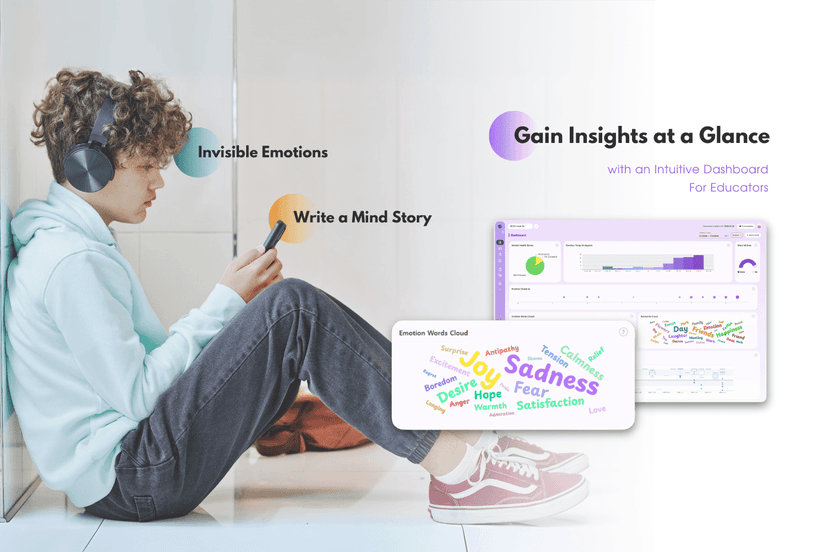
Seamspace uses an AI-mediated expressive writing approach to track and respond to student emotional states. Students log into the platform and complete digital journal entries responding to various prompts about their experiences and feelings. The system applies natural language processing to scan these text entries for vocabulary matching forty-six distinct emotional categories. As students write, an automated AI coach provides immediate, empathetic text responses to encourage further elaboration and continuous writing. This gamified chat interaction aims to increase student engagement with the journaling process. On the backend, the software aggregates this text data into a secure dashboard for educators, visualizing trends in classroom anxiety, stress, and self-esteem. Teachers are meant to use this aggregated data to identify specific students requiring additional support and to inform their broader classroom management strategies. The system blends this technology-driven monitoring with traditional classroom support, requiring educators to close the loop between data collection and actual skill instruction.
Strengths and tradeoffs of seamspace
Seamspace excels at encouraging continuous emotional self-reflection but fails to provide direct instruction on actionable coping strategies. Metacognitive processing is the platform's greatest asset. By requiring students to regularly name and describe their feelings, the app leverages the psychological principle of affect labeling, which has been shown to reduce emotional reactivity over time. The platform also provides immediate validation through its AI coach, offering a low-friction outlet for students who may be hesitant to speak directly to adults. However, the system's weaknesses are equally pronounced. The platform severely lacks explicit instruction. It relies entirely on assessment and tracking, incorrectly assuming that identifying an emotion is sufficient for managing it. There are no worked examples of conflict resolution, no spaced retrieval practice for behavioral strategies, and no direct teaching of emotional regulation techniques. Furthermore, the accuracy of self-reported data is highly variable, particularly in younger students who are still developing their emotional vocabulary. Ultimately, the software is highly dependent on the teacher's ability to interpret the AI-generated dashboard and deliver actual social-emotional interventions offline.
Who Might Benefit From seamspace?
Best for middle and high school administrators seeking a macro-level view of student wellbeing trends across a campus. Because the platform relies heavily on written journaling and complex emotional vocabulary, it is most effective for students in grades 6 through 12 who possess the necessary literacy skills to articulate internal states. It serves as a useful early-warning system for school counselors and teachers who have the training to implement targeted interventions based on the dashboard's data. It is not suitable for individual home use or younger elementary students.
Data Transparency
Does Not Meet Data Transparency Standard
seamspace reaches Level 1 of 3 (Basic protections), below our data transparency standard. Reaching Level 2 needs the policy to document data export and self-service deletion.
23 of 35 checks passed
Evaluated September 2026
[seamspace] Privacy Policy →Level 1 · Basic protections
Does not sell data or target ads at students, limits sharing, and lets parents see and delete their child's data.
Level 2 · Parent control (meets the standard)
Families can get their data out, know who processes it, and know how long it is kept.
Not documented: data export, self-service deletion
Level 3 · Direct data access
Families or schools can pull their own data through an API, in a stated format.
Not documented: an API for retrieving their own data, a named export format
View all 35 checks
Parent Access8/8
Does the policy mention parents specifically?
“Parents/legal guardians of users under 13 may request access or correction of their child’s information by contacting the Company or the educator.”
Can parents view their child's data?
“Parents/legal guardians of users under 13 may request access or correction of their child’s information by contacting the Company or the educator.”
Can parents modify their child's data?
“Parents/legal guardians of users under 13 may request access or correction of their child’s information by contacting the Company or the educator.”
Can parents delete their child's account?
“Parents/legal guardians may request account deletion or consent withdrawal for children under 13;”
Is there a dedicated Children's Privacy section?
“Section 14. Children Under the Age of 13 (COPPA Compliance)”
Does it reference COPPA compliance?
“The Company complies with the Children’s Online Privacy Protection Act (COPPA).”
Does it reference FERPA compliance?
“the Family Educational Rights and Privacy Act (FERPA) for safeguarding the privacy of student educational records, and”
Is parental consent required for child accounts?
“No child may register individually. All child accounts must be created and consented to by a verified parent/legal guardian or an authorized educator under school-based consent provisions.”
Data Portability2/5
Can users access their personal data?
“Users have the right to access and correct their personal information.”
Can users download/export their data?
The policy does not mention downloading or exporting data.
Is there a self-service data access tool?
“Students may review their own journals and LBTI results through the login interface.”
Is a specific data format mentioned for export?
The policy does not name any format for exported data.
Is there an API for data access?
The policy does not mention an API for getting data.
Data Minimization3/6
Is data collection itemized?
“At Registration: Name, email, ID, and optionally phone number. For student accounts, IDs may be created and distributed by educators or parents.”
Can the app be used without a real name?
The policy says a name is collected at registration.
Can the app be used without an email?
The policy says an email is collected at registration.
Does it state collection is limited to what is necessary?
“The Company does not collect or store sensitive data such as voice recordings, geolocation data, biometric identifiers, or other data not directly necessary for the delivery and improvement of the Service.”
Is IP address anonymized or truncated?
The policy says IP addresses are collected but does not say they are anonymized or truncated.
Is location tracking explicitly excluded?
“The Company does not collect or store sensitive data such as voice recordings, geolocation data, biometric identifiers, or other data not directly necessary for the delivery and improvement of the Service.”
Third-Party Protection6/7
Does it explicitly state no selling of data?
The policy only says personal information will not be sold if the company goes bankrupt or shuts down, and makes no general no-sale statement.
Are third-party providers named?
“OpenAI: Supports AI-powered journaling analysis.”
Are providers contractually restricted?
“All subcontractors are required to sign data protection agreements (DPAs);”
No-targeted-advertising commitment?
“The Company does not use advertising, behavioral tracking, or third-party analytics cookies in any child-directed or school-managed environments.”
Is AI/ML data sharing addressed?
“OpenAI: Supports AI-powered journaling analysis. The Company disables data logging and sharing features, ensuring that student-generated content is not retained or used for model training.”
Child-specific sharing restriction?
“Users under the age of 13 may only share content in systems where group sharing is enabled and managed by an adult administrator, and where such sharing is voluntarily chosen by the student.”
Cookies/tracking limited or opt-out?
“For users under the age of 13, only essential cookies necessary for secure access and service delivery are used.”
Deletion & Retention3/5
Can users delete their account?
“Parents/legal guardians may request account deletion or consent withdrawal for children under 13;”
Self-service deletion mechanism?
The policy handles deletion by request only and describes no self-service deletion tool.
Specific data retention timeline?
“Removed from backups through secure erasure processes within 30 days,”
Auto-deletion of inactive accounts?
The policy does not mention deleting inactive accounts automatically.
Post-deletion handling described?
“Permanently deleted from active systems,”
Advertising1/4
Advertising model explicitly disclosed?
The policy rules out advertising cookies in child and school settings but never says whether the product shows ads.
Free from third-party advertisements?
The policy does not say the product has no third-party advertisements.
Children excluded from ad targeting?
“The Company does not use advertising, behavioral tracking, or third-party analytics cookies in any child-directed or school-managed environments.”
Ad-free option available?
The policy does not say the product is ad-free or mention an ad-free option.
What This Means
The policy review did not meet our data transparency standard. The checks above show the documented findings and unknowns. A missing statement does not establish how the app handles data in practice.
About this evaluation: Based on automated analysis of [seamspace] Privacy Policy against 35 policy-disclosure questions, including questions adapted from the Common Sense Privacy Program's published evaluation questions. TLS is not affiliated with Common Sense Media, and this is not a Common Sense rating. Quoted text is copied from the policy; unquoted notes are our summary. Results describe what the policy documents, not the company's actual practices. Privacy policies can change: this review reflects the version we analyzed and does not determine legal compliance.
Sources and review method
TLS combines product information and editorial analysis to explain how seamspace works, its tradeoffs, and the questions to ask before choosing it. Product features, an instructional rationale and evidence of learning outcomes are different kinds of information.
Formal Learning Standard assessment: not yet completed. Data Transparency findings are reported separately and do not establish learning effectiveness. Read our methodology.
Frequently Asked Questions About seamspace
Is Seamspace free?
No, Seamspace is not a free application and is not designed for individual consumer use. It is an enterprise-level platform sold exclusively to educational institutions, schools, and districts. The software carries a steep institutional cost of approximately $10,000 per year per school. Because of this pricing structure and its reliance on a teacher dashboard, parents cannot download or purchase this tool independently for home use. Access is strictly managed through participating school districts.
Is Seamspace good for elementary students?
It is marginally effective for upper elementary students in grades 3 to 5, but highly dependent on existing reading and writing fluency. Because the platform relies entirely on independent, text-based journaling to fuel its AI analysis, younger students without strong expressive writing skills will struggle to engage. Children who cannot independently type or articulate complex emotional states will not generate the robust data required for the platform to provide accurate insights or trigger appropriate educator interventions.
What does Seamspace teach?
Seamspace facilitates metacognition and emotional awareness by prompting students to regularly write about their daily feelings and experiences. However, it does not actively teach explicit social-emotional skills, direct coping mechanisms, or behavioral strategies. There are no structured lessons or worked examples of conflict resolution. It serves primarily as an observational tracking and monitoring tool for educators. The actual teaching of emotional regulation relies entirely on the classroom teacher intervening after reviewing the AI-generated data.
How does Seamspace compare to traditional SEL curricula?
Traditional social-emotional learning curricula provide explicit, structured lessons with behavioral modeling, role-playing, and spaced practice. In contrast, Seamspace takes a fundamentally exploratory and data-gathering approach. It relies heavily on independent student journaling and artificial intelligence analysis to monitor baseline wellbeing rather than actively teaching specific social skills. Schools typically use Seamspace as a supplementary early-warning diagnostic tool to identify students in distress, whereas traditional programs serve as the primary instructional foundation for teaching emotional regulation.
Has The Learning Standard evaluated seamspace?
TLS has not yet completed a Learning Standard evaluation of how well seamspace teaches. Its privacy policy has been reviewed for Data Transparency and reaches Level 1, Basic protections.
Is seamspace COPPA compliant?
The reviewed privacy policy references COPPA. A policy reference alone does not establish COPPA compliance. Policy review note: The policy says the company complies with COPPA.
Is seamspace FERPA compliant?
The reviewed privacy policy references FERPA. A policy reference alone does not establish FERPA compliance. Policy review note: The policy lists FERPA among the laws it complies with.
Does seamspace have a children's privacy policy?
The reviewed policy includes a dedicated children's privacy section. Policy review note: Section 14 is a dedicated, headed section on children under 13 and COPPA.
Does seamspace sell student data?
A statement ruling out data selling was not found in the reviewed policy. This does not establish that the app sells student data. Policy review note: The policy only says personal information will not be sold if the company goes bankrupt or shuts down, and makes no general no-sale statement.
Can you delete your data from seamspace?
The reviewed privacy policy describes account deletion. We have not tested the deletion process. Policy review note: Account deletion can be requested.
Follow TLS Research
Subscribe to future TLS research updates: app reviews, findings, and what the evidence shows.
Screenshots


Take Action
For seamspace
If you represent Tebahsoft, Inc. and have a correction or new evidence, send the relevant source so we can review and update this page.
Submit a correctionDetails
- Pricing
- $10,000 / year / school
- Platforms
- Web Browser, iOS (Apple mobile), Android (Google mobile), Chrome OS (Google)
- Grade Levels
- 3rd Grade, 4th Grade, 5th Grade, 6th Grade, 7th Grade, 8th Grade, 9th Grade, 10th Grade, 11th Grade, 12th Grade, Adult Education
- Website
- Visit site