
SciQuiry
Product by SciQuiry
Facts checked: Not yet checked
Our take (not a Learning Standard rating). This label applies to learning-science judgments throughout this overview.
Our take (not a Learning Standard rating)
While SciQuiry claims to offer personalized science tutoring through mastery-based progression, The Learning Standard has not yet evaluated its effectiveness. Its competency-based structure theoretically supports knowledge retention by requiring proficiency before advancing, but without independent data on its retrieval practice mechanics, its actual learning impact remains unverified.
Pros
- Utilizes a competency-based progression model that requires students to demonstrate understanding before advancing to new material.
- Covers a broad span of science topics from kindergarten basics through ninth-grade applied science and career tech.
- Offers a freemium model that allows parents and educators to test basic functionality before committing to a subscription.
Cons
- Lacks independent evaluation data verifying the efficacy of its adaptive tutoring algorithms.
- Blended learning features may require substantial educator or parent oversight to function properly for younger primary students.
- The interface and questioning formats have not been verified for adherence to multimedia learning principles.
What Do We Know About SciQuiry?
SciQuiry is a potentially effective science platform, but its actual instructional value remains unverified because it is currently pending evaluation by The Learning Standard. For your child, the app promises an adaptive journey through general and applied sciences. It uses mastery-based learning, meaning your child cannot simply click through lessons; they must demonstrate proficiency in a concept before unlocking the next. This approach aligns well with established learning science, as it prevents foundational gaps from forming early in a student's education. However, until we analyze the platform's specific use of spaced repetition and feedback quality, we cannot guarantee it will improve your child's science grades. The app spans a massive age range from kindergarten to ninth grade, which often means the user interface struggles to engage both a five-year-old and a fifteen-year-old equally well. You can explore the basic features using the freemium tier, but monitor your child's initial sessions. Pay close attention to how the app handles wrong answers. If your child merely receives a red mark without a worked example explaining the correct scientific process, the app's instructional value is limited. We advise utilizing the free tier strictly as a supplemental tool until rigorous independent data proves its adaptive algorithm actually drives long-term retention.
How Does SciQuiry Work?
SciQuiry uses a competency-based, adaptive learning approach where students progress through science modules at their own pace. When your child logs in, the platform assesses their current knowledge level and serves up personalized lesson tracks. Because it is designed for blended learning, it is often used alongside traditional classroom instruction, allowing teachers to assign specific modules that align with their weekly curriculum. The core mechanic relies on continuous assessment. Students complete interactive tasks and quizzes to prove they understand the material. The adaptive engine theoretically adjusts the difficulty of these questions in real-time. If a student struggles with photosynthesis, the system should route them to remedial content or break the concept down into smaller, more manageable components. Once mastery is achieved, the system unlocks subsequent topics in applied science or career and technical education. This structured approach prevents students from advancing with critical misconceptions. By integrating these assessments directly into the learning flow, the platform attempts to create a seamless loop of instruction, practice, and evaluation.
Strengths and tradeoffs of SciQuiry
SciQuiry's biggest strength is its reliance on mastery-based progression, while its biggest weakness is the lack of independent verification regarding how it executes this pedagogy. By requiring students to reach a specific proficiency threshold before moving forward, the platform aligns with mastery learning principles. This prevents the common classroom issue where a class moves on to complex chemistry before a student fully grasps basic atomic structure. Another structural advantage is its inclusion of Career & Tech Education (CTE) alongside traditional science, bridging the gap between theoretical knowledge and real-world application. However, without a formal evaluation, significant instructional blind spots may exist. Effective science education requires rigorous retrieval practice and explanatory feedback. If SciQuiry relies heavily on multiple-choice questions without asking students to generate their own answers, the depth of learning will be shallow. Furthermore, the sheer breadth of the content covering K-9 grades suggests the app might rely on a standardized interface that lacks the necessary scaffolding for early readers in kindergarten and first grade. Cognitive load theory dictates that interfaces for young learners must minimize distractions, a factor not yet confirmed in this platform.
Who Might Benefit From SciQuiry?
SciQuiry is best for school districts and self-directed middle school students who need supplemental science practice aligned with a mastery-based curriculum. Because it spans from kindergarten to ninth grade, it serves as a continuous platform for families or schools wanting a single tool for multiple children. It is particularly suited for educators employing a blended learning environment where the software handles baseline knowledge acquisition while the teacher focuses on complex, hands-on scientific labs. Parents looking for career and technical education exposure for their eighth or ninth graders will also find its applied science tracks highly relevant.
Data Transparency
Does Not Meet Data Transparency Standard
SciQuiry does not meet our data transparency standard. Its privacy policy does not document basic protections, including a commitment against targeted advertising, limits on sharing children's data and contractual limits on service providers.
10 of 35 checks passed
Evaluated September 2026
Privacy policy →Level 1 · Basic protections
Does not sell data or target ads at students, limits sharing, and lets parents see and delete their child's data.
Not documented: a commitment against targeted advertising, limits on sharing children's data, contractual limits on service providers, parents' right to see their child's data, parents' right to delete their child's data
Level 2 · Parent control (meets the standard)
Families can get their data out, know who processes it, and know how long it is kept.
Not documented: data export, a data retention timeline, self-service deletion
Level 3 · Direct data access
Families or schools can pull their own data through an API, in a stated format.
Not documented: an API for retrieving their own data, a named export format
View all 35 checks
Parent Access4/8
Does the policy mention parents specifically?
“We do not knowingly collect personal information from children under 13 without parental consent.”
Can parents view their child's data?
The policy gives access rights to users generally and does not say parents can view their child's data.
Can parents modify their child's data?
The policy gives correction rights to users generally and does not say parents can modify their child's data.
Can parents delete their child's account?
The policy gives deletion rights to users generally and does not say parents can delete their child's data or account.
Is there a dedicated Children's Privacy section?
“Children's Privacy Our Service is designed for use by students in grades K-9.”
Does it reference COPPA compliance?
“We comply with the Children's Online Privacy Protection Act (COPPA) and similar laws.”
Does it reference FERPA compliance?
The policy does not mention FERPA.
Is parental consent required for child accounts?
“We do not knowingly collect personal information from children under 13 without parental consent.”
Data Portability1/5
Can users access their personal data?
“Depending on your location, you may have certain rights regarding your personal information, including: - Access to your data”
Can users download/export their data?
The policy does not mention downloading or exporting data.
Is there a self-service data access tool?
The policy directs users to contact the company and describes no self-service access tool.
Is a specific data format mentioned for export?
The policy does not mention any export format.
Is there an API for data access?
The policy does not describe an API for users to retrieve their data.
Data Minimization1/6
Is data collection itemized?
“Personal Information: This includes your name, email address, date of birth, school, and any other information you provide when registering for an account or contacting us.”
Can the app be used without a real name?
The policy states it collects users' names.
Can the app be used without an email?
The policy states it collects email addresses.
Does it state collection is limited to what is necessary?
The policy does not state that collection is limited to what is necessary.
Is IP address anonymized or truncated?
The policy says it collects IP addresses and does not mention anonymizing or truncating them.
Is location tracking explicitly excluded?
The policy does not address location tracking.
Third-Party Protection3/7
Does it explicitly state no selling of data?
“We do not sell your personal information to third parties.”
Are third-party providers named?
“Clever Single Sign-on: The Site enables students and educators to 1) create accounts and 2) log into the Site using Clever credentials.”
Are providers contractually restricted?
The policy mentions sharing with service providers and partners but not any contractual restrictions on them.
No-targeted-advertising commitment?
The policy does not commit to avoiding targeted advertising.
Is AI/ML data sharing addressed?
The policy does not address sharing data for AI or machine learning.
Child-specific sharing restriction?
The policy has no sharing restriction specific to children's data.
Cookies/tracking limited or opt-out?
“Cookies: We use cookies to improve your experience on our site. You can control the use of cookies through your browser settings.”
Deletion & Retention1/5
Can users delete their account?
“Deletion of your data”
Self-service deletion mechanism?
The policy requires contacting the company for deletion and describes no self-service mechanism.
Specific data retention timeline?
The policy does not state any data retention timeline.
Auto-deletion of inactive accounts?
The policy does not address automatic deletion of inactive accounts.
Post-deletion handling described?
The policy does not describe how data is handled after deletion.
Advertising0/4
Advertising model explicitly disclosed?
The policy does not disclose an advertising model or state that the product has no ads.
Free from third-party advertisements?
The policy does not state that the product is free of third-party advertisements.
Children excluded from ad targeting?
The policy does not address excluding children from ad targeting.
Ad-free option available?
The policy does not mention an ad-free option or state that the product has no advertising.
What This Means
The policy review did not meet our data transparency standard. The checks above show the documented findings and unknowns. A missing statement does not establish how the app handles data in practice.
About this evaluation: Based on automated analysis of Privacy policy against 35 policy-disclosure questions, including questions adapted from the Common Sense Privacy Program's published evaluation questions. TLS is not affiliated with Common Sense Media, and this is not a Common Sense rating. Quoted text is copied from the policy; unquoted notes are our summary. Results describe what the policy documents, not the company's actual practices. Privacy policies can change: this review reflects the version we analyzed and does not determine legal compliance.
Sources and review method
TLS combines product information and editorial analysis to explain how SciQuiry works, its tradeoffs, and the questions to ask before choosing it. Product features, an instructional rationale and evidence of learning outcomes are different kinds of information.
Formal Learning Standard assessment: not yet completed. Data Transparency findings are reported separately and do not establish learning effectiveness. Read our methodology.
Frequently Asked Questions About SciQuiry
Is SciQuiry free?
SciQuiry operates on a freemium model. Basic features are available for free to all students. However, full access requires a paid subscription, which costs $9.99 per student per month for parents, or an annual $10 per student license for schools and districts.
Is SciQuiry good for kindergarteners?
SciQuiry targets K-9 students, but its effectiveness for kindergarteners is pending evaluation. Young learners typically require highly interactive, voice-guided interfaces with low cognitive load. Parents should test the free version to ensure the app does not rely too heavily on text-based instruction before purchasing a subscription.
What does SciQuiry teach?
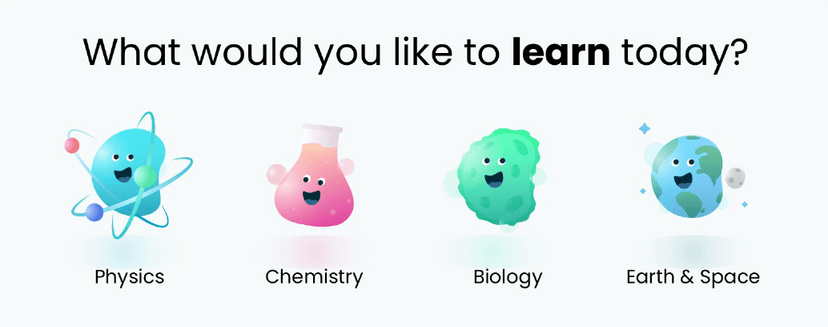
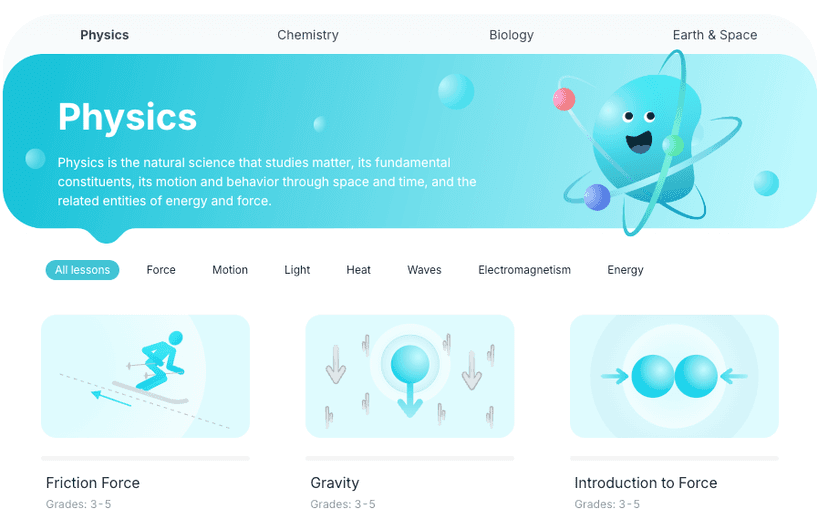
SciQuiry teaches general Science, Applied Science, and Career & Technical Education (CTE). The curriculum scales from foundational elementary science concepts up to ninth-grade material, focusing on personalized tracks that adapt to a student's individual proficiency level.
Does SciQuiry use spaced repetition?
SciQuiry claims to use an intelligent, adaptive tutoring platform, but The Learning Standard has not yet evaluated its specific mechanics. Effective adaptive engines typically incorporate spaced repetition, but you should review our methodology page to understand how we verify these learning science principles once an app is officially rated.
SciQuiry vs. Khan Academy: Which is better?
Khan Academy is a fully free, independently verified platform with robust worked examples and mastery-based progression across multiple subjects. SciQuiry specifically targets science and career tech with a paid adaptive model. Until SciQuiry is formally evaluated, Khan Academy remains the more proven, cost-effective option for core science instruction.
Has The Learning Standard evaluated SciQuiry?
TLS has not yet completed a Learning Standard evaluation of how well SciQuiry teaches. Its privacy policy has been reviewed for Data Transparency and does not yet document the basic protections (Level 1).
Is SciQuiry COPPA compliant?
The reviewed privacy policy references COPPA. A policy reference alone does not establish COPPA compliance. Policy review note: The policy states COPPA compliance.
Is SciQuiry FERPA compliant?
A FERPA reference was not found in the reviewed privacy policy. This does not determine whether the app complies with FERPA. Policy review note: The policy does not mention FERPA.
Does SciQuiry have a children's privacy policy?
The reviewed policy includes a dedicated children's privacy section. Policy review note: The policy has a dedicated Children's Privacy section.
Does SciQuiry sell student data?
The reviewed policy states that the app does not sell data. This is a policy statement; actual data practices were not verified. Policy review note: The policy states the company does not sell personal information.
Can you delete your data from SciQuiry?
The reviewed privacy policy describes account deletion. We have not tested the deletion process. Policy review note: The policy lists deletion of data as a right users can request by contacting the company.
Follow TLS Research
Subscribe to future TLS research updates: app reviews, findings, and what the evidence shows.
Screenshots
Take Action
For SciQuiry
If you represent SciQuiry and have a correction or new evidence, send the relevant source so we can review and update this page.
Submit a correctionDetails
- Pricing
- One-time license for schools/districts ($10 per student/ year). Monthly subscription for parents ($9.99 per student/ month). Freemium Model - Basic features for all students.
- Platforms
- Web Browser, iOS (Apple mobile), iPadOS (Apple tablet), Android (Google mobile), Tizen (Samsung mobile), Windows (Microsoft), macOS (Apple), Chrome OS (Google)
- Grade Levels
- Kindergarten, 1st Grade, 2nd Grade, 3rd Grade, 4th Grade, 5th Grade, 6th Grade, 7th Grade, 8th Grade, 9th Grade
- Website
- Visit site