
SchoolAI
Product by SchoolAI
Facts checked: Not yet checked
Our take (not a Learning Standard rating). This label applies to learning-science judgments throughout this overview.
Our take (not a Learning Standard rating)
SchoolAI empowers teachers to build custom, inquiry-based chatbots, but its direct teaching effectiveness depends entirely on how the educator configures it. The platform excels at providing safe, sandboxed AI environments for guided practice, though it lacks built-in curriculum or independent spaced repetition mechanics. Note: This tool is pending formal evaluation by The Learning Standard.
Pros
- Provides a FERPA and COPPA compliant sandbox for students to interact with large language models.
- Allows educators to design specific guardrails and prompts to constrain cognitive load during assignments.
- Supports personalized pacing by letting students ask clarifying questions without interrupting classroom flow.
- Generates real-time transcripts for teachers to monitor student comprehension and inquiry strategies.
Cons
- Lacks a structured, evidence-based curriculum, relying completely on the teacher for pedagogical design.
- Does not include automated spaced repetition or retrieval practice schedules.
- Requires significant setup time and prompt engineering skills from the educator to function effectively.
- May produce AI hallucinations if teacher-defined parameters are too broad.
What Do We Know About SchoolAI ?
SchoolAI is effective for learning only when a skilled teacher designs its parameters to support specific instructional goals. Your child does not use this app as a standalone curriculum or a self-paced tutor. Instead, it acts as a classroom tool where teachers create custom, monitored AI chat spaces. When your child logs in, they interact with an AI configured to act as a historical figure, a debate opponent, or a science lab assistant. This approach leverages active learning by forcing your child to generate questions and responses rather than passively consuming information. Because the teacher monitors all transcripts, they can intervene when your child exhibits misconceptions. However, the app itself does not contain built-in learning science mechanisms like spaced repetition or retrieval practice schedules. Its value lies entirely in the prompt engineering and scaffolding provided by the educator. Furthermore, the platform isolates your child in a safe, COPPA-compliant environment, removing the privacy risks associated with open AI models. This platform is currently pending evaluation by The Learning Standard, so formal efficacy data is not yet available.
How Does SchoolAI Work?
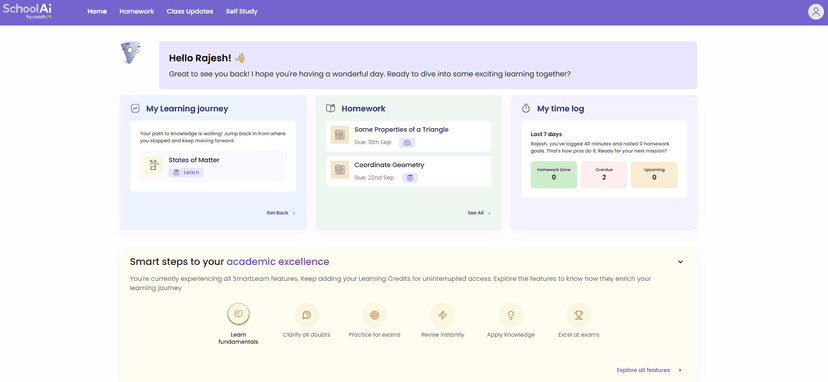
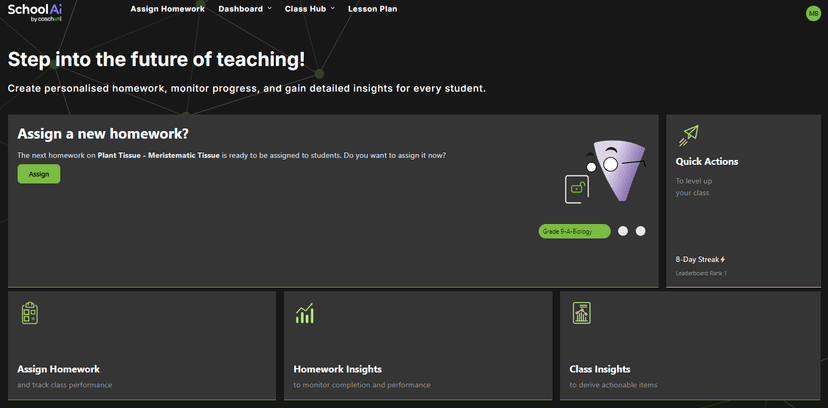
SchoolAI uses inquiry-based, teacher-scaffolded AI interactions to support classroom instruction. Educators log into a dashboard to create Spaces, which are customized chatbot environments programmed with specific system prompts and guardrails. A teacher might design a Space that refuses to give direct answers, forcing students to solve a math problem through guided hints. Students access these Spaces via a link or code and engage in text-based dialogue with the AI. The system employs natural language processing to adapt to student inputs, offering immediate, personalized feedback based on the teacher's predefined rules. As students interact, the platform logs the conversation and analyzes the data for the teacher, highlighting areas where students struggle. This allows educators to identify knowledge gaps and adjust their real-world instruction accordingly. Because the AI is constrained by the teacher's instructions, it prevents students from bypassing the productive struggle necessary for deep learning.
Strengths and tradeoffs of SchoolAI
SchoolAI's biggest strength is its ability to facilitate safe, highly customized active learning conversations, while its biggest weakness is its complete reliance on the teacher for pedagogical structure. The platform shines in providing immediate, tailored feedback. When a teacher configures the AI to act as a Socratic tutor, students benefit from guided inquiry, which cognitive science shows is highly effective for deepening conceptual understanding. It allows students to test hypotheses and receive instant corrections without the fear of peer judgment. Furthermore, the built-in monitoring tools give teachers excellent visibility into student thinking processes. Conversely, SchoolAI does not inherently utilize proven learning science principles like spaced repetition or interleaving. It is essentially an empty vessel. If a teacher builds a poor prompt, the AI might simply give students the answers, eliminating the productive struggle required for memory encoding. The tool also lacks formal assessments to measure long-term retention. Because SchoolAI is pending evaluation by The Learning Standard, we cannot yet verify its impact on standardized outcomes, but its utility as a supplementary scaffolding tool is evident.
Who Might Benefit From SchoolAI ?
Best for middle and high school teachers who want to safely integrate generative AI into inquiry-based classroom activities. The platform serves students from 3rd to 12th grade across all major subjects, but it requires a baseline of reading comprehension and typing ability to be effective. It is an excellent fit for project-based learning, cross-curricular assignments, and classrooms practicing blended learning. Because it is priced per faculty user, it is ideal for school districts seeking COPPA-compliant AI solutions that keep educators in the loop rather than replacing them with automated tutors.
Data Transparency
Meets Data Transparency Standard
SchoolAI meets our data transparency standard at Level 2 of 3 (Parent control). Level 3 needs the policy to document an API for retrieving their own data and a named export format.
23 of 35 checks passed
Evaluated October 2026
Website Privacy Policy GDPR →Website Privacy Policy GDPR ( Effective Aug 1, 2026) →Level 1 · Basic protections
Does not sell data or target ads at students, limits sharing, and lets parents see and delete their child's data.
Level 2 · Parent control (meets the standard)
Families can get their data out, know who processes it, and know how long it is kept.
Level 3 · Direct data access
Families or schools can pull their own data through an API, in a stated format.
Not documented: an API for retrieving their own data, a named export format
View all 35 checks
Parent Access8/8
Does the policy mention parents specifically?
“● **"Parent"** means a legal guardian of a Child.”
Can parents view their child's data?
“● Review the Personal Information SchoolAI holds about your Child;”
Can parents modify their child's data?
“● Request correction of inaccurate Personal Information about your Child;”
Can parents delete their child's account?
“● Request deletion of your Child’s Personal Information.”
Is there a dedicated Children's Privacy section?
“Children’s Privacy Notice and COPPA Disclosure (“COPPA Notice”)”
Does it reference COPPA compliance?
“SchoolAI will not make material changes to the COPPA Notice without prior notice to the Client, and will obtain renewed authorization from Client or new verifiable parental consent (as applicable under COPPA) before any material change takes effect.”
Does it reference FERPA compliance?
“(i) Client agrees that SchoolAI is performing an institutional service or function for which Client would otherwise use employees, and Client therefore designates SchoolAI as a “School Official” with “Legitimate Educational Interests” (as those terms are defined in FERPA);”
Is parental consent required for child accounts?
“(ii) Client consents on behalf of parents or guardians to the collection, use, and disclosure of such Personal Information with respect to use of the Products as described in SchoolAI’s COPPA Notice.”
Data Portability2/5
Can users access their personal data?
“Authorized Users may review, obtain a copy of and amend their own PII by contacting Client and following Client’s procedures for amending PII.”
Can users download/export their data?
“Authorized Users may review, obtain a copy of and amend their own PII by contacting Client and following Client’s procedures for amending PII.”
Is there a self-service data access tool?
The policy sends users to their Institution for access requests and does not describe a tool users can operate themselves.
Is a specific data format mentioned for export?
The policy does not name a format for exported data.
Is there an API for data access?
The policy mentions an API only for receiving SSO data, not for users or schools to retrieve their own data.
Data Minimization2/6
Is data collection itemized?
“● The Child’s SSO Provider username and unique SSO Provider identifier;”
Can the app be used without a real name?
The policy states it collects the child's first and last name.
Can the app be used without an email?
The policy states it collects the child's email address.
Does it state collection is limited to what is necessary?
“SchoolAI collects only the Personal Information from a Child that is reasonably necessary for the Child to use the Products for purposes authorized by an Institution. We do not collect more than that.”
Is IP address anonymized or truncated?
The policy states it collects IP addresses and does not say they are anonymized or truncated.
Is location tracking explicitly excluded?
The policy states it collects approximate geolocation derived from the IP address, so location tracking is not excluded.
Third-Party Protection7/7
Does it explicitly state no selling of data?
“● we do not sell, rent, or trade Children's Personal Information;”
Are third-party providers named?
“transmits the audio to SchoolAI’s speech-to-text sub-processor (currently Deepgram) solely for transcription”
Are providers contractually restricted?
“SchoolAI will enter into written agreements with each Sub-Processor containing terms that provide substantially similar levels of data protection and obligations for Client PII as those set out in this DPA.”
No-targeted-advertising commitment?
“**We do not** share Children's Personal Information for targeted advertising.”
Is AI/ML data sharing addressed?
“are not used by SchoolAI, Deepgram, or any other party to train, fine-tune, or improve any artificial intelligence or machine-learning model for any purpose outside the direct educational features of the Product.”
Child-specific sharing restriction?
“**We do not** share Children's Personal Information with third parties for those parties' own marketing or commercial purposes.”
Cookies/tracking limited or opt-out?
“complying with legal obligations. We do not place third-party marketing or advertising cookies, tags, or trackers on the Child-facing portions of the Products;”
Deletion & Retention3/5
Can users delete their account?
“● we will delete Children's Personal Information upon the Institution's request;”
Self-service deletion mechanism?
The policy handles deletion only by request through the Institution and does not describe a self-service tool for users.
Specific data retention timeline?
“Client PII will be deleted within ninety (90) days following a written request after the data is no longer needed for the purpose for which it was collected,”
Auto-deletion of inactive accounts?
The policy does not address deleting inactive accounts automatically.
Post-deletion handling described?
“Upon Client’s written request, SchoolAI will provide written certification that such return or deletion has been completed.”
Advertising1/4
Advertising model explicitly disclosed?
The policy rules out targeted advertising and ad trackers but does not explicitly say whether the product has advertising.
Free from third-party advertisements?
The policy rules out targeted advertising and ad cookies on child-facing parts, but does not say the product is free of third-party ads.
Children excluded from ad targeting?
“**We do not** share Children's Personal Information for targeted advertising.”
Ad-free option available?
The policy does not say the product has no advertising and does not offer an ad-free option.
Meets Data Transparency Standard
The reviewed policy met our data transparency standard. This result describes the policy disclosures we assessed. Actual practices and legal compliance were not verified.
About this evaluation: Based on automated analysis of Website Privacy Policy GDPR and Website Privacy Policy GDPR ( Effective Aug 1, 2026) against 35 policy-disclosure questions, including questions adapted from the Common Sense Privacy Program's published evaluation questions. TLS is not affiliated with Common Sense Media, and this is not a Common Sense rating. Quoted text is copied from the policy; unquoted notes are our summary. Results describe what the policy documents, not the company's actual practices. Privacy policies can change: this review reflects the version we analyzed and does not determine legal compliance.
Sources and review method
TLS combines product information and editorial analysis to explain how SchoolAI works, its tradeoffs, and the questions to ask before choosing it. Product features, an instructional rationale and evidence of learning outcomes are different kinds of information.
Formal Learning Standard assessment: not yet completed. Data Transparency findings are reported separately and do not establish learning effectiveness. Read our methodology.
Frequently Asked Questions About SchoolAI
Is SchoolAI free?
No, SchoolAI is not free for full access. It operates on a pricing model based on per-faculty user licenses, typically purchased by schools or districts. There may be limited trial access for individual teachers, but institutional adoption is required for wide-scale deployment.
Is SchoolAI good for elementary students?
Partially, though it is better suited for older students. While rated for grades 3 and up, the heavy reliance on reading and text-based chatting means younger children may experience cognitive overload. It works best for grades 6 through 12 where students can type fluently and engage in complex inquiry.
What does SchoolAI teach?
SchoolAI does not teach a specific curriculum. Instead, it supports instruction across Humanities, Social Science, Science, Math, and Career & Technical Education by allowing teachers to build custom AI chatbots. The AI can act as a tutor, historical figure, or debate partner based on the teacher's lesson plan.
How does SchoolAI compare to ChatGPT for classrooms?
SchoolAI provides necessary guardrails that consumer tools like ChatGPT lack. While both use large language models, SchoolAI allows teachers to restrict the AI's behavior, prevent it from simply giving students the answers, and monitor all student conversations to ensure data privacy and pedagogical alignment.
Has The Learning Standard evaluated SchoolAI?
TLS has not yet completed a Learning Standard evaluation of how well SchoolAI teaches. Its privacy policy has been reviewed for Data Transparency and reaches Level 2, Parent control.
Is SchoolAI COPPA compliant?
The reviewed privacy policy references COPPA. A policy reference alone does not establish COPPA compliance. Policy review note: The policy states it complies with COPPA.
Is SchoolAI FERPA compliant?
The reviewed privacy policy references FERPA. A policy reference alone does not establish FERPA compliance. Policy review note: The policy states it complies with FERPA as a School Official.
Does SchoolAI have a children's privacy policy?
The reviewed policy includes a dedicated children's privacy section. Policy review note: There is a dedicated Children's Privacy Notice and COPPA Disclosure.
Does SchoolAI sell student data?
The reviewed policy states that the app does not sell data. This is a policy statement; actual data practices were not verified. Policy review note: The vendor states it does not sell children's data.
Can you delete your data from SchoolAI ?
The reviewed privacy policy describes account deletion. We have not tested the deletion process. Policy review note: Data is deleted when requested through the Institution.
Follow TLS Research
Subscribe to future TLS research updates: app reviews, findings, and what the evidence shows.
Screenshots
Latest News
All SchoolAI NewsHow Florida Teachers Use AI to Decode Complex B.E.S.T. Standards
Florida educators are using AI tools like SchoolAI to decode complex B.E.S.T. academic standards and design daily lessons that prove student mastery.
Union-Backed Deal Restricts How Microsoft Uses Student Data
Microsoft agreed to legally binding AI privacy terms with the AFT. Learn how school districts can enforce these protections to keep student data secure.
Anthropic Launches Claude Fable 5.1: What It Means for Schools
Anthropic's new Claude Fable 5.1 model brings cheaper rates and fewer safety blocks, but invisible watermarks and strict school budgets raise critical questions.
Take Action
For SchoolAI
If you represent SchoolAI and have a correction or new evidence, send the relevant source so we can review and update this page.
Submit a correctionDetails
- Pricing
- Per faculty user
- Platforms
- Web Browser, iOS (Apple mobile), iPadOS (Apple tablet), Android (Google mobile), Tizen (Samsung mobile), Windows (Microsoft), macOS (Apple), Chrome OS (Google)
- Grade Levels
- 3rd Grade, 4th Grade, 5th Grade, 6th Grade, 7th Grade, 8th Grade, 9th Grade, 10th Grade, 11th Grade, 12th Grade
- Website
- Visit site