Scholastic W.O.R.D.
Product by Scholastic Inc.
Facts checked: Not yet checked
Our take (not a Learning Standard rating). This label applies to learning-science judgments throughout this overview.
Our take (not a Learning Standard rating)
Scholastic W.O.R.D. grounds its vocabulary instruction in proven morphological research, focusing on high-utility word families. However, because The Learning Standard has not yet evaluated this app, we cannot definitively confirm its efficacy in practice. It promises strong cross-curricular knowledge building but requires school-level implementation.
Pros
- Focuses instruction on high-utility word families rather than isolated vocabulary terms.
- Builds background knowledge across multiple subjects to support broader reading comprehension.
- Utilizes a mastery-based progression model that requires students to demonstrate competence before advancing.
- Provides educators with specific data dashboards to monitor word acquisition and track student progress.
Cons
- Limits access to institutional purchasers, preventing parents from utilizing the program independently at home.
- Relies heavily on gamification features that risk distracting from core cognitive tasks.
- Lacks independent efficacy evaluation by The Learning Standard to verify its pedagogical claims.
What Do We Know About Scholastic W.O.R.D.?
Scholastic W.O.R.D. uses research-backed methods to teach high-frequency vocabulary, though its actual effectiveness remains pending evaluation by The Learning Standard. You cannot purchase this program directly for your child at home, as Scholastic only sells it through school or district site licenses. If your child's school uses the program, your child will interact with game-based modules designed to teach the core vocabulary that makes up the majority of texts they read. The program focuses on word families and cross-curricular themes rather than isolated memorization. This approach aligns with learning science principles regarding semantic networks, helping your child connect new words to concepts they already understand. Because the program uses a mastery-based approach, your child must prove they understand a set of words before moving on to more difficult material. You should ask your child's teacher for updates on their progress, as the app provides detailed data dashboards specifically for educators. While the gamified environment aims to maintain engagement, you should monitor whether your child is actually focusing on the vocabulary rather than just clicking through the games.
How Does Scholastic W.O.R.D. Work?
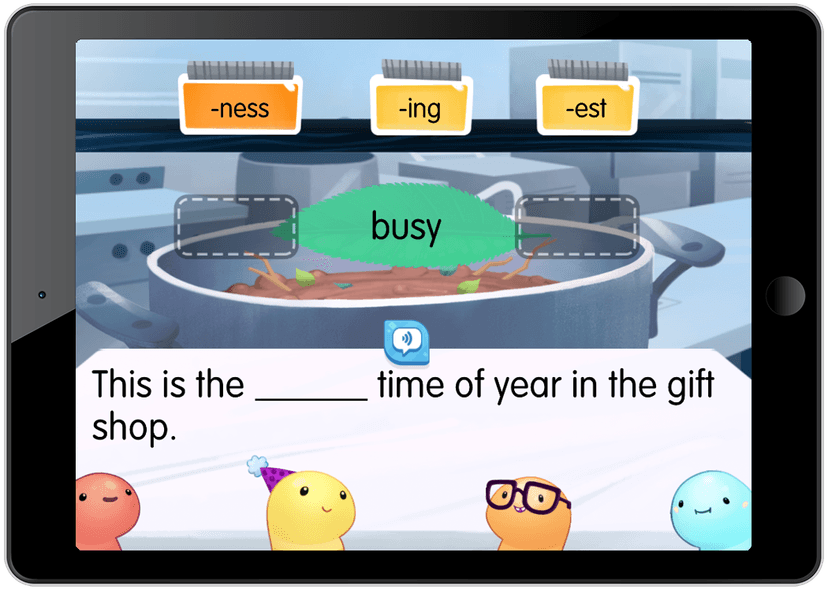
Scholastic W.O.R.D. uses a mastery-based progression system combined with game-based learning to teach high-frequency vocabulary. The platform introduces students to thematic learning modules that span both humanities and social sciences. Within these modules, students encounter target words multiple times in different contexts. This varied exposure acts as a form of spaced repetition, which strengthens long-term memory retention. Students complete interactive mini-games and reading tasks that require them to apply the vocabulary correctly. The system will not unlock advanced levels until a student demonstrates proficiency with the current word set. Behind the scenes, the app tracks every interaction and compiles this data into teacher-facing dashboards. Educators use these metrics to identify which students need targeted intervention and which word families require whole-class review.
Strengths and tradeoffs of Scholastic W.O.R.D.
The biggest strength of Scholastic W.O.R.D. is its focus on high-utility semantic networks, while its biggest weakness is its restricted availability solely to institutional buyers. Teaching vocabulary in thematic clusters rather than isolated lists leverages schema theory. When students learn related words together, they can attach new concepts to existing knowledge structures, making retrieval much easier. The platform's use of mastery-based progression ensures that foundational knowledge is secure before introducing complexity. By forcing students to demonstrate understanding across different contexts, the app employs a form of variable practice, which learning science shows improves the transfer of skills to new situations. However, the heavy reliance on extrinsic gamification presents a weakness. If game mechanics overshadow the instructional content, students may experience split attention, reducing the cognitive resources available for actual learning. Furthermore, because The Learning Standard has not yet formally evaluated the software, we cannot verify whether these research-backed design intentions translate into measurable reading gains in a real-world classroom setting.
Who Might Benefit From Scholastic W.O.R.D.?
Scholastic W.O.R.D. is best for K-5 classrooms that need a structured, research-based supplement for building core vocabulary and cross-curricular knowledge. It serves elementary educators who want actionable data on student word acquisition to drive their small-group instruction. Because it spans multiple grade levels, it works well for schools aiming to standardize their vocabulary approach across early and upper elementary tiers. It is not suitable for parents seeking at-home tutoring solutions, as the licensing model restricts access to school districts and institutions.
Data Transparency
Does Not Meet Data Transparency Standard
Scholastic W.O.R.D. reaches Level 1 of 3 (Basic protections), below our data transparency standard. Reaching Level 2 needs the policy to document a data retention timeline and self-service deletion.
24 of 35 checks passed
Evaluated September 2026
Privacy Policy →Level 1 · Basic protections
Does not sell data or target ads at students, limits sharing, and lets parents see and delete their child's data.
Level 2 · Parent control (meets the standard)
Families can get their data out, know who processes it, and know how long it is kept.
Not documented: a data retention timeline, self-service deletion
Level 3 · Direct data access
Families or schools can pull their own data through an API, in a stated format.
Not documented: an API for retrieving their own data, a named export format
View all 35 checks
Parent Access8/8
Does the policy mention parents specifically?
“Eligible students or their parents or guardians may have the legal right (including under FERPA, COPPA and the California Consumer Privacy Act (CCPA)) to access, correct, export or delete certain of their own information or content, or to make certain choices.”
Can parents view their child's data?
“Eligible students or their parents or guardians may have the legal right (including under FERPA, COPPA and the California Consumer Privacy Act (CCPA)) to access, correct, export or delete certain of their own information or content, or to make certain choices. To make a request, please contact your school or school district.”
Can parents modify their child's data?
“Eligible students or their parents or guardians may have the legal right (including under FERPA, COPPA and the California Consumer Privacy Act (CCPA)) to access, correct, export or delete certain of their own information or content, or to make certain choices. To make a request, please contact your school or school district.”
Can parents delete their child's account?
“Eligible students or their parents or guardians may have the legal right (including under FERPA, COPPA and the California Consumer Privacy Act (CCPA)) to access, correct, export or delete certain of their own information or content, or to make certain choices. To make a request, please contact your school or school district.”
Is there a dedicated Children's Privacy section?
“Scholastic designs its Products to comply with all applicable laws, including the Family Educational Rights and Privacy Act (FERPA) and the Children’s Online Privacy Protection Act (COPPA).”
Does it reference COPPA compliance?
“Scholastic designs its Products to comply with all applicable laws, including the Family Educational Rights and Privacy Act (FERPA) and the Children’s Online Privacy Protection Act (COPPA).”
Does it reference FERPA compliance?
“Scholastic designs its Products to comply with all applicable laws, including the Family Educational Rights and Privacy Act (FERPA) and the Children’s Online Privacy Protection Act (COPPA).”
Is parental consent required for child accounts?
“To the extent permitted by law, Scholastic relies on its Education Customers to act as intermediaries to obtain any parent, guardian or other consents required under applicable law or district policy for us to collect, process or maintain Personal Information or Student Data.”
Data Portability2/5
Can users access their personal data?
“Eligible students or their parents or guardians may have the legal right (including under FERPA, COPPA and the California Consumer Privacy Act (CCPA)) to access, correct, export or delete certain of their own information or content, or to make certain choices. To make a request, please contact your school or school district.”
Can users download/export their data?
“Eligible students or their parents or guardians may have the legal right (including under FERPA, COPPA and the California Consumer Privacy Act (CCPA)) to access, correct, export or delete certain of their own information or content, or to make certain choices. To make a request, please contact your school or school district.”
Is there a self-service data access tool?
The policy directs access requests to the school and describes no self-service tool.
Is a specific data format mentioned for export?
The policy mentions export but names no data format.
Is there an API for data access?
The policy does not describe an API for data access.
Data Minimization2/6
Is data collection itemized?
“Student roster data: First and last names, email address, student ID numbers, grade level, user name/password, reading level or other performance data.”
Can the app be used without a real name?
The policy states that student roster data includes first and last names.
Can the app be used without an email?
The policy states that student roster data includes email address.
Does it state collection is limited to what is necessary?
“We only collect Personal Information and Student Data reasonably necessary to provide the Products to our Education Customers.”
Is IP address anonymized or truncated?
The policy says it collects IP addresses and does not say they are anonymized or truncated.
Is location tracking explicitly excluded?
The policy says it collects general location based on IP address, so location tracking is not excluded.
Third-Party Protection6/7
Does it explicitly state no selling of data?
“Scholastic does not sell or rent Personal Information or Student Data.”
Are third-party providers named?
“Scholastic uses [Adobe Analytics](https://www.adobe.com/privacy.html "Adobe Privacy Center") or [Google Analytics](https://policies.google.com/technologies/partner-sites "Google Privacy & Terms") in some of its Products”
Are providers contractually restricted?
“Our service providers can only use Personal Information and Student Data to provide the contracted services, not for their own commercial purposes, and are subject to written security, confidentiality and non-disclosure obligations.”
No-targeted-advertising commitment?
“Our Products do not contain third party advertising or targeted advertising.”
Is AI/ML data sharing addressed?
The policy does not address AI or machine learning.
Child-specific sharing restriction?
“Our Products do not contain communication tools for students to directly message each other, nor do they enable students to publicly post Student Data.”
Cookies/tracking limited or opt-out?
“Information collected automatically may be linked to individual educators; it is not linked to individual students (though we the reserve the right to do so in the case of a security of safety issue).”
Deletion & Retention2/5
Can users delete their account?
“Eligible students or their parents or guardians may have the legal right (including under FERPA, COPPA and the California Consumer Privacy Act (CCPA)) to access, correct, export or delete certain of their own information or content, or to make certain choices. To make a request, please contact your school or school district.”
Self-service deletion mechanism?
The policy directs deletion requests to the school and describes no self-service deletion.
Specific data retention timeline?
The policy keeps data for the period reasonably necessary or as the contract requires, with no specific timeline.
Auto-deletion of inactive accounts?
The policy does not address deleting inactive accounts.
Post-deletion handling described?
“Where permitted, our destruction methods may include irreversible de-identification or overwriting. Scholastic may keep back-up and similar copies of Personal Information and Student Data that it is unable to destroy using commercially reasonable measures, to the extent permitted by law.”
Advertising4/4
Advertising model explicitly disclosed?
“Our Products do not contain third party advertising or targeted advertising.”
Free from third-party advertisements?
“Our Products do not contain third party advertising or targeted advertising.”
Children excluded from ad targeting?
“Scholastic does not track or build personal profiles of students for advertising purposes.”
Ad-free option available?
“Our Products do not contain third party advertising or targeted advertising.”
What This Means
The policy review did not meet our data transparency standard. The checks above show the documented findings and unknowns. A missing statement does not establish how the app handles data in practice.
About this evaluation: Based on automated analysis of Privacy Policy against 35 policy-disclosure questions, including questions adapted from the Common Sense Privacy Program's published evaluation questions. TLS is not affiliated with Common Sense Media, and this is not a Common Sense rating. Quoted text is copied from the policy; unquoted notes are our summary. Results describe what the policy documents, not the company's actual practices. Privacy policies can change: this review reflects the version we analyzed and does not determine legal compliance.
Sources and review method
TLS combines product information and editorial analysis to explain how Scholastic W.O.R.D. works, its tradeoffs, and the questions to ask before choosing it. Product features, an instructional rationale and evidence of learning outcomes are different kinds of information.
Formal Learning Standard assessment: not yet completed. Data Transparency findings are reported separately and do not establish learning effectiveness. Read our methodology.
Frequently Asked Questions About Scholastic W.O.R.D.
Is Scholastic W.O.R.D. free?
No, Scholastic W.O.R.D. is not free. It requires a paid site license purchased by a school or district. Pricing varies based on volume discounts and the size of the implementation, so individual parents cannot buy direct subscriptions for home use.
Is Scholastic W.O.R.D. good for elementary students?
Yes, the program targets students in kindergarten through 5th grade. It uses age-appropriate game mechanics and scales the reading complexity to match early elementary through upper elementary cognitive levels. However, its exact efficacy remains pending evaluation by The Learning Standard.
What does Scholastic W.O.R.D. teach?
Scholastic W.O.R.D. teaches high-utility vocabulary and cross-curricular background knowledge. It focuses on the core word families that appear most frequently in academic texts, blending humanities and social science themes to improve overall reading comprehension.
How does Scholastic W.O.R.D. compare to Lexia Core5?
While Lexia Core5 provides comprehensive phonics and literacy instruction, Scholastic W.O.R.D. focuses specifically on vocabulary acquisition and background knowledge. Schools often use them differently, with Lexia serving as a primary reading intervention and W.O.R.D. as a targeted vocabulary supplement.
Has The Learning Standard evaluated Scholastic W.O.R.D.?
TLS has not yet completed a Learning Standard evaluation of how well Scholastic W.O.R.D. teaches. Its privacy policy has been reviewed for Data Transparency and reaches Level 1, Basic protections.
Is Scholastic W.O.R.D. COPPA compliant?
The reviewed privacy policy references COPPA. A policy reference alone does not establish COPPA compliance. Policy review note: The policy states it is designed to comply with COPPA.
Is Scholastic W.O.R.D. FERPA compliant?
The reviewed privacy policy references FERPA. A policy reference alone does not establish FERPA compliance. Policy review note: The policy states it is designed to comply with FERPA.
Does Scholastic W.O.R.D. have a children's privacy policy?
The reviewed policy includes a dedicated children's privacy section. Policy review note: The policy has its own section headed "FERPA and COPPA".
Does Scholastic W.O.R.D. sell student data?
The reviewed policy states that the app does not sell data. This is a policy statement; actual data practices were not verified. Policy review note: The policy states Scholastic does not sell data.
Can you delete your data from Scholastic W.O.R.D.?
The reviewed privacy policy describes account deletion. We have not tested the deletion process. Policy review note: Users can ask for deletion through their school.
Follow TLS Research
Subscribe to future TLS research updates: app reviews, findings, and what the evidence shows.
Screenshots


Take Action
For Scholastic W.O.R.D.
If you represent Scholastic Inc. and have a correction or new evidence, send the relevant source so we can review and update this page.
Submit a correctionDetails
- Pricing
- Scholastic W.O.R.D. is available as a site-based purchase. Volume discounts may apply.
- Platforms
- iOS (Apple mobile), iPadOS (Apple tablet), Android (Google mobile), Tizen (Samsung mobile), Windows (Microsoft), macOS (Apple), Chrome OS (Google)
- Grade Levels
- Kindergarten, 1st Grade, 2nd Grade, 3rd Grade, 4th Grade, 5th Grade
- Website
- Visit site