
ReadTheory
Product by ReadTheory Education Services
Facts checked: Not yet checked
Our take (not a Learning Standard rating). This label applies to learning-science judgments throughout this overview.
Our take (not a Learning Standard rating)
ReadTheory provides adaptive reading comprehension practice that matches text complexity to student performance, but it lacks explicit instruction. While it excels at retrieval practice and competency-based leveling, it operates more as an assessment tool than a comprehensive teaching platform.
Pros
- Automatically adapts text Lexile levels based on real-time student quiz performance.
- Uses retrieval practice through immediate multiple-choice questioning after reading passages.
- Provides immediate corrective feedback on incorrect answers to support self-correction.
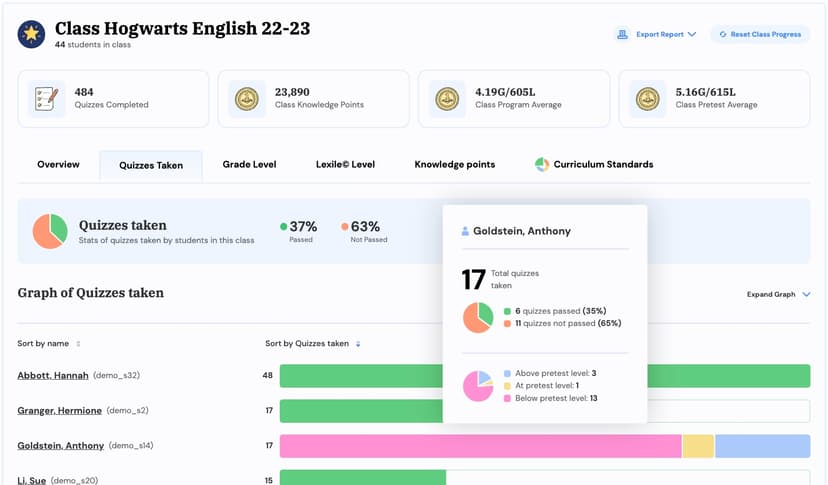
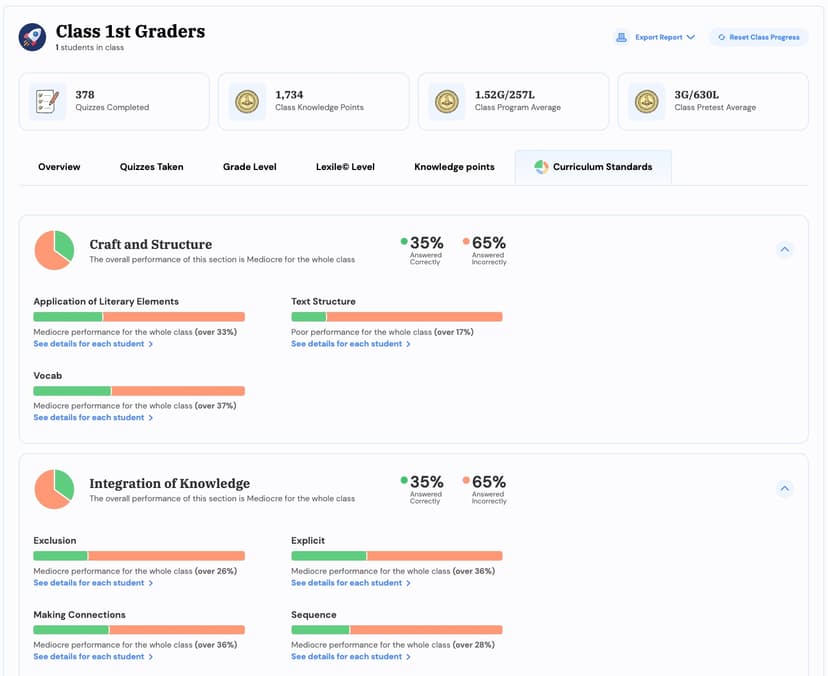
- Tracks detailed historical data on reading levels to make progression visible to educators and parents.
Cons
- Offers no explicit instruction on how to use foundational reading comprehension strategies.
- Relies entirely on multiple-choice formats which cannot measure expressive comprehension or writing skills.
- Passages lack thematic cohesion, preventing students from building deep background knowledge on specific subjects.
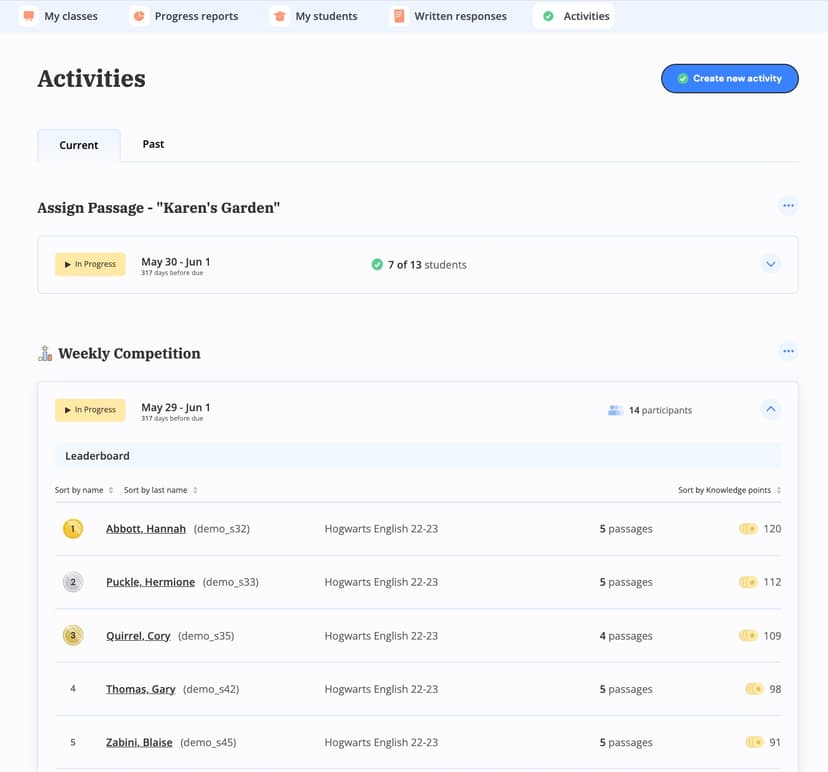
- The basic gamification elements provide minimal intrinsic motivation for middle and high school students.
What Do We Know About ReadTheory?
ReadTheory is effective for independent reading practice and assessment, but it does not explicitly teach your child how to read or comprehend text. The platform serves as a digital workbook that presents short reading passages followed by multiple-choice questions. Because the system is fully adaptive, it constantly adjusts the difficulty of the text based on your child's accuracy. This competency-based approach ensures students are consistently challenged within their zone of proximal development. However, parents should understand the difference between testing and teaching. When your child answers a question incorrectly, the app explains why the right answer is correct, but it does not teach foundational reading strategies like inferencing, summarizing, or decoding. It functions purely through repeated practice. For parents looking to build reading stamina or prepare children for standardized testing formats, the platform offers highly efficient retrieval practice. If your child struggles heavily with reading comprehension, they will need targeted human instruction alongside this app. The Learning Standard has not yet formally evaluated ReadTheory, but its design aligns with established principles of continuous assessment.
How Does ReadTheory Work?
ReadTheory uses a competency-based learning model driven by algorithmic adaptation and multiple-choice retrieval practice. When a student first logs in, they take a brief pre-test that anchors their starting Lexile level. From there, the platform presents short, standalone reading passages accompanied by a series of comprehension questions. The learning mechanics rely heavily on immediate performance feedback. If a student scores well on a quiz, the algorithm incrementally increases the complexity, vocabulary density, and sentence length of the next passage. If the student struggles, the difficulty drops. This personalized learning loop ensures the cognitive load remains appropriate for the learner. The questions require varying levels of cognitive processing, ranging from basic factual recall to higher-order inferencing. While the app uses basic gamification like points and level-ups, the core pedagogical engine is strictly drill-and-practice. There are no video lessons, interactive highlighters, or guided reading supports.
Strengths and tradeoffs of ReadTheory
ReadTheory's biggest strength is its highly responsive adaptive algorithm, while its biggest weakness is the complete absence of explicit strategy instruction. By continuously calibrating text difficulty, the platform excels at keeping students engaged in their zone of proximal development. This prevents the frustration of texts that are too hard and the boredom of texts that are too easy. The app effectively leverages retrieval practice by testing students immediately after exposure to a text, which learning science shows is highly effective for long-term retention. Furthermore, the inclusion of immediate corrective feedback helps students understand their errors in real-time. On the downside, ReadTheory operates purely as an assessment and practice tool rather than an instructional one. It fails to provide worked examples of how a strong reader breaks down a complex paragraph. Additionally, the passages are completely randomized. Cognitive science indicates that reading comprehension is deeply tied to background knowledge, yet this platform prevents students from building thematic expertise because every text jumps to a completely different, unrelated topic.
Who Might Benefit From ReadTheory?
Best for independent readers in grades 3 through 12 who need targeted comprehension drill and stamina building. It serves as an excellent supplementary tool for classroom teachers looking for differentiated practice centers or for parents wanting a free resource for standardized test preparation. Because it relies heavily on text-based passages without audio support or phonics instruction, it is not suitable for early emergent readers in kindergarten or first grade. It is also highly beneficial for ESL students who need exposure to a wide variety of English vocabulary and sentence structures in short, manageable bursts.
Data Transparency
Does Not Meet Data Transparency Standard
ReadTheory does not meet our data transparency standard. Its privacy policy does not document basic protections, including a statement that it does not sell data and a commitment against targeted advertising.
21 of 35 checks passed
Evaluated September 2026
Privacy Policy →Level 1 · Basic protections
Does not sell data or target ads at students, limits sharing, and lets parents see and delete their child's data.
Not documented: a statement that it does not sell data, a commitment against targeted advertising
Level 2 · Parent control (meets the standard)
Families can get their data out, know who processes it, and know how long it is kept.
Not documented: data export, self-service deletion
Level 3 · Direct data access
Families or schools can pull their own data through an API, in a stated format.
Not documented: an API for retrieving their own data, a named export format
View all 35 checks
Parent Access8/8
Does the policy mention parents specifically?
“If you, as a parent or legal guardian, become aware that a Child under your care or supervision has provided us information without your consent, or provided us with information that you would like to have removed or updated, please contact us at”
Can parents view their child's data?
“As required by applicable law, we enable you to view, amend or delete the PII that we have collected about you or your Child. To do so, contact our customer support at”
Can parents modify their child's data?
“As required by applicable law, we enable you to view, amend or delete the PII that we have collected about you or your Child. To do so, contact our customer support at”
Can parents delete their child's account?
“You also have the right to request that your or your Child’s Personal Information and/or account be deleted.”
Is there a dedicated Children's Privacy section?
“Our Website and the collection of Children’s Personal Information are operated in compliance with COPPA.”
Does it reference COPPA compliance?
“Our Website and the collection of Children’s Personal Information are operated in compliance with COPPA.”
Does it reference FERPA compliance?
“Under these contractual agreements, and to the extent applicable, we collect and use the data in compliance with FERPA.”
Is parental consent required for child accounts?
“Where a ‘Student Account’ is created on behalf of a student who is under the age of 13 (“ **Child**” or “ **Children**”, respectively), the Child’s parent or legal guardian will be required to consent to the collection of the Child’s Personal Information in accordance with the Children’s Online Privacy Protection Act (COPPA).”
Data Portability1/5
Can users access their personal data?
“You have a right to access and update your or your Child’s Personal Information at any time.”
Can users download/export their data?
The policy covers viewing, changing and deleting information but does not mention downloading or exporting it.
Is there a self-service data access tool?
The policy says access requests are made by emailing customer support, not through a tool users operate themselves.
Is a specific data format mentioned for export?
The policy does not name any format for exported data.
Is there an API for data access?
The policy does not mention an API for getting data.
Data Minimization1/6
Is data collection itemized?
“When associating a Student Account with a Teacher Account, we will collect the user’s first and last name to help teachers identify their students. The collection of the student’s e-mail address is optional.”
Can the app be used without a real name?
The policy says it collects students' first and last names (for Children, the first initial and last name) when a student account is linked to a teacher.
Can the app be used without an email?
The policy says students' email addresses are optional, so they may still be collected.
Does it state collection is limited to what is necessary?
The policy limits how long data is kept to what its purposes require but does not say collection itself is limited to what is necessary.
Is IP address anonymized or truncated?
The policy does not address anonymizing or truncating IP addresses.
Is location tracking explicitly excluded?
The policy says it does not track student behavior outside the Website but does not explicitly rule out location tracking.
Third-Party Protection5/7
Does it explicitly state no selling of data?
The policy's no-selling statement makes an exception for its online targeted advertising activities, so it is not an unqualified commitment.
Are third-party providers named?
“We use analytics and similar services (e.g., Google Analytics) to help us deliver a better and more personalized service to you”
Are providers contractually restricted?
“To trusted third parties in our business network in connection with providing services to educators and students (including advertising partners, but only as indicated above, business consultants, professional advisors, and service providers), all subject to confidentiality undertakings and data protection obligations in accordance with applicable laws.”
No-targeted-advertising commitment?
The policy excludes only students under 13 and certain school-district accounts from targeted-ad cookies; other users' data is used for targeted advertising.
Is AI/ML data sharing addressed?
“Students’ personal information — such as a student’s name, username, and their individual quiz responses and performance results — is never sent to or processed by any third-party AI system, and is never used to train or develop AI or machine learning models.”
Child-specific sharing restriction?
“such data and progress reports are accessible only by the teacher whose registered Teacher Account is directly linked to that particular ‘Student Account’, and are not shared by us with any third party for commercial purposes.”
Cookies/tracking limited or opt-out?
“You may remove our cookies by following the instructions of your device preferences; however, if you choose to disable cookies, some features of our Website and/or services we may offer may not operate properly and your online experience may be limited.”
Deletion & Retention4/5
Can users delete their account?
“Please be advised that if you request the deletion of your account, all Personal Information collected about/from you will be promptly deleted and you will no longer be able to use the services on our Website.”
Self-service deletion mechanism?
The policy says deletion is requested by emailing support, not done through a self-service tool.
Specific data retention timeline?
“Even if you do not request to opt-out, we automatically delete data of users that are inactive for more than two years.”
Auto-deletion of inactive accounts?
“Even if you do not request to opt-out, we automatically delete data of users that are inactive for more than two years.”
Post-deletion handling described?
“We reserve the right to retain a copy of the opt-out request and any necessary accompanying details for administrative and regulatory compliance purposes only.”
Advertising2/4
Advertising model explicitly disclosed?
“we will also allow third party cookies to be placed on your device so that our advertising partners can show you targeted ads on other websites and platforms, such as social media and search engines.”
Free from third-party advertisements?
The policy describes advertising partners and ad clicks and never says the product has no advertising.
Children excluded from ad targeting?
“However, we will not use cookies for targeted advertising in each of these cases: 1. Students under the age of 13 years.”
Ad-free option available?
The policy does not say there is an ad-free option or that the product has no advertising.
What This Means
The policy review did not meet our data transparency standard. The checks above show the documented findings and unknowns. A missing statement does not establish how the app handles data in practice.
About this evaluation: Based on automated analysis of Privacy Policy against 35 policy-disclosure questions, including questions adapted from the Common Sense Privacy Program's published evaluation questions. TLS is not affiliated with Common Sense Media, and this is not a Common Sense rating. Quoted text is copied from the policy; unquoted notes are our summary. Results describe what the policy documents, not the company's actual practices. Privacy policies can change: this review reflects the version we analyzed and does not determine legal compliance.
Sources and review method
TLS combines product information and editorial analysis to explain how ReadTheory works, its tradeoffs, and the questions to ask before choosing it. Product features, an instructional rationale and evidence of learning outcomes are different kinds of information.
Formal Learning Standard assessment: not yet completed. Data Transparency findings are reported separately and do not establish learning effectiveness. Read our methodology.
Frequently Asked Questions About ReadTheory
Is ReadTheory free?
ReadTheory offers its basic reading practice platform completely for free, making it highly accessible. This free tier includes the core adaptive algorithm, thousands of reading passages, and standard multiple-choice questions. Premium paid tiers are available for parents, teachers, and school districts. These paid subscriptions unlock advanced data reporting, historical student tracking, printable worksheets, and more granular performance insights to help educators isolate specific reading deficits.
Is ReadTheory good for elementary students?
ReadTheory is highly beneficial for upper elementary students in grades 3 through 5 who already possess solid, basic decoding skills. Because the platform lacks read-aloud features, interactive highlighters, and explicit phonics instruction, it is largely ineffective for early emergent readers in kindergarten through second grade. Students must be fully capable of reading independently to use the system effectively, as the app provides no auditory scaffolding for struggling decoders.
What does ReadTheory teach?
ReadTheory primarily teaches reading comprehension through repeated exposure and continuous retrieval practice. The question prompts target specific cognitive skills like identifying the main idea, making logical inferences, understanding vocabulary in context, and determining author intent. However, parents should note that it tests these skills rather than explicitly teaching the underlying strategies. It functions as a drill-and-practice environment to sharpen existing abilities rather than a foundational instructional curriculum.
How does ReadTheory compare to standard classroom reading instruction?
Standard classroom instruction provides students with structured background knowledge, cohesive thematic units, and explicit teacher modeling of complex reading strategies. ReadTheory, by contrast, acts solely as an independent practice module featuring randomized, disconnected texts. It cannot replace explicit human instruction or a comprehensive English Language Arts curriculum. However, it serves as an excellent, low-friction supplementary tool to help reinforce and automate the comprehension skills students are already learning in school.
Has The Learning Standard evaluated ReadTheory?
TLS has not yet completed a Learning Standard evaluation of how well ReadTheory teaches. Its privacy policy has been reviewed for Data Transparency and does not yet document the basic protections (Level 1).
Is ReadTheory COPPA compliant?
The reviewed privacy policy references COPPA. A policy reference alone does not establish COPPA compliance. Policy review note: The policy says it complies with COPPA.
Is ReadTheory FERPA compliant?
The reviewed privacy policy references FERPA. A policy reference alone does not establish FERPA compliance. Policy review note: The policy says it complies with FERPA.
Does ReadTheory have a children's privacy policy?
The reviewed policy includes a dedicated children's privacy section. Policy review note: The policy has its own section headed "COPPA Compliance".
Does ReadTheory sell student data?
A statement ruling out data selling was not found in the reviewed policy. This does not establish that the app sells student data. Policy review note: The policy's no-selling statement makes an exception for its online targeted advertising activities, so it is not an unqualified commitment.
Can you delete your data from ReadTheory?
The reviewed privacy policy describes account deletion. We have not tested the deletion process. Policy review note: Users can ask to have their account deleted.
Follow TLS Research
Subscribe to future TLS research updates: app reviews, findings, and what the evidence shows.
Screenshots

Take Action
For ReadTheory
If you represent ReadTheory Education Services and have a correction or new evidence, send the relevant source so we can review and update this page.
Submit a correctionDetails
- Pricing
- Our basic product is completely free and we have premium paid offerings for districts, schools, teachers and parents.
- Platforms
- Web Browser, iOS (Apple mobile), iPadOS (Apple tablet), Chrome OS (Google)
- Grade Levels
- 1st Grade, 2nd Grade, 3rd Grade, 4th Grade, 5th Grade, 6th Grade, 7th Grade, 8th Grade, 9th Grade, 10th Grade, 11th Grade, 12th Grade
- Website
- Visit site