
Quill.org
Product by Quill.org
Facts checked: Not yet checked
Our take (not a Learning Standard rating). This label applies to learning-science judgments throughout this overview.
Our take (not a Learning Standard rating)
Quill.org relies on proven instructional strategies like active recall and immediate, specific feedback to improve sentence-level writing skills. While The Learning Standard has not formally evaluated its curriculum, the app's focus on sentence combining and grammatical structure directly supports cognitive models of writing development by reducing working memory load.
Pros
- Delivers immediate, targeted feedback on grammar and syntax errors to prevent students from practicing mistakes.
- Uses sentence combining exercises to actively build syntactic awareness rather than relying on passive multiple-choice drills.
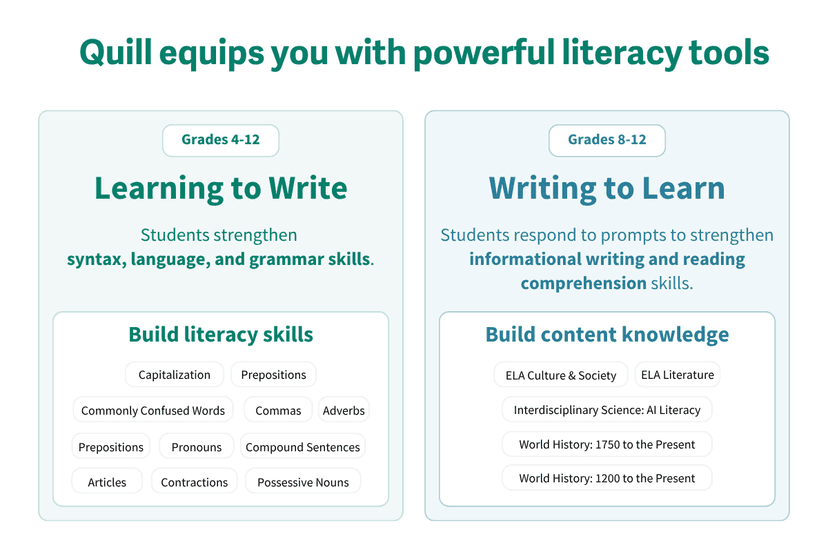
- Integrates reading comprehension with writing practice through cross-curricular passages that build academic background knowledge.
- Employs diagnostic assessments to personalize the learning path and target specific grammatical skill deficits.
Cons
- Focuses heavily on sentence-level mechanics, which does not independently develop long-form composition or paragraph structuring skills.
- Relies on automated feedback that occasionally misinterprets creative or unconventional but grammatically correct phrasing.
- Lacks engaging gamification or intrinsic motivational elements, which may cause student fatigue during extended practice sessions.
What Do We Know About Quill.org?
Quill.org is highly effective for building the foundational mechanics of writing, specifically sentence construction and grammar. Rather than asking your child to write full essays immediately, this tool isolates specific skills like using conjunctions, fixing run-on sentences, and combining ideas. This approach aligns with cognitive load theory; by mastering sentence-level mechanics first, your child frees up working memory for higher-order tasks like structuring arguments and organizing paragraphs later on. The platform uses active practice instead of passive multiple-choice tests. When your child answers a prompt, the system provides immediate feedback on their phrasing, spelling, and punctuation. If they make a mistake, they are prompted to try again with a specific hint. This iterative process prevents students from encoding incorrect habits. Parents should understand that Quill.org is not a comprehensive writing curriculum. It will not teach your child how to structure a five-paragraph essay or write a creative short story. However, it serves as an excellent supplemental tool to ensure their basic sentence structures are sound. While The Learning Standard has not yet formally rated Quill.org, its underlying mechanics are strongly supported by learning science.
How Does Quill.org Work?
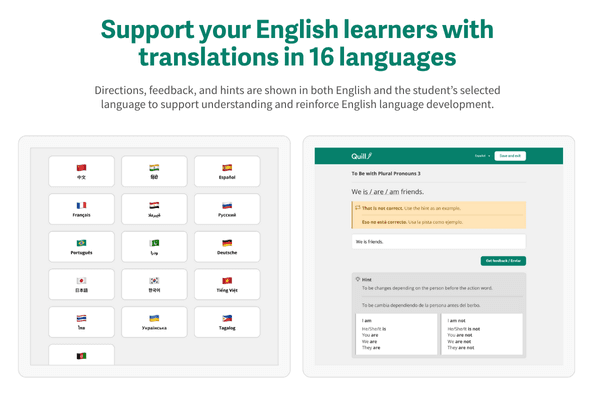
Quill.org utilizes a mastery-based progression model centered on active retrieval practice and immediate feedback. The learning sequence typically begins with a diagnostic test that assesses your child's baseline grammar and sentence construction skills. Based on these results, the platform generates a personalized learning plan composed of differentiated activities. During a lesson, students are presented with interactive prompts, such as two short sentences they must combine into a single complex sentence using a specific conjunction. When the student types their response, the system's natural language processing engine evaluates the submission instantly. If the answer contains an error or lacks the targeted structure, the app highlights the issue and provides a targeted hint, requiring the student to revise and resubmit. This immediate correction cycle is crucial for mastery learning. Students must demonstrate competence in a specific grammatical structure before progressing to more advanced concepts, ensuring foundational skills are deeply encoded before complexity increases.
Strengths and tradeoffs of Quill.org
Quill.org's biggest strength is its reliance on active sentence construction with immediate feedback, while its biggest weakness is its inability to support long-form composition. Active Sentence Combining: Unlike traditional grammar worksheets that rely on multiple-choice identification, Quill.org requires students to actively generate text. This engages retrieval practice, forcing the brain to recall and apply grammatical rules, which leads to stronger retention. Immediate, Corrective Feedback: Learning science shows that feedback is most effective when it is immediate and specific. The platform's ability to instantly flag a missing comma or incorrect tense prevents students from reinforcing bad habits. However, the focus is incredibly narrow. Cognitive Load Limitations: Because Quill.org hyper-focuses on sentence-level mechanics, it does not prompt students to organize complex thoughts across paragraphs. While mastering sentences reduces cognitive load for future writing, students still need separate instruction on macro-level writing skills like outlining and thesis development. AI Limitations: The automated feedback system, while robust, can sometimes struggle with worked examples that deviate from its programmed correct answers. It occasionally rejects valid sentences if they do not match the specific syntactic structure the exercise is trying to isolate.
Who Might Benefit From Quill.org?
Quill.org is best for students in upper elementary through high school who struggle with sentence structure, run-on sentences, or basic grammar mechanics. It is an ideal supplemental tool for classrooms or home environments where educators and parents want to provide rigorous, targeted grammar drill practice without creating an excessive grading burden. Because the interface is straightforward and academic, it is particularly well-suited for older students (grades 6-12) who need remedial intervention in foundational writing skills but might feel patronized by gamified, cartoon-based learning apps. It is not designed for younger learners who are still mastering basic phonics or early decoding.
Data Transparency
Meets Data Transparency Standard
Quill.org meets our data transparency standard at Level 2 of 3 (Parent control). Level 3 needs the policy to document an API for retrieving their own data and a named export format.
27 of 35 checks passed
Evaluated September 2026
Quill.org →Level 1 · Basic protections
Does not sell data or target ads at students, limits sharing, and lets parents see and delete their child's data.
Level 2 · Parent control (meets the standard)
Families can get their data out, know who processes it, and know how long it is kept.
Level 3 · Direct data access
Families or schools can pull their own data through an API, in a stated format.
Not documented: an API for retrieving their own data, a named export format
View all 35 checks
Parent Access7/8
Does the policy mention parents specifically?
“Parents of children under 13 may review or request deletion of their child's information at any time.”
Can parents view their child's data?
“Parents of children under 13 may review or request deletion of their child's information at any time. If your child's account was set up through a school, please contact your child's teacher or school to make such a request, and we will work with the school to promptly honor it.”
Can parents modify their child's data?
The policy gives parents the right to review or delete their child's information and sends questions about modifying it to the school, but does not say parents can have it corrected.
Can parents delete their child's account?
“Parents of children under 13 may review or request deletion of their child's information at any time. If your child's account was set up through a school, please contact your child's teacher or school to make such a request, and we will work with the school to promptly honor it.”
Is there a dedicated Children's Privacy section?
“This privacy notice supplements our Privacy Policy and provides additional information about how we collect, use and disclose personal information from children under the age of 13 (a “Child” or “Children”).”
Does it reference COPPA compliance?
“For Student Users under 13, our privacy practices are informed by the Children’s Online Privacy Protection Act (“COPPA”).”
Does it reference FERPA compliance?
“When Quill.org provides services to a School or district, we do so as a “School Official” under FERPA, using student information only for authorized educational purposes as directed by the School.”
Is parental consent required for child accounts?
“When Quill.org is used by a School, we rely on the School to provide the requisite consent, on behalf of the Parent, for Quill.org to collect information from a Student User under the age of 13 for educational purposes.”
Data Portability3/5
Can users access their personal data?
“We want you to have access to your information, so that you can help keep it as accurate as possible. If you register and provide Quill.org with information, you may update, correct, or delete your account and information at any time by reviewing your profile information and preferences on your account settings page.”
Can users download/export their data?
“The right to obtain access to your personal information, along with certain related information, and to receive that information in a commonly used format and to have it transferred to another data controller”
Is there a self-service data access tool?
“If you register and provide Quill.org with information, you may update, correct, or delete your account and information at any time by reviewing your profile information and preferences on your account settings page.”
Is a specific data format mentioned for export?
The policy mentions only a "commonly used format" and names no specific export format.
Is there an API for data access?
The policy does not describe an API for users or schools to retrieve their data.
Data Minimization2/6
Is data collection itemized?
“We collect a first and last name, username, and email address when a Student User registers for the Service. We collect information about the Student User’s use of the Service (activity completion, activity ratings, and performance data).”
Can the app be used without a real name?
The policy says it collects a first and last name when a Student User registers.
Can the app be used without an email?
The policy says it collects an email address when a Student User registers.
Does it state collection is limited to what is necessary?
“We do not require children to provide any more personal information than is necessary to use our educational Services”
Is IP address anonymized or truncated?
The policy says it may infer approximate location from IP address and does not say IP addresses are anonymized or truncated.
Is location tracking explicitly excluded?
The policy excludes precise geolocation but says it collects general location and infers approximate location from IP address.
Third-Party Protection7/7
Does it explicitly state no selling of data?
“We do not sell your personal information to third parties.”
Are third-party providers named?
“a teacher rosters a class using Google Classroom, Clever, or similar single sign-on service for School use”
Are providers contractually restricted?
“When we disclose information to third party service providers or vendors, these third parties are contractually obligated to maintain the security and confidentiality of that information.”
No-targeted-advertising commitment?
“Quill.org does not use, disclose, or compile Student Personal Data of Student Users on the Service for the purpose of marketing or advertising third party commercial products or services, including targeted advertising.”
Is AI/ML data sharing addressed?
“We may also use non-personal data elements (such as de-identified, anonymized or aggregated activity responses) for product development, AI development, research, analytics and other purposes”
Child-specific sharing restriction?
“We do not disclose Student Personal Data to any third party except (a) to service providers performing institutional services at our direction and bound by confidentiality, (b) to the student’s own teacher, school, or district administrators, or (c) as required by law.”
Cookies/tracking limited or opt-out?
“We take steps to avoid the use of tracking cookies on webpages with child directed content. We do not allow third‑party cookies or similar technologies on our Service that collect data for the third party’s own advertising or analytics purposes.”
Deletion & Retention4/5
Can users delete their account?
“To request deletion of your information at any time, please log into your account and select “Delete my account“ through My Account.”
Self-service deletion mechanism?
“Users can delete their accounts and personal information associated with the account at any time through account Settings.”
Specific data retention timeline?
The policy lists factors for retention and refers to an "extended period of inactivity" but gives no specific timeline.
Auto-deletion of inactive accounts?
“Student Personal Data will be permanently deleted or irrevocably de-identified (a) upon a valid deletion request from the School, (b) when a School severs its relationship with Quill.org, or (c) after an extended period of inactivity in accordance with our inactive-account policy”
Post-deletion handling described?
“We may not be able to delete information in all instances. For example, we may retain certain information as necessary to prevent fraud or future abuse, for recordkeeping or other legitimate business purposes, or if required by law. Retained personal information will remain subject to the terms of this Privacy Policy.”
Advertising4/4
Advertising model explicitly disclosed?
“We do not display traditional, contextual, or any other form of advertising on [Quill.org](https://www.quill.org/).”
Free from third-party advertisements?
“We do not display traditional, contextual, or any other form of advertising on [Quill.org](https://www.quill.org/).”
Children excluded from ad targeting?
“We do not disclose Student Personal Data for targeted advertising purposes.”
Ad-free option available?
“We do not display traditional, contextual, or any other form of advertising on [Quill.org](https://www.quill.org/).”
Meets Data Transparency Standard
The reviewed policy met our data transparency standard. This result describes the policy disclosures we assessed. Actual practices and legal compliance were not verified.
About this evaluation: Based on automated analysis of Quill.org against 35 policy-disclosure questions, including questions adapted from the Common Sense Privacy Program's published evaluation questions. TLS is not affiliated with Common Sense Media, and this is not a Common Sense rating. Quoted text is copied from the policy; unquoted notes are our summary. Results describe what the policy documents, not the company's actual practices. Privacy policies can change: this review reflects the version we analyzed and does not determine legal compliance.
Sources and review method
TLS combines product information and editorial analysis to explain how Quill.org works, its tradeoffs, and the questions to ask before choosing it. Product features, an instructional rationale and evidence of learning outcomes are different kinds of information.
Formal Learning Standard assessment: not yet completed. Data Transparency findings are reported separately and do not establish learning effectiveness. Read our methodology.
Frequently Asked Questions About Quill.org
Is Quill.org free?
Yes, Quill.org is completely free for students, parents, and teachers. The platform is operated by a nonprofit organization dedicated to improving literacy, meaning all of its core instructional tools, diagnostic assessments, and writing activities are accessible without a subscription.
Is Quill.org good for elementary students?
Quill.org is appropriate for older elementary students, specifically those in grades 3 through 5. It requires a baseline level of reading comprehension and typing ability. It is not suitable for early readers in kindergarten through second grade who are still developing phonics and basic spelling skills.
What does Quill.org teach?
Quill.org teaches foundational writing mechanics, focusing heavily on grammar, syntax, and sentence construction. Students practice combining sentences, identifying grammatical errors, using appropriate conjunctions, and pulling evidence from reading passages to form coherent, single-sentence responses.
How does Quill.org compare to NoRedInk?
Both platforms teach grammar and sentence mechanics, but they use different approaches. Quill.org focuses heavily on active sentence generation and sentence combining, requiring students to type out complete responses. NoRedInk incorporates more varied exercises, including editing and multiple-choice, and leans heavily into personalizing content based on student interests to drive engagement.
Has The Learning Standard evaluated Quill.org?
TLS has not yet completed a Learning Standard evaluation of how well Quill.org teaches. Its privacy policy has been reviewed for Data Transparency and reaches Level 2, Parent control.
Is Quill.org COPPA compliant?
The reviewed privacy policy references COPPA. A policy reference alone does not establish COPPA compliance. Policy review note: The policy references COPPA as the basis for its practices for students under 13.
Is Quill.org FERPA compliant?
The reviewed privacy policy references FERPA. A policy reference alone does not establish FERPA compliance. Policy review note: The policy says it operates as a School Official under FERPA.
Does Quill.org have a children's privacy policy?
The reviewed policy includes a dedicated children's privacy section. Policy review note: There is a dedicated "Supplement: Children’s Privacy Notice" section.
Does Quill.org sell student data?
The reviewed policy states that the app does not sell data. This is a policy statement; actual data practices were not verified. Policy review note: The policy explicitly says it does not sell personal information.
Can you delete your data from Quill.org?
The reviewed privacy policy describes account deletion. We have not tested the deletion process. Policy review note: Users can delete their account.
Follow TLS Research
Subscribe to future TLS research updates: app reviews, findings, and what the evidence shows.
Screenshots


Take Action
For Quill.org
If you represent Quill.org and have a correction or new evidence, send the relevant source so we can review and update this page.
Submit a correctionDetails
- Pricing
- Free
- Platforms
- Web Browser
- Grade Levels
- 3rd Grade, 4th Grade, 5th Grade, 6th Grade, 7th Grade, 8th Grade, 9th Grade, 10th Grade, 11th Grade, 12th Grade
- Website
- Visit site