PBLWorks TEACH
Facts checked: Not yet checked
Our take (not a Learning Standard rating). This label applies to learning-science judgments throughout this overview.
Our take (not a Learning Standard rating)
PBLWorks TEACH equips educators with structured Project-Based Learning units, but direct student learning outcomes rely heavily on teacher execution. It effectively provides standards-aligned frameworks to support teachers. However, because it lacks direct-to-student adaptive practice or retrieval mechanisms, actual learning effectiveness varies by classroom implementation.
Pros
- Structures inquiry-based learning through fully developed, standards-aligned project units.
- Includes embedded professional development to guide educators in facilitating complex problem-solving.
- Reduces teacher planning time by providing ready-to-use rubrics and assessment frameworks.
- Encourages deep cognitive processing by requiring students to apply concepts to real-world scenarios.
Cons
- Lacks direct student-facing instruction, relying entirely on teacher delivery.
- Does not include adaptive software mechanics like spaced repetition or immediate automated feedback.
- Requires significant classroom time to implement, which may disrupt traditional pacing guides.
- Currently limited to middle school grade levels, excluding elementary and high school classrooms.
What Do We Know About PBLWorks TEACH?
PBLWorks TEACH is highly effective at organizing complex project-based learning for classrooms, but its impact on your child depends entirely on how their teacher facilitates the provided materials. This is an instructional planning tool for educators, not a standalone learning app for students. Instead of delivering direct instruction or adaptive practice directly to a device, it gives teachers ready-made units spanning math, science, language arts, and social studies. Your child will experience this platform indirectly through classroom projects that require them to solve real-world problems. The platform succeeds at promoting deep cognitive processing by moving students away from rote memorization and toward applied inquiry. However, parents should know that this app does not provide targeted intervention, automated feedback, or spaced repetition drills to build foundational skills. It assumes students already have, or will receive alongside the project, the necessary direct instruction to complete the tasks. Because The Learning Standard has not yet rated this platform, concrete data on its independent efficacy remains pending evaluation. We always recommend asking your school how they plan to balance these large projects with foundational skill practice.
How Does PBLWorks TEACH Work?
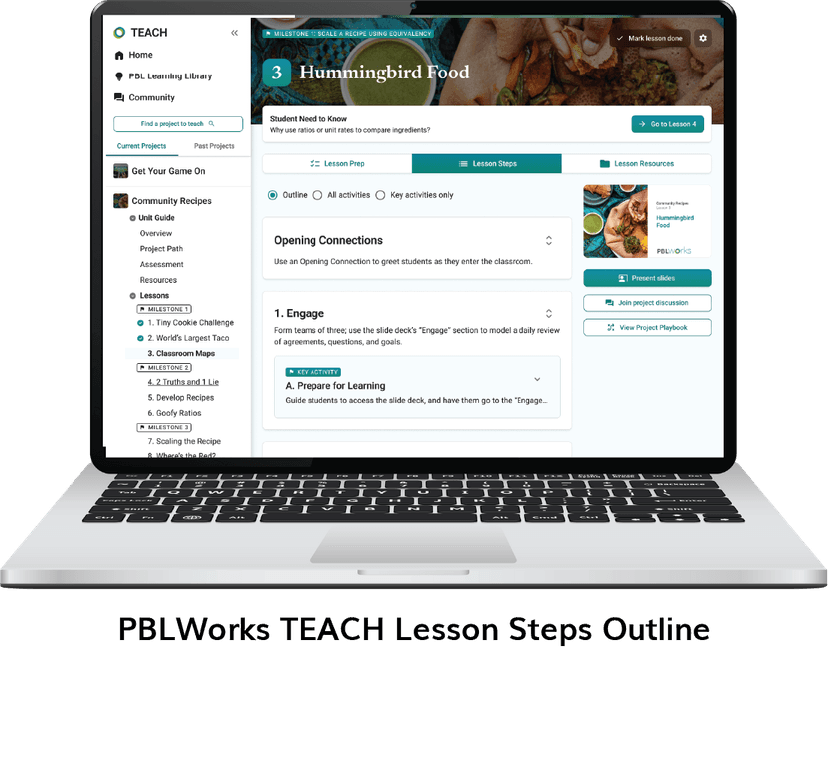
PBLWorks TEACH uses an inquiry-based learning framework by providing educators with comprehensive, standards-aligned project units. Teachers log into the web-based platform to select a pre-designed project tailored to middle school math, science, social studies, or language arts. The platform provides all necessary lesson plans, student handouts, and grading rubrics required to execute the unit. As the teacher rolls out the project, the software offers embedded professional development modules, giving educators just-in-time guidance on how to facilitate complex group work and student inquiry. Students do not log into this platform to consume content or complete daily assignments. Instead, they interact with the physical and digital materials provided by the teacher to research, collaborate, and build solutions to the project's central problem. This approach relies on constructivist learning principles, requiring students to actively build knowledge through exploration rather than passively receiving information.
Strengths and tradeoffs of PBLWorks TEACH
The biggest strength of PBLWorks TEACH is its ability to structure complex, applied learning, while its biggest weakness is the complete absence of independent, student-facing retrieval practice. Structuring Deep Learning: The platform effectively utilizes problem-based learning science by anchoring academic standards in authentic, real-world tasks. This promotes elaborative interrogation, forcing students to connect new information to existing knowledge to solve a central challenge. Teacher Support: By providing ready-made rubrics and embedded professional development, the app successfully reduces cognitive load for educators, allowing them to focus on facilitation rather than lesson design. Lack of Foundational Practice: However, learning science shows that students also need structured retrieval practice and spaced repetition to commit foundational facts to long-term memory. This platform does not offer automated drills, worked examples, or individualized feedback loops. Implementation Variability: Because it is exclusively a teacher-facing curriculum tool, the actual effectiveness hinges on classroom dynamics. Without adaptive mechanisms to catch struggling students, educators must manually monitor progress and intervene, which can be difficult during complex group projects. Furthermore, while inquiry-based learning is excellent for advanced application, cognitive science indicates it can overwhelm novices. Without explicitly modeled worked examples, students encountering new material for the first time may experience cognitive overload.
Who Might Benefit From PBLWorks TEACH?
Best for middle school educators and school districts seeking a structured way to implement project-based learning across core subjects. It specifically targets 6th, 7th, and 8th-grade classrooms where teachers want to transition from traditional lecture-based instruction to inquiry-based models. Because it requires annual school-level subscriptions, it is designed for administrative adoption rather than individual parent or solo teacher purchases. It is an excellent fit for classrooms that already have strong foundational skill instruction in place and are looking for rigorous, application-heavy capstone projects to deepen student engagement.
Data Transparency
Does Not Meet Data Transparency Standard
PBLWorks TEACH does not meet our data transparency standard. Its privacy policy does not document basic protections, including a commitment against targeted advertising, limits on sharing children's data and parents' right to see their child's data.
15 of 35 checks passed
Evaluated September 2026
Terms & Policies →Level 1 · Basic protections
Does not sell data or target ads at students, limits sharing, and lets parents see and delete their child's data.
Not documented: a commitment against targeted advertising, limits on sharing children's data, parents' right to see their child's data, parents' right to delete their child's data
Level 2 · Parent control (meets the standard)
Families can get their data out, know who processes it, and know how long it is kept.
Not documented: a data retention timeline
Level 3 · Direct data access
Families or schools can pull their own data through an API, in a stated format.
Not documented: an API for retrieving their own data, a named export format
View all 35 checks
Parent Access4/8
Does the policy mention parents specifically?
“If We become aware that We hae collected Personal Information from anyone under the age of 18, including any student, without verification of parental consent, We will delete that information.”
Can parents view their child's data?
The policy gives parents no right to view their child's data, because the Platform is for adults only.
Can parents modify their child's data?
The policy gives parents no right to modify their child's data.
Can parents delete their child's account?
The policy says the vendor itself deletes data collected from under-18s without parental consent, but it gives parents no right to request deletion.
Is there a dedicated Children's Privacy section?
“NO CHILDREN The Platform is not intended for use by anyone under 18 years of age.”
Does it reference COPPA compliance?
“You also shall use reasonable efforts to comply with the Children's Online Privacy Protection Act (“COPPA”) and will not permit registration by and will not knowingly collect personally identifiable information from anyone under 18.”
Does it reference FERPA compliance?
“PBLWorks complies with the Family Educational Rights and Privacy Act of 1974 (“ **FERPA**”) for protecting the privacy of student education records.”
Is parental consent required for child accounts?
The policy prohibits all users under 18 and describes no process for getting parental consent for child accounts.
Data Portability3/5
Can users access their personal data?
“You may also contact Us at [**privacy@pblworks.org**](mailto:privacy@pblworks.org) to request access to, correct, or delete any personal information.”
Can users download/export their data?
“Access. You have the right to obtain a copy, in a portable format, of personal information that We collect, use, disclose, share, and sell about you.”
Is there a self-service data access tool?
“You may update, amend, or delete Your information anytime by signing into Your account if You have one, and visiting the account settings section.”
Is a specific data format mentioned for export?
The policy mentions only a "portable" or "machine-readable" format and names no specific file format.
Is there an API for data access?
The policy does not mention an API for data access.
Data Minimization2/6
Is data collection itemized?
“Contact information (e.g.,Your email address, first name, last name, address, city, state, and ZIP code): To communicate withYou and provide access to the Platform.”
Can the app be used without a real name?
The policy says it collects users' first and last names.
Can the app be used without an email?
The policy says it collects users' email addresses.
Does it state collection is limited to what is necessary?
The policy limits how long data is kept to what is necessary, but it does not say collection is limited to what is necessary.
Is IP address anonymized or truncated?
“This means We have enabled IP anonymization (also known as IP masking), which removes identifying portions of Your IP address before it is processed by Our analytics providers.”
Is location tracking explicitly excluded?
The policy says it collects location and geographic information and does not rule out location tracking.
Third-Party Protection4/7
Does it explicitly state no selling of data?
“We do not "sell" or "share" personal information, as We understand sale to be defined under state privacy law.”
Are third-party providers named?
“These cookies help us understand how visitors interact with our website by collecting and reporting information anonymously (for example, Google Analytics).”
Are providers contractually restricted?
“These providers are bound by confidentiality obligations and comply with applicable privacy laws.”
No-targeted-advertising commitment?
The policy makes no commitment against targeted advertising and says marketing cookies deliver relevant ads (for example, Google Ads).
Is AI/ML data sharing addressed?
The policy does not address sharing data with AI or machine-learning systems.
Child-specific sharing restriction?
The policy has no restriction on sharing that applies specifically to children; it only says children may not use the Platform.
Cookies/tracking limited or opt-out?
“When You visit Our Platform, depending on where You are located, We may show You a notice which tells You how and why We use certain cookies and provide You the ability to opt out of certain cookie use (other than necessary/essential cookies).”
Deletion & Retention2/5
Can users delete their account?
“Deletion. You can ask Us to delete the personal information that You have provided to Us or that We maintain about you.”
Self-service deletion mechanism?
“You may update, amend, or delete Your information anytime by signing into Your account if You have one, and visiting the account settings section.”
Specific data retention timeline?
The policy says data is kept only as long as necessary and gives no specific timeline.
Auto-deletion of inactive accounts?
The policy does not address automatic deletion of inactive accounts.
Post-deletion handling described?
The policy says only that some information may be kept for legal reasons and does not describe how data is handled after deletion.
Advertising0/4
Advertising model explicitly disclosed?
The policy does not disclose the product's advertising model; only the site's cookie banner mentions marketing cookies used for ads.
Free from third-party advertisements?
The policy does not say the product is free of third-party ads, and the cookie banner mentions Google Ads marketing cookies.
Children excluded from ad targeting?
The policy does not address excluding children from ad targeting, apart from barring users under 18.
Ad-free option available?
The policy does not mention an ad-free option or say the product has no ads.
What This Means
The policy review did not meet our data transparency standard. The checks above show the documented findings and unknowns. A missing statement does not establish how the app handles data in practice.
About this evaluation: Based on automated analysis of Terms & Policies against 35 policy-disclosure questions, including questions adapted from the Common Sense Privacy Program's published evaluation questions. TLS is not affiliated with Common Sense Media, and this is not a Common Sense rating. Quoted text is copied from the policy; unquoted notes are our summary. Results describe what the policy documents, not the company's actual practices. Privacy policies can change: this review reflects the version we analyzed and does not determine legal compliance.
Sources and review method
TLS combines product information and editorial analysis to explain how PBLWorks TEACH works, its tradeoffs, and the questions to ask before choosing it. Product features, an instructional rationale and evidence of learning outcomes are different kinds of information.
Formal Learning Standard assessment: not yet completed. Data Transparency findings are reported separately and do not establish learning effectiveness. Read our methodology.
Frequently Asked Questions About PBLWorks TEACH
Is PBLWorks TEACH free?
No, PBLWorks TEACH is not free. It requires an annual subscription purchased at the school or district level. Discounts are typically available for multi-school or district-wide implementations.
Is PBLWorks TEACH good for middle schoolers?
Yes, the platform is specifically designed for 6th, 7th, and 8th-grade students. The provided project units are aligned with middle school academic standards in math, science, social studies, and language arts.
What does PBLWorks TEACH teach?
It provides curriculum units for Humanities, Social Science, Science, and Math. Rather than teaching rote facts, it focuses on critical thinking, collaboration, and applying academic concepts to real-world scenarios through project-based learning.
Does PBLWorks TEACH adapt to my child's learning level?
No, the platform does not include adaptive learning software. It relies entirely on the classroom teacher to differentiate instruction, scaffold complex tasks, and adjust the project difficulty for individual students.
Has The Learning Standard evaluated PBLWorks TEACH?
TLS has not yet completed a Learning Standard evaluation of how well PBLWorks TEACH teaches. Its privacy policy has been reviewed for Data Transparency and does not yet document the basic protections (Level 1).
Is PBLWorks TEACH COPPA compliant?
The reviewed privacy policy references COPPA. A policy reference alone does not establish COPPA compliance. Policy review note: The Terms mention COPPA compliance, though as an obligation placed on users.
Is PBLWorks TEACH FERPA compliant?
The reviewed privacy policy references FERPA. A policy reference alone does not establish FERPA compliance. Policy review note: PBLWorks states that it complies with FERPA.
Does PBLWorks TEACH have a children's privacy policy?
The reviewed policy includes a dedicated children's privacy section. Policy review note: The privacy policy has a section headed "No Children" about children's data.
Does PBLWorks TEACH sell student data?
The reviewed policy states that the app does not sell data. This is a policy statement; actual data practices were not verified. Policy review note: The policy states that PBLWorks does not sell personal information.
Can you delete your data from PBLWorks TEACH?
The reviewed privacy policy describes account deletion. We have not tested the deletion process. Policy review note: Users can ask for their personal information to be deleted.
Follow TLS Research
Subscribe to future TLS research updates: app reviews, findings, and what the evidence shows.
Screenshots


Take Action
For PBLWorks TEACH
If you represent PBLWorks (formerly Buck Institute for Education) and have a correction or new evidence, send the relevant source so we can review and update this page.
Submit a correctionDetails
- Pricing
- PBLWorks TEACH is available for annual subscriptions at the school level. Discounts are available for districts interested in purchasing subscriptions for multiple schools.
- Platforms
- Web Browser, iPadOS (Apple tablet), Windows (Microsoft), macOS (Apple), Chrome OS (Google)
- Grade Levels
- 6th Grade, 7th Grade, 8th Grade
- Website
- Visit site