NoteDex
Product by NoteDex
Facts checked: Not yet checked
Our take (not a Learning Standard rating). This label applies to learning-science judgments throughout this overview.
Our take (not a Learning Standard rating)
NoteDex provides a capable platform for retrieval practice through its digital index cards and Leitner-based study mode. Because it is a content-agnostic tool rather than a curriculum, its effectiveness depends entirely on the quality of the notes the user creates. It excels at spaced repetition but requires significant learner self-direction.
Pros
- Implements the Leitner system to automate spaced repetition and prioritize difficult concepts.
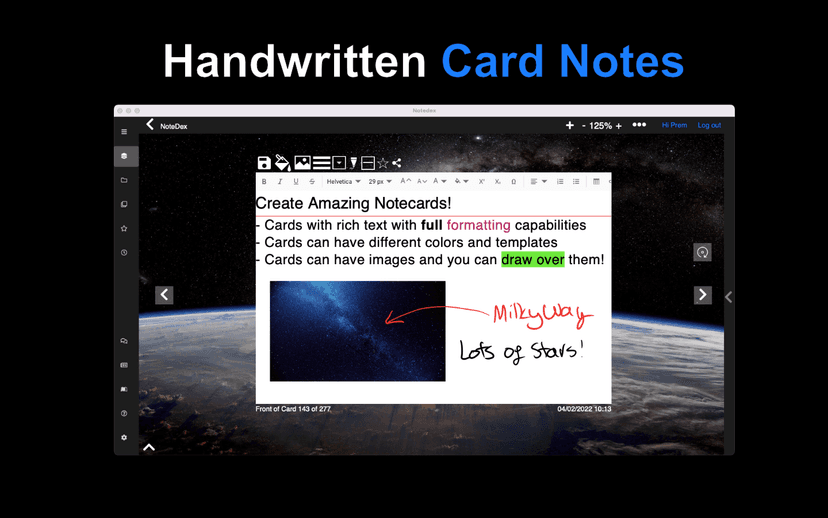
- Supports handwritten digital ink, which learning science links to better encoding of information than typing.
- Enables cross-device synchronization for consistent access to study materials.
- Forces learners to synthesize information into bite-sized index cards, promoting active processing.
Cons
- Requires the user to generate all content, offering no pre-built educational curriculum or verified facts.
- Lacks built-in mechanisms to correct factual errors in user-generated study materials.
- Demands high executive functioning and self-discipline to consistently maintain study habits.
What Do We Know About NoteDex?
NoteDex is an effective study utility for older students who already possess strong note-taking skills, but it will not teach your child new concepts on its own. It is a blank canvas designed for active retrieval practice. The app uses digital flashcards to help learners memorize material they have already encountered in class. By forcing students to condense lectures into index cards, the app encourages active cognitive processing. Your child must actively write, organize, and review the cards. The inclusion of digital handwriting support is a significant advantage, as research shows that physically writing notes improves memory encoding compared to typing. However, because NoteDex does not provide any instructional content, its value relies entirely on the accuracy and quality of the learner's input. If your child creates a flashcard with incorrect information, the app will effectively help them memorize that error. NoteDex is currently pending evaluation by The Learning Standard. Parents should view this as an organizational tool to support existing coursework rather than a standalone educational solution.
How Does NoteDex Work?
NoteDex uses a student-generated retrieval practice model combined with the Leitner system of spaced repetition. Users begin by creating digital index cards for their subjects, adding text, images, or handwritten notes. When studying, the app utilizes a Leitner box method. This algorithm tracks which cards the user answers correctly and which they miss. Cards answered incorrectly appear more frequently in subsequent review sessions, while known concepts are spaced further apart to optimize memory retention. This forces the brain to retrieve information just before it is likely to be forgotten. The interface mimics physical index cards, allowing users to visually organize information into stacks and flip them for self-testing. Cross-device syncing ensures that learners can capture a note on a tablet during a lecture and review it later on a phone. The app operates purely as a framework for the learner's own curriculum.
Strengths and tradeoffs of NoteDex
NoteDex's biggest strength is its automated use of spaced repetition to maximize memory retention, while its biggest weakness is its complete reliance on the user to generate accurate study material. The app effectively leverages retrieval practice, forcing learners to pull information from memory rather than passively rereading notes. This is widely recognized as one of the most effective study techniques. By integrating the Leitner system, NoteDex ensures that study sessions are efficient, concentrating effort on weaker areas while spacing out successful recalls to build long-term memory. The support for handwritten digital ink also plays to the science of embodied cognition, where the physical act of writing enhances learning. On the negative side, the blank-slate nature of the app means there are no worked examples, scaffolding, or expert feedback. If a student misunderstands a concept during a lecture, the app cannot correct them. It simply reinforces whatever is written on the card. This lack of external validation means NoteDex is best used alongside formal instruction rather than as a primary learning source.
Who Might Benefit From NoteDex?
Best for high school, college, and adult learners who need a structured way to memorize complex information from their coursework. NoteDex requires a high degree of self-direction, making it unsuitable for young children or students who struggle with executive functioning. The app thrives in higher education environments where students must synthesize large volumes of reading material and lecture notes into digestible facts. It is particularly well-suited for learners preparing for standardized exams, medical boards, or professional certifications, provided they are capable of accurately curating their own study materials.
Data Transparency
Does Not Meet Data Transparency Standard
NoteDex does not meet our data transparency standard. Its privacy policy does not document basic protections, including a commitment against targeted advertising, limits on sharing children's data and a COPPA or FERPA commitment.
16 of 35 checks passed
Evaluated September 2026
Privacy Policy →Level 1 · Basic protections
Does not sell data or target ads at students, limits sharing, and lets parents see and delete their child's data.
Not documented: a commitment against targeted advertising, limits on sharing children's data, a COPPA or FERPA commitment, parents' right to see their child's data, parents' right to delete their child's data
Level 2 · Parent control (meets the standard)
Families can get their data out, know who processes it, and know how long it is kept.
Not documented: a data retention timeline
Level 3 · Direct data access
Families or schools can pull their own data through an API, in a stated format.
Not documented: an API for retrieving their own data
View all 35 checks
Parent Access3/8
Does the policy mention parents specifically?
“If we learn we have collected or received personal information from a child under 16 without verification of parental consent, we will delete that information.”
Can parents view their child's data?
The policy does not give parents a right to view their child's data.
Can parents modify their child's data?
The policy does not give parents a right to modify their child's data.
Can parents delete their child's account?
The policy says NoteDex will delete a child's data if it learns it was collected without parental consent, but it does not give parents a deletion right.
Is there a dedicated Children's Privacy section?
“Does NoteDex allow children to use its Services?”
Does it reference COPPA compliance?
The policy does not mention COPPA.
Does it reference FERPA compliance?
The policy does not mention FERPA.
Is parental consent required for child accounts?
“If we learn we have collected or received personal information from a child under 16 without verification of parental consent, we will delete that information.”
Data Portability4/5
Can users access their personal data?
“If you prefer, you can contact us at [support@notedexapp.com](mailto:support@notedexapp.com) to ask us to provide access to, correct, update, or delete your personal information.”
Can users download/export their data?
“You may also export your notes at any time using export to PDF and other similar features in NoteDex.”
Is there a self-service data access tool?
“You may also export your notes at any time using export to PDF and other similar features in NoteDex.”
Is a specific data format mentioned for export?
“You may also export your notes at any time using export to PDF and other similar features in NoteDex.”
Is there an API for data access?
The policy does not mention an API for data access.
Data Minimization1/6
Is data collection itemized?
“Basic subscriber information. To open your account and process payments, we collect and receive identifiers like your email address and, depending on how you purchase a subscription to a Paid Service, your billing address and other payment information.”
Can the app be used without a real name?
The policy says NoteDex receives users' names through Google single sign-on.
Can the app be used without an email?
The policy says NoteDex collects an email address to open the account.
Does it state collection is limited to what is necessary?
The policy limits disclosure to the minimum necessary but does not say collection is limited to what is necessary.
Is IP address anonymized or truncated?
The policy says it collects IP addresses and does not mention anonymizing them.
Is location tracking explicitly excluded?
The policy says it collects IP addresses and, if users share it, mobile device location.
Third-Party Protection4/7
Does it explicitly state no selling of data?
“NoteDex is not in the business of selling or renting your information.”
Are third-party providers named?
“We may, for instance, participate in the Google Adwords Remarketing, [Twitter Tailored Audience](https://support.twitter.com/articles/20170405) and [Facebook Custom Audience](https://www.facebook.com/help/341425252616329) services.”
Are providers contractually restricted?
“We require these providers to agree to strict data protection requirements in keeping with our privacy policy standards and our obligations under data protection laws.”
No-targeted-advertising commitment?
The policy says NoteDex uses third-party ad networks and retargeting services to show its users targeted NoteDex ads.
Is AI/ML data sharing addressed?
The policy does not address sharing data for AI or machine learning.
Child-specific sharing restriction?
The policy has no sharing restrictions specific to children.
Cookies/tracking limited or opt-out?
“You may opt out of certain ad targeting and retargeting services by visiting the Digital Advertising Alliance’s [opt-out page](http://www.aboutads.info/), or the Network Advertising Initiative’s [opt-out page](http://www.networkadvertising.org/choices/).”
Deletion & Retention3/5
Can users delete their account?
“If you prefer, you can contact us at [support@notedexapp.com](mailto:support@notedexapp.com) to ask us to provide access to, correct, update, or delete your personal information.”
Self-service deletion mechanism?
“As described above, you can delete your Content at any time, and you can stop using the NoteDex Service at any time.”
Specific data retention timeline?
The policy keeps content until the user deletes it and gives no specific retention period.
Auto-deletion of inactive accounts?
The policy only says NoteDex may close inactive accounts and does not commit to deleting them automatically.
Post-deletion handling described?
“If you delete your Content and then sync, it will no longer be accessible to you or others who may access the NoteDex Service. The NoteDex Service’s back-up systems may retain residual copies of your deleted Content due to the nature of those systems’ operations.”
Advertising1/4
Advertising model explicitly disclosed?
“We contract with third-party advertising networks in order to deliver relevant NoteDex advertisements to you across the Internet and to manage our communications with you. We do not use your Content for these purposes.”
Free from third-party advertisements?
The policy does not say whether the product shows third-party ads.
Children excluded from ad targeting?
The policy does not exclude children from ad targeting.
Ad-free option available?
The policy does not mention an ad-free option or say the product has no advertising.
What This Means
The policy review did not meet our data transparency standard. The checks above show the documented findings and unknowns. A missing statement does not establish how the app handles data in practice.
About this evaluation: Based on automated analysis of Privacy Policy against 35 policy-disclosure questions, including questions adapted from the Common Sense Privacy Program's published evaluation questions. TLS is not affiliated with Common Sense Media, and this is not a Common Sense rating. Quoted text is copied from the policy; unquoted notes are our summary. Results describe what the policy documents, not the company's actual practices. Privacy policies can change: this review reflects the version we analyzed and does not determine legal compliance.
Sources and review method
TLS combines product information and editorial analysis to explain how NoteDex works, its tradeoffs, and the questions to ask before choosing it. Product features, an instructional rationale and evidence of learning outcomes are different kinds of information.
Formal Learning Standard assessment: not yet completed. Data Transparency findings are reported separately and do not establish learning effectiveness. Read our methodology.
Frequently Asked Questions About NoteDex
Is NoteDex free?
NoteDex is not completely free for learners. The developer offers both one-time purchase and subscription payment options to access the full suite of note-taking tools. Upgrading to a paid tier typically unlocks essential study features like cross-device synchronization across mobile and desktop platforms, as well as the full Leitner spaced repetition study mode. You will need to review their current pricing structure directly on their platform to determine which payment model fits your educational budget and needs.
Is NoteDex good for high school students?
Yes, NoteDex is highly effective for 11th and 12th graders managing rigorous coursework like Advanced Placement classes or standardized test preparation. Because it relies heavily on self-direction and independent study habits, it is best suited for older teenagers who already possess baseline organizational skills. Younger students may struggle with the blank-slate nature of the app and the discipline required to consistently build and review their own index card decks.
What does NoteDex teach?
NoteDex does not explicitly teach any specific subjects or provide a pre-built curriculum. Instead, it provides an organizational framework and a spaced repetition algorithm for students to study their own notes. Whether your child is studying high school biology, college calculus, or a professional technical credential, the app acts as a blank canvas. The learning comes entirely from the process of condensing lecture material into flashcards and actively retrieving that information during study sessions.
How does NoteDex compare to Anki or Quizlet?
NoteDex focuses heavily on the visual aesthetic of physical index cards and robust support for handwritten digital ink using styluses. Anki, its primary competitor in the spaced repetition space, offers much deeper customization for its learning algorithms but has a steeper learning curve. Quizlet provides millions of pre-made card decks for instant studying but leans more toward standardized gamification. NoteDex bridges the gap for learners who want the cognitive benefits of handwriting combined with structured spaced repetition.
Has NoteDex been evaluated by The Learning Standard?
NoteDex is currently pending evaluation by The Learning Standard. We have not yet rated its overall efficacy according to our full rubric. When evaluated, our research team will apply our standard methodology to assess how well its spaced repetition features drive verifiable learning outcomes. Until that data is published, educators and parents should view NoteDex as a capable study utility rather than a scientifically validated instructional platform.
Has The Learning Standard evaluated NoteDex?
TLS has not yet completed a Learning Standard evaluation of how well NoteDex teaches. Its privacy policy has been reviewed for Data Transparency and does not yet document the basic protections (Level 1).
Is NoteDex COPPA compliant?
A COPPA reference was not found in the reviewed privacy policy. This does not determine whether the app complies with COPPA. Policy review note: The policy does not mention COPPA.
Is NoteDex FERPA compliant?
A FERPA reference was not found in the reviewed privacy policy. This does not determine whether the app complies with FERPA. Policy review note: The policy does not mention FERPA.
Does NoteDex have a children's privacy policy?
The reviewed policy includes a dedicated children's privacy section. Policy review note: The policy has a section with its own heading about children's use.
Does NoteDex sell student data?
The reviewed policy states that the app does not sell data. This is a policy statement; actual data practices were not verified. Policy review note: The policy says NoteDex does not sell user information.
Can you delete your data from NoteDex?
The reviewed privacy policy describes account deletion. We have not tested the deletion process. Policy review note: Users can request deletion of their personal information.
Follow TLS Research
Subscribe to future TLS research updates: app reviews, findings, and what the evidence shows.
Screenshots

Take Action
For NoteDex
If you represent NoteDex and have a correction or new evidence, send the relevant source so we can review and update this page.
Submit a correctionDetails
- Pricing
- One-time and subscription payment options
- Platforms
- Web Browser, iOS (Apple mobile), iPadOS (Apple tablet), Android (Google mobile), Windows (Microsoft), macOS (Apple), Chrome OS (Google)
- Grade Levels
- 11th Grade, 12th Grade, Associate's degree, Bachelor's degree, Post-baccalaureate certificate, Master's Degree, Post-master's certificate, Doctoral Degree, Post-doctoral certificate, Adult Education, Professional or Technical Credential
- Website
- Visit site