
MentalUP Educational Games
Product by MentalUP
Facts checked: Not yet checked
Our take (not a Learning Standard rating). This label applies to learning-science judgments throughout this overview.
Our take (not a Learning Standard rating)
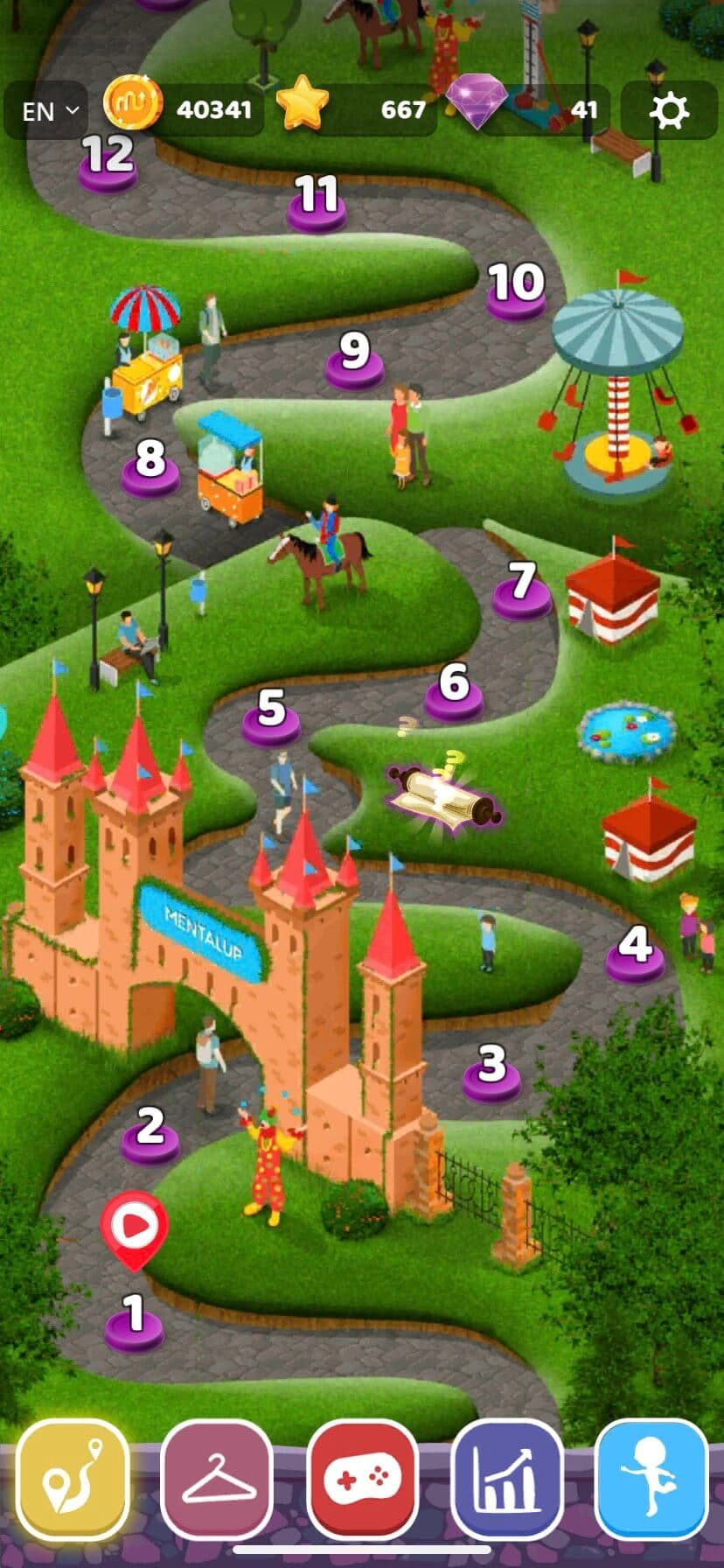
MentalUP provides engaging gamified tasks targeting memory and attention, but the transfer of these cognitive skills to broader academic achievement remains debated in learning science. It excels at motivating daily practice through game mechanics, yet lacks direct instruction in core academic subjects like reading or math.
Pros
- Uses gamification elements to maintain student engagement during repetitive cognitive tasks.
- Adjusts difficulty levels dynamically based on user performance to prevent frustration.
- Provides separate dashboards for parents and teachers to monitor activity and progress.
- Includes physical exercises alongside cognitive tasks to promote motor skill development.
Cons
- Relies heavily on working memory drills which often fail to transfer to general academic proficiency.
- Lacks explicit instruction or worked examples for users when they fail a task.
- Requires an expensive annual subscription of $99.99 for home users.
- Does not align with standard school curricula for math or literacy.
What Do We Know About MentalUP Educational Games?
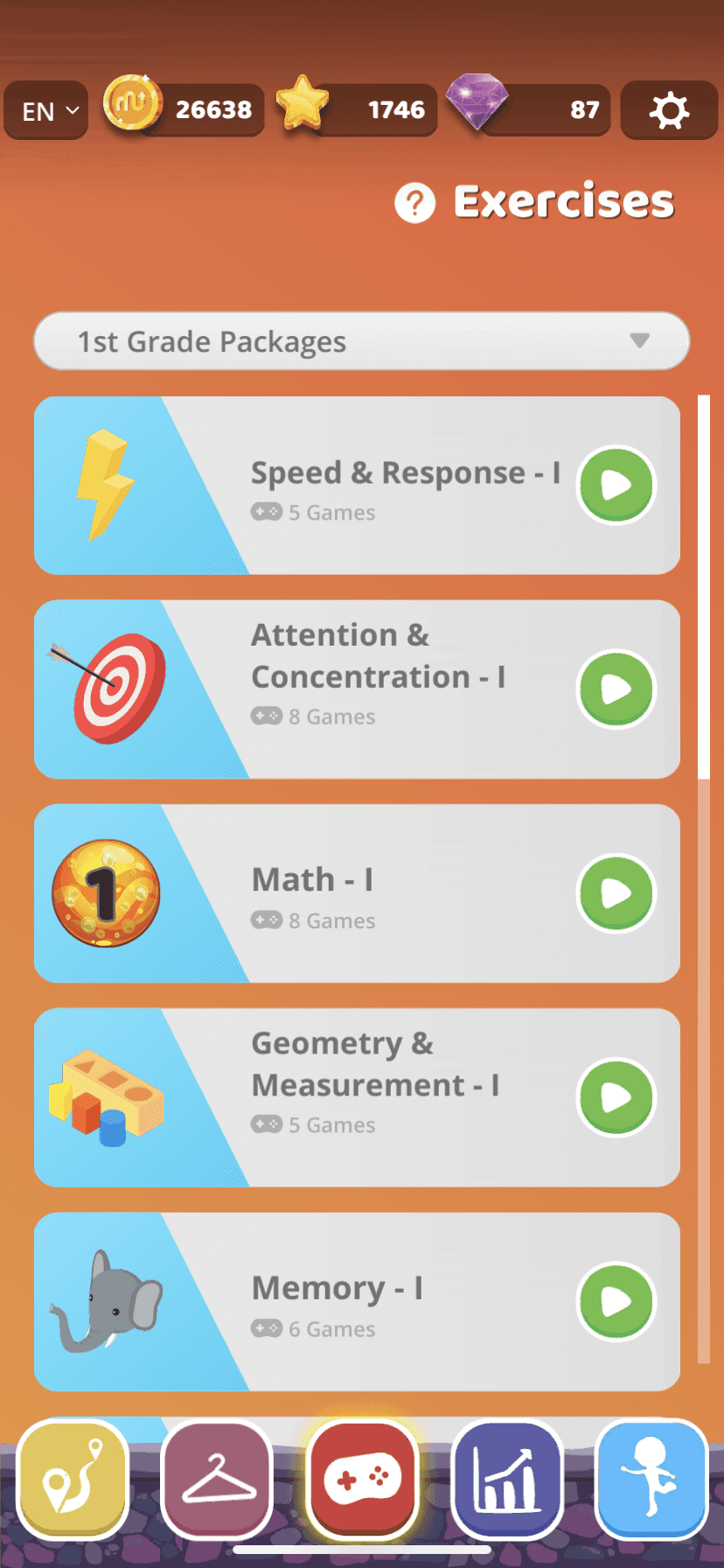
MentalUP is partially effective for practicing isolated cognitive skills like working memory and spatial reasoning, but it will not replace structured academic instruction. Your child will engage with a series of mini-games designed to test attention, logic, and memory. The app uses strong gamification elements to keep children returning to the platform daily, building a consistent habit of interactive play. However, parents should understand that learning science shows mixed results regarding brain training games. Improving at a memory game often just makes a child better at that specific game, rather than improving overall academic performance or test scores. The platform does not teach standard math, science, or reading curriculum. Instead, it functions as a supplemental tool for keeping the mind active during downtime. The addition of physical exercises is a unique benefit that encourages gross motor movement and helps prevent sedentary screen time. At $99.99 per year, parents must weigh the high cost against the specific benefits of cognitive drill practice. The Learning Standard has not yet formally evaluated this app's learning outcomes in our labs, so these observations are based on its structural pedagogy rather than tested results.
How Does MentalUP Educational Games Work?
MentalUP uses game-based cognitive training paired with adaptive difficulty to drill specific mental faculties. Your child logs into the platform and completes a daily sequence of mini-games targeting logic, memory, visual intelligence, and attention. As your child answers questions correctly, the algorithm increases the complexity of the puzzles, applying a concept similar to progressive overload in physical training. If your child struggles, the app scales back the difficulty to prevent cognitive overload and frustration. The platform does not rely on direct instruction or worked examples. Instead, it uses trial-and-error mechanics where users learn the rules of the puzzle through active participation and immediate feedback. Alongside the digital puzzles, the app prompts users to complete short, guided physical exercises to break up screen time and support gross motor development. Progress is tracked internally on a specialized dashboard, allowing parents and educators to view completion rates, daily streaks, and accuracy metrics across different cognitive skill domains.
Strengths and tradeoffs of MentalUP Educational Games
The biggest strength of MentalUP is its ability to sustain engagement through gamification, while its biggest weakness is the lack of proven transferability of its cognitive drills to academic success. Grounded in game-based learning, the app effectively uses immediate feedback and adaptive difficulty to keep users within their zone of proximal development. This means the puzzles constantly adjust so they are rarely too easy or too hard for your child. However, learning science repeatedly demonstrates that practicing working memory tasks primarily improves performance on those specific tasks, rather than boosting general intelligence. The app lacks explicit instruction and worked examples, meaning children who misunderstand a puzzle's core concept are left to guess rather than learn the underlying strategy. Additionally, the app does not utilize spaced repetition for core academic facts, focusing instead on rapid visual and logical processing. The inclusion of physical exercises is a highly effective pedagogical choice, as physical movement is known to increase blood flow and briefly improve cognitive focus before returning to screen-based tasks. While the interface is highly polished, the annual price tag is steep for a supplementary tool.
Who Might Benefit From MentalUP Educational Games?
MentalUP is best for elementary students who need an engaging, structured way to practice attention and logic puzzles outside of traditional schoolwork. It serves children aged 4 to 13 well as a supplementary activity during school breaks or weekends to keep them mentally and physically active. Parents looking for a safe, closed environment that combines basic cognitive drills with prompted physical movement will find significant value here. However, it is not suitable for students needing targeted remedial help in reading, writing, or mathematics, as the platform does not teach standard academic subjects.
Data Transparency
Does Not Meet Data Transparency Standard
MentalUP Educational Games does not meet our data transparency standard. Its privacy policy does not document basic protections, including a statement that it does not sell data, a commitment against targeted advertising and limits on sharing children's data.
5 of 35 checks passed
Evaluated September 2026
Privacy Policy →Level 1 · Basic protections
Does not sell data or target ads at students, limits sharing, and lets parents see and delete their child's data.
Not documented: a statement that it does not sell data, a commitment against targeted advertising, limits on sharing children's data, contractual limits on service providers, a COPPA or FERPA commitment, parents' right to see their child's data, parents' right to delete their child's data
Level 2 · Parent control (meets the standard)
Families can get their data out, know who processes it, and know how long it is kept.
Not documented: data export, a data retention timeline, named service providers, self-service deletion
Level 3 · Direct data access
Families or schools can pull their own data through an API, in a stated format.
Not documented: an API for retrieving their own data, a named export format
View all 35 checks
Parent Access2/8
Does the policy mention parents specifically?
“If the member is at least 13 years of age and under 18 years of age, and have the power to discriminate, he/she must sign up to MentalUp and must provide his / her data only in the presence of one of his/her parents or his/her legal representative.”
Can parents view their child's data?
The policy gives access rights only to the Member and does not give parents a right to view their child's data.
Can parents modify their child's data?
The policy gives correction rights only to the Member, not to parents.
Can parents delete their child's account?
The policy gives deletion rights only to the Member, not to parents.
Is there a dedicated Children's Privacy section?
The policy has no separate children's privacy section; age rules appear inside a general paragraph.
Does it reference COPPA compliance?
The policy does not reference COPPA.
Does it reference FERPA compliance?
The policy does not reference FERPA.
Is parental consent required for child accounts?
“In this context, the Member declares that his or her parent or legal representative has reviewed and accepted this Privacy Policy and that the data has been shared following the said permission. Neither person under 13 (thirteen) years of age can be directly a member of the MentalUP itself, nor submit his/her own personal data directly.”
Data Portability1/5
Can users access their personal data?
“request information on personal data, if it has been processed;”
Can users download/export their data?
The policy does not offer a data download or export.
Is there a self-service data access tool?
The policy handles access rights only through written or email requests, not a self-service tool.
Is a specific data format mentioned for export?
The policy does not name any export format.
Is there an API for data access?
The policy does not mention an API for data access.
Data Minimization1/6
Is data collection itemized?
“The Company might collect the Member's personal information (user name, name if provided, IP address, the date and time of access, the pages accessed while being on MentalUP) and the activities taken place under MentalUP”
Can the app be used without a real name?
The policy says the Company may collect the Member's name if it is provided.
Can the app be used without an email?
The policy does not say whether the product can be used without an email address.
Does it state collection is limited to what is necessary?
The policy limits use and processing to its stated purposes but does not say collection is limited to what is necessary.
Is IP address anonymized or truncated?
The policy says it collects IP addresses and does not mention anonymizing or truncating them.
Is location tracking explicitly excluded?
The policy does not address location tracking.
Third-Party Protection0/7
Does it explicitly state no selling of data?
The policy restricts sharing with third parties but never explicitly says the Company does not sell data.
Are third-party providers named?
The policy does not name any third-party providers.
Are providers contractually restricted?
The policy does not describe contractual restrictions on providers.
No-targeted-advertising commitment?
The policy does not address targeted advertising.
Is AI/ML data sharing addressed?
The policy does not address sharing data for AI or machine learning; it only mentions objecting to automated analysis.
Child-specific sharing restriction?
The policy has no sharing restriction specific to children.
Cookies/tracking limited or opt-out?
The policy mentions cookies but offers no limit on tracking or way to opt out.
Deletion & Retention1/5
Can users delete their account?
“request that personal data be erased or destroyed if the circumstances requiring the processing of the personal data disappearance;”
Self-service deletion mechanism?
The policy handles deletion only through written requests, not a self-service mechanism.
Specific data retention timeline?
The policy says data is deleted after the processing purposes end but gives no specific retention period.
Auto-deletion of inactive accounts?
The policy does not address deleting inactive accounts.
Post-deletion handling described?
The policy does not describe how data is handled after an account is deleted, such as backups or residual copies.
Advertising0/4
Advertising model explicitly disclosed?
The policy does not disclose an advertising model.
Free from third-party advertisements?
The policy does not say whether the product carries third-party ads.
Children excluded from ad targeting?
The policy does not address ad targeting of children.
Ad-free option available?
The policy does not mention advertising or an ad-free option.
What This Means
The policy review did not meet our data transparency standard. The checks above show the documented findings and unknowns. A missing statement does not establish how the app handles data in practice.
About this evaluation: Based on automated analysis of Privacy Policy against 35 policy-disclosure questions, including questions adapted from the Common Sense Privacy Program's published evaluation questions. TLS is not affiliated with Common Sense Media, and this is not a Common Sense rating. Quoted text is copied from the policy; unquoted notes are our summary. Results describe what the policy documents, not the company's actual practices. Privacy policies can change: this review reflects the version we analyzed and does not determine legal compliance.
Sources and review method
TLS combines product information and editorial analysis to explain how MentalUP Educational Games works, its tradeoffs, and the questions to ask before choosing it. Product features, an instructional rationale and evidence of learning outcomes are different kinds of information.
Formal Learning Standard assessment: not yet completed. Data Transparency findings are reported separately and do not establish learning effectiveness. Read our methodology.
Frequently Asked Questions About MentalUP Educational Games
Is MentalUP free?
No, MentalUP is not free. The app requires a paid subscription, which costs $99.99 for a 12-month membership for home users. Schools can purchase corporate licenses at variable rates depending on student volume.
Is MentalUP good for 4-year-olds?
Yes, MentalUP is suitable for 4-year-olds. The app includes early childhood content and adjusts its difficulty to match a preschooler's cognitive level, focusing on basic visual recognition and simple logic rather than complex problem-solving.
What does MentalUP teach?
MentalUP teaches isolated cognitive skills such as visual intelligence, working memory, attention, and spatial logic. It also includes guided physical exercises to support gross motor development. It does not teach standard academic subjects like math or literacy.
How does MentalUP compare to Lumosity?
Both MentalUP and Lumosity offer gamified cognitive training, but MentalUP is specifically designed for children aged 4 to 13. MentalUP also uniquely integrates physical exercise routines alongside its mental puzzles, whereas Lumosity strictly focuses on digital brain-training games for a wider age range.
Has The Learning Standard evaluated MentalUP Educational Games?
TLS has not yet completed a Learning Standard evaluation of how well MentalUP Educational Games teaches. Its privacy policy has been reviewed for Data Transparency and does not yet document the basic protections (Level 1).
Is MentalUP Educational Games COPPA compliant?
A COPPA reference was not found in the reviewed privacy policy. This does not determine whether the app complies with COPPA. Policy review note: The policy does not reference COPPA.
Is MentalUP Educational Games FERPA compliant?
A FERPA reference was not found in the reviewed privacy policy. This does not determine whether the app complies with FERPA. Policy review note: The policy does not reference FERPA.
Does MentalUP Educational Games have a children's privacy policy?
No dedicated children's privacy section was found in the reviewed policy. Policy review note: The policy has no separate children's privacy section; age rules appear inside a general paragraph.
Does MentalUP Educational Games sell student data?
A statement ruling out data selling was not found in the reviewed policy. This does not establish that the app sells student data. Policy review note: The policy restricts sharing with third parties but never explicitly says the Company does not sell data.
Can you delete your data from MentalUP Educational Games?
The reviewed privacy policy describes account deletion. We have not tested the deletion process. Policy review note: Members can request that their personal data be erased or destroyed.
Follow TLS Research
Subscribe to future TLS research updates: app reviews, findings, and what the evidence shows.
Screenshots

Take Action
For MentalUP Educational Games
If you represent MentalUP and have a correction or new evidence, send the relevant source so we can review and update this page.
Submit a correctionDetails
- Pricing
- For the end user, MentalUP offers 12 months membership at $99.99 For corporate usage (in schools), the unit price can be changed depending on the amount of students.
- Platforms
- Web Browser, iOS (Apple mobile), Android (Google mobile)
- Grade Levels
- Preschool, Prekindergarten, Transitional Kindergarten, Kindergarten, 1st Grade, 2nd Grade, 3rd Grade, 4th Grade, 5th Grade, 6th Grade
- Website
- Visit site