
Matific
Product by Matific
Facts checked: Not yet checked
Our take (not a Learning Standard rating). This label applies to learning-science judgments throughout this overview.
Our take (not a Learning Standard rating)
Matific leverages game-based environments to teach K-6 math, but its full efficacy remains unverified by our team. It focuses on conceptual understanding through interactive problem-solving rather than rote memorization. While its gamified approach increases time-on-task, parents must pair it with feedback to ensure actual learning transfer occurs.
Pros
- Replaces static rote memorization with interactive virtual manipulatives that leverage embodied cognition principles.
- Uses adaptive sequencing to adjust problem difficulty based on real-time student performance.
- Increases student time-on-task through highly engaging scenario-based games.
Cons
- Lacks explicit worked examples, causing novices to rely heavily on trial-and-error guessing.
- Over-gamification introduces extraneous cognitive load that distracts from core mathematical concepts.
- Fails to provide sufficient rapid retrieval practice necessary for developing basic math fact fluency.
What Do We Know About Matific?
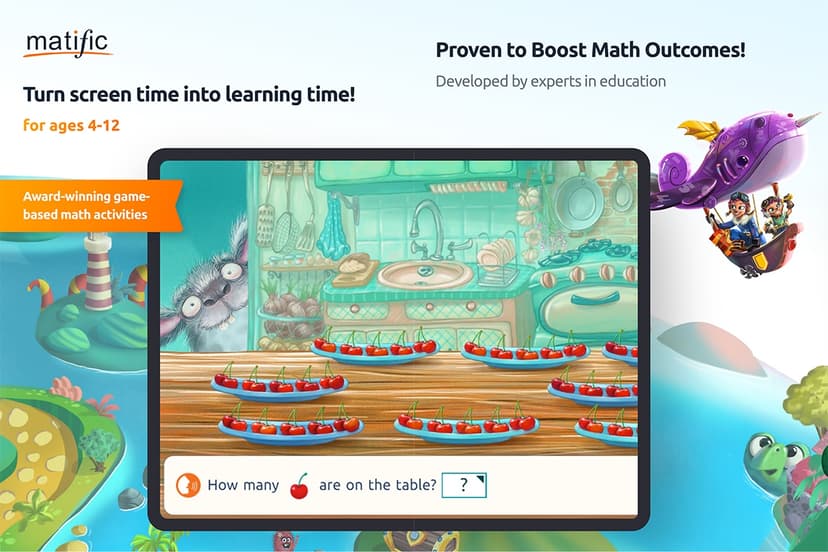
Matific is a potentially effective tool for conceptual math practice, though it is currently pending formal evaluation by The Learning Standard. Your child will use this app to navigate interactive math mini-games designed for kindergarten through sixth grade. Because it relies heavily on gamification, you must monitor whether your child is genuinely grasping math concepts or simply clicking through animations to earn rewards. The program attempts to build mathematical intuition by having students manipulate digital objects rather than just typing in numbers. This tactile approach aligns well with concrete-representational-abstract learning models, helping younger learners visualize fractions, geometry, and basic arithmetic. However, without explicit instruction or worked examples, students who struggle may become frustrated by the trial-and-error design. You should treat Matific as a supplementary practice environment rather than a standalone math curriculum. To get the most out of it, sit with your child during early sessions and ask them to explain their reasoning out loud. This self-explanation strategy prevents passive clicking and ensures the game-based mechanics translate into durable math skills.
How Does Matific Work?
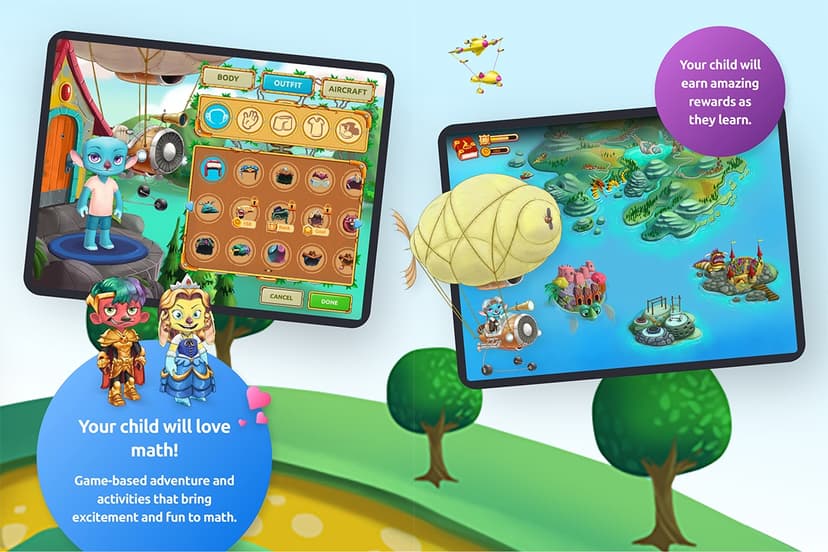
Matific uses a game-based, personalized learning approach to deliver K-6 math practice through interactive episodes. Students begin by taking a placement test or diving into assigned grade-level content, which dictates the initial difficulty of the activities. Instead of traditional worksheets, learners interact with drag-and-drop puzzles, virtual manipulatives, and scenario-based games. The system utilizes an adaptive algorithm that tracks accuracy and response time, adjusting subsequent tasks to keep students within their zone of proximal development. When a student answers incorrectly, the app typically offers visual hints or allows another attempt, leaning on a trial-and-error instructional model. The interface is highly gamified, rewarding users with digital items and progression milestones to maintain motivation. Educators and parents have access to a dashboard that aggregates performance data, highlighting specific math standards where the child is succeeding or struggling.
Strengths and tradeoffs of Matific
Matific's biggest strength is its use of interactive virtual manipulatives to build conceptual understanding, while its biggest weakness is the potential for its game mechanics to overshadow explicit instruction. Strengths: The platform excels at creating concrete representations of abstract math concepts. By forcing students to physically manipulate digital objects like blocks or measuring tapes, it utilizes embodied cognition principles that strengthen memory retention. This approach moves away from rote memorization and encourages deep mathematical intuition. The adaptive sequencing also attempts to provide spaced practice, theoretically improving long-term recall of foundational skills. Weaknesses: The heavy reliance on trial-and-error learning can be detrimental to novices. Without sufficient worked examples, students lacking prior knowledge resort to guessing rather than engaging in productive struggle. The gamified environment, while excellent for engagement, introduces extraneous cognitive load. Bright colors, animations, and reward systems pull attention away from the core mathematical tasks. Additionally, since the app relies heavily on interactive scenarios, it offers limited opportunities for the rapid retrieval practice needed to build math fact fluency.
Who Might Benefit From Matific?
Matific is best for elementary students who benefit from visual, hands-on learning rather than traditional math worksheets. The app targets learners from kindergarten through sixth grade who need supplementary practice to reinforce classroom instruction. It works particularly well for children who experience math anxiety, as the low-stakes, game-based environment reduces the pressure of standard assessments. Parents seeking a core curriculum will find it insufficient on its own, but those wanting an engaging, interactive platform to build conceptual understanding in spatial reasoning, fractions, and basic operations will find it a highly useful addition to their educational toolkit.
Data Transparency
Does Not Meet Data Transparency Standard
Matific does not meet our data transparency standard. Its privacy policy does not document basic protections, including a commitment against targeted advertising and parents' right to delete their child's data.
16 of 35 checks passed
Evaluated September 2026
Privacy →Level 1 · Basic protections
Does not sell data or target ads at students, limits sharing, and lets parents see and delete their child's data.
Not documented: a commitment against targeted advertising, parents' right to delete their child's data
Level 2 · Parent control (meets the standard)
Families can get their data out, know who processes it, and know how long it is kept.
Not documented: a data retention timeline, named service providers, self-service deletion
Level 3 · Direct data access
Families or schools can pull their own data through an API, in a stated format.
Not documented: an API for retrieving their own data, a named export format
View all 35 checks
Parent Access4/8
Does the policy mention parents specifically?
“When you register as a parent – your first and last name, email address, chosen password.”
Can parents view their child's data?
“Your information (including student's progress in the games and achievements) may be visible only to the parent, teacher or school representative that initially uploaded student's information to the Platform or to other authorized school staff.”
Can parents modify their child's data?
The policy gives a general right to correct data but does not say parents can change their child's data.
Can parents delete their child's account?
The policy gives a general right to request deletion but does not say parents can delete their child's data or account.
Is there a dedicated Children's Privacy section?
“SHORT PRIVACY NOTICE FOR STUDENTS”
Does it reference COPPA compliance?
The policy does not mention COPPA.
Does it reference FERPA compliance?
“To the extent we receive any Personal Data in a capacity of a "School Official" pursuant to a disclosure from an educational agency or institution, Please be advised that (a) the educational agency or institution must execute a separate purchase order and a data processing addendum (DPA) thereto”
Is parental consent required for child accounts?
The policy says only parents, teachers or schools should register students, but it does not require parental consent.
Data Portability2/5
Can users access their personal data?
“The right to access the personal information we hold about you.”
Can users download/export their data?
“In some circumstances, the right to request that we transfer or port elements of your data either to you or another service provider – if the processing is based on your consent, and is made by automated means.”
Is there a self-service data access tool?
The policy describes access by request only, not a self-service data access tool.
Is a specific data format mentioned for export?
The policy does not name an export format.
Is there an API for data access?
The policy does not describe an API for users to get their data.
Data Minimization1/6
Is data collection itemized?
“you may upload to the Platform the following information about your students in each of your classes: first and last name, user name, password, parent email address.”
Can the app be used without a real name?
The policy says it collects students' first and last names.
Can the app be used without an email?
The policy does not say that no student email is collected, and it collects parent email addresses along with SSO login data.
Does it state collection is limited to what is necessary?
The policy does not say that collection is limited to what is necessary.
Is IP address anonymized or truncated?
The policy says it collects IP addresses but does not say they are anonymized or truncated.
Is location tracking explicitly excluded?
The policy says it collects country geolocation and does not rule out location tracking.
Third-Party Protection3/7
Does it explicitly state no selling of data?
“We do not, and will not, sell any of your personal data to any third party – including your name, address, email address or credit card information.”
Are third-party providers named?
The policy lists only categories of service providers, not their names.
Are providers contractually restricted?
“These are binding contractual commitments requiring third parties who process personal data on our behalf to follow strict data protection standards, including enforceable rights and legal remedies for individuals.”
No-targeted-advertising commitment?
The policy says the product shows no ads but does not commit that user data is never used for targeted advertising.
Is AI/ML data sharing addressed?
The policy does not address sharing data with AI or ML systems.
Child-specific sharing restriction?
“We collect your name and data about what you do within the Matific platform. this data isn’t shared with anyone outside of Matific and never will be.”
Cookies/tracking limited or opt-out?
The policy says it does not respond to Do Not Track or other opt-out mechanisms and points to a separate cookies notice.
Deletion & Retention3/5
Can users delete their account?
“You can request that your personal information be deleted by contacting Slate Science Data Protection and Privacy Officer at [DPO@slatescience.com](mailto:DPO@slatescience.com).”
Self-service deletion mechanism?
The policy offers deletion by emailing the DPO only, with no self-service tool.
Specific data retention timeline?
The policy says data is kept as long as needed and gives no specific timeline.
Auto-deletion of inactive accounts?
“We take reasonable steps to delete the personal information we collect if your registration to use our Platform lapses, if you opt out of receiving further communications from us, or if you ask us to delete your information.”
Post-deletion handling described?
“We may however retain and use personal information as necessary to comply with our legal and regulatory obligations, to resolve disputes and to enforce our agreements, and we may retain and use anonymous and aggregated information for performance reporting and analytic purposes and for product and service improvement.”
Advertising3/4
Advertising model explicitly disclosed?
“The Site and the Platform does not display any advertising.”
Free from third-party advertisements?
“The Site and the Platform does not display any advertising.”
Children excluded from ad targeting?
The policy does not explicitly exclude children from ad targeting; it only says the product shows no ads.
Ad-free option available?
“The Site and the Platform does not display any advertising.”
What This Means
The policy review did not meet our data transparency standard. The checks above show the documented findings and unknowns. A missing statement does not establish how the app handles data in practice.
About this evaluation: Based on automated analysis of Privacy against 35 policy-disclosure questions, including questions adapted from the Common Sense Privacy Program's published evaluation questions. TLS is not affiliated with Common Sense Media, and this is not a Common Sense rating. Quoted text is copied from the policy; unquoted notes are our summary. Results describe what the policy documents, not the company's actual practices. Privacy policies can change: this review reflects the version we analyzed and does not determine legal compliance.
Sources and review method
TLS combines product information and editorial analysis to explain how Matific works, its tradeoffs, and the questions to ask before choosing it. Product features, an instructional rationale and evidence of learning outcomes are different kinds of information.
Formal Learning Standard assessment: not yet completed. Data Transparency findings are reported separately and do not establish learning effectiveness. Read our methodology.
Frequently Asked Questions About Matific
Is Matific free?
No, Matific requires a paid subscription. Pricing is structured on a per-student basis, with options for yearly or multi-year commitments. Some schools provide access for their students, so check with your child's teacher before purchasing a home license.
Is Matific good for elementary students?
Yes, Matific is specifically designed for kindergarten through sixth-grade students. The interface uses age-appropriate graphics and virtual manipulatives that cater well to early cognitive development, though older students in fifth or sixth grade might find the gamified elements slightly juvenile.
What does Matific teach?
Matific teaches foundational K-6 mathematics. The content covers core arithmetic, geometry, fractions, spatial reasoning, and basic data measurement. It emphasizes conceptual understanding and problem-solving over rapid rote memorization of math facts.
How does Matific compare to Khan Academy?
Matific focuses heavily on game-based, interactive manipulatives for elementary students, while Khan Academy provides direct video instruction and traditional practice sets. Matific requires a subscription, whereas Khan Academy is entirely free.
Has The Learning Standard evaluated Matific?
TLS has not yet completed a Learning Standard evaluation of how well Matific teaches. Its privacy policy has been reviewed for Data Transparency and does not yet document the basic protections (Level 1).
Is Matific COPPA compliant?
A COPPA reference was not found in the reviewed privacy policy. This does not determine whether the app complies with COPPA. Policy review note: The policy does not mention COPPA.
Is Matific FERPA compliant?
The reviewed privacy policy references FERPA. A policy reference alone does not establish FERPA compliance. Policy review note: The policy has a FERPA Notice section about acting as a School Official.
Does Matific have a children's privacy policy?
The reviewed policy includes a dedicated children's privacy section. Policy review note: The policy has its own section, written for child students, about their data.
Does Matific sell student data?
The reviewed policy states that the app does not sell data. This is a policy statement; actual data practices were not verified. Policy review note: The policy says the vendor does not sell personal data.
Can you delete your data from Matific?
The reviewed privacy policy describes account deletion. We have not tested the deletion process. Policy review note: Users can ask for their personal information to be deleted.
Follow TLS Research
Subscribe to future TLS research updates: app reviews, findings, and what the evidence shows.
Screenshots
Take Action
For Matific
If you represent Matific and have a correction or new evidence, send the relevant source so we can review and update this page.
Submit a correctionDetails
- Pricing
- Subscription, yearly and multi-year options. Priced per student.
- Platforms
- Web Browser, iOS (Apple mobile), iPadOS (Apple tablet), Android (Google mobile), Tizen (Samsung mobile), Windows (Microsoft), macOS (Apple), Chrome OS (Google)
- Grade Levels
- Kindergarten, 1st Grade, 2nd Grade, 3rd Grade, 4th Grade, 5th Grade, 6th Grade
- Website
- Visit site