
MathGPT
Product by MathGPT
Facts checked: Not yet checked
Our take (not a Learning Standard rating). This label applies to learning-science judgments throughout this overview.
Our take (not a Learning Standard rating)
MathGPT effectively uses worked examples by breaking down user-submitted problems into step-by-step explanations. However, because it provides full solutions instantly, it risks bypassing the productive struggle essential for deep learning. While flashcards offer basic retrieval practice, the tool functions primarily as an answer engine rather than a structured curriculum.
Pros
- Breaks complex math problems into step-by-step worked examples to reduce cognitive load.
- Includes interactive flashcards that support retrieval practice for formulas and key concepts.
- Offers a dedicated Kids Mode that adjusts instructional language complexity for younger learners.
- Provides targeted practice drills across multiple STEM subjects to build procedural fluency.
Cons
- Instantly solving user-submitted problems eliminates the productive struggle required for long-term retention.
- Lacks a structured, progressive curriculum to guide students through a complete learning pathway.
- Generative AI math explanations can sometimes produce plausible but mathematically incorrect steps.
- Games feature prioritizes gamification over focused, distraction-free learning time.
What Do We Know About MathGPT?
MathGPT is more effective as a homework safety net than as a standalone instructional tool. Your child can use this app to unblock themselves when stuck on a specific math problem, but it does not replace a structured math curriculum. By allowing users to snap a photo of a problem and instantly receive a full solution, MathGPT relies heavily on worked examples. Learning science shows that worked examples are highly effective for novices, provided the student actually studies the steps rather than just copying the final answer. Parents should monitor usage to ensure your child is not simply bypassing the cognitive effort required to learn math. The app supplements its core solver with flashcards and practice drills, which utilize retrieval practice to help lock formulas and procedures into long-term memory. The inclusion of a Kids Mode attempts to adjust the reading level for elementary students, making the explanations easier to process. While the developer states an upcoming feature will require students to write their own steps for live feedback, the current iteration gives the answer away immediately. Use this app to support your child during homework sessions, but do not rely on it to teach foundational math concepts from scratch.
How Does MathGPT Work?
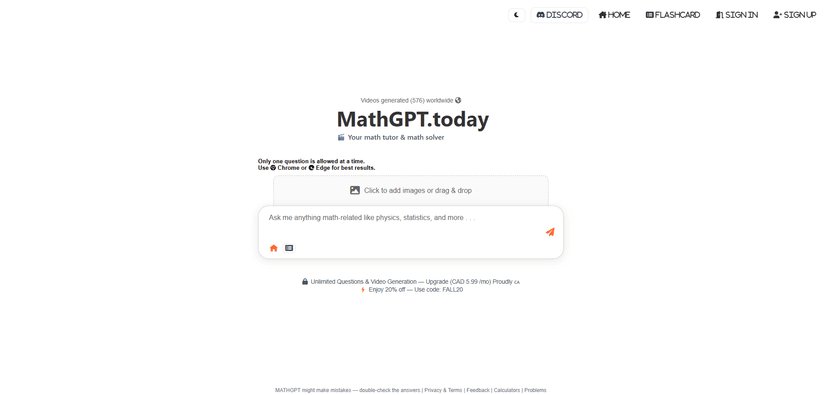
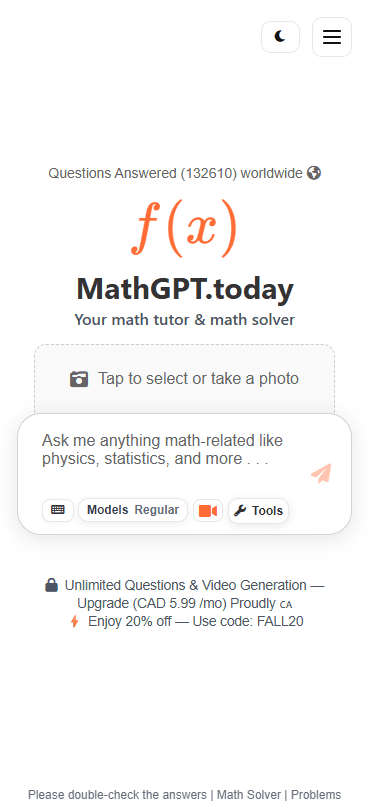
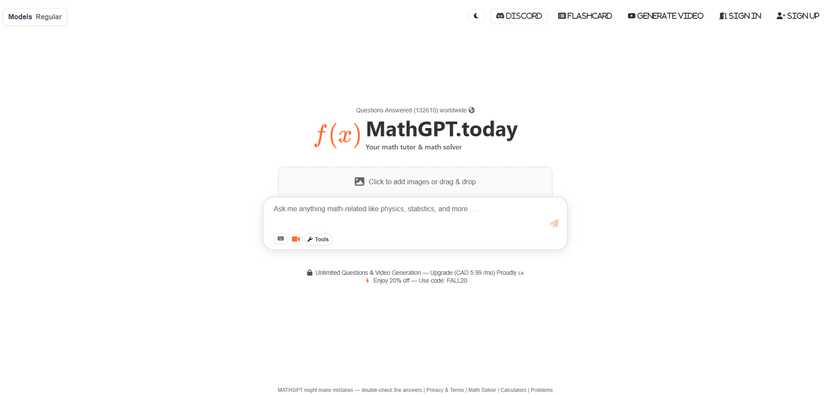
MathGPT uses an on-demand worked example model powered by generative AI. Users input a specific STEM problem by typing or uploading a photograph, and the system outputs a complete, step-by-step solution. This approach models the exact sequence of operations required to reach the correct answer. Alongside the primary solver function, the app includes a study suite featuring flashcards and practice question banks. These tools allow students to drill specific topics like algebra or calculus, employing basic retrieval practice to build procedural fluency. MathGPT also generates on-demand video lessons based on user queries, attempting to mimic direct instruction by narrating the problem-solving process. A Discord bot integration brings this solver capability directly into community chat servers. Users navigate a dashboard to toggle between the solver, flashcards, generated videos, and targeted practice drills, allowing them to switch from passive reading of solutions to active self-testing.
Strengths and tradeoffs of MathGPT
MathGPT's biggest strength is its ability to instantly generate detailed worked examples, while its biggest weakness is the ease with which students can use it to bypass productive struggle. Worked examples are a proven method for reducing cognitive load, allowing your child to see the exact sequence of steps needed to solve a problem without becoming overwhelmed. When a student is genuinely stuck, seeing the structural breakdown of an algebra or calculus problem is highly beneficial. Retrieval practice is also supported through the app's flashcards and targeted drills, helping reinforce formulas and core procedures. However, giving students immediate access to answers presents a major learning risk. True mastery requires productive struggle, the process of wrestling with a concept and making mistakes before arriving at the solution. Because MathGPT simply hands over the completed work, it requires high self-discipline from the student to analyze the steps rather than just copying the final number. Furthermore, the inclusion of quick games introduces seductive details: elements that are engaging but distract from the core learning objective. Until the app introduces its planned live-feedback feature where students must attempt the steps themselves, it remains a passive learning tool.
Who Might Benefit From MathGPT?
MathGPT is best for self-motivated middle school, high school, and college students who need on-demand homework help. Because the app requires the user to study the provided solutions rather than just copying them, it is most effective for learners who already possess strong self-regulation skills. While the app includes a Kids Mode for elementary students, younger children generally require more structured, sequential instruction rather than an open-ended solver. It serves well as a digital tutor for students preparing for exams in algebra, calculus, or physics who need to quickly verify their methodology.
Data Transparency
Does Not Meet Data Transparency Standard
MathGPT does not meet our data transparency standard. Its privacy policy does not document basic protections, including a commitment against targeted advertising, limits on sharing children's data and contractual limits on service providers.
13 of 35 checks passed
Evaluated September 2026
Privacy Policy →Level 1 · Basic protections
Does not sell data or target ads at students, limits sharing, and lets parents see and delete their child's data.
Not documented: a commitment against targeted advertising, limits on sharing children's data, contractual limits on service providers, parents' right to see their child's data
Level 2 · Parent control (meets the standard)
Families can get their data out, know who processes it, and know how long it is kept.
Not documented: a data retention timeline, self-service deletion
Level 3 · Direct data access
Families or schools can pull their own data through an API, in a stated format.
Not documented: an API for retrieving their own data
View all 35 checks
Parent Access4/8
Does the policy mention parents specifically?
“If you are a parent or guardian and believe we may have collected information from your child under 13, please contact us immediately at [info@mathgpt.today](mailto:info@mathgpt.today), and we will take steps to remove such information.”
Can parents view their child's data?
The policy gives parents no right to view their child's data; it only lets them ask for removal.
Can parents modify their child's data?
The policy gives parents no right to change their child's data.
Can parents delete their child's account?
“If you are a parent or guardian and believe we may have collected information from your child under 13, please contact us immediately at [info@mathgpt.today](mailto:info@mathgpt.today), and we will take steps to remove such information.”
Is there a dedicated Children's Privacy section?
“### 6\. Children's Privacy”
Does it reference COPPA compliance?
“**COPPA Compliance:** In accordance with the Children's Online Privacy Protection Act (COPPA), our Services are not intended for children under 13 years of age.”
Does it reference FERPA compliance?
The policy does not mention FERPA.
Is parental consent required for child accounts?
The policy says the service is not meant for anyone under 18 and does not describe a parental consent process for child accounts.
Data Portability3/5
Can users access their personal data?
“Right to access and receive a copy of your personal information”
Can users download/export their data?
“**Data Export and Portability:** Users may request an export of their account data and associated content in a commonly used machine-readable format (such as JSON or CSV).”
Is there a self-service data access tool?
The policy handles data access and export by email request; the only self-service view it describes is a log of AI actions, not a tool for accessing personal data.
Is a specific data format mentioned for export?
“Users may request an export of their account data and associated content in a commonly used machine-readable format (such as JSON or CSV).”
Is there an API for data access?
The policy does not describe an API that users can use to get their own data.
Data Minimization1/6
Is data collection itemized?
“- **Account Information:** Basic identifiers such as name, email address, password, and optional profile information.”
Can the app be used without a real name?
The policy says account information includes the user's name.
Can the app be used without an email?
The policy says account information includes the user's email address.
Does it state collection is limited to what is necessary?
The policy limits how long data is kept to what is necessary, but does not say collection is limited to what is necessary.
Is IP address anonymized or truncated?
The policy says it collects IP addresses and does not say they are anonymized or truncated.
Is location tracking explicitly excluded?
The policy does not rule out location tracking.
Third-Party Protection3/7
Does it explicitly state no selling of data?
“We commit to **never selling your personal information** to third parties for advertising or any other commercial purposes.”
Are third-party providers named?
“Our analytics provider, Amplitude, helps us understand platform usage patterns but does not store conversation content – only interaction events such as feature usage statistics.”
Are providers contractually restricted?
The policy lists service providers but does not say they are bound by contract restrictions.
No-targeted-advertising commitment?
The policy rules out selling data and says revenue comes from subscriptions, but never commits to not using data for targeted advertising.
Is AI/ML data sharing addressed?
“**Service Training and AI Improvement:** We may use your conversations and interactions to train and improve our AI models' responses and capabilities.”
Child-specific sharing restriction?
The policy only says it has never sold data of users under 16 in the past; it sets no ongoing sharing limit specific to children.
Cookies/tracking limited or opt-out?
The policy says it uses cookies but offers no way to opt out of or limit tracking.
Deletion & Retention1/5
Can users delete their account?
“When information is no longer needed or you request deletion, we will promptly remove it in accordance with our data retention policies.”
Self-service deletion mechanism?
The policy has users request deletion by email and does not describe a deletion tool they can use themselves.
Specific data retention timeline?
The policy keeps data only 'as long as necessary' and gives no specific timeline.
Auto-deletion of inactive accounts?
The policy does not mention automatically deleting inactive accounts.
Post-deletion handling described?
The policy only says data will be removed 'in accordance with our data retention policies' and does not explain what happens after deletion.
Advertising1/4
Advertising model explicitly disclosed?
“Our business model is based solely on subscription fees from users, not on monetizing your data or the platforms' data.”
Free from third-party advertisements?
The policy never says outright that the product shows no advertisements.
Children excluded from ad targeting?
The policy does not say children are excluded from ad targeting.
Ad-free option available?
The policy never says outright that the product is ad-free or offers an ad-free option.
What This Means
The policy review did not meet our data transparency standard. The checks above show the documented findings and unknowns. A missing statement does not establish how the app handles data in practice.
About this evaluation: Based on automated analysis of Privacy Policy against 35 policy-disclosure questions, including questions adapted from the Common Sense Privacy Program's published evaluation questions. TLS is not affiliated with Common Sense Media, and this is not a Common Sense rating. Quoted text is copied from the policy; unquoted notes are our summary. Results describe what the policy documents, not the company's actual practices. Privacy policies can change: this review reflects the version we analyzed and does not determine legal compliance.
Sources and review method
TLS combines product information and editorial analysis to explain how MathGPT works, its tradeoffs, and the questions to ask before choosing it. Product features, an instructional rationale and evidence of learning outcomes are different kinds of information.
Formal Learning Standard assessment: not yet completed. Data Transparency findings are reported separately and do not establish learning effectiveness. Read our methodology.
Frequently Asked Questions About MathGPT
Is MathGPT free?
MathGPT requires a subscription priced at $5.99. It does not appear to offer a robust free tier, meaning parents must purchase a subscription to access the step-by-step solutions, flashcards, and AI video generation tools.
Is MathGPT good for elementary students?
The app includes a Kids Mode designed to simplify the language of explanations, but an open-ended solver is generally not ideal for young learners. Elementary students benefit more from structured, progressive curricula rather than tools that instantly provide answers to specific homework problems.
What does MathGPT teach?
MathGPT covers general STEM subjects ranging from basic arithmetic to advanced calculus, statistics, and physics. It teaches primarily by demonstrating the step-by-step methodology required to solve specific problems inputted by the user.
How does MathGPT compare to Photomath?
Both MathGPT and Photomath allow students to scan equations to receive step-by-step worked examples. While Photomath relies on highly structured, heavily vetted algorithmic pathways for standard math problems, MathGPT leverages generative AI to provide conversational explanations and additional study tools like generated video lessons.
Has The Learning Standard evaluated MathGPT?
TLS has not yet completed a Learning Standard evaluation of how well MathGPT teaches. Its privacy policy has been reviewed for Data Transparency and does not yet document the basic protections (Level 1).
Is MathGPT COPPA compliant?
The reviewed privacy policy references COPPA. A policy reference alone does not establish COPPA compliance. Policy review note: The policy names COPPA compliance directly.
Is MathGPT FERPA compliant?
A FERPA reference was not found in the reviewed privacy policy. This does not determine whether the app complies with FERPA. Policy review note: The policy does not mention FERPA.
Does MathGPT have a children's privacy policy?
The reviewed policy includes a dedicated children's privacy section. Policy review note: The policy has its own Children's Privacy section.
Does MathGPT sell student data?
The reviewed policy states that the app does not sell data. This is a policy statement; actual data practices were not verified. Policy review note: The company commits to never selling personal information.
Can you delete your data from MathGPT?
The reviewed privacy policy describes account deletion. We have not tested the deletion process. Policy review note: Users can ask to have their data deleted.
Follow TLS Research
Subscribe to future TLS research updates: app reviews, findings, and what the evidence shows.
Screenshots

Take Action
For MathGPT
If you represent MathGPT and have a correction or new evidence, send the relevant source so we can review and update this page.
Submit a correctionDetails
- Pricing
- 5.99
- Platforms
- Web Browser, iOS (Apple mobile), iPadOS (Apple tablet), Android (Google mobile), Windows (Microsoft), macOS (Apple), Chrome OS (Google)
- Grade Levels
- 2nd Grade, 3rd Grade, 4th Grade, 5th Grade, 6th Grade, 7th Grade, 8th Grade, 9th Grade, 10th Grade, 12th Grade, Associate's degree, Bachelor's degree, Post-baccalaureate certificate, Master's Degree
- Website
- Visit site