
LUCA
Product by LUCA.ai
Facts checked: Not yet checked
Our take (not a Learning Standard rating). This label applies to learning-science judgments throughout this overview.
Our take (not a Learning Standard rating)
While The Learning Standard has not yet formally evaluated LUCA, its design relies on voice recognition and personalized content generation to support reading practice. Delivering immediate auditory feedback aligns well with established decoding interventions, though the efficacy of AI-generated texts for deep reading comprehension remains unproven compared to authentic literature.
Pros
- Utilizes automated speech recognition to provide immediate corrective feedback on pronunciation and fluency.
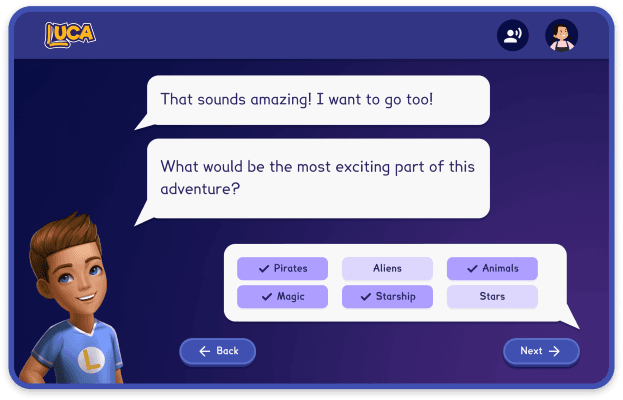
- Generates personalized reading material tailored to the specific interests and reading level of the child.
- Integrates text-to-speech scaffolding to model fluent reading behaviors before the student reads aloud.
- Adjusts text complexity dynamically, supporting the zone of proximal development for struggling readers.
Cons
- Relies heavily on AI-generated texts rather than authentic, published literature for comprehension practice.
- Automated speech recognition often struggles with diverse childhood dialects and speech impediments.
- Gamification elements may distract from the core cognitive task of reading comprehension.
- Effectiveness data has not yet been formally evaluated by independent researchers.
What Do We Know About LUCA?
LUCA offers a technologically sound approach to reading fluency practice, though its ultimate effectiveness for deep comprehension remains pending evaluation by The Learning Standard. Your child will interact with an AI-driven reading tutor that listens to them read aloud and corrects mistakes in real time. This immediate feedback loop is critical in learning science, as it prevents students from encoding incorrect phoneme-grapheme associations. By generating custom stories based on your child's interests, the app attempts to leverage intrinsic motivation to increase time spent reading. However, parents should monitor whether the automated speech recognition accurately registers their child's specific voice, as frequent false corrections can severely damage reading confidence. Furthermore, while AI-generated texts are excellent for targeted phonics practice, they often lack the narrative complexity and rich vocabulary found in authentic human-authored books. You should consider LUCA as a supplementary tool for fluency and decoding drill practice rather than a complete replacement for reading real books together. The integration of gamification keeps younger users engaged, but ensure these reward systems do not overshadow the actual reading tasks.
How Does LUCA Work?
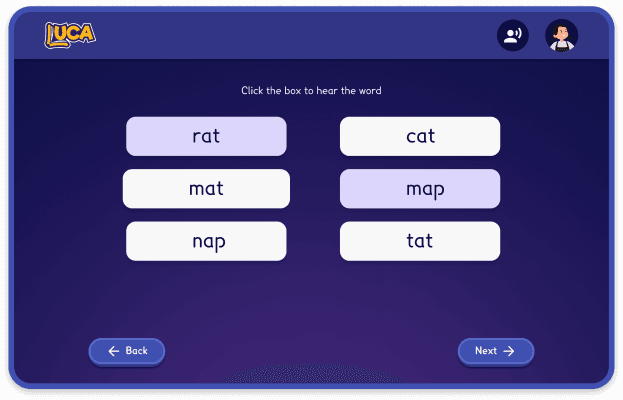
LUCA utilizes personalized, mastery-based reading instruction powered by voice recognition and generative AI to target individual reading deficits. Your child begins by reading passages aloud into the device's microphone. The app's automated speech recognition engine listens for mispronunciations, hesitations, and skipped words, acting as a digital tutor. When an error is detected, the text-to-speech function models the correct pronunciation, providing immediate corrective feedback. This aligns with errorless learning principles, ensuring students do not practice and internalize mistakes. The underlying language model dynamically generates new reading passages calibrated to your child's precise Lexile level and personal interests, adapting the difficulty as their fluency improves. This ensures the student operates within their zone of proximal development. Gamified rewards are distributed upon completion of reading milestones to sustain engagement.
Strengths and tradeoffs of LUCA
LUCA's biggest strength is its use of immediate, targeted audio feedback for decoding errors, while its biggest weakness is the inherent unreliability of speech recognition software with young voices. Immediate corrective feedback is a cornerstone of effective learning science; by catching pronunciation mistakes the moment they happen, LUCA prevents students from building detrimental reading habits. Personalized content generation is another significant advantage, as allowing your child to read about topics they care about lowers the affective filter and increases reading volume. However, the app's reliance on automated speech recognition (ASR) presents a major vulnerability. ASR struggles notoriously with regional accents, lisps, and typical childhood speech patterns. False negatives, where the app tells a child they are wrong when they are actually correct, can induce deep frustration and harm a struggling reader's self-efficacy. Additionally, relying on AI-generated texts means students may miss out on the complex sentence structures and nuanced vocabulary acquisition provided by traditional literature. Pending formal evaluation, parents must carefully observe whether the app's gamification features promote actual reading volume or simply encourage clicking through text to earn digital rewards.
Who Might Benefit From LUCA?
LUCA is best for elementary and middle school students who need high-volume, low-stakes reading aloud practice to build decoding fluency. While the developer claims the app serves Pre-K through 12th grade, its immediate feedback mechanics are most beneficial for foundational readers or older students with specific decoding interventions. It is an ideal supplementary tool for busy households where parents cannot sit and listen to their child read aloud for thirty minutes every day. Because it generates texts based on user interest, it serves reluctant readers particularly well.
Data Transparency
Meets Data Transparency Standard
LUCA meets our data transparency standard at Level 2 of 3 (Parent control). Level 3 needs the policy to document an API for retrieving their own data and a named export format.
24 of 35 checks passed
Evaluated September 2026
Privacy Policy →Level 1 · Basic protections
Does not sell data or target ads at students, limits sharing, and lets parents see and delete their child's data.
Level 2 · Parent control (meets the standard)
Families can get their data out, know who processes it, and know how long it is kept.
Level 3 · Direct data access
Families or schools can pull their own data through an API, in a stated format.
Not documented: an API for retrieving their own data, a named export format
View all 35 checks
Parent Access8/8
Does the policy mention parents specifically?
“A parent or legal guardian may provide information about a child when registering an account for that child.”
Can parents view their child's data?
“A parent or legal guardian may at any time review the personal information we have collected from their child, request that we delete it, and refuse to permit further collection.”
Can parents modify their child's data?
“The LEA controls access to Student Data and is responsible for responding to parent and eligible student requests to access, review, or correct education records. We will support the LEA in fulfilling those requests by providing access to Student Data we store on the LEA's behalf.”
Can parents delete their child's account?
“A parent or legal guardian may at any time review the personal information we have collected from their child, request that we delete it, and refuse to permit further collection.”
Is there a dedicated Children's Privacy section?
“## 13\. Children's Privacy (COPPA)”
Does it reference COPPA compliance?
“Consistent with the 2025 amendments to the COPPA Rule (16 CFR § 312.5(a)(2)), parents and schools have the right to consent to LUCA's collection and use of a child's personal information **without** also consenting to disclosure of that information to third parties for purposes that are not integral to providing the Services.”
Does it reference FERPA compliance?
“LUCA acts as a "school official" under the Family Educational Rights and Privacy Act (FERPA), with a legitimate educational interest in the Student Data, and handles Student Data only in accordance with our agreements with the LEA and applicable law.”
Is parental consent required for child accounts?
“Where LUCA is provided directly to a family rather than through a school, we obtain verifiable parental consent before collecting personal information from a child under 13.”
Data Portability3/5
Can users access their personal data?
“Access and update personal information by logging into your account or by contacting us.”
Can users download/export their data?
“Receive a copy of your personal information in a portable format.”
Is there a self-service data access tool?
“Access and update personal information by logging into your account or by contacting us.”
Is a specific data format mentioned for export?
The policy mentions only a "portable" or "commonly used electronic" format and names no specific file format.
Is there an API for data access?
The policy does not describe any API for users, parents or schools to retrieve their data.
Data Minimization1/6
Is data collection itemized?
“First and last name, school or district name, postal address, city or state, telephone number, email address, grade or ID number assigned by your school or district, username, and account password.”
Can the app be used without a real name?
The policy says it collects users' first and last names.
Can the app be used without an email?
The policy says it collects email addresses.
Does it state collection is limited to what is necessary?
The policy refers to Maryland's data-minimization standard but never states that collection is limited to what is necessary.
Is IP address anonymized or truncated?
The policy says it collects IP addresses and does not say they are anonymized or truncated.
Is location tracking explicitly excluded?
The policy collects postal address, city or state, and IP address, and does not explicitly rule out location tracking.
Third-Party Protection7/7
Does it explicitly state no selling of data?
“We do not use Student Data to advertise or market to students or their families, and we do not sell Student Data.”
Are third-party providers named?
“We share certain technical and usage information with advertising platforms (Meta and Google) to deliver, measure, and retarget LUCA's own advertising to adult website visitors.”
Are providers contractually restricted?
“They are bound by written contracts that limit use of the information to providing services to LUCA.”
No-targeted-advertising commitment?
“We do not use student data, child user information, or any data collected from a logged-in student session for advertising.”
Is AI/ML data sharing addressed?
“LUCA does not disclose children's personal information to third parties for advertising, profiling, or model training without separate, declinable consent obtained in addition to the consent to use the Services.”
Child-specific sharing restriction?
“LUCA does not disclose children's personal information to third parties for advertising, profiling, or model training without separate, declinable consent obtained in addition to the consent to use the Services.”
Cookies/tracking limited or opt-out?
“You can **change or withdraw your choice at any time** through the **Cookie Settings** link in our website footer, and we honor the **Global Privacy Control (GPC)** browser signal as a withdrawal of consent for analytics and marketing.”
Deletion & Retention3/5
Can users delete their account?
“Request deletion of your account and personal information by contacting us.”
Self-service deletion mechanism?
The policy says deletion happens by contacting LUCA and describes no self-service deletion tool.
Specific data retention timeline?
“While account is active. Within thirty (30) days of a deletion request, deleted or de-identified in active systems.”
Auto-deletion of inactive accounts?
The policy keeps data while an account is active and does not describe deleting inactive accounts automatically.
Post-deletion handling described?
“Copies of personal information may remain in routine system backups for up to thirty (30) days after active-system deletion. Backup copies are overwritten in the ordinary course of business and are not used to restore deleted records except where required to recover from a system failure.”
Advertising2/4
Advertising model explicitly disclosed?
“LUCA may use third-party advertising services (Meta and Google) to deliver LUCA's own advertising to **adult website visitors** (parents, educators, administrators) on those platforms based on prior visits to luca.ai.”
Free from third-party advertisements?
The policy describes LUCA's own ads on Meta and Google but never states that the product has no third-party ads.
Children excluded from ad targeting?
“We do not target advertising to children, students, or any user we know to be under 13.”
Ad-free option available?
The policy neither offers an ad-free option nor states that the product has no advertising.
Meets Data Transparency Standard
The reviewed policy met our data transparency standard. This result describes the policy disclosures we assessed. Actual practices and legal compliance were not verified.
About this evaluation: Based on automated analysis of Privacy Policy against 35 policy-disclosure questions, including questions adapted from the Common Sense Privacy Program's published evaluation questions. TLS is not affiliated with Common Sense Media, and this is not a Common Sense rating. Quoted text is copied from the policy; unquoted notes are our summary. Results describe what the policy documents, not the company's actual practices. Privacy policies can change: this review reflects the version we analyzed and does not determine legal compliance.
Sources and review method
TLS combines product information and editorial analysis to explain how LUCA works, its tradeoffs, and the questions to ask before choosing it. Product features, an instructional rationale and evidence of learning outcomes are different kinds of information.
Formal Learning Standard assessment: not yet completed. Data Transparency findings are reported separately and do not establish learning effectiveness. Read our methodology.
Frequently Asked Questions About LUCA
Is LUCA free?
No, LUCA requires a paid subscription. It costs $15 per month or $150 for an annual plan, providing full access to the AI reading tutor, automated speech recognition, and personalized content generation tools.
Is LUCA good for early childhood education?
Yes, it can be beneficial for young readers practicing foundational literacy. The immediate text-to-speech feedback helps early learners map sounds to letters, though parents should supervise to ensure the voice recognition understands their child's developing articulation accurately.
What does LUCA teach?
LUCA teaches reading fluency, phonics decoding, and pronunciation. By listening to your child read aloud, the app identifies specific word-level challenges and provides targeted audio corrections to improve overall oral reading proficiency.
LUCA vs. traditional human tutoring: which is better?
While LUCA provides convenient, on-demand fluency practice, human tutors remain superior for deep reading comprehension and relationship-building. A digital tool cannot yet replicate the nuanced questioning, emotional support, and behavioral management a trained educator provides to a struggling reader.
Has The Learning Standard evaluated LUCA?
TLS has not yet completed a Learning Standard evaluation of how well LUCA teaches. Its privacy policy has been reviewed for Data Transparency and reaches Level 2, Parent control.
Is LUCA COPPA compliant?
The reviewed privacy policy references COPPA. A policy reference alone does not establish COPPA compliance. Policy review note: The policy references compliance with the COPPA Rule.
Is LUCA FERPA compliant?
The reviewed privacy policy references FERPA. A policy reference alone does not establish FERPA compliance. Policy review note: The policy says LUCA acts as a school official under FERPA.
Does LUCA have a children's privacy policy?
The reviewed policy includes a dedicated children's privacy section. Policy review note: The policy has a dedicated Children's Privacy (COPPA) section.
Does LUCA sell student data?
The reviewed policy states that the app does not sell data. This is a policy statement; actual data practices were not verified. Policy review note: The policy states that LUCA does not sell Student Data.
Can you delete your data from LUCA?
The reviewed privacy policy describes account deletion. We have not tested the deletion process. Policy review note: Users can ask to have their account deleted.
Follow TLS Research
Subscribe to future TLS research updates: app reviews, findings, and what the evidence shows.
Screenshots


Take Action
For LUCA
If you represent LUCA.ai and have a correction or new evidence, send the relevant source so we can review and update this page.
Submit a correctionDetails
- Pricing
- $15 per month or $150 for the year.
- Platforms
- Web Browser
- Grade Levels
- Preschool, Prekindergarten, Transitional Kindergarten, Kindergarten, 1st Grade, 2nd Grade, 3rd Grade, 4th Grade, 5th Grade, 6th Grade, 7th Grade, 8th Grade, 9th Grade, 10th Grade, 11th Grade, 12th Grade
- Website
- Visit site