
LiteracyPlanet
Product by LiteracyPlanet
Facts checked: Not yet checked
Our take (not a Learning Standard rating). This label applies to learning-science judgments throughout this overview.
Our take (not a Learning Standard rating)
LiteracyPlanet provides a highly gamified environment for English language arts practice, but its true effectiveness relies heavily on how teachers integrate it with direct instruction. While it successfully employs retrieval practice for spelling and phonics, the heavy emphasis on rewards can sometimes overshadow the core learning objectives.
Pros
- Utilizes spaced retrieval practice to reinforce phonics rules and spelling patterns over time.
- Adapts lesson pathways automatically based on your child's performance in foundational literacy skills.
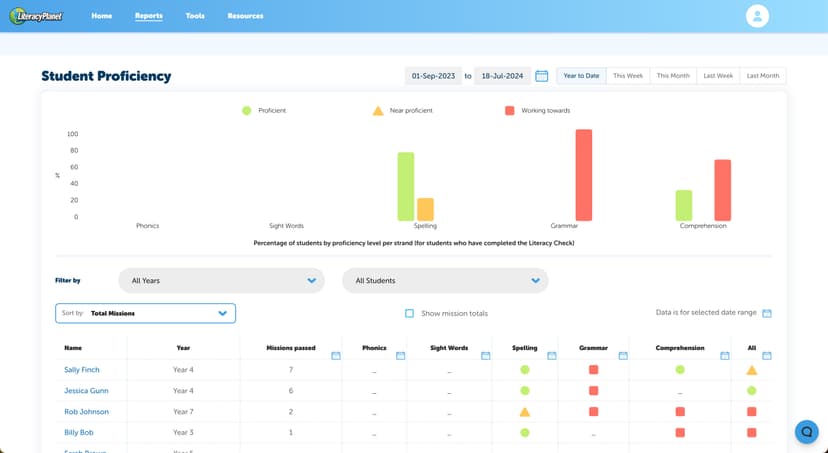
- Provides educators with granular diagnostic data to identify specific gaps in reading comprehension.
- Breaks complex grammar concepts into digestible, interactive worked examples before independent practice.
Cons
- Relies heavily on extrinsic gamification rewards which can diminish intrinsic motivation for reading.
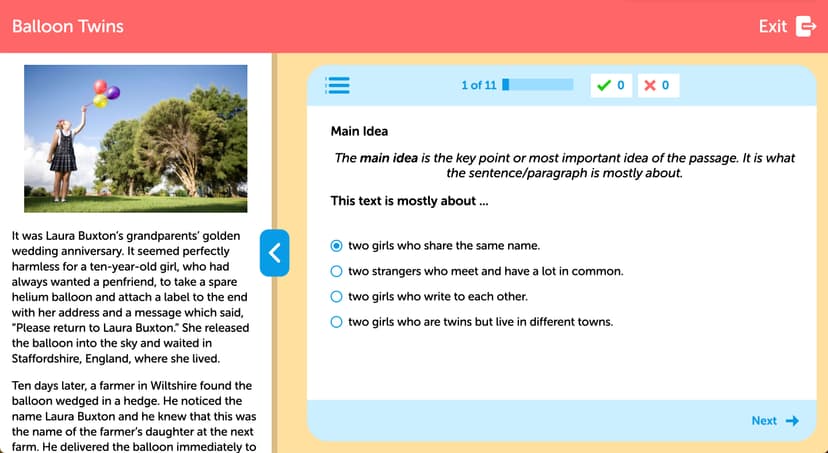
- Feedback on reading comprehension questions often lacks detailed explanations for incorrect choices.
- The fast-paced game mechanics may cause anxiety or rushing in students who need more processing time.
- Not yet evaluated by The Learning Standard to independently verify its long-term impact on reading proficiency.
What Do We Know About LiteracyPlanet?
LiteracyPlanet functions effectively as a supplementary practice tool for English language arts, provided your child uses it alongside formal reading instruction rather than as a standalone curriculum. The platform targets foundational skills like phonics, sight words, spelling, reading comprehension, and grammar through a highly gamified interface designed to maximize engagement. Your child will encounter missions and mini-games that require them to apply specific literacy rules to progress. From a learning science perspective, the app succeeds at building automaticity through repeated retrieval practice, forcing students to recall spelling patterns and grammar rules under varied conditions. However, parents should monitor how their child interacts with the reward systems. Because the app heavily relies on extrinsic motivators like virtual coins and avatars, some students may focus more on game completion than on internalizing the reading concepts. Additionally, while the app claims alignment with the science of reading, it is currently pending evaluation by The Learning Standard, meaning its long-term efficacy data has not yet been independently verified. You will get the best results if you use the platform's detailed parent and teacher dashboards to identify exactly which phonics or comprehension skills your child struggles with, and then address those gaps through real-world reading together.
How Does LiteracyPlanet Work?
LiteracyPlanet uses a personalized, gamified progression model that blends adaptive software practice with traditional English language arts curriculum objectives. When your child logs in, they are placed into a customized learning pathway based on initial diagnostic assessments or teacher-assigned modules. The mechanics rely heavily on active participation, requiring students to complete interactive mini-games that drill phonics, spelling, and grammar rules. Rather than passively watching videos, your child must actively drag, drop, type, and select answers to advance through thematic missions. The software dynamically adjusts the difficulty of these tasks, employing spaced repetition to cycle back to concepts a student previously missed. As students complete assignments, they earn gems and credits to upgrade their digital avatars, a mechanic designed to increase time-on-task. Teachers and administrators access a separate backend dashboard that translates student gameplay into actionable, curriculum-aligned data, highlighting specific areas where a class or individual needs targeted intervention.
Strengths and tradeoffs of LiteracyPlanet
LiteracyPlanet's biggest strength is its ability to build automaticity in foundational reading skills through adaptive retrieval practice, while its biggest weakness is an over-reliance on extrinsic game mechanics that can distract from deep reading comprehension. The platform shines when teaching explicit, rule-based concepts like phonics and spelling patterns. By repeatedly prompting students to recall and apply these rules in varied contexts, the app leverages the testing effect to move knowledge into long-term memory. The diagnostic reporting tools also provide excellent visibility into student mastery. Conversely, the gamification strategy presents a double-edged sword. While avatars and leaderboards reliably increase short-term engagement, learning science indicates that heavy extrinsic rewards can undermine a student's intrinsic motivation to read for pleasure. Furthermore, the platform struggles to provide high-quality explanatory feedback. When a student misses a complex reading comprehension question, the app often simply highlights the correct answer rather than offering a worked example or explaining the underlying logic of the text. Because LiteracyPlanet is not yet rated by The Learning Standard, educators should treat it as a robust digital worksheet for drill-and-practice rather than a primary vehicle for initial instruction.
Who Might Benefit From LiteracyPlanet?
LiteracyPlanet is best for elementary and middle school students who need high-engagement, structured drill practice to reinforce foundational literacy skills taught in the classroom. Because the platform spans Kindergarten through 10th grade, it is particularly useful for schools seeking a unified supplemental tool for diverse age ranges. It works exceptionally well for reluctant readers who respond to game-based learning and digital rewards. However, it is not ideal for self-directed learners who need rich, standalone instruction, as the app functions best when a teacher or parent actively curates the lesson pathways and intervenes when the data shows a student is struggling.
Data Transparency
Does Not Meet Data Transparency Standard
LiteracyPlanet reaches Level 1 of 3 (Basic protections), below our data transparency standard. Reaching Level 2 needs the policy to document named service providers and self-service deletion.
23 of 35 checks passed
Evaluated September 2026
Privacy at 3P Learning →Level 1 · Basic protections
Does not sell data or target ads at students, limits sharing, and lets parents see and delete their child's data.
Level 2 · Parent control (meets the standard)
Families can get their data out, know who processes it, and know how long it is kept.
Not documented: named service providers, self-service deletion
Level 3 · Direct data access
Families or schools can pull their own data through an API, in a stated format.
Not documented: an API for retrieving their own data, a named export format
View all 35 checks
Parent Access8/8
Does the policy mention parents specifically?
“Parents and guardians can contact us to update or delete a child’s account at any time.”
Can parents view their child's data?
“For privacy questions or requests (including parental requests for access, correction or deletion), or to exercise any of your rights please contact”
Can parents modify their child's data?
“Parents and guardians can contact us to update or delete a child’s account at any time.”
Can parents delete their child's account?
“Parents and guardians can contact us to update or delete a child’s account at any time.”
Is there a dedicated Children's Privacy section?
“When a parent or guardian creates a child’s account, the parent gives consent on the child’s behalf to our collection and use of the child’s personal information.”
Does it reference COPPA compliance?
“the Children’s Online Privacy Protection Act 1998 (“COPPA”) and the FTC COPPA Rule (16 CFR Part 312, including the Final Rule published 22 April 2025)”
Does it reference FERPA compliance?
“we agree to act as a “school official” with a legitimate educational interest under the US Family Educational Rights and Privacy Act (FERPA, 20 USC §1232g) and to only use student education records to provide the service under the school’s direction.”
Is parental consent required for child accounts?
“We obtain verifiable parental consent via the monetary-transaction method.”
Data Portability2/5
Can users access their personal data?
“Requests by individuals to exercise their privacy rights (access, rectification, erasure, restriction, portability, objection, and rights related to automated individual decision-making) should be directed to the school as the Controller.”
Can users download/export their data?
“Requests by individuals to exercise their privacy rights (access, rectification, erasure, restriction, portability, objection, and rights related to automated individual decision-making) should be directed to the school as the Controller.”
Is there a self-service data access tool?
The policy has users make data access requests by email or through the school and does not describe a tool users operate themselves to access their data.
Is a specific data format mentioned for export?
The policy mentions export and portability but names no data format.
Is there an API for data access?
The policy does not mention an API for data access.
Data Minimization3/6
Is data collection itemized?
“First name and last name or initials, year/grade level, school name, class assignment, login ID, learning activity data (scores, progress, time on task, content interactions, free-text entered into learning activities and read aloud voice feature).”
Can the app be used without a real name?
The policy says it collects students' first and last names (or initials) from schools.
Can the app be used without an email?
The policy says a student's identifier may be an email address, depending on the school's rostering system.
Does it state collection is limited to what is necessary?
“Data minimisation as standard.”
Is IP address anonymized or truncated?
The policy collects IP addresses for internal operations but does not say they are anonymized or truncated.
Is location tracking explicitly excluded?
“We do not collect, store, infer or surface precise or coarse geolocation data about children or any other users through the products covered by this Policy.”
Third-Party Protection6/7
Does it explicitly state no selling of data?
“We do not sell data to advertisers (whether personal, anonymous or aggregated).”
Are third-party providers named?
The policy refers to subprocessors only through a linked list and names no third-party providers in its text.
Are providers contractually restricted?
“Subprocessors process personal information only on our instructions and under contractual privacy and security obligations. 3P Learning does not authorise subprocessors to use personal information for their own purposes.”
No-targeted-advertising commitment?
“We do not use cookies or third-party providers to engage in behavioural targeting of advertisements to students or children.”
Is AI/ML data sharing addressed?
“For example, we do not share children data to any data brokerage, AI training or promotional activities.”
Child-specific sharing restriction?
“We do not share children’s personal information with third parties for the third parties’ own purposes.”
Cookies/tracking limited or opt-out?
“We use limited technical data — “persistent identifiers” such as IP addresses, device identifiers, cookies, log data, and mobile-app identifiers — solely to support the internal operations of our services.”
Deletion & Retention3/5
Can users delete their account?
“A child can withdraw the permission to our processing of their personal information by asking their parent to delete their account.”
Self-service deletion mechanism?
The policy handles deletion only through requests by email or through the school, with no self-service deletion tool.
Specific data retention timeline?
“Security logs containing persistent identifiers are retained for 12 months and then deleted.”
Auto-deletion of inactive accounts?
The policy explains when an account becomes inactive and links to a separate retention document, but does not state that inactive accounts are deleted automatically.
Post-deletion handling described?
“On receipt of a verified request we will delete or anonymise the data from production systems within 30 days.”
Advertising1/4
Advertising model explicitly disclosed?
The policy says there is no marketing to children and it does not sell data to advertisers, but it never explicitly says the products have no advertising.
Free from third-party advertisements?
The policy does not explicitly say the products are free of third-party advertisements.
Children excluded from ad targeting?
“We do not use children data for behavioural advertising, or marketing profiles.”
Ad-free option available?
The policy does not explicitly say the products are ad-free or offer an ad-free option.
What This Means
The policy review did not meet our data transparency standard. The checks above show the documented findings and unknowns. A missing statement does not establish how the app handles data in practice.
About this evaluation: Based on automated analysis of Privacy at 3P Learning against 35 policy-disclosure questions, including questions adapted from the Common Sense Privacy Program's published evaluation questions. TLS is not affiliated with Common Sense Media, and this is not a Common Sense rating. Quoted text is copied from the policy; unquoted notes are our summary. Results describe what the policy documents, not the company's actual practices. Privacy policies can change: this review reflects the version we analyzed and does not determine legal compliance.
Sources and review method
TLS combines product information and editorial analysis to explain how LiteracyPlanet works, its tradeoffs, and the questions to ask before choosing it. Product features, an instructional rationale and evidence of learning outcomes are different kinds of information.
Formal Learning Standard assessment: not yet completed. Data Transparency findings are reported separately and do not establish learning effectiveness. Read our methodology.
Frequently Asked Questions About LiteracyPlanet
Is LiteracyPlanet free?
LiteracyPlanet is not free for students, though it does offer free accounts for teachers and administrators. The platform charges an annual per-student subscription fee, which currently ranges from $23.00 to $33.00 depending on the total number of licenses purchased by the school. Because implementation and training costs are fully bundled into this quote-based pricing structure, districts do not have to worry about hidden professional development fees.
Is LiteracyPlanet good for Kindergarten students?
LiteracyPlanet is appropriate for Kindergarten students, but it functions best when used with active adult supervision for early learners. The platform introduces basic phonics and sight words through highly visual and interactive games tailored to early childhood development. However, young children may initially struggle to navigate the gamified interface independently and will likely need a parent or teacher to guide them through the mechanics of the early missions.
What does LiteracyPlanet teach?
LiteracyPlanet teaches comprehensive English language arts skills spanning from early elementary foundational literacy through early high school English. The core curriculum focuses heavily on explicit phonics instruction, sight word recognition, complex spelling rules, reading comprehension strategies, and advanced grammar mechanics. The content is directly aligned with standard school curricula to ensure your child is actively practicing the exact literacy concepts they are simultaneously learning in their physical classrooms.
Has LiteracyPlanet been evaluated by The Learning Standard?
LiteracyPlanet is currently pending evaluation and has not yet been officially rated by The Learning Standard. We have not yet applied our full rigorous methodology to determine its specific impacts on long-term literacy outcomes or to verify its claims regarding the science of reading. Parents and educators should review our methodology page to deeply understand how we rigorously assess the pedagogical validity and learning science foundations of gamified reading platforms.
How does LiteracyPlanet compare to Lexia Core5?
LiteracyPlanet leans significantly more into gamification and extrinsic reward systems than competitors like Lexia Core5 Reading. While both adaptive platforms adjust to student performance in foundational reading and phonics, Lexia offers much more explicit, structured scaffolding and direct instructional interventions when a student struggles with a concept. LiteracyPlanet is typically chosen by educators who are specifically looking for a highly game-like, high-energy environment to temporarily motivate extremely reluctant readers.
Has The Learning Standard evaluated LiteracyPlanet?
TLS has not yet completed a Learning Standard evaluation of how well LiteracyPlanet teaches. Its privacy policy has been reviewed for Data Transparency and reaches Level 1, Basic protections.
Is LiteracyPlanet COPPA compliant?
The reviewed privacy policy references COPPA. A policy reference alone does not establish COPPA compliance. Policy review note: The policy says it supports COPPA compliance.
Is LiteracyPlanet FERPA compliant?
The reviewed privacy policy references FERPA. A policy reference alone does not establish FERPA compliance. Policy review note: The policy commits to acting as a FERPA school official.
Does LiteracyPlanet have a children's privacy policy?
The reviewed policy includes a dedicated children's privacy section. Policy review note: This text sits under its own heading, "Children data and privacy rights", in Part B.
Does LiteracyPlanet sell student data?
The reviewed policy states that the app does not sell data. This is a policy statement; actual data practices were not verified. Policy review note: The vendor itself says it does not sell data to advertisers.
Can you delete your data from LiteracyPlanet?
The reviewed privacy policy describes account deletion. We have not tested the deletion process. Policy review note: Accounts can be deleted on request, through the parent or the school.
Follow TLS Research
Subscribe to future TLS research updates: app reviews, findings, and what the evidence shows.
Screenshots

Take Action
For LiteracyPlanet
If you represent LiteracyPlanet and have a correction or new evidence, send the relevant source so we can review and update this page.
Submit a correctionDetails
- Pricing
- <60 students: up to $33.00 per student for 12 months (quote provided) >60 students: up to $23.00 per student for 12 months (quote provided) Teacher and Administrator accounts: no cost Implementation and training costs are included in the per-student price.
- Platforms
- Web Browser, iPadOS (Apple tablet), Windows (Microsoft), macOS (Apple), Chrome OS (Google), Other
- Grade Levels
- Kindergarten, 1st Grade, 2nd Grade, 3rd Grade, 4th Grade, 5th Grade, 6th Grade, 7th Grade, 8th Grade, 9th Grade, 10th Grade
- Website
- Visit site