Lincoln Content Bank
Product by Lincoln Learning Solutions
Facts checked: Not yet checked
Our take (not a Learning Standard rating). This label applies to learning-science judgments throughout this overview.
Our take (not a Learning Standard rating)
While pending official evaluation, Lincoln Content Bank provides educators with a vast repository of resources, but its effectiveness depends entirely on how teachers implement it. Because it is a content library rather than an adaptive instructional tool, it relies entirely on instructors to enforce active retrieval practice.
Pros
- Integrates directly into existing learning management systems to streamline lesson planning and content delivery.
- Offers diverse multimodal resources including text, video, and interactive practice to support varied instructional methods.
- Allows educators to align supplemental materials directly to specific academic standards and learning goals.
- Supports blended learning models by providing asynchronous practice materials for independent student work.
Cons
- Lacks built-in adaptive algorithms to automatically adjust difficulty based on student performance.
- Relies completely on the teacher to sequence materials logically for optimal cognitive load management.
- Does not independently verify student mastery or enforce spaced repetition without teacher intervention.
- Quality and instructional rigor vary significantly across the massive library of individual learning objects.
What Do We Know About Lincoln Content Bank?
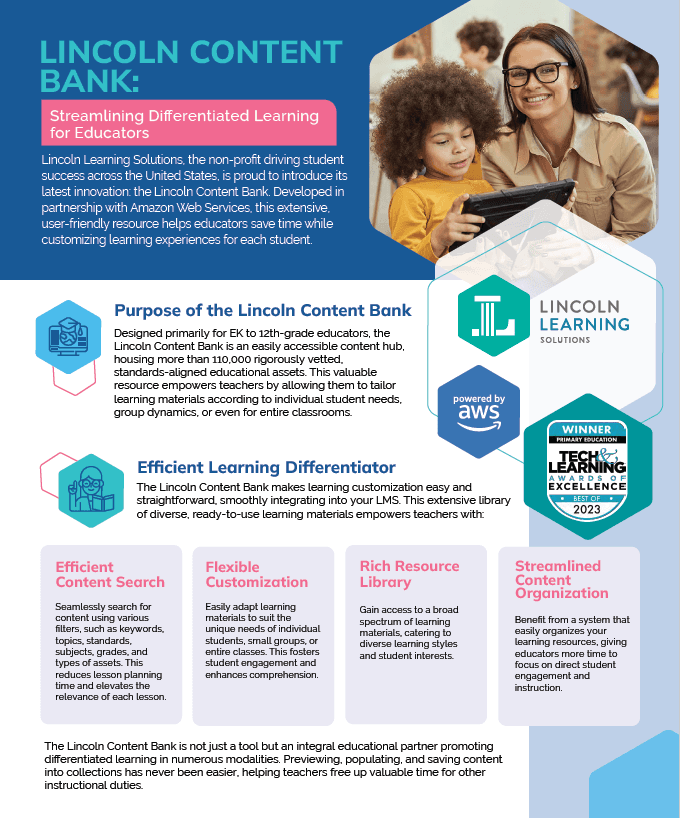
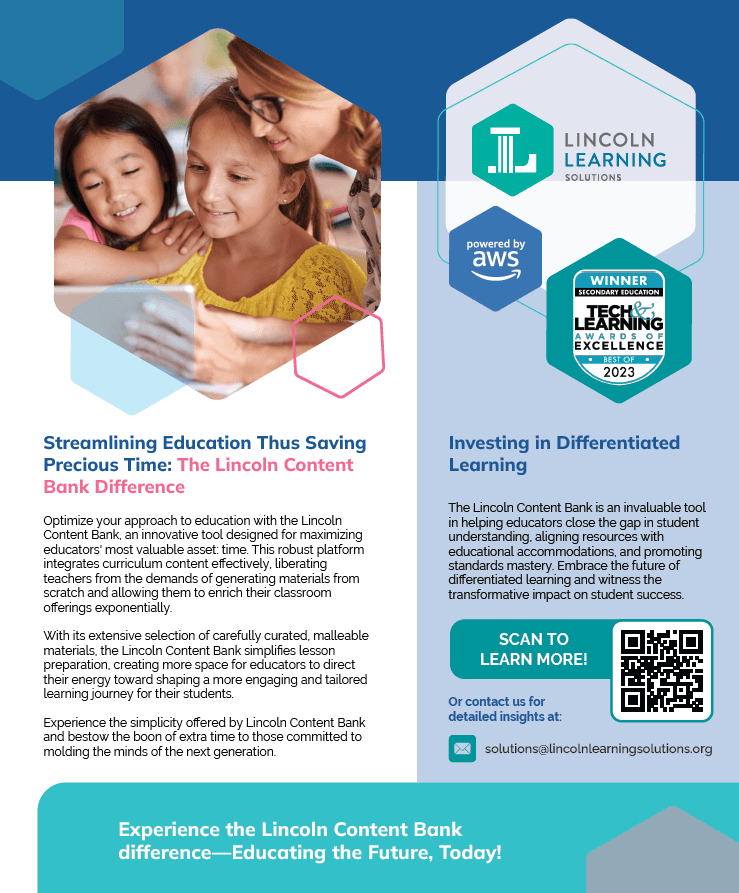
Lincoln Content Bank is effective for learning only when paired with active, strategic instruction from a dedicated teacher. This platform is not a standalone teaching app that your child will log into for guided instruction. Instead, it is a digital filing cabinet of 110,000 educational resources designed specifically for educators. Teachers use this platform to pull worksheets, videos, and interactive games directly into their school's learning management system. Because the tool does not provide its own adaptive learning pathway, your child's success depends on how well the teacher selects and sequences the material. When educators use these resources to provide targeted retrieval practice or present worked examples in math and science, the platform effectively supports classroom instruction. However, if assigned simply as busywork without immediate feedback, the materials will not independently close learning gaps. Parents should understand that this tool acts as a supplement to human teaching, not a replacement for it. The Learning Standard has not yet evaluated the rigorousness of the individual learning objects within this vast library.
How Does Lincoln Content Bank Work?
Lincoln Content Bank uses a resource-based, supplementary pedagogical approach where teachers curate and assign multimodal content to support direct instruction. The platform functions as a massive, searchable database rather than a sequential curriculum. Educators filter the 110,000 learning objects by standard, subject, grade level, and media type. Once a teacher identifies a relevant video, reading passage, or practice worksheet, they plug it directly into their school's existing Learning Management System. Students then access these specific items to complete assignments, review concepts, or engage in cross-curricular projects. The mechanics rely entirely on teacher curation rather than software-driven progression. There are no built-in assessments that automatically unlock new levels or adapt to a student's prior knowledge. The system is designed to facilitate blended learning environments by providing the raw materials needed for both in-class instruction and independent, asynchronous study.
Strengths and tradeoffs of Lincoln Content Bank
The biggest strength of Lincoln Content Bank is its massive, easily searchable volume of standards-aligned material, while its biggest weakness is the complete lack of built-in instructional sequencing or adaptive feedback. Multimodal learning is well supported here, as teachers can present the same concept through a video, an interactive game, and a reading passage to reinforce dual coding. This flexibility allows educators to easily implement differentiation by assigning specific scaffolding materials to struggling students. However, because the platform is just a repository, it lacks intrinsic mechanisms for spaced repetition or retrieval practice. The software does not track when a student last studied a concept to reintroduce it at the optimal forgetting curve interval. Furthermore, the absence of automated, immediate corrective feedback on many of the static worksheets means students risk reinforcing misconceptions if teachers do not grade and return the work promptly. Ultimately, the cognitive load management and instructional scaffolding rest entirely on the teacher's ability to curate the content effectively.
Who Might Benefit From Lincoln Content Bank?
Lincoln Content Bank is best for classroom teachers and school districts seeking a centralized repository of supplemental materials to plug into their existing Learning Management Systems. It serves educators working across all age ranges, from Prekindergarten through an Associate's degree, who need quick access to standards-aligned resources. It is highly useful for instructors building blended learning environments or personalizing assignments for students who require remediation or enrichment. This tool is not intended for parents looking for a standalone, self-guided educational app for home use, as it requires an institutional framework and educator curation to function properly.
Data Transparency
Does Not Meet Data Transparency Standard
Lincoln Content Bank does not meet our data transparency standard. Its privacy policy does not document basic protections, including a commitment against targeted advertising, limits on sharing children's data and contractual limits on service providers.
8 of 35 checks passed
Evaluated September 2026
Privacy Policy →Level 1 · Basic protections
Does not sell data or target ads at students, limits sharing, and lets parents see and delete their child's data.
Not documented: a commitment against targeted advertising, limits on sharing children's data, contractual limits on service providers, parents' right to see their child's data, parents' right to delete their child's data
Level 2 · Parent control (meets the standard)
Families can get their data out, know who processes it, and know how long it is kept.
Not documented: data export, a data retention timeline, named service providers, self-service deletion
Level 3 · Direct data access
Families or schools can pull their own data through an API, in a stated format.
Not documented: an API for retrieving their own data, a named export format
View all 35 checks
Parent Access2/8
Does the policy mention parents specifically?
The policy never mentions parents; it only mentions minors, students, clients and administrators.
Can parents view their child's data?
The policy does not give parents any right to view their child's data.
Can parents modify their child's data?
The policy does not give parents any right to modify their child's data.
Can parents delete their child's account?
The policy does not give parents any right to delete their child's data or account.
Is there a dedicated Children's Privacy section?
“LLS understands that as a function of providing curriculum resources to schools, it will encounter and receive data from students who are considered minors.”
Does it reference COPPA compliance?
“LLS use of data and data storage complies with COPPA concerning the privacy of minors.”
Does it reference FERPA compliance?
The policy does not mention FERPA.
Is parental consent required for child accounts?
The policy does not require parental consent for child accounts.
Data Portability1/5
Can users access their personal data?
“You may request to review, correct, delete, or otherwise modify any of the personal information that you have previously provided to us through our website(s) and Services.”
Can users download/export their data?
The policy does not offer a way to download or export data.
Is there a self-service data access tool?
The policy only lets users make requests by email or phone and describes no self-service access tool.
Is a specific data format mentioned for export?
The policy does not name any export format.
Is there an API for data access?
The policy does not mention an API for data access.
Data Minimization1/6
Is data collection itemized?
“In addition to this PII, LLS also stores academic information, which is included as PII. These include, but are not limited to, grades, IEPS, health records, and test scores.”
Can the app be used without a real name?
The policy says student names are among the PII held in the Services.
Can the app be used without an email?
The policy lists email address as PII it collects and does not say students can use the app without one.
Does it state collection is limited to what is necessary?
The policy limits how long data is kept to what is necessary, but it does not say collection is limited to what is necessary.
Is IP address anonymized or truncated?
The policy says web beacons may collect IP addresses and that IPs may be linked to PII; it does not mention anonymizing them.
Is location tracking explicitly excluded?
The policy does not rule out location tracking.
Third-Party Protection2/7
Does it explicitly state no selling of data?
“We will use your information to respond to you, regarding the reason you contacted us. We will not sell or rent this information to anyone.”
Are third-party providers named?
The policy does not name any third-party providers.
Are providers contractually restricted?
The policy says third-party vendors are vetted and follow LLS guidelines, but it does not say they are contractually restricted.
No-targeted-advertising commitment?
The policy only says customer profile information will not be used for targeted advertising in the student or teacher experience; it makes no such promise about student data.
Is AI/ML data sharing addressed?
The policy does not address sharing data with AI or ML systems.
Child-specific sharing restriction?
The policy has no sharing restriction specific to children.
Cookies/tracking limited or opt-out?
“You may choose to decline cookies if your browser permits, but doing so may affect your ability to access or use certain features of our website.”
Deletion & Retention2/5
Can users delete their account?
“You may request to review, correct, delete, or otherwise modify any of the personal information that you have previously provided to us through our website(s) and Services.”
Self-service deletion mechanism?
The policy only allows deletion by contacting LLS by email or phone.
Specific data retention timeline?
The policy says data is kept for a "reasonable period" or as long as necessary, with no specific timeline.
Auto-deletion of inactive accounts?
The policy does not describe automatic deletion of inactive accounts.
Post-deletion handling described?
“Upon service completion and when student data is no longer needed, any PII related student data is either destroyed or transformed to be unidentifiable or unrelatable to any client or person.”
Advertising0/4
Advertising model explicitly disclosed?
The policy does not explain an advertising model or say the product has no ads.
Free from third-party advertisements?
The policy does not say the product is free of third-party ads.
Children excluded from ad targeting?
The policy does not explicitly exclude children from ad targeting.
Ad-free option available?
The policy does not mention an ad-free option or say the product has no ads.
What This Means
The policy review did not meet our data transparency standard. The checks above show the documented findings and unknowns. A missing statement does not establish how the app handles data in practice.
About this evaluation: Based on automated analysis of Privacy Policy against 35 policy-disclosure questions, including questions adapted from the Common Sense Privacy Program's published evaluation questions. TLS is not affiliated with Common Sense Media, and this is not a Common Sense rating. Quoted text is copied from the policy; unquoted notes are our summary. Results describe what the policy documents, not the company's actual practices. Privacy policies can change: this review reflects the version we analyzed and does not determine legal compliance.
Sources and review method
TLS combines product information and editorial analysis to explain how Lincoln Content Bank works, its tradeoffs, and the questions to ask before choosing it. Product features, an instructional rationale and evidence of learning outcomes are different kinds of information.
Formal Learning Standard assessment: not yet completed. Data Transparency findings are reported separately and do not establish learning effectiveness. Read our methodology.
Frequently Asked Questions About Lincoln Content Bank
Is Lincoln Content Bank free?
No, Lincoln Content Bank is not free. Pricing models vary based on institutional needs and implementation size, and schools or districts must contact the developer directly for a custom quote.
Is Lincoln Content Bank good for elementary students?
Yes, it contains materials specifically designed for elementary students. However, the effectiveness depends on the teacher assigning the content, as the platform itself is a resource library rather than a structured, student-facing app.
What does Lincoln Content Bank teach?
Lincoln Content Bank provides supplemental materials for nearly every core academic subject. The library covers early childhood education, humanities, social science, science, math, applied science, and career and technical education.
How does Lincoln Content Bank compare to Teachers Pay Teachers?
Lincoln Content Bank provides a centrally vetted, standards-aligned library managed by a single educational organization, whereas Teachers Pay Teachers is a decentralized marketplace of user-generated content. Lincoln Content Bank ensures standard formatting and direct LMS integration.
Has The Learning Standard evaluated Lincoln Content Bank?
TLS has not yet completed a Learning Standard evaluation of how well Lincoln Content Bank teaches. Its privacy policy has been reviewed for Data Transparency and does not yet document the basic protections (Level 1).
Is Lincoln Content Bank COPPA compliant?
The reviewed privacy policy references COPPA. A policy reference alone does not establish COPPA compliance. Policy review note: The policy says it complies with COPPA.
Is Lincoln Content Bank FERPA compliant?
A FERPA reference was not found in the reviewed privacy policy. This does not determine whether the app complies with FERPA. Policy review note: The policy does not mention FERPA.
Does Lincoln Content Bank have a children's privacy policy?
The reviewed policy includes a dedicated children's privacy section. Policy review note: The policy has a section headed "Policy Regarding Children" about minors' data.
Does Lincoln Content Bank sell student data?
The reviewed policy states that the app does not sell data. This is a policy statement; actual data practices were not verified. Policy review note: The policy says LLS will not sell or rent the information users give it.
Can you delete your data from Lincoln Content Bank?
The reviewed privacy policy describes account deletion. We have not tested the deletion process. Policy review note: Users can ask to have their personal information deleted.
Follow TLS Research
Subscribe to future TLS research updates: app reviews, findings, and what the evidence shows.
Screenshots
Take Action
For Lincoln Content Bank
If you represent Lincoln Learning Solutions and have a correction or new evidence, send the relevant source so we can review and update this page.
Submit a correctionDetails
- Pricing
- Pricing models and options vary. Please reach out to our Solutions Specialists at solutions@lincolnlearningsolutions.org to learn more.
- Platforms
- Web Browser, Windows (Microsoft), macOS (Apple), Chrome OS (Google)
- Grade Levels
- Prekindergarten, Transitional Kindergarten, Kindergarten, 1st Grade, 2nd Grade, 3rd Grade, 4th Grade, 5th Grade, 6th Grade, 7th Grade, 8th Grade, 9th Grade, 10th Grade, 11th Grade, 12th Grade, Associate's degree
- Website
- Visit site