
LearningLemur
Product by WIRIS
Facts checked: Not yet checked
Our take (not a Learning Standard rating). This label applies to learning-science judgments throughout this overview.
Our take (not a Learning Standard rating)
While LearningLemur relies on adaptive quizzing and immediate feedback to leverage retrieval practice, its efficacy remains pending formal evaluation by The Learning Standard. As a beta assessment tool, it reinforces prior instruction well but lacks the explicit scaffolding needed to teach new math concepts from scratch.
Pros
- Uses retrieval practice through frequent quizzing to strengthen long-term memory.
- Provides immediate feedback on incorrect answers to correct misconceptions early.
- Adjusts question difficulty dynamically based on student performance to maintain engagement.
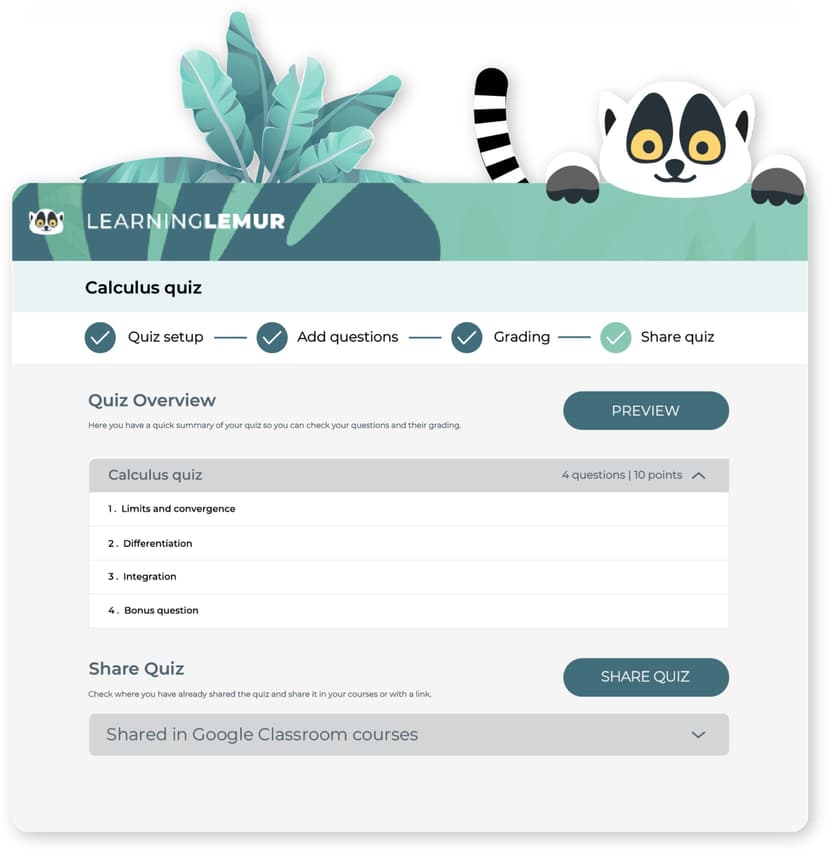
- Integrates directly with Google Classroom to automate assignments and track progress.
Cons
- Operates in a beta phase so stability and feature completeness remain unverified.
- Lacks explicit instruction or worked examples before assessing students on new concepts.
- Relies heavily on assessment formats that may encourage guessing rather than deep problem-solving.
- Not yet evaluated by The Learning Standard for strict pedagogical efficacy.
What Do We Know About LearningLemur?
LearningLemur shows potential for reinforcing math skills through adaptive practice, but its overall effectiveness remains pending evaluation. This platform functions primarily as a practice and assessment tool rather than a primary instructional curriculum. It tests your child using a large bank of math questions and adjusts the difficulty based on their answers. This approach leverages retrieval practice, a well-documented learning science principle where the act of recalling information strengthens long-term retention. Because it is currently in a beta testing phase, parents and educators should expect occasional bugs and incomplete features. The app integrates smoothly with Google Classroom, making it easy for teachers to assign work and track progress. However, parents should monitor whether their child is actually learning new concepts or simply guessing until they get the right answer. Without robust explicit instruction or step-by-step worked examples, students who struggle with new material may experience frustration. Until The Learning Standard completes a full evaluation, use LearningLemur as a supplemental drill tool alongside traditional classroom instruction rather than a standalone tutor.
How Does LearningLemur Work?
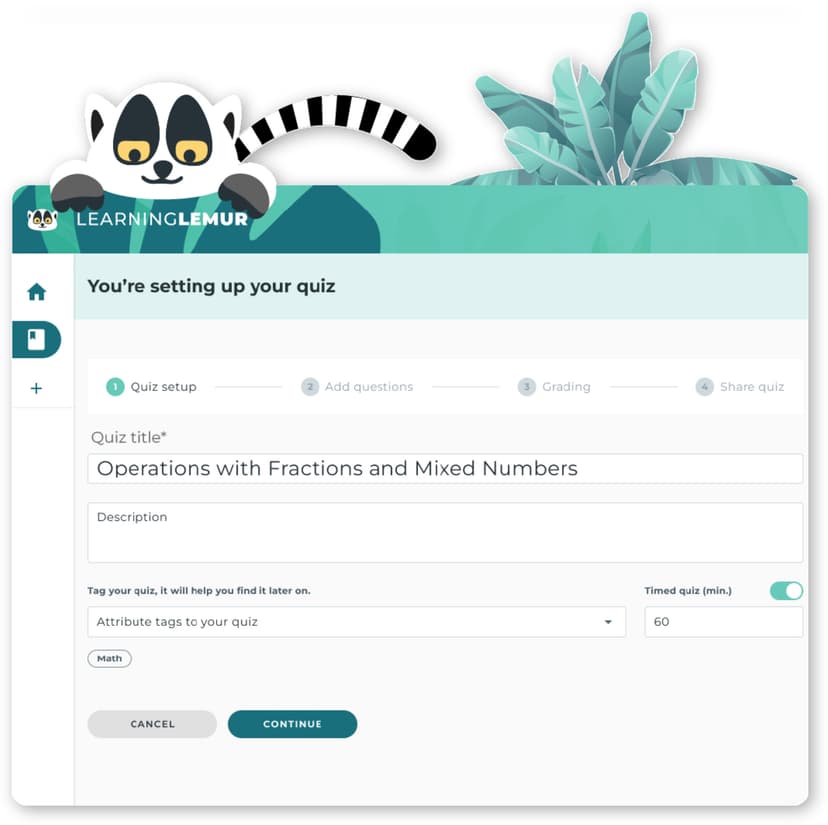
LearningLemur uses an adaptive assessment model combined with immediate feedback loops to test and reinforce mathematical knowledge. Educators use the platform to generate customizable quizzes from an existing library of math problems. When your child logs in, they answer questions designed to match their current skill level. If they answer correctly, the system gradually increases the complexity of the problems. If they make a mistake, the software provides instant feedback to correct the error immediately. This immediate correction prevents students from encoding incorrect procedures into their long-term memory. Behind the scenes, the software tracks performance data and populates an analytics dashboard for the teacher. This allows educators to identify specific skill gaps across the classroom and intervene where necessary. Because it integrates directly into Google Classroom, the assignment workflow and grading process are fully automated for the teacher.
Strengths and tradeoffs of LearningLemur
LearningLemur's biggest strength is its automated, adaptive retrieval practice, while its biggest weakness is the apparent lack of explicit instructional scaffolding. The platform successfully applies the science of retrieval practice. By repeatedly asking students to pull information from memory, it helps cement math facts and procedures. Furthermore, its immediate feedback mechanism is crucial; learning science shows that feedback given right after an assessment is more effective at correcting misconceptions than delayed grading. The adaptive difficulty ensures students remain in their zone of proximal development, preventing boredom from overly easy tasks and frustration from overly difficult ones. However, the platform relies heavily on assessment rather than teaching. Effective learning requires worked examples and explicit instruction before a student can successfully practice a skill. If a student does not already understand the underlying math concept, merely quizzing them will not generate new understanding. Additionally, as a beta product, its user interface and content depth are still maturing. The Learning Standard is currently pending a full evaluation of its long-term pedagogical impact.
Who Might Benefit From LearningLemur?
LearningLemur is best for grades 1-12 classroom teachers who need an automated tool to generate adaptive math homework and track student progress. Because it requires Google Classroom integration and focuses on quiz generation, it is primarily designed for school environments rather than independent home use. It works well for students who already receive direct instruction during the school day and need spaced practice to solidify those skills. Parents looking for a complete, stand-alone math curriculum will find it insufficient. It serves best as a supplemental reinforcement tool for educators.
Data Transparency
Does Not Meet Data Transparency Standard
LearningLemur reaches Level 1 of 3 (Basic protections), below our data transparency standard. Reaching Level 2 needs the policy to document a data retention timeline and self-service deletion.
23 of 35 checks passed
Level 1 · Basic protections
Does not sell data or target ads at students, limits sharing, and lets parents see and delete their child's data.
Level 2 · Parent control (meets the standard)
Families can get their data out, know who processes it, and know how long it is kept.
Not documented: a data retention timeline, self-service deletion
Level 3 · Direct data access
Families or schools can pull their own data through an API, in a stated format.
Not documented: an API for retrieving their own data, a named export format
View all 35 checks
Parent Access8/8
Does the policy mention parents specifically?
“Under FERPA regulations, Parents have the right to refuse the site further contact with their child and to have access to their child’s school record information and to have it deleted by contacting the school administrator.”
Can parents view their child's data?
“If you wish to review your or your student’s or your child’s personally identifiable information stored by WIRIS, you may email us your request at [privacy@wiris.com](mailto:privacy@wiris.com) . We will respond to your request within 30 days.”
Can parents modify their child's data?
“If your or your student’s or your child’s personally identifiable information changes, or if you no longer desire our service, you may correct, update, or delete it, email us at [privacy@wiris.com](mailto:privacy@wiris.com). We will respond to your request within 30 days.”
Can parents delete their child's account?
“If your or your student’s or your child’s personally identifiable information changes, or if you no longer desire our service, you may correct, update, or delete it, email us at [privacy@wiris.com](mailto:privacy@wiris.com). We will respond to your request within 30 days.”
Is there a dedicated Children's Privacy section?
“This policy is in accordance with the U.S. Children’s Online Privacy Protection Act (“COPPA”) and Family Educational Rights and Privacy Act (FERPA), and outlines our practices world-wide regarding the personal information of all students under 13.”
Does it reference COPPA compliance?
“This policy is in accordance with the U.S. Children’s Online Privacy Protection Act (“COPPA”) and Family Educational Rights and Privacy Act (FERPA), and outlines our practices world-wide regarding the personal information of all students under 13.”
Does it reference FERPA compliance?
“This policy is in accordance with the U.S. Children’s Online Privacy Protection Act (“COPPA”) and Family Educational Rights and Privacy Act (FERPA), and outlines our practices world-wide regarding the personal information of all students under 13.”
Is parental consent required for child accounts?
“If you are accessing WIRIS Tools on behalf of a Class, School or District, you represent and warrant that you are solely responsible for complying with the Child Online Privacy Protection Act (COPPA) requirement to secure parental consent for accessing applications which require personal information from children under 13.”
Data Portability2/5
Can users access their personal data?
“The right to access personal data: you can ask if we are processing your data and, if so, access it.”
Can users download/export their data?
“The right to data portability: if you wish to have your data processed by a different data controller, we will make it possible to transfer your data to the new controller as long as this is technically possible.”
Is there a self-service data access tool?
The policy provides access only through email or postal requests and describes no self-service tool.
Is a specific data format mentioned for export?
The policy does not name any export format.
Is there an API for data access?
The policy does not mention an API for data access.
Data Minimization2/6
Is data collection itemized?
“your personal details (e.g., your name, surname, email address, postal address, other contact details, etc.);”
Can the app be used without a real name?
The policy says it collects personal details including name and surname.
Can the app be used without an email?
The policy says users give their email address to use WIRIS products.
Does it state collection is limited to what is necessary?
“We will not require a child to provide more information than is reasonably necessary in order to use our services, and we use this personal data for no other purpose than providing the service to the user.”
Is IP address anonymized or truncated?
The policy says IP addresses are collected in log files and may be analyzed individually, with no mention of anonymization.
Is location tracking explicitly excluded?
The policy does not explicitly rule out location tracking.
Third-Party Protection5/7
Does it explicitly state no selling of data?
“We do not sell (as such term is defined in the CCPA) the personal information we collect (and will not sell it without providing a right to opt out).”
Are third-party providers named?
“**Google Analytics, Hotjar:** these cookies help us understand and improve our users’ experience of our websites”
Are providers contractually restricted?
“We have contracts with these third parties which guarantee that they do not share your information with any other third parties and protect the data at least the same level as we do ourselves.”
No-targeted-advertising commitment?
“We do not sell or share your data with third parties to advertise or market to you.”
Is AI/ML data sharing addressed?
The policy does not address sharing data for AI or machine learning.
Child-specific sharing restriction?
“We do not disclose personal information collected from Children to third parties other than to persons who provide support for the operations of the service and who do not use the information for any other purpose, except as follows:”
Cookies/tracking limited or opt-out?
The policy says it hosts no third-party trackers but also lists Facebook, Quora, Twitter and Outbrain pixels for remarketing, and it offers no opt-out.
Deletion & Retention2/5
Can users delete their account?
“If you ever want to be forgotten, simply email us at [privacy@wiris.com](mailto:privacy@wiris.com) and all your data will be completely removed from our system.”
Self-service deletion mechanism?
The policy handles deletion only through email requests, with no self-service option.
Specific data retention timeline?
The policy says data is kept while the account is active or as needed, with no specific timeline.
Auto-deletion of inactive accounts?
The policy does not describe automatic deletion of inactive accounts.
Post-deletion handling described?
“If you wish to cancel your account or request that we no longer use your information to provide you services, contact us at [support@wiris.com](mailto:support@wiris.com). We will only retain and use your information as necessary to comply with our legal obligations.”
Advertising4/4
Advertising model explicitly disclosed?
“We do not display advertising on our tools or on our website”
Free from third-party advertisements?
“We do not display advertising on our tools or on our website”
Children excluded from ad targeting?
“We will not require a child to provide more information than is reasonably necessary in order to use our services, and we use this personal data for no other purpose than providing the service to the user.”
Ad-free option available?
“We do not display advertising on our tools or on our website”
What This Means
The policy review did not meet our data transparency standard. The checks above show the documented findings and unknowns. A missing statement does not establish how the app handles data in practice.
About this evaluation: Based on automated analysis of Privacy Policy / GDPR, Student Data Privacy Policy and Privacy Policy against 35 policy-disclosure questions, including questions adapted from the Common Sense Privacy Program's published evaluation questions. TLS is not affiliated with Common Sense Media, and this is not a Common Sense rating. Quoted text is copied from the policy; unquoted notes are our summary. Results describe what the policy documents, not the company's actual practices. Privacy policies can change: this review reflects the version we analyzed and does not determine legal compliance.
Sources and review method
TLS combines product information and editorial analysis to explain how LearningLemur works, its tradeoffs, and the questions to ask before choosing it. Product features, an instructional rationale and evidence of learning outcomes are different kinds of information.
Formal Learning Standard assessment: not yet completed. Data Transparency findings are reported separately and do not establish learning effectiveness. Read our methodology.
Frequently Asked Questions About LearningLemur
Is LearningLemur free?
LearningLemur is currently in a beta phase, and pricing details are not formally established. Beta products are often free during testing, but developers typically introduce paid subscription tiers for schools or premium features once the software officially launches.
Is LearningLemur good for elementary students?
Yes, it provides adaptive math practice for early childhood through elementary grades. However, younger students often require physical manipulatives and visual models to grasp abstract math concepts, which screen-based quizzing cannot fully replace.
What does LearningLemur teach?
LearningLemur focuses strictly on mathematics, spanning early childhood numeracy through high school concepts. It provides practice problems and quizzes rather than comprehensive video lessons or textbook-style instruction.
Has LearningLemur been evaluated by The Learning Standard?
No. LearningLemur is currently pending evaluation. You can read more about how we test educational tools in our methodology section.
LearningLemur vs Khan Academy: Which is better?
Khan Academy offers a complete instructional loop with video lessons, worked examples, and practice sets. LearningLemur focuses more heavily on customizable quizzing and teacher analytics. Students needing explicit instruction will benefit more from Khan Academy, while teachers needing rapid quiz generation may prefer LearningLemur.
Has The Learning Standard evaluated LearningLemur?
TLS has not yet completed a Learning Standard evaluation of how well LearningLemur teaches. Its privacy policy has been reviewed for Data Transparency and reaches Level 1, Basic protections.
Is LearningLemur COPPA compliant?
The reviewed privacy policy references COPPA. A policy reference alone does not establish COPPA compliance. Policy review note: The policy states it follows COPPA.
Is LearningLemur FERPA compliant?
The reviewed privacy policy references FERPA. A policy reference alone does not establish FERPA compliance. Policy review note: The policy states it follows FERPA.
Does LearningLemur have a children's privacy policy?
The reviewed policy includes a dedicated children's privacy section. Policy review note: The Student Data Privacy Policy has a section headed "COPPA" about students under 13.
Does LearningLemur sell student data?
The reviewed policy states that the app does not sell data. This is a policy statement; actual data practices were not verified. Policy review note: The policy states Wiris does not sell the personal information it collects.
Can you delete your data from LearningLemur?
The reviewed privacy policy describes account deletion. We have not tested the deletion process. Policy review note: Users can ask by email to have all their data deleted.
Follow TLS Research
Subscribe to future TLS research updates: app reviews, findings, and what the evidence shows.
Screenshots
Take Action
For LearningLemur
If you represent WIRIS and have a correction or new evidence, send the relevant source so we can review and update this page.
Submit a correctionDetails
- Pricing
- Product in Beta phase
- Platforms
- Web Browser
- Grade Levels
- 1st Grade, 2nd Grade, 3rd Grade, 4th Grade, 5th Grade, 6th Grade, 7th Grade, 8th Grade, 9th Grade, 10th Grade, 11th Grade, 12th Grade
- Website
- Visit site