Learning Lab App
Product by Learning Lab For Educators
The Bottom Line
Partially. Learning Lab App relies on the Protege Effect, where teaching others reinforces the mentor's own mastery, but its overall effectiveness depends heavily on user-generated curriculums. The peer-mentorship model provides excellent collaborative practice, yet the lack of standardized instruction means learning outcomes will vary.
Pros
- Utilizes the Protege Effect by requiring advanced students to teach beginners to solidify their own mastery.
- Supports competency-based progression by requiring verified mastery of mini-lessons before advancing.
- Features progress video uploads that allow educators to assess applied knowledge rather than just multiple-choice recall.
Cons
- Relies entirely on user-generated curriculums, which lack guaranteed alignment with established learning science principles.
- Exposes novice learners to instruction from peers who lack formal pedagogical training, increasing the risk of encoding errors.
- Lacks built-in automated feedback mechanisms like spaced repetition or immediate corrective algorithms.
What Do We Know About Learning Lab App?
Learning Lab App is an effective tool for collaborative adult education when guided by a strong educator, but it cannot replace foundational instruction. The Learning Standard has not yet formally evaluated this app, but its design relies heavily on peer tutoring and cooperative learning. Because advanced students teach beginners, the app leverages the well-documented cognitive benefit of learning by teaching. This forces the mentor to recall and organize information, which strengthens their own neural pathways and promotes deeper retention. However, this model places the burden of instructional quality on the peers themselves. If you are an educator building a curriculum, you must monitor these interactions closely. Novice students learning complex subjects like math or applied sciences need precise, worked examples and immediate corrective feedback to avoid encoding errors during early skill acquisition. The app allows for progress video uploads, which gives educators a valuable window into student understanding. This is excellent for assessing actual competency and applied skills rather than simple multiple-choice recall. Ultimately, the effectiveness depends entirely on the rigor of the curriculum the educator inputs and the accuracy of the peer mentors facilitating the mini-lessons.
How Does Learning Lab App Work?
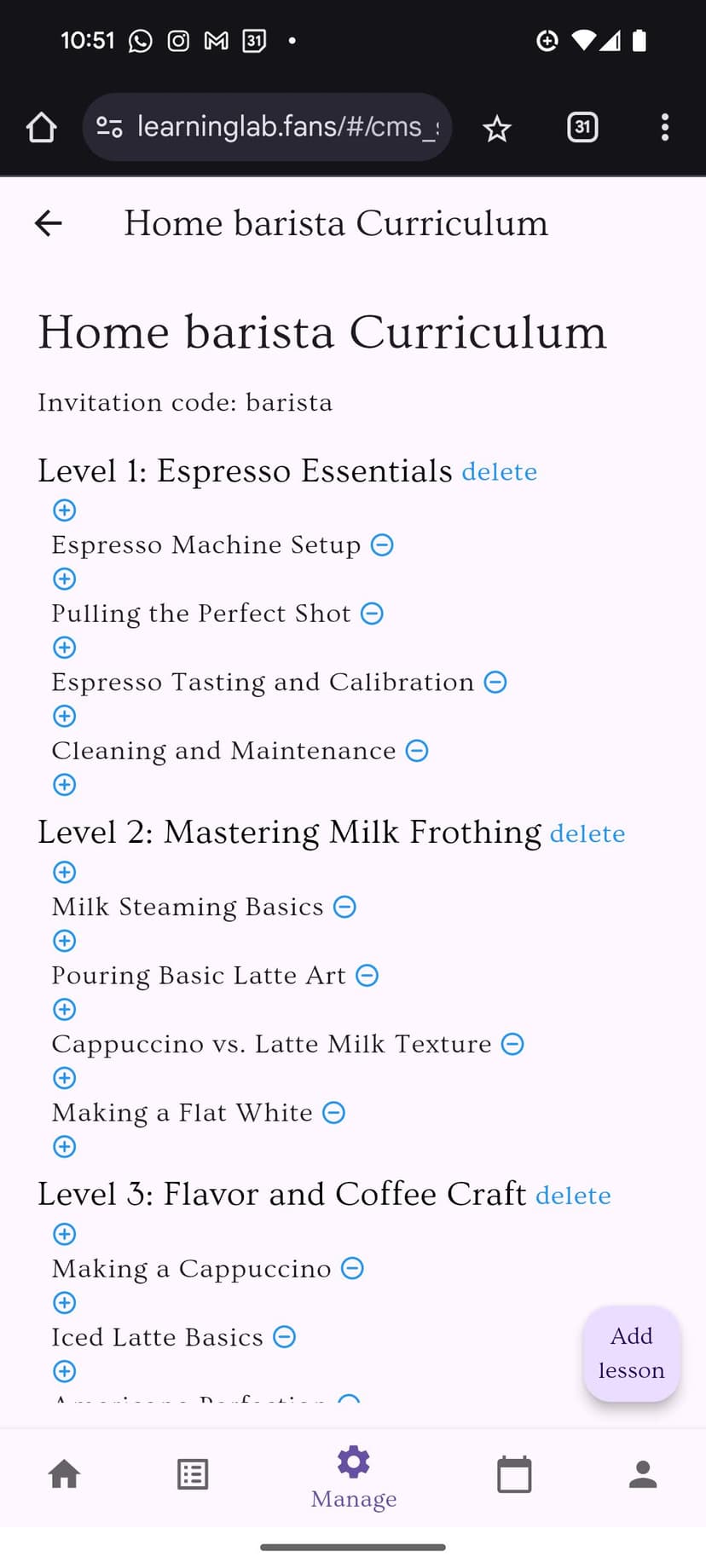
Learning Lab App uses a cooperative, mastery-based approach where students progress through customized mini-lessons by acting as both learners and teachers. Educators first build or import a structured curriculum divided into manageable chunks. As adult learners complete these foundational mini-lessons, the app's algorithm pairs them with beginners who need help with that exact material. The platform manages these class sessions and tracks who is teaching whom. Students must demonstrate mastery of a concept before they can mentor someone else. To prove this mastery, learners upload progress videos showing their work or explaining concepts. Educators review these uploads to ensure accuracy. This setup creates a continuous loop of initial learning followed by immediate retrieval practice through the act of teaching. The app provides the necessary infrastructure for this peer-mentorship model, handling the matchmaking and progress tracking while the educator oversees the actual content and final learning outcomes.
Strengths and tradeoffs of Learning Lab App
The app's biggest strength is its use of the teaching effect to deepen mentor knowledge, while its biggest weakness is the risk of novices learning incorrect information from untrained peers. Learning by teaching is a highly effective cognitive strategy. When advanced students explain concepts in humanities or technical education to beginners, they engage in deep cognitive processing. This forces them to organize their knowledge and identify their own blind spots. Cooperative learning also increases motivation and engagement among adult learners. However, cognitive science shows that novices require clear, accurate worked examples to build proper mental models. When a peer mentor lacks specific teaching skills, they may provide confusing explanations or fail to correct foundational misunderstandings. Furthermore, the app lacks automated immediate feedback, meaning encoding errors might not be caught until an educator manually reviews a progress video later. Personalized pacing is another strong point, as students only move forward when they have completed the required mentorship tasks. Ultimately, the software excels as a logistical tool for peer tutoring but relies entirely on human oversight to maintain strict instructional quality.
Who Might Benefit From Learning Lab App?
Best for adult education programs and vocational training centers that rely on hands-on collaborative learning. It serves educators who want to implement a structured peer-mentorship model without manually organizing the mentor-mentee pairs. Because the app requires students to teach each other, it is highly effective for adults building practical skills in applied sciences or career and technical education. It is not suitable for independent learners without a cohort, as the entire pedagogical model depends on having a steady pool of peers at varying levels of mastery to function.
Data Transparency
Does Not Meet Data Transparency Standard
Learning Lab App does not meet our data transparency standard. Its privacy policy does not document basic protections, including a statement that it does not sell data, a commitment against targeted advertising and limits on sharing children's data.
13 of 35 checks passed
Evaluated September 2026
Privacy Policy →Level 1 · Basic protections
Does not sell data or target ads at students, limits sharing, and lets parents see and delete their child's data.
Not documented: a statement that it does not sell data, a commitment against targeted advertising, limits on sharing children's data, a COPPA or FERPA commitment, parents' right to see their child's data, parents' right to delete their child's data
Level 2 · Parent control (meets the standard)
Families can get their data out, know who processes it, and know how long it is kept.
Not documented: a data retention timeline, self-service deletion
Level 3 · Direct data access
Families or schools can pull their own data through an API, in a stated format.
Not documented: an API for retrieving their own data, a named export format
View all 35 checks
Parent Access3/8
Does the policy mention parents specifically?
“By using the Services, you represent that you are at least 18 or that you are the parent or guardian of such a minor and consent to such minor dependent’s use of the Services.”
Can parents view their child's data?
The policy does not give parents a right to view their child's data.
Can parents modify their child's data?
The policy does not give parents a right to modify their child's data.
Can parents delete their child's account?
The policy says it will delete data it learns came from under-18 users but does not give parents a right to delete their child's account.
Is there a dedicated Children's Privacy section?
“**10\. DO WE COLLECT INFORMATION FROM MINORS?** **_In Short:_** _We do not knowingly collect data from or market to children under 18 years of age._”
Does it reference COPPA compliance?
The policy does not mention COPPA.
Does it reference FERPA compliance?
The policy does not mention FERPA.
Is parental consent required for child accounts?
“By using the Services, you represent that you are at least 18 or that you are the parent or guardian of such a minor and consent to such minor dependent’s use of the Services.”
Data Portability2/5
Can users access their personal data?
“These may include the right (i) to request access and obtain a copy of your personal information, (ii) to request rectification or erasure; (iii) to restrict the processing of your personal information; (iv) if applicable, to data portability; and (v) not to be subject to automated decision-making.”
Can users download/export their data?
“Right to obtain a copy of the personal data you previously shared with us”
Is there a self-service data access tool?
The policy offers only a request form and email contact, not a tool users operate themselves.
Is a specific data format mentioned for export?
The policy does not name any export format.
Is there an API for data access?
The policy does not mention an API for users to retrieve their data.
Data Minimization1/6
Is data collection itemized?
“The personal information we collect may include the following:”
Can the app be used without a real name?
The policy says it collects names.
Can the app be used without an email?
The policy says it collects email addresses.
Does it state collection is limited to what is necessary?
The policy limits how long data is kept to what is necessary but does not say collection is limited to what is necessary.
Is IP address anonymized or truncated?
The policy says it collects IP addresses and does not mention anonymizing or truncating them.
Is location tracking explicitly excluded?
The policy says it may collect precise geolocation data, including through GPS.
Third-Party Protection3/7
Does it explicitly state no selling of data?
The policy only says it has not sold data in the past twelve months and offers an opt-out from future selling; it does not commit to never selling data.
Are third-party providers named?
“When we use Google Analytics.** We may share your information with Google Analytics to track and analyze the use of the Services.”
Are providers contractually restricted?
“We have contracts in place with our third parties, which are designed to help safeguard your personal information. This means that they cannot do anything with your personal information unless we have instructed them to do it.”
No-targeted-advertising commitment?
The policy says it uses personal information to deliver targeted advertising.
Is AI/ML data sharing addressed?
The policy does not address AI or machine-learning data sharing.
Child-specific sharing restriction?
The policy has no sharing restriction specific to children.
Cookies/tracking limited or opt-out?
“To opt out of being tracked by Google Analytics across the Services, visit [https://tools.google.com/dlpage/gaoptout](https://tools.google.com/dlpage/gaoptout).”
Deletion & Retention2/5
Can users delete their account?
“Upon your request to terminate your account, we will deactivate or delete your account and information from our active databases.”
Self-service deletion mechanism?
Account deletion requires contacting the company or submitting a request; there is no self-service tool.
Specific data retention timeline?
The policy keeps data as long as the account exists or as long as necessary, with some data kept indefinitely, and gives no specific time period.
Auto-deletion of inactive accounts?
The policy does not mention automatically deleting inactive accounts.
Post-deletion handling described?
“Upon your request to terminate your account, we will deactivate or delete your account and information from our active databases. However, we may retain some information in our files to prevent fraud, troubleshoot problems, assist with any investigations, enforce our legal terms and/or comply with applicable legal requirements.”
Advertising2/4
Advertising model explicitly disclosed?
“To deliver targeted advertising to you.** We may process your information to develop and display personalized content and advertising tailored to your interests, location, and more.”
Free from third-party advertisements?
The policy shares data with ad networks and retargeting platforms and never says the product is free of third-party ads.
Children excluded from ad targeting?
“We do not knowingly solicit data from or market to children under 18 years of age.”
Ad-free option available?
The policy does not offer an ad-free option and describes targeted advertising.
What This Means
The policy review did not meet our data transparency standard. The checks above show the documented findings and unknowns. A missing statement does not establish how the app handles data in practice.
About this evaluation: Based on automated analysis of Privacy Policy using the Common Sense Privacy Program framework. Quoted text is copied from the policy; unquoted notes are our summary. Results describe the policy disclosures we assessed; unknown checks are excluded from scores. Privacy policies can change. This review reflects the version we analyzed and does not determine legal compliance.
Sources and review method
TLS combines product information and editorial analysis to explain how Learning Lab App works, its tradeoffs, and the questions to ask before choosing it. Product features, an instructional rationale and evidence of learning outcomes are different kinds of information.
Formal Learning Standard assessment: not yet completed. Data Transparency findings are reported separately and do not establish learning effectiveness. Read our methodology.
Frequently Asked Questions About Learning Lab App
Is Learning Lab App free?
Yes, Learning Lab App is currently free for early adopters. The developers plan to transition to a subscription model charging around $10 per month in the future, but current students and educators can access the platform at no cost right now. Because the developers are seeking an initial user base to test the peer-mentorship mechanics, educational programs can take advantage of the full suite of class session management and video upload tools without any financial commitment.
Is Learning Lab App good for adult learners?
Yes, the platform is specifically designed for adult education. The cooperative learning model respects the prior experience of adult learners by allowing them to take ownership of the material and act as mentors. This peer-to-peer dynamic builds confidence and reinforces mastery in subjects ranging from humanities to technical education. Unlike many edtech apps that use gamification suited for young children, this app utilizes professional collaboration and video-based skill demonstration, making it highly appropriate for mature students in vocational training.
What does Learning Lab App teach?
Learning Lab App does not provide its own pre-built content. Instead, it provides a blank logistical framework for educators to build custom curriculums in subjects like math, science, humanities, and career and technical education. The actual lessons depend entirely on what the instructor inputs into the system. The platform facilitates the mini-lessons and peer matching, but the educator is fully responsible for designing the learning objectives, creating the rubrics, and ensuring the material aligns with rigorous educational standards.
Has The Learning Standard evaluated Learning Lab App?
TLS has not yet completed a Learning Standard evaluation of how well Learning Lab App teaches. Its privacy policy has been reviewed for Data Transparency and does not yet document the basic protections (Level 1).
Is Learning Lab App COPPA compliant?
A COPPA reference was not found in the reviewed privacy policy. This does not determine whether the app complies with COPPA. Policy review note: The policy does not mention COPPA.
Is Learning Lab App FERPA compliant?
A FERPA reference was not found in the reviewed privacy policy. This does not determine whether the app complies with FERPA. Policy review note: The policy does not mention FERPA.
Does Learning Lab App have a children's privacy policy?
The reviewed policy includes a dedicated children's privacy section. Policy review note: The policy has its own section on collecting information from minors.
Does Learning Lab App sell student data?
A statement ruling out data selling was not found in the reviewed policy. This does not establish that the app sells student data. Policy review note: The policy only says it has not sold data in the past twelve months and offers an opt-out from future selling; it does not commit to never selling data.
Can you delete your data from Learning Lab App?
The reviewed privacy policy describes account deletion. We have not tested the deletion process. Policy review note: Users can ask to have their account deleted.
Follow TLS Research
Subscribe to future TLS research updates: app reviews, findings, and what the evidence shows.
Screenshots
Take Action
For Learning Lab App
If you represent Learning Lab For Educators and have a correction or new evidence, send the relevant source so we can review and update this page.
Submit a correctionDetails
- Pricing
- The learning lab is currently available for free for students and educators. As we are seeking first adopters, we'll try to keep the pricing that way. At a later point, we see moving to a subscription model, where students pay a membership fee, kind of like Apple Music for about $10 a month.
- Platforms
- Web Browser
- Grade Levels
- Adult Education
- Website
- Visit site