
Jamworks
Product by Jamworks
Facts checked: Not yet checked
Our take (not a Learning Standard rating). This label applies to learning-science judgments throughout this overview.
Our take (not a Learning Standard rating)
Jamworks does not directly teach new concepts, but it provides robust cognitive support by offloading the working memory demands of note-taking. While its automated flashcards facilitate vital retrieval practice, the app relies entirely on user self-regulation and the original lecture quality for effective long-term learning.
Pros
- Reduces cognitive load during dense lectures by fully automating transcription and summarization.
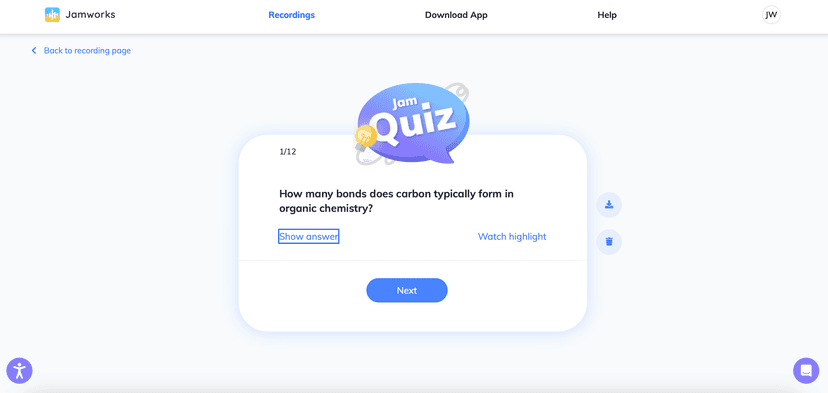
- Facilitates active retrieval practice through automatically generated flashcards based on exact lecture content.
- Supports diverse learning profiles by offering multimodal review options including text summaries, audio chapters, and an AI tutor.
- Provides seamless integration with common university content management systems to streamline student workflows.
Cons
- Bypasses the generative learning process of manual note-taking, which research shows aids the initial encoding of information.
- Relies heavily on the user's executive function to deliberately engage with study tools rather than passively reading transcripts.
- AI tutor responses are constrained by the quality, audio clarity, and factual accuracy of the original recorded lecture.
What Do We Know About Jamworks?
Jamworks is effective as an assistive study tool rather than a standalone instructional platform. Your student will not learn new material directly from the app; instead, they will use it to capture and organize classroom lectures for later review. By recording and transcribing classes in real-time, the app eliminates the cognitive overload of trying to listen and write simultaneously. This is particularly beneficial for students with processing deficits or those who struggle with traditional note-taking. However, learning science dictates that the act of summarizing information in one's own words builds stronger neural pathways than simply reading AI-generated notes. To actually learn the material, your student must actively engage with the app's secondary features. The platform generates flashcards and interactive study materials from the transcripts, which allows for crucial retrieval practice. Without using these active recall tools, the app functions merely as a passive recording device, which limits deep comprehension. Parents and educators should view Jamworks as a powerful accessibility tool that requires strong student self-regulation to translate captured notes into actual knowledge.
How Does Jamworks Work?
Jamworks uses automated cognitive offloading to capture lecture content, followed by AI-driven material generation for review. During a class, the app actively records and transcribes the instructor's audio. It segments this recording into digestible audio chapters and text summaries, organizing the raw information into a structured format. Once the recording is complete, the platform applies natural language processing to extract key concepts and automatically generates flashcards. Your student can then use these flashcards to test their knowledge, leveraging the spacing effect and retrieval practice. Additionally, the app features an AI tutor interface where students can ask direct questions about the specific lecture. The AI references only the recorded transcript to provide answers, ensuring the information remains contextually accurate to the course. Because it integrates with existing university platforms, the workflow is seamless, but it requires the user to deliberately return to the app to utilize the study tools.
Strengths and tradeoffs of Jamworks
The biggest strength of Jamworks is its ability to reduce cognitive load during live instruction, while its biggest weakness is the potential to encourage passive learning. Cognitive Load Theory suggests that working memory has limited capacity; by automating transcription, Jamworks frees up a student's mental resources to focus entirely on understanding the instructor's spoken concepts rather than frantically copying them down. This is an exceptional application of assistive technology. Furthermore, the platform's automatic generation of flashcards brilliantly facilitates retrieval practice, which is one of the most robust strategies for long-term retention. However, this automation comes with a significant pedagogical tradeoff. The Generation Effect proves that information is better remembered if it is generated from one's own mind rather than simply read. When Jamworks creates the notes and summaries, the student bypasses the crucial encoding step of synthesizing information themselves. Active engagement becomes the sole responsibility of the user. If your student actively tests themselves using the AI tutor and flashcards, the app is highly effective. If they merely scan the AI summaries before an exam, their retention will be incredibly shallow.
Who Might Benefit From Jamworks?
Jamworks is best for high school upperclassmen and college students who need assistive technology to manage the cognitive demands of heavy lecture courses. It is specifically designed for older students attending dense, information-heavy classes where manual note-taking is a barrier to comprehension. Students with learning disabilities, processing delays, or working memory deficits will find the automated transcription and summarization invaluable. It is not suitable for younger students or highly interactive, hands-on classes where passive recording provides little value. The ideal user is a mature learner who possesses the self-discipline to use the app's flashcards and AI tutor for active review.
Data Transparency
Does Not Meet Data Transparency Standard
Jamworks does not meet our data transparency standard. Its privacy policy does not document basic protections, including a commitment against targeted advertising, limits on sharing children's data and parents' right to see their child's data.
16 of 35 checks passed
Evaluated September 2026
Jamworks Privacy Policy →Level 1 · Basic protections
Does not sell data or target ads at students, limits sharing, and lets parents see and delete their child's data.
Not documented: a commitment against targeted advertising, limits on sharing children's data, parents' right to see their child's data, parents' right to delete their child's data
Level 2 · Parent control (meets the standard)
Families can get their data out, know who processes it, and know how long it is kept.
Not documented: named service providers
Level 3 · Direct data access
Families or schools can pull their own data through an API, in a stated format.
Not documented: an API for retrieving their own data, a named export format
View all 35 checks
Parent Access5/8
Does the policy mention parents specifically?
“Jamworks does not knowingly collect personal data from children under 16 years of age without consent from a parent, guardian, or educational Institution acting as the Controller.”
Can parents view their child's data?
The policy gives access rights to "you (or the Institution)" but does not say parents can view their child's data.
Can parents modify their child's data?
The policy gives correction rights to users or the Institution but does not say parents can change their child's data.
Can parents delete their child's account?
The policy asks anyone who believes a child's data was collected by mistake to get in touch, but it does not name parents as able to delete their child's data or account.
Is there a dedicated Children's Privacy section?
“**13 Children’s privacy (COPPA & UK GDPR)**”
Does it reference COPPA compliance?
“**13 Children’s privacy (COPPA & UK GDPR)**”
Does it reference FERPA compliance?
“For US Institutions subject to the Family Educational Rights and Privacy Act (“FERPA”), where Jamworks receives or accesses personally identifiable information from education records to provide the Services:”
Is parental consent required for child accounts?
“Jamworks does not knowingly collect personal data from children under 16 years of age without consent from a parent, guardian, or educational Institution acting as the Controller.”
Data Portability2/5
Can users access their personal data?
“Access the personal data we hold about you;”
Can users download/export their data?
“Port data to another service;”
Is there a self-service data access tool?
The policy says rights are exercised by emailing legal@jamworks.com and describes no self-service access tool.
Is a specific data format mentioned for export?
The policy does not name a format for exported data.
Is there an API for data access?
The policy does not mention an API for data access.
Data Minimization1/6
Is data collection itemized?
“Account and profile data: including an End User’s name, institutional email address, role and account or authentication information, including single sign-on identifiers where institutional SSO is enabled.”
Can the app be used without a real name?
The policy says it collects the End User's name as account data.
Can the app be used without an email?
The policy says it collects the End User's institutional email address.
Does it state collection is limited to what is necessary?
The policy limits how long data is kept to what is necessary, but it does not say collection is limited to what is necessary.
Is IP address anonymized or truncated?
The policy says it collects IP addresses and does not say they are anonymized or truncated.
Is location tracking explicitly excluded?
The policy does not explicitly rule out location tracking.
Third-Party Protection4/7
Does it explicitly state no selling of data?
“Jamworks **does not** sell, rent, or license personal data for advertising or other commercial gain.”
Are third-party providers named?
The policy describes types of service providers but does not name any.
Are providers contractually restricted?
“Cloud hosting, transcription engines, video processing, analytics, and customer‑support vendors who are contractually bound to: (i) process data solely under our instructions; (ii) implement adequate security measures; and (iii) delete data when the service ends.”
No-targeted-advertising commitment?
The policy says data is not sold or licensed for advertising, but it makes no commitment against targeted or behavioral advertising.
Is AI/ML data sharing addressed?
““Subprocessor” refers to a third party engaged by Jamworks to process Personal Data on its behalf, such as a cloud-hosting, transcription or AI-processing provider.”
Child-specific sharing restriction?
The policy has no sharing restrictions specific to children.
Cookies/tracking limited or opt-out?
“You can control cookies through our consent banner and your browser settings.”
Deletion & Retention4/5
Can users delete their account?
“Delete data or restrict its processing;”
Self-service deletion mechanism?
“**Content Data** – retained until the User deletes it or the Institution contract ends, whichever comes first.”
Specific data retention timeline?
“**Account & Usage Data** – retained for the life of the account + 12 months.”
Auto-deletion of inactive accounts?
The policy does not address automatic deletion of inactive accounts.
Post-deletion handling described?
“**Account & Usage Data** – retained for the life of the account + 12 months.”
Advertising0/4
Advertising model explicitly disclosed?
The policy does not disclose an advertising model or state that the product has no ads.
Free from third-party advertisements?
The policy does not state that the product is free of third-party ads.
Children excluded from ad targeting?
The policy does not explicitly exclude children from ad targeting.
Ad-free option available?
The policy does not mention an ad-free option or state that the product has no ads.
What This Means
The policy review did not meet our data transparency standard. The checks above show the documented findings and unknowns. A missing statement does not establish how the app handles data in practice.
About this evaluation: Based on automated analysis of Jamworks Privacy Policy against 35 policy-disclosure questions, including questions adapted from the Common Sense Privacy Program's published evaluation questions. TLS is not affiliated with Common Sense Media, and this is not a Common Sense rating. Quoted text is copied from the policy; unquoted notes are our summary. Results describe what the policy documents, not the company's actual practices. Privacy policies can change: this review reflects the version we analyzed and does not determine legal compliance.
Sources and review method
TLS combines product information and editorial analysis to explain how Jamworks works, its tradeoffs, and the questions to ask before choosing it. Product features, an instructional rationale and evidence of learning outcomes are different kinds of information.
Formal Learning Standard assessment: not yet completed. Data Transparency findings are reported separately and do not establish learning effectiveness. Read our methodology.
Frequently Asked Questions About Jamworks
Is Jamworks free?
No, Jamworks is not generally free for individual users. Pricing is calculated on a per-student subscription basis. However, many students access the platform at no personal cost because their institution purchases a campus-wide license. Universities frequently use Jamworks to meet Universal Design for Learning requirements and provide equitable accessibility for students with disabilities, replacing traditional peer note-taking services entirely.
Is Jamworks good for high school students?
Jamworks is highly effective for 11th and 12th graders taking advanced, lecture-heavy courses such as Advanced Placement or dual-enrollment classes. It is not appropriate for elementary or middle school students. The platform relies heavily on long-form audio capture and requires significant self-regulation to review the generated flashcards and notes, making it best suited for older adolescents preparing for college-level executive functioning.
What does Jamworks teach?
Jamworks does not provide its own original curriculum or teach specific academic concepts. Instead, it is an agnostic study utility that processes whatever the instructor is teaching. By capturing and analyzing live audio, the app organizes educational content across all disciplines, from advanced mathematics to the humanities, allowing your student to focus on understanding the lecture in real-time rather than frantically taking notes.
How does Jamworks compare to traditional peer note-takers?
Jamworks replaces human peer note-takers by providing immediate, comprehensive transcripts and AI-generated study materials without relying on another student's subjective interpretation. This guarantees your student receives complete information rather than missing details a peer might omit. Conversely, a skilled human note-taker naturally filters out irrelevant classroom chatter or administrative announcements, whereas an AI system may initially transcribe unnecessary audio before summarizing the core educational content.
Has The Learning Standard evaluated Jamworks?
TLS has not yet completed a Learning Standard evaluation of how well Jamworks teaches. Its privacy policy has been reviewed for Data Transparency and does not yet document the basic protections (Level 1).
Is Jamworks COPPA compliant?
The reviewed privacy policy references COPPA. A policy reference alone does not establish COPPA compliance. Policy review note: The children's privacy section references COPPA.
Is Jamworks FERPA compliant?
The reviewed privacy policy references FERPA. A policy reference alone does not establish FERPA compliance. Policy review note: The policy includes a FERPA acknowledgement.
Does Jamworks have a children's privacy policy?
The reviewed policy includes a dedicated children's privacy section. Policy review note: The policy has a dedicated children's privacy section.
Does Jamworks sell student data?
The reviewed policy states that the app does not sell data. This is a policy statement; actual data practices were not verified. Policy review note: The policy explicitly says Jamworks does not sell personal data.
Can you delete your data from Jamworks?
The reviewed privacy policy describes account deletion. We have not tested the deletion process. Policy review note: Users or the Institution can request deletion of data by email.
Follow TLS Research
Subscribe to future TLS research updates: app reviews, findings, and what the evidence shows.
Screenshots



Take Action
For Jamworks
If you represent Jamworks and have a correction or new evidence, send the relevant source so we can review and update this page.
Submit a correctionDetails
- Pricing
- Pricing is calculated on a per student basis. Campus-wide pricing is also available to aid UDL.
- Platforms
- Web Browser, iOS (Apple mobile), iPadOS (Apple tablet), Android (Google mobile), Windows (Microsoft), macOS (Apple)
- Grade Levels
- 11th Grade, 12th Grade, Associate's degree, Bachelor's degree, Post-baccalaureate certificate, Master's Degree, Post-master's certificate, Doctoral Degree, Post-doctoral certificate, Adult Education, Professional or Technical Credential
- Website
- Visit site