
HR Management Simulation: People Analytics
Product by Sim Institute
Facts checked: Not yet checked
Our take (not a Learning Standard rating). This label applies to learning-science judgments throughout this overview.
Our take (not a Learning Standard rating)
While The Learning Standard has not yet formally evaluated this simulation, its design aligns with situated learning theory. It places users in realistic decision-making contexts. However, without built-in spaced retrieval or explicit scaffolding, its effectiveness likely depends entirely on the quality of the instructor facilitating the debriefing.
Pros
- Employs situated learning by placing students in realistic call center management scenarios.
- Forces learners to balance competing variables like customer satisfaction and cost to encourage higher-order cognitive processing.
- Provides immediate consequence feedback based on the user's strategic HR decisions.
Cons
- Lacks explicit instructional scaffolding to guide novices before they make complex decisions.
- Does not utilize spaced repetition for retention of foundational HR terminology and metrics.
- Relies heavily on external instructor debriefing to solidify learning transfer.
What Do We Know About HR Management Simulation: People Analytics?
This simulation is effective for applying existing HR knowledge, but it will not teach foundational concepts from scratch. You should use this tool as a capstone or synthesis exercise for your students, rather than an introductory lesson. The People Analytics simulation places learners in the role of an HR Director at a customer support call center. Your students must make strategic choices about training, engagement, and staffing to drive customer satisfaction while keeping costs low. From a learning science perspective, this app relies on problem-based learning. It forces learners to grapple with complex, interconnected variables. When your students change a training budget, they immediately see the impact on employee retention and customer feedback. This immediate consequence feedback is excellent for correcting misconceptions about how HR levers interact. However, The Learning Standard notes that simulations of this type often induce high cognitive load. Because it does not provide worked examples or step-by-step scaffolding, novice learners will likely feel overwhelmed. It is entirely dependent on your facilitation. You must guide the debriefing process to ensure students connect their simulated outcomes back to core academic theories.
How Does HR Management Simulation: People Analytics Work?
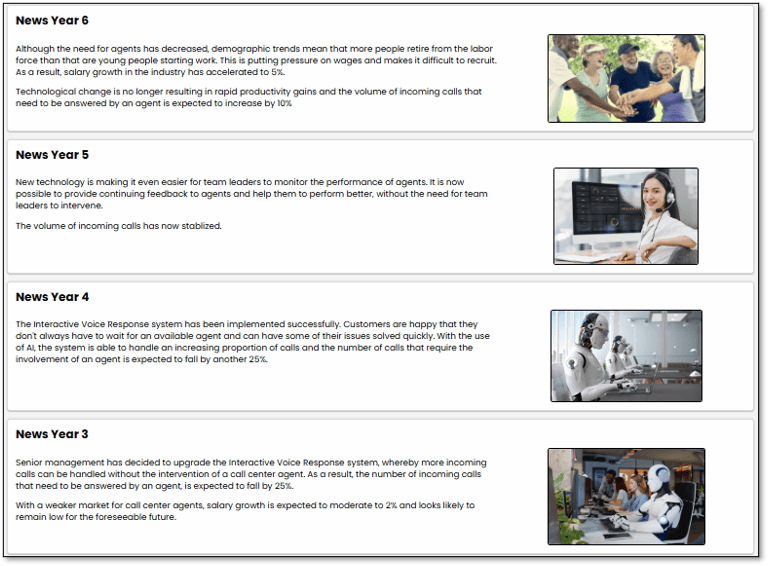
HR Management Simulation: People Analytics relies on problem-based situated learning to teach strategic decision-making. Your students assume the role of an HR Director tasked with optimizing a customer support call center. The interface presents learners with a dashboard of competing metrics, primarily customer satisfaction scores and operational costs. Students manipulate various human resources levers, such as training budgets, employee engagement initiatives, and hiring criteria. Once decisions are locked in, the simulation calculates the outcomes and updates the dashboard. This creates a continuous feedback loop. If a student underfunds training, they will observe a tangible drop in call center performance and customer satisfaction. The simulation does not spoon-feed right or wrong answers. Instead, it forces learners to analyze data trends over multiple simulated periods. This mechanics-driven approach targets the higher levels of Bloom's Taxonomy, requiring users to synthesize information and evaluate the consequences of their HR strategies in a zero-risk environment.
Strengths and tradeoffs of HR Management Simulation: People Analytics
The biggest strength of this simulation is its realistic application of consequence feedback, while its biggest weakness is the lack of instructional scaffolding for novice learners. Situated learning environments excel at showing students how isolated concepts interact in the real world. By forcing users to balance employee engagement with strict budget constraints, the simulation accurately models the cognitive demands of actual HR management. When your students make a poor hiring choice, the immediate drop in performance metrics serves as corrective feedback, which learning science shows is critical for skill acquisition. However, this complexity comes at a cost. The app does not utilize worked examples or gradual difficulty progression to manage cognitive load. Novice students faced with a dashboard of interconnected analytics will likely resort to guessing rather than applying strategic thought. Furthermore, the platform lacks any mechanism for retrieval practice or spaced repetition to ensure learners remember key HR formulas or theories. It functions purely as an application tool. Therefore, its educational value hinges entirely on the instructor's ability to facilitate a structured debrief and connect the simulation data back to foundational academic concepts.
Who Might Benefit From HR Management Simulation: People Analytics?
This simulation is best for advanced undergraduate and graduate business students who already possess foundational knowledge in human resources and data analytics. Because the tool lacks basic instructional scaffolding, it is inappropriate for novices or high school CTE students. It serves as an excellent capstone exercise for adult learners and professionals seeking technical credentials. Instructors should deploy this simulation to bridge the gap between theoretical textbook knowledge and practical application, using it to teach complex problem-solving and systems thinking within corporate management environments.
Data Transparency
Does Not Meet Data Transparency Standard
HR Management Simulation: People Analytics does not meet our data transparency standard. Its privacy policy does not document basic protections, including a statement that it does not sell data, a commitment against targeted advertising and limits on sharing children's data.
7 of 35 checks passed
Evaluated September 2026
cdn.prod.website-files.com →Level 1 · Basic protections
Does not sell data or target ads at students, limits sharing, and lets parents see and delete their child's data.
Not documented: a statement that it does not sell data, a commitment against targeted advertising, limits on sharing children's data, contractual limits on service providers, a COPPA or FERPA commitment, parents' right to see their child's data, parents' right to delete their child's data
Level 2 · Parent control (meets the standard)
Families can get their data out, know who processes it, and know how long it is kept.
Not documented: a data retention timeline, self-service deletion
Level 3 · Direct data access
Families or schools can pull their own data through an API, in a stated format.
Not documented: an API for retrieving their own data, a named export format
View all 35 checks
Parent Access0/8
Does the policy mention parents specifically?
The policy does not mention parents.
Can parents view their child's data?
The policy does not give parents any right to view their child's data.
Can parents modify their child's data?
The policy does not give parents any right to modify their child's data.
Can parents delete their child's account?
The policy does not give parents any right to delete their child's data or account.
Is there a dedicated Children's Privacy section?
The policy has no section on children's privacy.
Does it reference COPPA compliance?
The policy does not reference COPPA.
Does it reference FERPA compliance?
The policy does not reference FERPA.
Is parental consent required for child accounts?
The policy does not address parental consent.
Data Portability2/5
Can users access their personal data?
“**The right to access**\- You have the right to request Our Company for copies of your personal data. We may charge you a small fee for this service.”
Can users download/export their data?
“**The right to data portability**\- You have the right to request that Our Company transfer the data that we have collected to another organization, or directly to you, under certain conditions.”
Is there a self-service data access tool?
The policy only describes requests by email or post, not a self-service tool.
Is a specific data format mentioned for export?
The policy does not name an export format.
Is there an API for data access?
The policy does not mention an API for data access.
Data Minimization1/6
Is data collection itemized?
“Our Company collects the following data: - Personal identification information (Name, email address)”
Can the app be used without a real name?
The policy says it collects users' names.
Can the app be used without an email?
The policy says it collects users' email addresses.
Does it state collection is limited to what is necessary?
The policy does not say collection is limited to what is necessary.
Is IP address anonymized or truncated?
The policy says advertising cookies collect IP addresses and does not mention anonymizing them.
Is location tracking explicitly excluded?
The policy does not rule out location tracking and says functionality cookies may remember the user's location.
Third-Party Protection2/7
Does it explicitly state no selling of data?
The policy does not say the company does not sell data.
Are third-party providers named?
“Our Company securely stores your data at Webflow (for web enquiries), Forio (for simulation users) and Thinkific (for online course participants)”
Are providers contractually restricted?
The policy does not describe contractual limits on providers.
No-targeted-advertising commitment?
The policy says cookie data is shared with advertising partners to show ads based on browsing patterns.
Is AI/ML data sharing addressed?
The policy does not address AI or machine learning.
Child-specific sharing restriction?
The policy has no sharing restrictions specific to children.
Cookies/tracking limited or opt-out?
“You can set your browser not to accept cookies, and the above website tells you how to remove cookies from your browser. However, in a few cases, some of our website features may not function as a result.”
Deletion & Retention1/5
Can users delete their account?
“**The right to erasure**\- You have the right to request that Our Company erase your personal data, under certain conditions.”
Self-service deletion mechanism?
The policy only describes deletion by request, not a self-service option.
Specific data retention timeline?
The policy does not give a data retention timeline.
Auto-deletion of inactive accounts?
The policy does not address automatic deletion of inactive accounts.
Post-deletion handling described?
The policy does not describe what happens to data after deletion.
Advertising1/4
Advertising model explicitly disclosed?
“Our Company sometimes shares some limited aspects of this data with third parties for advertising purposes. We may also share online data collected through cookies with our advertising partners.”
Free from third-party advertisements?
The policy says it works with advertising partners and does not say it is free of third-party ads.
Children excluded from ad targeting?
The policy does not exclude children from ad targeting.
Ad-free option available?
The policy does not mention an ad-free option.
What This Means
The policy review did not meet our data transparency standard. The checks above show the documented findings and unknowns. A missing statement does not establish how the app handles data in practice.
About this evaluation: Based on automated analysis of cdn.prod.website-files.com against 35 policy-disclosure questions, including questions adapted from the Common Sense Privacy Program's published evaluation questions. TLS is not affiliated with Common Sense Media, and this is not a Common Sense rating. Quoted text is copied from the policy; unquoted notes are our summary. Results describe what the policy documents, not the company's actual practices. Privacy policies can change: this review reflects the version we analyzed and does not determine legal compliance.
Sources and review method
TLS combines product information and editorial analysis to explain how HR Management Simulation: People Analytics works, its tradeoffs, and the questions to ask before choosing it. Product features, an instructional rationale and evidence of learning outcomes are different kinds of information.
Formal Learning Standard assessment: not yet completed. Data Transparency findings are reported separately and do not establish learning effectiveness. Read our methodology.
Frequently Asked Questions About HR Management Simulation: People Analytics
Is HR Management Simulation: People Analytics free?
No, this simulation requires a paid license for access. The developer charges $18 per user for academic use within universities and educational institutions. For corporate training and professional use, the cost is $48 per user. There is no free tier or freemium version available for individual students to practice on their own.
Is HR Management Simulation: People Analytics good for high school students?
No, this tool is too advanced for typical high school students. The simulation requires a strong pre-existing understanding of business operations, data analytics, and human resources terminology. It is explicitly designed for higher education, including bachelor's and master's degree programs, as well as adult professionals seeking technical credentials in HR management.
What does HR Management Simulation: People Analytics teach?
It teaches applied strategic decision-making within a corporate human resources context. Your students learn how to analyze call center performance metrics, balance operational budgets, and adjust training and engagement variables to maximize workforce efficiency. Rather than teaching rote vocabulary, it forces learners to apply systems thinking to see how HR decisions directly impact customer satisfaction and company costs.
Has The Learning Standard evaluated HR Management Simulation: People Analytics?
TLS has not yet completed a Learning Standard evaluation of how well HR Management Simulation: People Analytics teaches. Its privacy policy has been reviewed for Data Transparency and does not yet document the basic protections (Level 1).
Is HR Management Simulation: People Analytics COPPA compliant?
A COPPA reference was not found in the reviewed privacy policy. This does not determine whether the app complies with COPPA. Policy review note: The policy does not reference COPPA.
Is HR Management Simulation: People Analytics FERPA compliant?
A FERPA reference was not found in the reviewed privacy policy. This does not determine whether the app complies with FERPA. Policy review note: The policy does not reference FERPA.
Does HR Management Simulation: People Analytics have a children's privacy policy?
No dedicated children's privacy section was found in the reviewed policy. Policy review note: The policy has no section on children's privacy.
Does HR Management Simulation: People Analytics sell student data?
A statement ruling out data selling was not found in the reviewed policy. This does not establish that the app sells student data. Policy review note: The policy does not say the company does not sell data.
Can you delete your data from HR Management Simulation: People Analytics?
The reviewed privacy policy describes account deletion. We have not tested the deletion process. Policy review note: Users can request that their personal data be erased, under certain conditions.
Follow TLS Research
Subscribe to future TLS research updates: app reviews, findings, and what the evidence shows.
Screenshots


Take Action
For HR Management Simulation: People Analytics
If you represent Sim Institute and have a correction or new evidence, send the relevant source so we can review and update this page.
Submit a correctionDetails
- Pricing
- $48 for professional use. $18 for academic use.
- Platforms
- Web Browser, iPadOS (Apple tablet), Windows (Microsoft), Chrome OS (Google)
- Grade Levels
- Bachelor's degree, Master's Degree, Adult Education, Professional or Technical Credential
- Website
- Visit site