
HelloCode
Product by Hello World Kids
Facts checked: Not yet checked
Our take (not a Learning Standard rating). This label applies to learning-science judgments throughout this overview.
Our take (not a Learning Standard rating)
While HelloCode has not yet been formally evaluated by The Learning Standard, its reliance on a proprietary coding language limits real-world application. However, it incorporates multimedia learning principles through cartoon instruction and project-based practice to build foundational logic skills and computational thinking for younger students.
Pros
- Utilizes multimedia learning principles by combining visual and auditory information in short instructional videos.
- Incorporates project-based learning to help students apply abstract programming concepts to concrete tasks.
- Scaffolds problem-solving skills through game-based challenges that require logical sequencing.
- Offers self-paced, mastery-based progression to ensure comprehension before advancing to complex topics.
Cons
- Teaches a proprietary programming language rather than industry-standard languages like Python or JavaScript.
- Lacks independent verification of its claims to improve general cognitive and arithmetic skills.
- Offers limited real-time corrective feedback during coding exercises to address specific student misconceptions.
- Requires separate purchases for each course rather than providing a comprehensive subscription model.
What Do We Know About HelloCode?
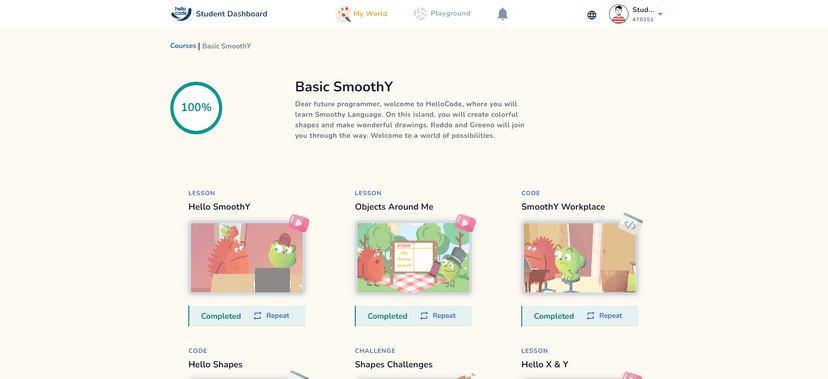
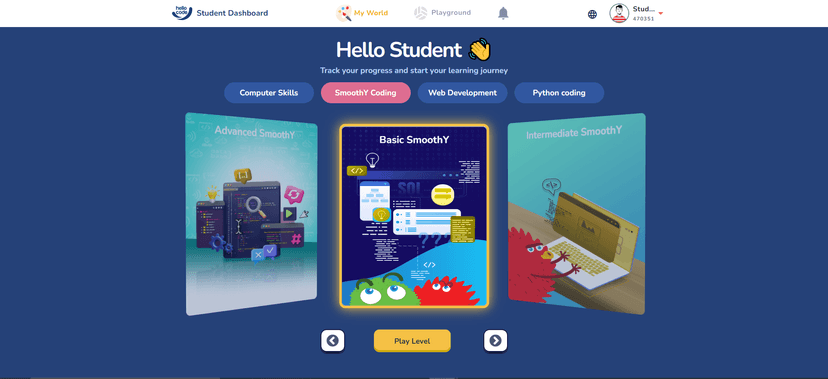
HelloCode is a coding platform that teaches foundational logic, but its effectiveness remains partially unverified because it uses a proprietary programming language rather than teaching real-world syntax. Your child will learn basic computational thinking, sequencing, and problem-solving through a series of animated videos and game-based activities. The platform uses a fictional coding language called SmoothY. This approach reduces the cognitive load associated with learning complex syntax, making it accessible for early elementary students. However, older students in middle or high school will not gain transferable syntax skills needed for actual software development. The Learning Standard has not yet formally evaluated HelloCode for long-term retention or engagement. The program requires you to purchase individual courses, which means parents must actively monitor progression and decide when to buy the next module. The curriculum aligns with project-based learning models, asking your child to complete specific tasks to prove mastery before moving forward. This ensures they do not face advanced challenges without understanding the basics. Parents should consider this a stepping stone for conceptual understanding rather than a tool for producing fluent programmers.
How Does HelloCode Work?
HelloCode uses a mastery-based progression model that combines video instruction with game-based practice sets. Your child begins each module by watching a short, animated cartoon that introduces a specific programming concept, such as loops or conditionals. This leverages the multimedia principle of learning by presenting information through both visual and auditory channels. After the video, your child enters a practice environment where they write code using the platform's proprietary language, SmoothY. They must successfully complete a project-based challenge to prove they understand the concept. The system requires mastery of the current lesson before unlocking the next video. This prevents students from rushing through the material without grasping the foundational logic. The activities are gamified, offering rewards and interactive elements to maintain engagement. Because the instruction relies heavily on passive video consumption followed by immediate practice, it utilizes short-term retrieval practice, though long-term spaced repetition features are not clearly emphasized in the platform's design.
Strengths and tradeoffs of HelloCode
HelloCode's biggest strength is its accessible, low-friction introduction to computational thinking, while its biggest weakness is the reliance on a proprietary coding language that lacks real-world application. The platform effectively utilizes multimedia instruction by using animated cartoons to explain abstract programming concepts. This reduces the initial cognitive load for younger learners, making the material highly approachable. By employing mastery-based progression, the app ensures that students engage in immediate retrieval practice after watching an instructional video. They must apply what they just saw to a concrete problem before moving forward. However, teaching kids a proprietary language like SmoothY limits the transfer of learning. While students may grasp logical sequencing, they will not learn the actual syntax of widely used languages like Python or HTML. Furthermore, the platform heavily relies on game-based elements, which can sometimes lead to students focusing on the game mechanics rather than the underlying educational content. The Learning Standard has not yet evaluated the depth of the corrective feedback provided when a student makes an error. Effective learning requires specific, actionable feedback rather than simple trial-and-error repetition, and it is unclear if HelloCode consistently provides this level of scaffolding.
Who Might Benefit From HelloCode?
HelloCode is best for elementary students who need a gentle, highly visual introduction to computational thinking before tackling actual programming languages. The platform targets a wide age range from grades 1 through 10, but the cartoon-based instruction and proprietary coding language are most appropriate for younger learners. It serves well as an after-school enrichment activity or a homeschooling supplement for parents who want to introduce logic and sequencing without the frustration of complex coding syntax. Older students or those looking to build practical, real-world coding skills will quickly outgrow the platform and should look for programs teaching standard languages.
Data Transparency
Does Not Meet Data Transparency Standard
HelloCode does not meet our data transparency standard. Its privacy policy does not document basic protections, including a commitment against targeted advertising, parents' right to see their child's data and parents' right to delete their child's data.
14 of 35 checks passed
Level 1 · Basic protections
Does not sell data or target ads at students, limits sharing, and lets parents see and delete their child's data.
Not documented: a commitment against targeted advertising, parents' right to see their child's data, parents' right to delete their child's data
Level 2 · Parent control (meets the standard)
Families can get their data out, know who processes it, and know how long it is kept.
Not documented: data export, named service providers
Level 3 · Direct data access
Families or schools can pull their own data through an API, in a stated format.
Not documented: an API for retrieving their own data, a named export format
View all 35 checks
Parent Access4/8
Does the policy mention parents specifically?
“This Privacy Policy outlines how we collect, use, disclose, and protect your personal information when you use our platform, whether as a parent, student, teacher, or school supervisor.”
Can parents view their child's data?
The policy gives users access to their own data but never says parents can view their child's data.
Can parents modify their child's data?
The policy gives users the right to correct their own data but never says parents can modify their child's data.
Can parents delete their child's account?
The policy explains how users delete their own accounts but never says parents can delete their child's account or data.
Is there a dedicated Children's Privacy section?
“6\. Children’s Privacy”
Does it reference COPPA compliance?
“We comply with child privacy laws such as **COPPA** (for U.S. users) and **GDPR-K** (for EU users).”
Does it reference FERPA compliance?
The policy does not mention FERPA.
Is parental consent required for child accounts?
“Children under 13 (or applicable age limit) require parental consent.”
Data Portability1/5
Can users access their personal data?
“Access, correct, or delete your personal data.”
Can users download/export their data?
The policy does not offer a way to download or export data.
Is there a self-service data access tool?
The policy says users ask for access by contacting the company and describes no self-service access tool.
Is a specific data format mentioned for export?
The policy names no export format.
Is there an API for data access?
The policy does not mention an API for getting data.
Data Minimization1/6
Is data collection itemized?
“The personal information we collect may include your name, business name, email address, and other related information necessary for providing our service. Additionally, we may collect your IP address, website visits, and other data typically stored in website logs.”
Can the app be used without a real name?
The policy says it collects names from parents and students who use the product at home.
Can the app be used without an email?
The policy says it collects email addresses from parents and students who use the product at home.
Does it state collection is limited to what is necessary?
The policy does not say collection is limited to what is necessary.
Is IP address anonymized or truncated?
The policy says it collects IP addresses and does not say they are anonymized or truncated.
Is location tracking explicitly excluded?
The policy does not rule out location tracking.
Third-Party Protection4/7
Does it explicitly state no selling of data?
“We do not sell or rent personal information.”
Are third-party providers named?
The policy names service-provider categories (hosting, analytics, payments) but no specific companies.
Are providers contractually restricted?
“These providers are obligated to use the information solely for the purpose of performing services on our behalf and in compliance with legal requirements.”
No-targeted-advertising commitment?
The policy makes no promise that user data will not be used for targeted advertising.
Is AI/ML data sharing addressed?
The policy does not address AI or machine learning.
Child-specific sharing restriction?
“Personal information of users under the age of 12 will not be shared with third parties for marketing purposes.”
Cookies/tracking limited or opt-out?
“You can disable cookies in your browser settings, but please note that some features and functionality of our service may be affected.”
Deletion & Retention4/5
Can users delete their account?
“Under the "Basic Data" section, you will find the option to "Delete My Account."”
Self-service deletion mechanism?
“Click on the "Delete My Account" button to initiate the deletion process.”
Specific data retention timeline?
“After the 4-day waiting period has elapsed with no login activity, your account and associated data will be permanently deleted from our system.”
Auto-deletion of inactive accounts?
The policy does not say inactive accounts are deleted automatically.
Post-deletion handling described?
“After the 4-day waiting period has elapsed with no login activity, your account and associated data will be permanently deleted from our system.”
Advertising0/4
Advertising model explicitly disclosed?
The policy does not describe whether or how the product uses advertising.
Free from third-party advertisements?
The policy does not say whether the product shows third-party ads.
Children excluded from ad targeting?
The policy only limits sharing data of users under 12 for marketing and does not exclude children from ad targeting.
Ad-free option available?
The policy does not mention an ad-free option or say the product has no ads.
What This Means
The policy review did not meet our data transparency standard. The checks above show the documented findings and unknowns. A missing statement does not establish how the app handles data in practice.
About this evaluation: Based on automated analysis of Hello Code and HelloCode Privacy Policy against 35 policy-disclosure questions, including questions adapted from the Common Sense Privacy Program's published evaluation questions. TLS is not affiliated with Common Sense Media, and this is not a Common Sense rating. Quoted text is copied from the policy; unquoted notes are our summary. Results describe what the policy documents, not the company's actual practices. Privacy policies can change: this review reflects the version we analyzed and does not determine legal compliance.
Sources and review method
TLS combines product information and editorial analysis to explain how HelloCode works, its tradeoffs, and the questions to ask before choosing it. Product features, an instructional rationale and evidence of learning outcomes are different kinds of information.
Formal Learning Standard assessment: not yet completed. Data Transparency findings are reported separately and do not establish learning effectiveness. Read our methodology.
Frequently Asked Questions About HelloCode
Is HelloCode free?
No, HelloCode is not free. The pricing model is based on individual course purchases, meaning you pay a one-time fee for each specific module your child takes.
Is HelloCode good for elementary students?
Yes, HelloCode is highly suitable for elementary students. The platform uses animated cartoons and game-based learning to introduce abstract logic concepts, keeping the cognitive load low for younger children.
What does HelloCode teach?
HelloCode teaches basic programming principles and computational logic. Students learn sequencing, problem-solving, and basic arithmetic by using a proprietary coding language designed specifically for the platform.
Does HelloCode teach Python or JavaScript?
No, HelloCode teaches a proprietary programming language called SmoothY. While this helps teach the logic of coding, students will not learn industry-standard syntax used in real-world software development.
Has The Learning Standard evaluated HelloCode?
TLS has not yet completed a Learning Standard evaluation of how well HelloCode teaches. Its privacy policy has been reviewed for Data Transparency and does not yet document the basic protections (Level 1).
Is HelloCode COPPA compliant?
The reviewed privacy policy references COPPA. A policy reference alone does not establish COPPA compliance. Policy review note: The policy says it complies with COPPA.
Is HelloCode FERPA compliant?
A FERPA reference was not found in the reviewed privacy policy. This does not determine whether the app complies with FERPA. Policy review note: The policy does not mention FERPA.
Does HelloCode have a children's privacy policy?
The reviewed policy includes a dedicated children's privacy section. Policy review note: The policy has a section headed Children's Privacy.
Does HelloCode sell student data?
The reviewed policy states that the app does not sell data. This is a policy statement; actual data practices were not verified. Policy review note: The company says it does not sell personal information.
Can you delete your data from HelloCode?
The reviewed privacy policy describes account deletion. We have not tested the deletion process. Policy review note: Users can delete their account.
Follow TLS Research
Subscribe to future TLS research updates: app reviews, findings, and what the evidence shows.
Screenshots
Take Action
For HelloCode
If you represent Hello World Kids and have a correction or new evidence, send the relevant source so we can review and update this page.
Submit a correctionDetails
- Pricing
- The price is based on each course purchased paid once/course.
- Platforms
- Web Browser, Chrome OS (Google)
- Grade Levels
- 1st Grade, 2nd Grade, 3rd Grade, 4th Grade, 5th Grade, 6th Grade, 7th Grade, 8th Grade, 9th Grade, 10th Grade
- Website
- Visit site