GiveThx Program
Product by GiveThx
Facts checked: Not yet checked
Our take (not a Learning Standard rating). This label applies to learning-science judgments throughout this overview.
Our take (not a Learning Standard rating)
GiveThx effectively facilitates peer-to-peer gratitude, which learning science links to improved social-emotional wellbeing and classroom climate. However, because The Learning Standard has not yet evaluated its specific curriculum, we cannot definitively verify its pedagogical efficacy. The platform excels at building pro-social habits but requires consistent teacher moderation to ensure meaningful reflection rather than superficial interactions.
Pros
- Encourages active reflection by requiring students to articulate specific reasons for gratitude rather than just clicking a preset button.
- Integrates directly into school-wide systems to provide a blended learning approach to social-emotional skill building.
- Uses personalized practice by allowing students to review their own positive feedback over time to reinforce self-worth.
Cons
- Requires significant teacher oversight to ensure peer interactions remain constructive and aligned with learning objectives.
- Lacks immediate, automated corrective feedback if a student submits a low-effort or off-topic response.
- Depends heavily on whole-school adoption, meaning individual classrooms may struggle to see full benefits without broader administrative support.
What Do We Know About GiveThx Program?
GiveThx is a structured social-emotional learning tool that helps your child practice gratitude to improve their mental wellbeing, though its academic impact remains pending evaluation by The Learning Standard. The platform relies on a blended learning model where classroom lessons are paired with digital exercises. Your child will send and receive digital thank-you notes to classmates and teachers, which serves as a form of active reflection. Learning science shows that deliberately practicing gratitude can lower stress and increase social belonging, which creates a better cognitive environment for traditional academic learning. You should know that this is a school-based platform, not a standalone app your child will use independently at home. Your child's school manages the curriculum and oversees the interactions to ensure a safe environment. Because the platform relies heavily on peer-to-peer interaction, its effectiveness depends entirely on how well your child's teacher moderates the activity and integrates the lessons into the daily routine. If your child's school uses GiveThx, you can expect them to participate in guided reflections that build their emotional vocabulary and help them recognize positive traits in themselves and others.
How Does GiveThx Program Work?
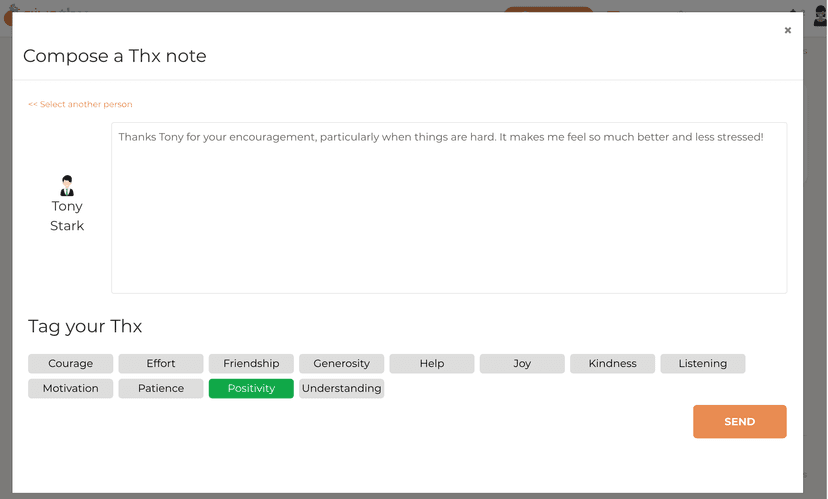
GiveThx uses a blended, personalized learning approach that combines direct social-emotional instruction with digital peer-to-peer gratitude practice. The core mechanic requires students to write specific, digital thank-you notes to their peers and teachers based on provided behavioral prompts. This process utilizes active reflection, asking students to identify and articulate specific pro-social behaviors they observe in their environment. The platform includes a structured curriculum that teachers deliver in the classroom, followed by digital practice where students apply the concepts. As students receive notes, the system builds a personalized digital portfolio of positive feedback. Reviewing this portfolio serves as a form of spaced reinforcement for self-esteem and social belonging. Teachers have access to dashboards that map social connections within the classroom, allowing them to identify students who may be isolated and intervene appropriately. The system relies on competency-based progression, meaning students must demonstrate understanding of core social-emotional concepts through their written interactions before moving to more complex interpersonal reflections.
Strengths and tradeoffs of GiveThx Program
GiveThx's biggest strength is its use of active, peer-to-peer reflection to build social-emotional vocabulary, while its biggest weakness is its heavy reliance on teacher moderation to prevent superficial engagement. Building pro-social habits requires consistent practice, and GiveThx provides a structured environment for this routine. By asking students to write out their gratitude, the platform employs a form of generative learning. Students must recall an event, identify the positive behavior, and articulate its impact, which deepens their emotional intelligence far more effectively than passive instruction. Spaced reinforcement occurs organically as students continuously receive and review notes over the school year, cementing positive self-concept. However, the system's reliance on peer interaction introduces variability. Quality of feedback is entirely dependent on the users. Without strict teacher oversight, students may submit low-effort responses that fail to engage the target social-emotional competencies. Additionally, because the software lacks automated scaffolding to correct poorly constructed reflections, the burden falls on educators to ensure the cognitive work is actually happening. While the framework is grounded in sound psychological principles, its execution is highly vulnerable to uneven classroom implementation.
Who Might Benefit From GiveThx Program?
GiveThx is best for school districts and classroom teachers seeking a structured, peer-driven platform to integrate social-emotional learning into their daily routines. The program spans second through twelfth grade, adapting its prompts to match the developmental maturity of the students. It is particularly effective for schools struggling with classroom climate or student isolation, as the digital format lowers the barrier for introverted students to participate in positive social interactions. Because it is an enterprise solution, it is not designed for individual parents seeking at-home emotional regulation tools for their child, but rather for educators building inclusive school communities.
Data Transparency
Meets Data Transparency Standard
GiveThx Program meets our data transparency standard at Level 2 of 3 (Parent control). Level 3 needs the policy to document an API for retrieving their own data and a named export format.
22 of 35 checks passed
Evaluated September 2026
Privacy Policy →Level 1 · Basic protections
Does not sell data or target ads at students, limits sharing, and lets parents see and delete their child's data.
Level 2 · Parent control (meets the standard)
Families can get their data out, know who processes it, and know how long it is kept.
Level 3 · Direct data access
Families or schools can pull their own data through an API, in a stated format.
Not documented: an API for retrieving their own data, a named export format
View all 35 checks
Parent Access7/8
Does the policy mention parents specifically?
“Parents: To review your child’s User data you must request the information from your child’s teacher.”
Can parents view their child's data?
“Parents: To review your child’s User data you must request the information from your child’s teacher.”
Can parents modify their child's data?
The policy mentions only that FERPA gives parents unspecified rights and does not say parents can correct or change their child's data.
Can parents delete their child's account?
“please contact your child’s school and [contact GiveThx](https://www.givethx.org/contact-us) to request that we delete that child’s personal information from our systems.”
Is there a dedicated Children's Privacy section?
“**7\. How does GiveThx protect children’s information?**”
Does it reference COPPA compliance?
“GiveThx provides schools that use its Services with full notice of its collection, use, and disclosure practices and otherwise complies with all COPPA requirements of a service provider.”
Does it reference FERPA compliance?
“Training consists of how to remain compliant with federal and state regulations (e.g . FERPA, COPPA, and SOPIPA), GiveThx policies, and general security posturing to protect student data”
Is parental consent required for child accounts?
“GiveThx is therefore committed to obtaining all consents necessary to comply with COPPA. Since GiveThx collects such information from students solely for the purpose of providing its Services and not for any commercial purposes and since GiveThx’s Services are solely for the benefit of its clients’ school systems and their students, client schools are able to give any necessary consents that would otherwise be required to be given by parents of the students.”
Data Portability3/5
Can users access their personal data?
“**_Access_**. Provide you with information about our processing of your personal information and give you access to your personal information.”
Can users download/export their data?
“**_Transfer_**. Transfer a machine-readable copy of your personal information to you or a third party of your choice.”
Is there a self-service data access tool?
“You may be able to review the information you provided to us on a Service and make any desired changes to the information, or to the settings for your account on that Service, by logging in to your account for that Service and editing or deleting the information.”
Is a specific data format mentioned for export?
The policy says only "machine-readable" and names no specific export format.
Is there an API for data access?
The policy mentions APIs only for security purposes and describes no API that users can use to get their own data.
Data Minimization1/6
Is data collection itemized?
“Teachers must create a facilitator account that contains the teacher’s name, password (unless using Google, Microsoft or Clever single sign-in), email, role, and school. Students or teachers may create participant accounts for students which contain a student’s name, password, classroom (associated with a facilitator account), and school or email ID.”
Can the app be used without a real name?
The policy says student accounts contain the student's name.
Can the app be used without an email?
The policy says student accounts may contain a school or email ID, and teachers can view students' email.
Does it state collection is limited to what is necessary?
The policy limits collection to purposes the school authorizes but does not say collection is limited to what is necessary.
Is IP address anonymized or truncated?
The policy says IP addresses are collected automatically and does not say they are anonymized or truncated.
Is location tracking explicitly excluded?
The policy says mobile providers may supply the device's physical location and does not rule out location tracking.
Third-Party Protection6/7
Does it explicitly state no selling of data?
“GiveThx does not sell any user Personal Information.”
Are third-party providers named?
“If you choose to connect to the Services via Google, Microsoft or Clever (each, a “sign-in party”), you may have the ability to limit the information that we may obtain from the sign-in party at the time you login to the Service.”
Are providers contractually restricted?
“We will share your Personal Information with third parties to provide services to us or you in connection with the Services, but subject to confidentiality obligations which limit their use and disclosure of such information.”
No-targeted-advertising commitment?
“GiveThx will never use any student data to advertise or market to students or their parents. We will not mine student data for any purposes other than those agreed to by the parties.”
Is AI/ML data sharing addressed?
The policy does not address AI or machine learning.
Child-specific sharing restriction?
“No student’s profile is made available or visible to the public through GiveThx.”
Cookies/tracking limited or opt-out?
“You can always decline to share personal information with us or block all cookies.”
Deletion & Retention3/5
Can users delete their account?
“If you wish to close your account with one of our Services, please [contact us](https://givethx.org/contact.html), and we will remove your Personal Information and Profile, if applicable, from the active databases for the Service(s) you request.”
Self-service deletion mechanism?
The policy says closing an account requires contacting GiveThx and describes no self-service way to delete the account.
Specific data retention timeline?
“Upon termination of your Account, GiveThx will take commercially reasonable steps to delete any Personal Information of yours, excluding information relating to messages you sent to active users, from our live databases in a reasonable amount of time not to exceed ninety (90) days.”
Auto-deletion of inactive accounts?
The policy does not say inactive accounts are deleted automatically.
Post-deletion handling described?
“Even if your account is closed, information may remain in backup or archival records and we may retain certain data relevant to preventing fraud or future abuse or for legitimate business purposes, such as analysis of aggregated, non-personally-identifiable or de-identified data, account recovery or if required by law.”
Advertising2/4
Advertising model explicitly disclosed?
“GiveThx will never use any student data to advertise or market to students or their parents. We will not mine student data for any purposes other than those agreed to by the parties. Data mining or scanning of user content for the purpose of advertising or marketing to students or their parents is prohibited.”
Free from third-party advertisements?
The policy has a "No Third-Party Advertising" heading, but its summary says third parties may serve ads when you use the Services, so it does not clearly say the product has no ads.
Children excluded from ad targeting?
“GiveThx will never use any student data to advertise or market to students or their parents.”
Ad-free option available?
The policy's summary says third parties may serve ads, and it does not clearly say the product is ad-free or offer an ad-free option.
Meets Data Transparency Standard
The reviewed policy met our data transparency standard. This result describes the policy disclosures we assessed. Actual practices and legal compliance were not verified.
About this evaluation: Based on automated analysis of Privacy Policy against 35 policy-disclosure questions, including questions adapted from the Common Sense Privacy Program's published evaluation questions. TLS is not affiliated with Common Sense Media, and this is not a Common Sense rating. Quoted text is copied from the policy; unquoted notes are our summary. Results describe what the policy documents, not the company's actual practices. Privacy policies can change: this review reflects the version we analyzed and does not determine legal compliance.
Sources and review method
TLS combines product information and editorial analysis to explain how GiveThx Program works, its tradeoffs, and the questions to ask before choosing it. Product features, an instructional rationale and evidence of learning outcomes are different kinds of information.
Formal Learning Standard assessment: not yet completed. Data Transparency findings are reported separately and do not establish learning effectiveness. Read our methodology.
Frequently Asked Questions About GiveThx Program
Is GiveThx free?
No, GiveThx is not free. It uses a tiered pricing model where schools and districts pay a flat fee based on their student enrollment. This fee covers the software, the social-emotional curriculum, and professional development training for staff.
Is GiveThx good for elementary students?
Yes, GiveThx is appropriate for students starting in the second grade. The curriculum provides developmentally appropriate prompts and scaffolding to help younger students build foundational emotional vocabulary and understand the basic concepts of gratitude and peer appreciation.
What does GiveThx teach?
GiveThx teaches social-emotional skills through the active practice of gratitude. Students learn to identify positive behaviors, articulate their feelings, and build inclusive relationships. The curriculum targets self-awareness, social awareness, and relationship skills using applied science principles.
Has The Learning Standard evaluated GiveThx Program?
TLS has not yet completed a Learning Standard evaluation of how well GiveThx Program teaches. Its privacy policy has been reviewed for Data Transparency and reaches Level 2, Parent control.
Is GiveThx Program COPPA compliant?
The reviewed privacy policy references COPPA. A policy reference alone does not establish COPPA compliance. Policy review note: The policy states that it complies with COPPA.
Is GiveThx Program FERPA compliant?
The reviewed privacy policy references FERPA. A policy reference alone does not establish FERPA compliance. Policy review note: The policy names FERPA among the rules it trains staff to comply with.
Does GiveThx Program have a children's privacy policy?
The reviewed policy includes a dedicated children's privacy section. Policy review note: The policy has its own section on children's information.
Does GiveThx Program sell student data?
The reviewed policy states that the app does not sell data. This is a policy statement; actual data practices were not verified. Policy review note: The policy states that GiveThx does not sell personal information.
Can you delete your data from GiveThx Program?
The reviewed privacy policy describes account deletion. We have not tested the deletion process. Policy review note: Users can ask to close their account and have their data removed.
Follow TLS Research
Subscribe to future TLS research updates: app reviews, findings, and what the evidence shows.
Screenshots


Take Action
For GiveThx Program
If you represent GiveThx and have a correction or new evidence, send the relevant source so we can review and update this page.
Submit a correctionDetails
- Pricing
- Pricing is tiered, where schools and districts pay a flat-fee for the complete program - curriculum, software, and training - depending on their enrollment.
- Platforms
- Web Browser
- Grade Levels
- 2nd Grade, 3rd Grade, 4th Grade, 5th Grade, 6th Grade, 7th Grade, 8th Grade, 9th Grade, 10th Grade, 11th Grade, 12th Grade
- Website
- Visit site