
Frankenstories
Product by Writelike
Facts checked: Not yet checked
Our take (not a Learning Standard rating). This label applies to learning-science judgments throughout this overview.
Our take (not a Learning Standard rating)
While The Learning Standard has not yet fully evaluated Frankenstories, its design strongly supports peer-mediated learning and rapid iterative writing. The time-constrained collaborative format forces students to synthesize ideas and practice adaptive writing, though the fast pace may overwhelm struggling writers who need structured scaffolding.
Pros
- Incorporates peer evaluation, requiring students to analyze and critique varied writing styles actively.
- Uses time constraints to build writing fluency and reduce blank-page anxiety.
- Promotes adaptive thinking by forcing writers to continue narratives started by others.
- Blends cooperative learning with gamification to maintain high engagement during humanities lessons.
Cons
- The rapid pacing limits opportunities for deep, reflective revision and editing.
- Lacks targeted, system-generated feedback on grammar or sentence structure.
- May cause cognitive overload for students with processing delays or foundational writing deficits.
What Do We Know About Frankenstories?
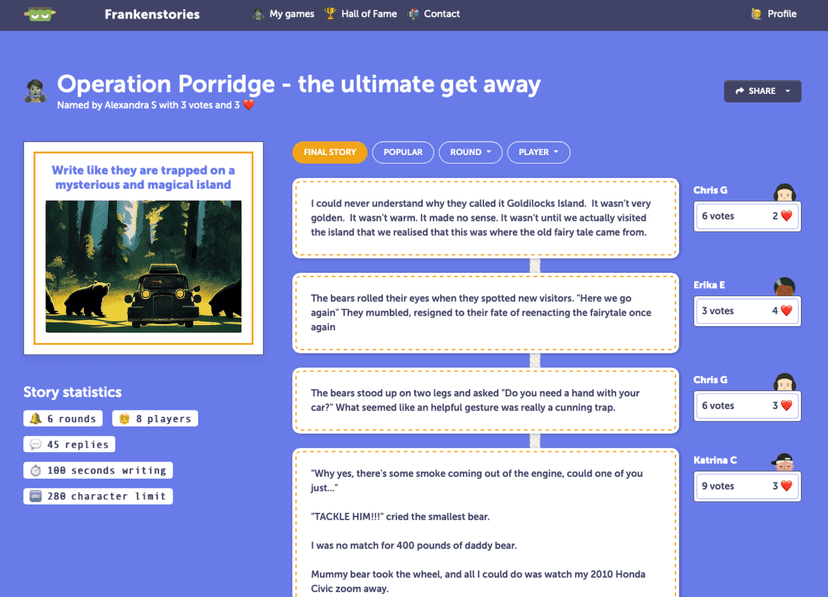
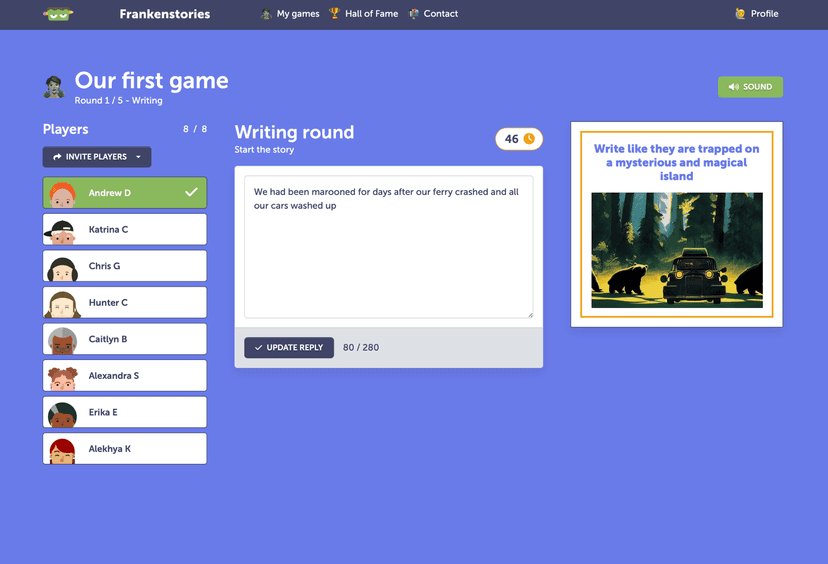
Frankenstories effectively builds writing fluency and collaborative skills through fast-paced, peer-reviewed creative challenges. Your child will not learn foundational grammar or spelling rules here, but they will practice generating ideas quickly and adapting to unexpected narrative shifts. The game operates in rounds where players receive a prompt, write a short response, and then read and vote on peer submissions. The winning submission becomes the next part of the story. This structure relies heavily on peer-mediated learning, exposing your child to diverse vocabulary and writing styles. Because the environment is timed and highly social, it may induce anxiety in reluctant writers. The lack of explicit instruction means your child must already possess basic writing competency to participate meaningfully. For parents seeking a tool to make writing less isolating and more dynamic, this platform offers a unique approach. The Learning Standard has not yet formally evaluated this app, but its mechanics align well with strategies for reducing writer's block and encouraging creative risk-taking.
How Does Frankenstories Work?
Frankenstories uses a game-based, cooperative learning model structured around time-constrained writing sprints and peer evaluation. Teachers or game hosts initiate a session by selecting a specific prompt or humanities topic. Students join the multiplayer lobby and begin the first round, which provides a strict time limit to write a short text segment. Once the timer ends, the platform immediately displays all anonymous submissions to the group. Students must then read, evaluate, and vote on the best entry based on narrative flow, creativity, or adherence to the prompt. The winning text is locked in as the official continuation of the story. In the subsequent round, students must read the newly established narrative baseline and write the next logical segment. This continuous cycle of reading, synthesizing, writing, and evaluating forces rapid cognitive shifting. Teachers control the round lengths, prompts, and evaluation criteria, allowing them to adapt the game for different grade levels.
Strengths and tradeoffs of Frankenstories
Frankenstories' biggest strength is its use of peer evaluation to model diverse writing strategies, while its biggest weakness is the absence of targeted instructional feedback on foundational mechanics. The power of peer review: By forcing students to read and judge multiple peer responses under a time limit, the platform actively builds comparative analysis skills. Evaluating others' work helps students internalize what makes writing effective. Building writing fluency: The rigid time constraints serve as a forcing function that bypasses perfectionism, building fluency through rapid output. Lack of explicit scaffolding: Because the game focuses on speed and peer consensus, it does not provide worked examples or systemic corrections for grammatical errors. Students practice writing, but they do not necessarily practice correct writing if the peer group lacks strong skills. Potential cognitive overload: The rapid shifting between writing, reading, and voting leaves little room for spaced repetition or careful revision, which may frustrate students with processing delays.
Who Might Benefit From Frankenstories?
Frankenstories is best for middle and high school students who already possess basic writing mechanics but need to build fluency and overcome writer's block. It serves grades 5 through 12 exceptionally well in collaborative classroom settings where teachers can facilitate discussions around the generated texts. The platform is highly effective for language arts and humanities educators looking to inject gamification into creative writing assignments. It is less suited for independent learners at home or students who require direct remediation in spelling.
Data Transparency
Does Not Meet Data Transparency Standard
Frankenstories reaches Level 1 of 3 (Basic protections), below our data transparency standard. Reaching Level 2 needs the policy to document data export and a data retention timeline.
18 of 35 checks passed
Evaluated September 2026
Frankenstories privacy policy →Level 1 · Basic protections
Does not sell data or target ads at students, limits sharing, and lets parents see and delete their child's data.
Level 2 · Parent control (meets the standard)
Families can get their data out, know who processes it, and know how long it is kept.
Not documented: data export, a data retention timeline
Level 3 · Direct data access
Families or schools can pull their own data through an API, in a stated format.
Not documented: an API for retrieving their own data, a named export format
View all 35 checks
Parent Access5/8
Does the policy mention parents specifically?
“A parent or guardian of a child may contact us via the below listed details to request to view the information provided by their child”
Can parents view their child's data?
“A parent or guardian of a child may contact us via the below listed details to request to view the information provided by their child”
Can parents modify their child's data?
The policy lets parents ask to view or delete their child's information, but it does not say parents can ask to modify it.
Can parents delete their child's account?
“A parent or guardian of a child may contact us via the below listed details to request to view the information provided by their child, or for the account of their child and all personal information to be permanently deleted or no longer collected.”
Is there a dedicated Children's Privacy section?
“A parent or guardian of a child may contact us via the below listed details to request to view the information provided by their child, or for the account of their child and all personal information to be permanently deleted or no longer collected.”
Does it reference COPPA compliance?
“For COPPA-related requests, contact Andrew Duval at L1/324 Wickham St, Fortitude Valley, QLD 4006, Australia.”
Does it reference FERPA compliance?
The policy does not mention FERPA.
Is parental consent required for child accounts?
The policy says a parent can withdraw consent for their child, but it does not say parental consent is required to create a child account.
Data Portability1/5
Can users access their personal data?
“The right to request to see what personal information is held about you.”
Can users download/export their data?
The policy does not mention downloading or exporting data.
Is there a self-service data access tool?
The policy handles access through email requests and does not describe a self-service access tool.
Is a specific data format mentioned for export?
The policy does not mention an export format.
Is there an API for data access?
The policy does not mention an API for data access.
Data Minimization4/6
Is data collection itemized?
“First name (mandatory - can be pseudonymous) - Last name (mandatory - can be pseudonymous) - Email address (mandatory) - School name (optional)”
Can the app be used without a real name?
The policy requires a first name for student accounts; it can be a pseudonym, but a real first name may be collected.
Can the app be used without an email?
“For student accounts, we only collect sufficient information for a teacher to distinguish between students in their class and save their writing. This consists of:”
Does it state collection is limited to what is necessary?
“We request only the bare minimum of information and particularly where children are likely to be users, we do not require any personal data at all.”
Is IP address anonymized or truncated?
“This includes a device's IP address (processed during your session and stored in a de-identified form)”
Is location tracking explicitly excluded?
The policy says analytics collect geographical data, including country-level location.
Third-Party Protection5/7
Does it explicitly state no selling of data?
“No user data is sold or shared with third parties (except anonymised, encrypted web analytics data which is stored by third party analytics platforms such as Google and Clarity to help us improve our service design).”
Are third-party providers named?
“Frankenstories uses website analytics such as Google Analytics and Microsoft Clarity to help us better understand our users’ experience”
Are providers contractually restricted?
“Clarity is contractually forbidden to sell any of the data collected on our behalf.”
No-targeted-advertising commitment?
The policy does not address targeted advertising.
Is AI/ML data sharing addressed?
The policy does not address AI or machine learning.
Child-specific sharing restriction?
“We do not share student names but we may share de-identified student writing in the Frankenstories Hall of Fame”
Cookies/tracking limited or opt-out?
“You can opt out of Google Analytics tracking using the Google Analytics Opt-out Browser Add-on”
Deletion & Retention3/5
Can users delete their account?
“The right for any of your personal information to be modified or permanently deleted.”
Self-service deletion mechanism?
“Teachers can delete games they have created before, during, or after playing a game. When a teacher deletes a game, all associated data is deleted from Writelike servers.”
Specific data retention timeline?
The policy only says data is kept while the user has an active account, with no specific timeline.
Auto-deletion of inactive accounts?
The policy does not address automatic deletion of inactive accounts.
Post-deletion handling described?
“When a teacher deletes a game, all associated data is deleted from Writelike servers.”
Advertising0/4
Advertising model explicitly disclosed?
The policy does not address advertising.
Free from third-party advertisements?
The policy does not address third-party advertising.
Children excluded from ad targeting?
The policy does not address ad targeting of children.
Ad-free option available?
The policy does not address advertising or an ad-free option.
What This Means
The policy review did not meet our data transparency standard. The checks above show the documented findings and unknowns. A missing statement does not establish how the app handles data in practice.
About this evaluation: Based on automated analysis of Frankenstories privacy policy against 35 policy-disclosure questions, including questions adapted from the Common Sense Privacy Program's published evaluation questions. TLS is not affiliated with Common Sense Media, and this is not a Common Sense rating. Quoted text is copied from the policy; unquoted notes are our summary. Results describe what the policy documents, not the company's actual practices. Privacy policies can change: this review reflects the version we analyzed and does not determine legal compliance.
Sources and review method
TLS combines product information and editorial analysis to explain how Frankenstories works, its tradeoffs, and the questions to ask before choosing it. Product features, an instructional rationale and evidence of learning outcomes are different kinds of information.
Formal Learning Standard assessment: not yet completed. Data Transparency findings are reported separately and do not establish learning effectiveness. Read our methodology.
Frequently Asked Questions About Frankenstories
Is Frankenstories free?
Frankenstories uses a freemium model. Casual games are completely free for users to play. Teachers or parents who want advanced administrative tools, custom prompts, and class management features must purchase a monthly or annual subscription.
Is Frankenstories good for middle schoolers?
Yes, the platform is highly appropriate for grades 5 through 8. The gamified, collaborative format appeals to middle school social dynamics, and the quick writing rounds match their developing attention spans while building necessary writing fluency.
What does Frankenstories teach?
Frankenstories teaches writing fluency, narrative structure, peer evaluation, and adaptability. It does not teach foundational phonics, spelling, or grammar rules, but rather focuses on the rapid application of existing writing skills in a collaborative environment.
How does Frankenstories compare to independent writing practice?
Frankenstories prioritizes speed and social consensus over deep revision. Independent practice allows for self-paced drafting and editing, while this app forces rapid synthesis and peer review to build specific fluency skills.
Has The Learning Standard evaluated Frankenstories?
TLS has not yet completed a Learning Standard evaluation of how well Frankenstories teaches. Its privacy policy has been reviewed for Data Transparency and reaches Level 1, Basic protections.
Is Frankenstories COPPA compliant?
The reviewed privacy policy references COPPA. A policy reference alone does not establish COPPA compliance. Policy review note: The policy names a contact for COPPA-related requests.
Is Frankenstories FERPA compliant?
A FERPA reference was not found in the reviewed privacy policy. This does not determine whether the app complies with FERPA. Policy review note: The policy does not mention FERPA.
Does Frankenstories have a children's privacy policy?
The reviewed policy includes a dedicated children's privacy section. Policy review note: The section headed 'Parents and Guardians' is about children's data and parents' COPPA-style rights, so it counts as a dedicated children's section.
Does Frankenstories sell student data?
The reviewed policy states that the app does not sell data. This is a policy statement; actual data practices were not verified. Policy review note: The policy says no user data is sold.
Can you delete your data from Frankenstories?
The reviewed privacy policy describes account deletion. We have not tested the deletion process. Policy review note: Users can ask for their personal information to be permanently deleted.
Follow TLS Research
Subscribe to future TLS research updates: app reviews, findings, and what the evidence shows.
Screenshots

Take Action
For Frankenstories
If you represent Writelike and have a correction or new evidence, send the relevant source so we can review and update this page.
Submit a correctionDetails
- Pricing
- Frankenstories uses a freemium model. Casual games are free. Teachers can subscribe to useful admin tools for a monthly or annual fee. Pricing is flat per teacher and teachers can have as many classes and students as they want.
- Platforms
- Web Browser
- Grade Levels
- 5th Grade, 6th Grade, 7th Grade, 8th Grade, 9th Grade, 10th Grade, 11th Grade, 12th Grade
- Website
- Visit site