Formative
Product by Formative
Facts checked: Not yet checked
Our take (not a Learning Standard rating). This label applies to learning-science judgments throughout this overview.
Our take (not a Learning Standard rating)
Formative does not teach students autonomously, but it provides a highly effective digital framework for educators to implement retrieval practice and deliver real-time feedback. By allowing teachers to see student thought processes live, it enables immediate instructional adjustments, though its learning impact depends entirely on teacher-created content.
Pros
- Enables low-stakes retrieval practice to strengthen students' long-term memory retention.
- Provides educators with real-time visibility into student work to correct misconceptions immediately.
- Supports a wide variety of response types to assess complex problem-solving rather than just factual recall.
- Allows for timely, targeted feedback directly mapped to specific student errors while the context is fresh.
Cons
- Requires significant educator time to build, configure, and align assessments to specific curriculum standards.
- Relies entirely on teacher-generated content, meaning the pedagogical quality varies widely between different classrooms.
- Lacks built-in autonomous instructional scaffolding for students who answer incorrectly.
- Does not include algorithmic spaced repetition to automatically review older material over time.
What Do We Know About Formative?
Formative is not a standalone tutoring app for your child, but rather a digital assessment platform used by their teachers to monitor understanding during class. Unlike apps that deliver direct instruction or adaptive practice, Formative requires an educator to build the questions, interpret the answers, and provide the feedback. When your child uses this tool at school or for homework, they are engaging in retrieval practice, which is the act of recalling information from memory that learning science confirms is critical for durable learning. Because teachers can see your child's responses typing or drawing in real-time, they can identify and correct misconceptions the moment they happen instead of waiting to grade a quiz the next day. However, you will not find pre-packaged lessons or educational games here for independent home use. Its effectiveness depends entirely on how skillfully your child's teacher designs the questions and acts on the resulting data to guide their instruction.
How Does Formative Work?
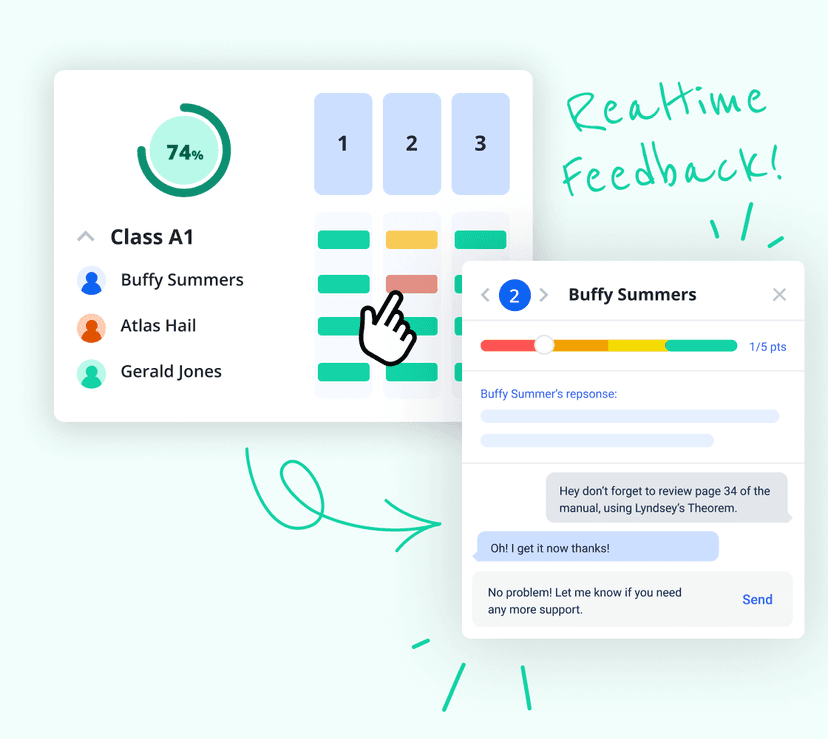
Formative relies on the pedagogical strategy of continuous formative assessment to make student thinking visible to educators. Teachers create digital assignments, quizzes, or interactive documents containing various question types, such as multiple-choice, short answer, or drawing prompts. As students complete these tasks on their individual devices, their inputs appear immediately on the teacher's dashboard. This live data stream allows the educator to identify common errors across the classroom or spot a specific student struggling with a concept. Teachers can send individual messages, award partial credit, or pause the lesson to re-teach a misunderstood topic. The platform acts as a digital conduit for the feedback loop, ensuring that students receive corrections while the cognitive context of the problem is still active in their working memory.
Strengths and tradeoffs of Formative
Formative's biggest strength is its facilitation of real-time feedback, while its biggest weakness is its complete reliance on the instructional design skills of the individual teacher. Real-time error correction is a pillar of effective learning; when a student receives immediate clarification on a mistake, they are far less likely to encode that misconception into long-term memory. Formative excels at this by making invisible cognitive processes visible on a teacher's screen. Furthermore, it easily facilitates low-stakes retrieval practice, forcing students to recall material rather than passively restudying it. However, the platform is an empty vessel. It lacks built-in worked examples or algorithmic spaced repetition tracks. If a teacher writes poorly constructed questions or fails to provide meaningful feedback, the platform's educational benefits evaporate completely. It does not teach autonomously, meaning it cannot step in to scaffold a struggling learner with hints or prerequisite knowledge unless the teacher has explicitly designed those supports into the assigned activity.
Who Might Benefit From Formative?
Formative is best for classroom educators across all grade levels who want to implement data-driven, immediate feedback loops during their daily instruction. It is not designed for parents seeking independent enrichment or tutoring software for their children at home. The platform serves K-12 teachers, university professors, and adult education instructors who need a reliable mechanism to assess understanding instantly. It is particularly useful for math and science educators who utilize the platform's drawing tools to watch students work through complex equations.
Data Transparency
Does Not Meet Data Transparency Standard
Formative reaches Level 1 of 3 (Basic protections), below our data transparency standard. Reaching Level 2 needs the policy to document a data retention timeline and self-service deletion.
25 of 35 checks passed
Evaluated September 2026
Newsela Privacy Policy →Level 1 · Basic protections
Does not sell data or target ads at students, limits sharing, and lets parents see and delete their child's data.
Level 2 · Parent control (meets the standard)
Families can get their data out, know who processes it, and know how long it is kept.
Not documented: a data retention timeline, self-service deletion
Level 3 · Direct data access
Families or schools can pull their own data through an API, in a stated format.
Not documented: an API for retrieving their own data, a named export format
View all 35 checks
Parent Access7/8
Does the policy mention parents specifically?
“If you are a parent, please continue reading this Privacy Policy for Children and Students to understand how your child’s information will be collected and used by Newsela on behalf of your child’s school.”
Can parents view their child's data?
“If you are a student, or the parent or legal guardian of a student, please contact your School to submit a request to access, review, modify or delete Student Data.”
Can parents modify their child's data?
“If you are a student, or the parent or legal guardian of a student, please contact your School to submit a request to access, review, modify or delete Student Data.”
Can parents delete their child's account?
“If you are a student, or the parent or legal guardian of a student, please contact your School to submit a request to access, review, modify or delete Student Data.”
Is there a dedicated Children's Privacy section?
“b. Children Under 13”
Does it reference COPPA compliance?
“Our collection, use, and disclosure of Student Data is governed by our agreement with the applicable School, and by the provisions of FERPA, COPPA, and applicable state laws which relate to the collection of Student Data.”
Does it reference FERPA compliance?
“Our collection, use, and disclosure of Student Data is governed by our agreement with the applicable School, and by the provisions of FERPA, COPPA, and applicable state laws which relate to the collection of Student Data.”
Is parental consent required for child accounts?
The policy relies on the school to give consent for students under 13 and does not require parental consent.
Data Portability3/5
Can users access their personal data?
“Right to Know and Access: You have the right to confirm whether we are processing your personal data and to request access to specific pieces of personal data we have collected about you”
Can users download/export their data?
“you may have the right to request to access, correct (rectification), delete (erasure) your Personal Information, and/or to request to opt-out of certain types of data practices (such as restrict processing and/or object to processing), or transfer data we have collected to another organization or directly to you under certain circumstances.”
Is there a self-service data access tool?
“You may, at any time, log into your account and manage or modify the Personal Information stored in your account.”
Is a specific data format mentioned for export?
The policy does not name any format for exported data.
Is there an API for data access?
The policy mentions APIs only for services and third-party AI providers, not as a way for users to get their own data.
Data Minimization1/6
Is data collection itemized?
“Full Name and Contact Information, including email address and address”
Can the app be used without a real name?
The policy says it collects students' full names.
Can the app be used without an email?
The policy says it collects students' email addresses.
Does it state collection is limited to what is necessary?
The policy limits student data to educational purposes and limits retention and AI sharing to what is necessary, but never says collection is limited to what is necessary.
Is IP address anonymized or truncated?
The policy says it collects IP addresses and says nothing about anonymizing or truncating them.
Is location tracking explicitly excluded?
The policy says analytics collect approximate location and does not rule out location tracking.
Third-Party Protection7/7
Does it explicitly state no selling of data?
“We do not sell Student Data.”
Are third-party providers named?
“For the Generation Genius product offering, we use a server-side implementation of Google Analytics to analyze website usage.”
Are providers contractually restricted?
“We also disclose Student Data to our trusted service providers who have a legitimate need to access such information on our behalf, subject to appropriate contractual terms to protect such data.”
No-targeted-advertising commitment?
“We do not use or disclose Student Data for targeted advertising purposes.”
Is AI/ML data sharing addressed?
“Your information will only be shared with these AI vendors to the extent necessary to provide you with the Services and support. The AI vendors only use your information in accordance with directions from Newsela.”
Child-specific sharing restriction?
“We disclose Student Data solely as needed to provide the Services on behalf of specific Schools in accordance with our contractual agreements with those Schools.”
Cookies/tracking limited or opt-out?
“You can exercise control over the use of cookies on the Services through our cookie banner or cookie preference center.”
Deletion & Retention3/5
Can users delete their account?
“You can request your Personal Information to be deleted at any time by filling out our Privacy Rights Request Webform or emailing us at privacy@newsela.com.”
Self-service deletion mechanism?
The policy offers deletion only by request (webform, email or the school), not through a tool users operate themselves.
Specific data retention timeline?
The policy keeps data while the account is active or as long as reasonably necessary and gives no specific time period.
Auto-deletion of inactive accounts?
“Even if we do not receive a deletion request from a School, we may delete or de-identify Student Data after a period of inactivity in accordance with our standard data retention practices.”
Post-deletion handling described?
“We may not be able to immediately or completely delete all data in all instances, such as information retained in technical support records, customer service records, backups, and other similar business records.”
Advertising4/4
Advertising model explicitly disclosed?
“We do not display advertisements on our Services.”
Free from third-party advertisements?
“We do not display advertisements on our Services.”
Children excluded from ad targeting?
“For clarity, we do not use Student Data to: (i) advertise or market to students on our Services or to direct targeted online advertising to students on our Services”
Ad-free option available?
“We do not display advertisements on our Services.”
What This Means
The policy review did not meet our data transparency standard. The checks above show the documented findings and unknowns. A missing statement does not establish how the app handles data in practice.
About this evaluation: Based on automated analysis of Newsela Privacy Policy against 35 policy-disclosure questions, including questions adapted from the Common Sense Privacy Program's published evaluation questions. TLS is not affiliated with Common Sense Media, and this is not a Common Sense rating. Quoted text is copied from the policy; unquoted notes are our summary. Results describe what the policy documents, not the company's actual practices. Privacy policies can change: this review reflects the version we analyzed and does not determine legal compliance.
Sources and review method
TLS combines product information and editorial analysis to explain how Formative works, its tradeoffs, and the questions to ask before choosing it. Product features, an instructional rationale and evidence of learning outcomes are different kinds of information.
Formal Learning Standard assessment: not yet completed. Data Transparency findings are reported separately and do not establish learning effectiveness. Read our methodology.
Frequently Asked Questions About Formative
Is Formative free?
Yes, Formative offers a free basic tier that individual educators and students can use to create and participate in assessments. However, the platform's more advanced capabilities, such as automated student rostering, co-teaching permissions, and shared institutional libraries, require a premium subscription. These premium software tiers are typically sold directly to schools and districts to manage broader deployments rather than to individual parents seeking home tools.
Is Formative good for elementary students?
Yes, Formative is effective for elementary students when it is directly guided by a trained classroom teacher. The interface supports simple, intuitive interactions like drawing with a finger and recording audio responses, making it highly accessible for early readers and younger children. However, teachers must carefully manage the digital screen time and ensure the questions are age-appropriate, as the platform itself does not adjust difficulty or provide built-in scaffolding for young learners.
What does Formative teach?
Formative itself does not teach any specific subject, as it does not contain pre-packaged curriculum or lessons. Instead, it is a completely content-agnostic digital assessment tool that educators must populate with their own material. Teachers across the world use it to instruct and evaluate everything from early childhood literacy and elementary mathematics to high school humanities and post-doctoral applied sciences. The learning depends entirely on the teacher's input.
How does Formative compare to traditional paper worksheets?
Formative dramatically shortens the instructional feedback loop compared to traditional paper assignments. Instead of waiting days for a graded worksheet to be returned, students can receive targeted corrections from their teacher during the actual cognitive process of solving the problem. Learning science shows that intervening while the concept is still active in the student's working memory leads to significantly better long-term retention and prevents misconceptions from taking root.
Has The Learning Standard evaluated Formative?
TLS has not yet completed a Learning Standard evaluation of how well Formative teaches. Its privacy policy has been reviewed for Data Transparency and reaches Level 1, Basic protections.
Is Formative COPPA compliant?
The reviewed privacy policy references COPPA. A policy reference alone does not establish COPPA compliance. Policy review note: The policy says student data handling is governed by COPPA.
Is Formative FERPA compliant?
The reviewed privacy policy references FERPA. A policy reference alone does not establish FERPA compliance. Policy review note: The policy says student data handling is governed by FERPA.
Does Formative have a children's privacy policy?
The reviewed policy includes a dedicated children's privacy section. Policy review note: The policy has a Children & Student Privacy Policy that includes a "Children Under 13" heading.
Does Formative sell student data?
The reviewed policy states that the app does not sell data. This is a policy statement; actual data practices were not verified. Policy review note: The policy states that Newsela does not sell student data.
Can you delete your data from Formative?
The reviewed privacy policy describes account deletion. We have not tested the deletion process. Policy review note: Users can ask to have their personal information deleted.
Follow TLS Research
Subscribe to future TLS research updates: app reviews, findings, and what the evidence shows.
Screenshots

Latest News
All Formative NewsHow to Keep Autumn Classroom Activities Academically Rigorous
Learn how parents and educators can use seasonal fall activities to boost math and reading skills while keeping daily school lessons academically rigorous.
Virtual IEP Goal Tracking: Lessons From Georgia Cyber Academy
Discover how virtual schools like Georgia Cyber Academy track IEP goals using digital tools, and learn the federal legal guidelines that protect families.
How Schools Can Switch Assessment Software Without Classroom Chaos
Discover how school districts can successfully transition to new assessment platforms without disrupting classrooms, using insights from recent EdTech audits.
Take Action
For Formative
If you represent Formative and have a correction or new evidence, send the relevant source so we can review and update this page.
Submit a correctionDetails
- Pricing
- Formative is available for free for anyone, our pricing model starts with more advanced premium features (such as rostering, co-teaching, private library), and is sold to Shools & Districts.
- Platforms
- Web Browser
- Grade Levels
- 1st Grade, 2nd Grade, 3rd Grade, 4th Grade, 5th Grade, 6th Grade, 7th Grade, 8th Grade, 9th Grade, 10th Grade, 11th Grade, 12th Grade, Associate's degree, Bachelor's degree, Post-baccalaureate certificate, Master's Degree, Post-master's certificate, Doctoral Degree, Post-doctoral certificate, Adult Education, Professional or Technical Credential
- Website
- Visit site