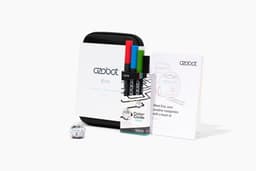
Evo Entry Kit
Product by Ozobot
Facts checked: Not yet checked
Our take (not a Learning Standard rating). This label applies to learning-science judgments throughout this overview.
Our take (not a Learning Standard rating)
While The Learning Standard has not yet formally evaluated the Evo Entry Kit, its dual approach of screen-free color coding and block-based programming offers a tangible way to teach computational thinking. It successfully bridges physical and digital learning, but the high upfront cost means parents must ensure sustained use to justify the investment.
Pros
- Integrates physical movement with coding logic, leveraging embodied cognition to reinforce abstract programming concepts.
- Provides scaffolding through five distinct skill levels in Ozobot Blockly, supporting learners as they progress from novice to advanced.
- Enables screen-free learning via Color Code markers, reducing digital fatigue while teaching sequential logic and debugging.
- Includes a library of over 700 cross-curricular lessons, allowing educators to connect coding to core math and science standards.
Cons
- Requires a significant upfront financial investment, making it less accessible for casual home use than digital-only alternatives.
- Relies heavily on external physical markers and precise calibration, which can cause frustration if the robot misreads inputs.
- Demands active adult facilitation for younger learners to translate color-coding activities into actual computational thinking skills.
- Lacks explicit automated feedback on why a physical color code failed, requiring manual debugging by the student.
What Do We Know About Evo Entry Kit?
The Evo Entry Kit by Ozobot is a highly engaging tool for teaching foundational coding logic, though its ultimate effectiveness depends entirely on how consistently your child uses the structured lesson plans. Rather than staring at a screen, your child programs a small physical robot using either colored markers or a drag-and-drop block interface. This reliance on tangible, physical outputs leverages embodied cognition, a learning science principle showing that physical movement helps cement abstract concepts in the brain. When your child draws a red-blue-red line and watches the robot speed up, they experience immediate visual feedback on their sequential logic. The kit includes access to a massive library of activities. However, without adult guidance, children often treat the robot as a simple remote-control toy rather than a rigorous learning tool. You must actively participate in the beginner activities and guide your child through the progressively harder Ozobot Blockly levels. Because The Learning Standard has not yet formally evaluated this product, we cannot guarantee long-term mastery outcomes, but the pedagogical foundation of transitioning from concrete physical actions to abstract digital code blocks is highly effective.
How Does Evo Entry Kit Work?
The Evo Entry Kit uses a scaffolded, dual-modality approach that transitions students from tactile, screen-free programming to digital, block-based coding. Your child begins with Color Codes, drawing specific sequences of colored lines on paper using the provided markers. The Evo robot's optical sensors read these colors as commands, such as speeding up, spinning, or changing direction. This teaches basic sequential logic and debugging in a purely physical environment. Once your child masters these concrete commands, they transition to Ozobot Blockly on a digital device. This interface features five distinct mastery levels. Beginners snap together visual blocks to control the robot's lights and movements, while advanced users write complex loops, conditional statements, and variables. The code is then uploaded to the physical robot to execute. This immediate translation of digital code into physical action provides worked examples in real time, allowing students to test hypotheses, observe the outcomes, and correct their errors instantly.
Strengths and tradeoffs of Evo Entry Kit
The biggest strength of the Evo Entry Kit is its seamless bridging of concrete, physical inputs with abstract programming logic, while its biggest weakness is the high likelihood of devolving into unstructured play without active adult facilitation. The dual-coding approach is excellent for cognitive development. By allowing younger students to use markers to program the robot, the kit reduces cognitive load. They do not have to navigate a complex user interface while simultaneously learning what a logical sequence is. This physical-first approach builds strong mental models. As they advance to Ozobot Blockly, the platform utilizes scaffolding, slowly introducing more complex concepts like loops and conditionals over five distinct levels. However, physical robots inherently introduce friction. The robot's optical sensors require precise line drawing and frequent calibration. If your child draws a messy line, the robot fails to execute the code, which can cause frustration unrelated to their actual programming logic. Furthermore, the high price point means the kit needs to be used systematically to provide educational value. Without utilizing the structured lesson library, kids often exhaust the novelty of drawing colored lines within a few hours and abandon the tool.
Who Might Benefit From Evo Entry Kit?
The Evo Entry Kit is best for kinesthetic learners in elementary and middle school who struggle with purely screen-based coding applications. Because it spans from screen-free drawing to advanced block coding, it suits a wide age range. It is an excellent choice for homeschooling parents or classroom teachers who want to integrate computer science into core subjects like math and science. It is less suitable for families seeking an independent, hands-off app to occupy their child, as maximizing its educational value requires active adult involvement.
Data Transparency
Meets Data Transparency Standard
Evo Entry Kit meets our data transparency standard at Level 2 of 3 (Parent control). Level 3 needs the policy to document an API for retrieving their own data and a named export format.
21 of 35 checks passed
Evaluated September 2026
Privacy Policy →Level 1 · Basic protections
Does not sell data or target ads at students, limits sharing, and lets parents see and delete their child's data.
Level 2 · Parent control (meets the standard)
Families can get their data out, know who processes it, and know how long it is kept.
Level 3 · Direct data access
Families or schools can pull their own data through an API, in a stated format.
Not documented: an API for retrieving their own data, a named export format
View all 35 checks
Parent Access5/8
Does the policy mention parents specifically?
“This notice provides information for parents of children under 13 years of age, or any higher minimum age in the jurisdiction where that child resides, about our practices with respect to personal information that we collect from such children”
Can parents view their child's data?
“We adhere to the following COPPA tenants: parents can review, delete, manage or refuse with whom their child’s information is shared through contacting us directly.”
Can parents modify their child's data?
The policy lets parents review, delete, or "manage" their child's information, but it never explicitly says parents can modify or correct it.
Can parents delete their child's account?
“Parents and guardians can request that we stop collecting and delete any personal information we collected from their children, but we will no longer be able to provide such children with access to the Service.”
Is there a dedicated Children's Privacy section?
“**Notice to Parents of Children**”
Does it reference COPPA compliance?
“We do not knowingly collect, use, or disclose personal information from children under 13 years of age, except as permitted by the Children’s Online Privacy Protection Act (“COPPA”) and the Federal Trade Commission’s rules implementing COPPA.”
Does it reference FERPA compliance?
The policy text does not mention FERPA; only a certification badge image appears on the page.
Is parental consent required for child accounts?
The policy does not say parental consent is required for child accounts; it only says a parent's email is collected for password resets.
Data Portability3/5
Can users access their personal data?
“By logging into your account, you may access your personal information and you can also download your personal information in a common file format.”
Can users download/export their data?
“By logging into your account, you may access your personal information and you can also download your personal information in a common file format.”
Is there a self-service data access tool?
“By logging into your account, you may access your personal information and you can also download your personal information in a common file format.”
Is a specific data format mentioned for export?
The policy only says "a common file format" and does not name a specific format.
Is there an API for data access?
The policy does not mention an API for data access.
Data Minimization1/6
Is data collection itemized?
“We collect name, email address, address, birthday, and IP address from you when you register, make a purchase, sign up for our newsletter, respond to a survey or marketing communication, surf the website, or use certain other site features.”
Can the app be used without a real name?
The policy says users are asked for their name when registering; only children under 13 are limited to giving a parent's email.
Can the app be used without an email?
The policy says email addresses are collected at registration, and a parent's email is collected for children.
Does it state collection is limited to what is necessary?
The policy does not say collection is limited to what is necessary.
Is IP address anonymized or truncated?
The policy says IP addresses are collected but does not say they are anonymized or truncated.
Is location tracking explicitly excluded?
The policy does not explicitly rule out location tracking.
Third-Party Protection5/7
Does it explicitly state no selling of data?
“We do not sell, trade, or otherwise transfer to outside parties your personally identifiable information.”
Are third-party providers named?
“We use Google AdSense Advertising on our website. Google, as a third party vendor, uses cookies to serve ads on our site.”
Are providers contractually restricted?
“This does not include website hosting partners and other parties who assist us in operating our website, conducting our business, or servicing you, so long as those parties agree to keep this information confidential.”
No-targeted-advertising commitment?
The policy says Google AdSense serves ads based on users' visits to this and other sites; the no-advertising promise covers only users under 13.
Is AI/ML data sharing addressed?
The policy does not address sharing data with AI or machine learning systems.
Child-specific sharing restriction?
“We may share information collected from children under 13 (or any higher minimum age in the jurisdiction where that child resides) with our service providers so they may help us provide Services, but we do not typically share such information with other third parties as part of providing the Service.”
Cookies/tracking limited or opt-out?
“We honor do not track signals and do not track, plant cookies, or use advertising when a Do Not Track (DNT) browser mechanism is in place.”
Deletion & Retention4/5
Can users delete their account?
“In your account settings, you can change or delete your personal information. Additionally, you may delete your account if you wish.”
Self-service deletion mechanism?
“In your account settings, you can change or delete your personal information. Additionally, you may delete your account if you wish.”
Specific data retention timeline?
“You can also delete your account at any time, and we will permanently delete your account and data within 90 days unless we are required to keep it under applicable law.”
Auto-deletion of inactive accounts?
The policy does not mention automatically deleting inactive accounts.
Post-deletion handling described?
“If you choose to delete your account, most of your information will be deleted within 30 days, but it may take longer to delete all your data and other data stored in our backup systems due to size and complexity of our systems used to store data.”
Advertising3/4
Advertising model explicitly disclosed?
“We use Google AdSense Advertising on our website. Google, as a third party vendor, uses cookies to serve ads on our site.”
Free from third-party advertisements?
The policy says Google AdSense serves third-party ads on the site.
Children excluded from ad targeting?
“We will not display advertising or send marketing messages to users under 13 (or any higher minimum age in the jurisdiction where that child resides).”
Ad-free option available?
“We honor do not track signals and do not track, plant cookies, or use advertising when a Do Not Track (DNT) browser mechanism is in place.”
Meets Data Transparency Standard
The reviewed policy met our data transparency standard. This result describes the policy disclosures we assessed. Actual practices and legal compliance were not verified.
About this evaluation: Based on automated analysis of Privacy Policy against 35 policy-disclosure questions, including questions adapted from the Common Sense Privacy Program's published evaluation questions. TLS is not affiliated with Common Sense Media, and this is not a Common Sense rating. Quoted text is copied from the policy; unquoted notes are our summary. Results describe what the policy documents, not the company's actual practices. Privacy policies can change: this review reflects the version we analyzed and does not determine legal compliance.
Sources and review method
TLS combines product information and editorial analysis to explain how Evo Entry Kit works, its tradeoffs, and the questions to ask before choosing it. Product features, an instructional rationale and evidence of learning outcomes are different kinds of information.
Formal Learning Standard assessment: not yet completed. Data Transparency findings are reported separately and do not establish learning effectiveness. Read our methodology.
Frequently Asked Questions About Evo Entry Kit
Is the Evo Entry Kit free?
No, the Evo Entry Kit requires a significant upfront purchase of $175.00 for the physical robot, markers, and accessories. However, once you own the hardware, access to the Ozobot Blockly software and the library of over 700 lesson plans is completely free, with no recurring subscription fees required to access the core educational content.
Is the Evo Entry Kit good for kindergarteners?
Yes, the kit is highly effective for kindergarteners because of its screen-free Color Code system. Young children do not need to know how to read or use a computer to start coding. They simply draw thick lines with the provided colored markers to control the robot, which teaches foundational logic, sequencing, and cause-and-effect in an age-appropriate, tactile way.
What does the Evo Entry Kit teach?
The Evo Entry Kit teaches computational thinking, sequential logic, and computer science fundamentals. It begins with basic cause-and-effect and sequencing using color-coded lines. As your child progresses to the Ozobot Blockly platform, it teaches more advanced programming concepts including loops, conditional statements, variables, and debugging. The included lesson library also connects these coding skills to math and science standards.
How does the Evo Entry Kit compare to purely digital coding apps like Scratch?
While digital platforms like Scratch confine learning to a screen, the Evo Entry Kit bridges the digital and physical worlds. Kids write code on a screen and watch a physical robot execute it on their desk. This embodied learning helps solidify abstract concepts, though it comes at a much higher financial cost than free digital-only alternatives.
Has The Learning Standard evaluated Evo Entry Kit?
TLS has not yet completed a Learning Standard evaluation of how well Evo Entry Kit teaches. Its privacy policy has been reviewed for Data Transparency and reaches Level 2, Parent control.
Is Evo Entry Kit COPPA compliant?
The reviewed privacy policy references COPPA. A policy reference alone does not establish COPPA compliance. Policy review note: The policy references COPPA compliance.
Is Evo Entry Kit FERPA compliant?
A FERPA reference was not found in the reviewed privacy policy. This does not determine whether the app complies with FERPA. Policy review note: The policy text does not mention FERPA; only a certification badge image appears on the page.
Does Evo Entry Kit have a children's privacy policy?
The reviewed policy includes a dedicated children's privacy section. Policy review note: The policy has a dedicated children's section with its own heading.
Does Evo Entry Kit sell student data?
The reviewed policy states that the app does not sell data. This is a policy statement; actual data practices were not verified. Policy review note: The policy says the company does not sell personally identifiable information.
Can you delete your data from Evo Entry Kit?
The reviewed privacy policy describes account deletion. We have not tested the deletion process. Policy review note: Users can delete their account.
Follow TLS Research
Subscribe to future TLS research updates: app reviews, findings, and what the evidence shows.
Screenshots

Take Action
For Evo Entry Kit
If you represent Ozobot and have a correction or new evidence, send the relevant source so we can review and update this page.
Submit a correctionDetails
- Pricing
- $175.00
- Platforms
- iOS (Apple mobile), iPadOS (Apple tablet), Android (Google mobile), Windows (Microsoft), macOS (Apple), Chrome OS (Google)
- Grade Levels
- Kindergarten, 1st Grade, 2nd Grade, 3rd Grade, 4th Grade, 5th Grade, 6th Grade, 7th Grade, 8th Grade, 9th Grade, 10th Grade, 11th Grade, 12th Grade
- Website
- Visit site