
Ethiqly.ai
Product by Ethiqly
Facts checked: Not yet checked
Our take (not a Learning Standard rating). This label applies to learning-science judgments throughout this overview.
Our take (not a Learning Standard rating)
Ethiqly.ai provides real-time writing support, but its effectiveness depends heavily on teacher implementation. While automated feedback offers immediate error correction, a principle aligned with cognitive science, the platform lacks rigorous mechanisms to ensure students engage deeply with the revisions rather than passively accepting AI suggestions.
Pros
- Delivers immediate formative feedback on student writing to reduce cognitive load during the drafting process.
- Frees instructional time by automating foundational grammar and structure checks so educators can focus on higher-order writing skills.
- Supports cross-curricular writing practice by allowing teachers to customize prompts across various subjects.
Cons
- Risks over-reliance on automated suggestions, potentially bypassing the productive struggle necessary for deep learning.
- Lacks explicit instructional modules or worked examples for students who need foundational writing instruction before drafting.
- Effectiveness relies entirely on the quality of teacher-generated prompts and subsequent classroom instruction.
What Do We Know About Ethiqly.ai?
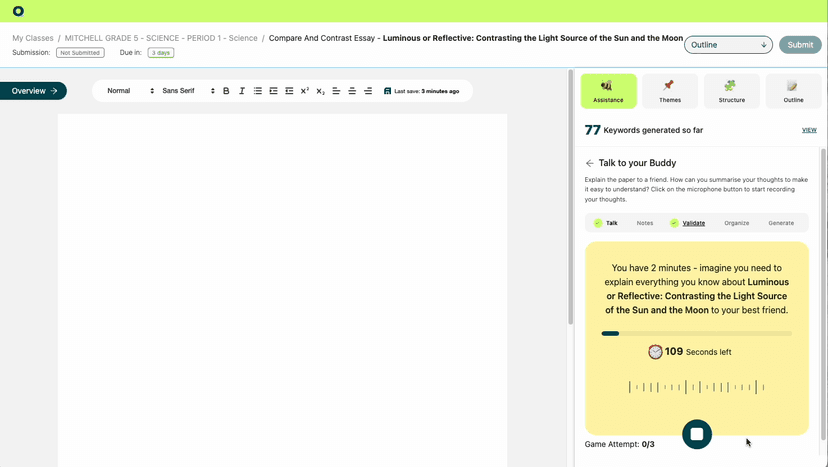
Ethiqly.ai functions primarily as an instructional tool for classrooms rather than a standalone learning app for your child. It uses artificial intelligence to provide immediate feedback on student writing assignments. From a learning science perspective, immediate feedback is highly effective for correcting misconceptions before they become ingrained. However, parents should understand that this platform does not teach writing from scratch. Instead, it supplements teacher instruction by acting as a digital editor. When your child writes an essay or response, the AI flags structural issues, grammar, and clarity, allowing the student to revise in real time. The risk here is passive learning; if your child simply accepts the AI's suggestions without understanding why the changes were made, long-term retention of writing skills will suffer. To be effective, teachers must pair this tool with targeted lessons on the mechanics of writing and engage students in analyzing the AI's feedback. Currently, Ethiqly.ai serves best as a practice environment that accelerates the revision process, rather than a primary instructor.
How Does Ethiqly.ai Work?
Ethiqly.ai utilizes a personalized, cross-curricular approach by integrating AI-driven formative assessment directly into the student drafting process. Teachers begin by assigning a writing prompt within the platform, which can range from middle school humanities to college-level applied sciences. As students draft their responses, the platform's AI engine analyzes the text in real time. It identifies areas for improvement, such as syntax, argument structure, and clarity, offering immediate suggestions. This leverages the learning science principle of timely feedback, preventing students from practicing errors. On the teacher's side, the platform aggregates data from these student submissions to provide actionable insights. Educators can view dashboard metrics highlighting common weaknesses across the classroom, allowing them to adjust their subsequent instruction to target specific deficits. The platform relies heavily on the integration of these analytics into actual classroom problem-based learning scenarios.
Strengths and tradeoffs of Ethiqly.ai
The biggest strength of Ethiqly.ai is its capacity to deliver instantaneous formative feedback, while its biggest weakness is the potential for students to bypass the cognitive effort required for actual skill acquisition. Immediate Feedback: Learning science demonstrates that feedback is most effective when delivered close to the point of performance. Ethiqly.ai excels here, highlighting syntax and structural errors while the student is actively engaged in the drafting process. This reduces the cognitive load of holding complex writing rules in working memory. Teacher Efficiency: By offloading rote proofreading, the platform enables educators to dedicate more time to teaching high-level analytical writing and critical thinking. Passive Acceptance Risk: The primary danger of AI writing assistants is that they do the thinking for the user. If the platform allows students to simply click to accept a revision without a required explanation or retrieval practice, it fails to build long-term writing proficiency. Lack of Direct Instruction: Ethiqly.ai assumes the user already possesses foundational writing knowledge. It lacks worked examples or direct scaffolding, meaning struggling writers may find the feedback overwhelming if they do not understand the underlying grammar or structural rules the AI is correcting.
Who Might Benefit From Ethiqly.ai?
Ethiqly.ai is best for middle school through college educators who want to streamline the grading process and provide their students with immediate, iterative writing feedback. Because it spans from 3rd grade to the collegiate level, its utility is broad. However, it is most appropriate for students who already possess basic writing fluency and can critically evaluate AI-generated suggestions. It is not designed for early elementary students or those needing phonics and foundational sentence-level instruction. It serves best in classrooms where teachers actively review the platform's analytics to drive their daily lesson planning.
Data Transparency
Does Not Meet Data Transparency Standard
Ethiqly.ai does not meet our data transparency standard. Its privacy policy does not document basic protections, including a statement that it does not sell data, contractual limits on service providers and parents' right to see their child's data.
14 of 35 checks passed
Evaluated September 2026
Software Privacy Policy →Level 1 · Basic protections
Does not sell data or target ads at students, limits sharing, and lets parents see and delete their child's data.
Not documented: a statement that it does not sell data, contractual limits on service providers, parents' right to see their child's data, parents' right to delete their child's data
Level 2 · Parent control (meets the standard)
Families can get their data out, know who processes it, and know how long it is kept.
Not documented: data export, a data retention timeline, self-service deletion
Level 3 · Direct data access
Families or schools can pull their own data through an API, in a stated format.
Not documented: an API for retrieving their own data, a named export format
View all 35 checks
Parent Access5/8
Does the policy mention parents specifically?
“Schools are responsible for ensuring compliance with COPPA and FERPA, including obtaining parental consent for students under the age of 13 to use our tools.”
Can parents view their child's data?
The policy says student data access can be granted on request but does not say parents can view their child's data.
Can parents modify their child's data?
The policy mentions review or modification of student data on request but does not say parents can do this.
Can parents delete their child's account?
The policy allows general deletion requests but does not say parents can delete their child's data or account.
Is there a dedicated Children's Privacy section?
“Children's Privacy (a) Services and Tools: Schools are responsible for ensuring compliance with COPPA and FERPA”
Does it reference COPPA compliance?
“Schools are responsible for ensuring compliance with COPPA and FERPA, including obtaining parental consent for students under the age of 13 to use our tools.”
Does it reference FERPA compliance?
“We remain committed to data-handling practices in accordance with North American laws and FERPA standards.”
Is parental consent required for child accounts?
“Schools are responsible for ensuring compliance with COPPA and FERPA, including obtaining parental consent for students under the age of 13 to use our tools.”
Data Portability1/5
Can users access their personal data?
“Student data is controlled by the respective school. Upon request, we can grant access to Personal User Data about a student for review or modification.”
Can users download/export their data?
The policy does not address downloading or exporting data.
Is there a self-service data access tool?
The policy provides data access only by request, not through a self-service tool.
Is a specific data format mentioned for export?
The policy does not mention any export format.
Is there an API for data access?
The policy does not mention an API for data access.
Data Minimization1/6
Is data collection itemized?
“Personal User Data: Information that identifies you as a user, including but not limited to your name, email address, telephone number, and location.”
Can the app be used without a real name?
The policy says it collects names, and schools may provide student information.
Can the app be used without an email?
The policy says an email address is required to use the tools.
Does it state collection is limited to what is necessary?
The policy limits how data is used but does not say collection is limited to what is necessary.
Is IP address anonymized or truncated?
The policy classifies IP addresses as anonymous data but does not say they are anonymized or truncated.
Is location tracking explicitly excluded?
The policy says it collects location and geographic location data.
Third-Party Protection5/7
Does it explicitly state no selling of data?
The policy does not state that the company does not sell data.
Are third-party providers named?
“Our application may share certain non-personally identifiable data with trusted partners, including OpenAI and Azure Open AI, to enhance our services and improve user experience.”
Are providers contractually restricted?
The policy limits sharing with service providers to their work purpose but does not mention contractual restrictions.
No-targeted-advertising commitment?
“We use this information solely for providing services in accordance with this Privacy Policy, and we do not use student Personal User Data for targeted advertising.”
Is AI/ML data sharing addressed?
“The data shared may include user-generated content and interaction data, but no personally identifiable information (PII) is shared.”
Child-specific sharing restriction?
“Student Data: Student Personal User Data is shared only as authorized and directed by the respective school.”
Cookies/tracking limited or opt-out?
“You may disable cookies in your browser settings, but this may affect the functionality of our websites..”
Deletion & Retention1/5
Can users delete their account?
“If you would like us to delete your personal information or have any questions or concerns about how your data is handled, please contact us using the details provided at the end of this Privacy Policy.”
Self-service deletion mechanism?
The policy provides deletion only by contacting the company.
Specific data retention timeline?
The policy says data is kept as long as needed for services, with no specific timeline.
Auto-deletion of inactive accounts?
The policy does not address automatic deletion of inactive accounts.
Post-deletion handling described?
The policy notes some data may be kept for legal or business reasons but does not describe what happens after deletion.
Advertising1/4
Advertising model explicitly disclosed?
The policy says personal data is not shared or used for advertising but does not disclose whether the product shows ads.
Free from third-party advertisements?
The policy does not state that the product is free of third-party ads.
Children excluded from ad targeting?
“we do not use student Personal User Data for targeted advertising.”
Ad-free option available?
The policy does not state that the product has no ads or offers an ad-free option.
What This Means
The policy review did not meet our data transparency standard. The checks above show the documented findings and unknowns. A missing statement does not establish how the app handles data in practice.
About this evaluation: Based on automated analysis of Software Privacy Policy against 35 policy-disclosure questions, including questions adapted from the Common Sense Privacy Program's published evaluation questions. TLS is not affiliated with Common Sense Media, and this is not a Common Sense rating. Quoted text is copied from the policy; unquoted notes are our summary. Results describe what the policy documents, not the company's actual practices. Privacy policies can change: this review reflects the version we analyzed and does not determine legal compliance.
Sources and review method
TLS combines product information and editorial analysis to explain how Ethiqly.ai works, its tradeoffs, and the questions to ask before choosing it. Product features, an instructional rationale and evidence of learning outcomes are different kinds of information.
Formal Learning Standard assessment: not yet completed. Data Transparency findings are reported separately and do not establish learning effectiveness. Read our methodology.
Frequently Asked Questions About Ethiqly.ai
Is Ethiqly.ai free?
Ethiqly.ai is currently transitioning its pricing model. It was free for the 2023-2024 school year, but the developer has stated that subscription plans will begin in the 2024-2025 academic year. Pricing tiers for districts and individual educators are expected.
Is Ethiqly.ai good for elementary students?
Ethiqly.ai is rated for students starting in 3rd grade, but it requires a baseline level of independent writing ability. It is better suited for late elementary, middle, and high school students who are transitioning from learning to write to writing to learn.
What does Ethiqly.ai teach?
Ethiqly.ai does not teach specific subjects; rather, it facilitates cross-curricular writing practice. It acts as an AI editor to help students improve grammar, syntax, argument structure, and clarity across disciplines like humanities, science, and math.
Does Ethiqly.ai do the writing for the student?
No. The platform is designed as an assistant that provides suggestions and feedback on student-generated text. However, educators must monitor usage to ensure students are actively engaging with the feedback rather than passively accepting automated revisions.
Ethiqly.ai vs Grammarly: Which is better for schools?
Both tools offer AI-driven writing assistance, but Ethiqly.ai is built specifically as a classroom hub. While Grammarly focuses purely on individual text correction, Ethiqly.ai provides teacher dashboards and actionable insights designed to connect student performance data directly to classroom instruction.
Has The Learning Standard evaluated Ethiqly.ai?
TLS has not yet completed a Learning Standard evaluation of how well Ethiqly.ai teaches. Its privacy policy has been reviewed for Data Transparency and does not yet document the basic protections (Level 1).
Is Ethiqly.ai COPPA compliant?
The reviewed privacy policy references COPPA. A policy reference alone does not establish COPPA compliance. Policy review note: The policy refers to COPPA compliance.
Is Ethiqly.ai FERPA compliant?
The reviewed privacy policy references FERPA. A policy reference alone does not establish FERPA compliance. Policy review note: The policy commits to following FERPA standards.
Does Ethiqly.ai have a children's privacy policy?
The reviewed policy includes a dedicated children's privacy section. Policy review note: The policy has a section headed Children's Privacy.
Does Ethiqly.ai sell student data?
A statement ruling out data selling was not found in the reviewed policy. This does not establish that the app sells student data. Policy review note: The policy does not state that the company does not sell data.
Can you delete your data from Ethiqly.ai?
The reviewed privacy policy describes account deletion. We have not tested the deletion process. Policy review note: Users can ask for their personal information to be deleted.
Follow TLS Research
Subscribe to future TLS research updates: app reviews, findings, and what the evidence shows.
Screenshots

Take Action
For Ethiqly.ai
If you represent Ethiqly and have a correction or new evidence, send the relevant source so we can review and update this page.
Submit a correctionDetails
- Pricing
- For the 2023-24 school year, there is not cost for our product. We will offer subscriptions starting with the 24-25 school year.
- Platforms
- Web Browser
- Grade Levels
- 3rd Grade, 4th Grade, 5th Grade, 6th Grade, 7th Grade, 8th Grade, 9th Grade, 10th Grade, 11th Grade, 12th Grade, Associate's degree, Bachelor's degree
- Website
- Visit site