
eFit Software
Product by eFit Software
Facts checked: Not yet checked
Our take (not a Learning Standard rating). This label applies to learning-science judgments throughout this overview.
Our take (not a Learning Standard rating)
EFit Software functions primarily as a tracking and assessment tool rather than a direct instructional platform, though its included interactive eBook provides foundational kinesiology content. It excels at applying self-monitoring principles to physical education, helping older students connect daily habits to long-term fitness goals through immediate data feedback.
Pros
- Utilizes self-monitoring theory by requiring students to track daily nutrition and activity data.
- Integrates directly with wearable fitness trackers to provide immediate feedback on physiological metrics like heart rate.
- Supports personalized learning by generating individualized workouts and meal plans based on student-entered data.
- Provides an interactive eBook that pairs practical tracking tasks with foundational kinesiology concepts.
Cons
- Focuses heavily on data collection rather than explicit instruction of complex physiological mechanisms.
- Relies heavily on student self-reporting for nutrition, which introduces significant data inaccuracies and user friction.
- Prioritizes instructor dashboards and data aggregation over engaging student-facing instructional design.
- Lacks built-in scaffolding to support students who struggle to interpret their own fitness data without direct teacher intervention.
What Do We Know About eFit Software?
eFit Software acts as a digital logbook and assessment tool for physical education rather than a traditional teaching app. Your child will use this platform to log daily steps, track active minutes, monitor heart rate, and record nutritional intake for their physical education or kinesiology classes. Instead of watching lectures or completing quizzes, your child applies self-monitoring principles by observing how their daily habits impact their overall fitness. The software pairs this data collection with a $59 interactive eBook that explains the science behind the metrics. By making invisible data like heart rate zones visible, the platform helps students build a tangible connection between their behavior and their health. However, parents should understand that this tool is highly dependent on an instructor. The software generates grades and reports based on the metrics, meaning your child must be consistent with their data entry. If your child uses a wearable fitness tracker, eFit Software syncs with it to automate this process. Without a tracker, manual entry requires high executive functioning and daily discipline. The Learning Standard has not yet evaluated eFit Software, but the platform's reliance on real-world data collection effectively bridges the gap between theoretical health science and practical application.
How Does eFit Software Work?
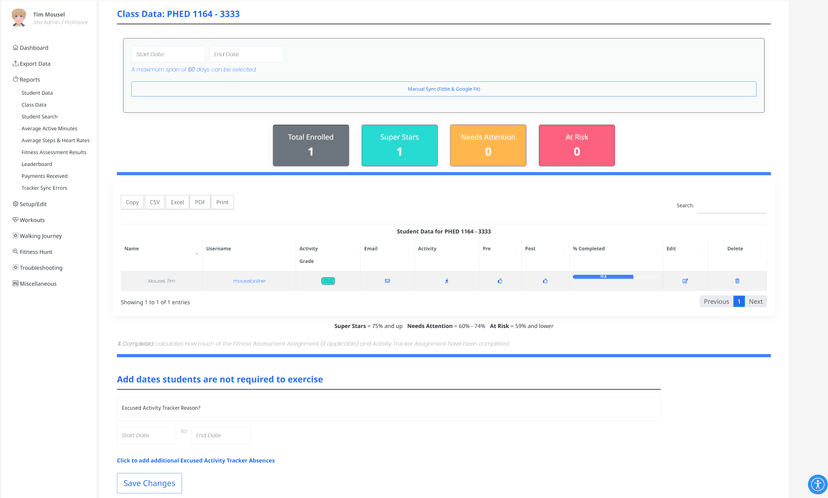
eFit Software uses a mastery-based tracking approach paired with self-monitoring to connect health theory to physical practice. Students begin by entering baseline physiological data and fitness assessment results into the platform. As the course progresses, students continuously feed the system daily metrics, including step counts, nutrition logs, and active minutes. The software analyzes this incoming data to generate personalized workouts and meal plans tailored to the student's specific health goals. Instructors view this data through a centralized dashboard, allowing them to monitor progress and assign grades based on concrete activity metrics rather than subjective participation. The integration with common learning management systems means students can access their interactive kinesiology eBook and their tracking tools in one place. By consistently logging data, students engage in behavioral self-regulation, a proven framework in health education that requires learners to reflect on their habits and adjust them to meet mastery thresholds set by their teachers.
Strengths and tradeoffs of eFit Software
The biggest strength of eFit Software is its seamless integration of real-time physiological data into the learning process, while its biggest weakness is its reliance on consistent self-reporting from students. Real-world application is highly effective in applied sciences; by syncing with activity trackers, the software allows students to observe the immediate physical effects of their workouts. This continuous feedback loop reinforces learning significantly better than reading about abstract heart rate zones in a textbook. Personalization is another strong point. Because the system generates meal plans and workouts based on individual assessments, it applies the science of individualized instruction directly to physical education. However, the platform demands high executive functioning. Self-monitoring only works when data is accurate. If a student forgets to wear their tracker or manually logs incorrect nutritional information, the generated feedback becomes useless. Additionally, the software acts primarily as a dashboard. It lacks the robust instructional scaffolding needed to teach a struggling student why their macronutrient balance is off, leaving that explanatory burden entirely on the classroom teacher or the included interactive eBook.
Who Might Benefit From eFit Software?
Best for high school and college students enrolled in structured physical education or kinesiology courses that require rigorous fitness tracking. Because the platform relies heavily on consistent data entry and self-monitoring, it is ideal for older students who possess the executive functioning skills necessary to log daily nutrition and activity. It is highly effective for learners who already own wearable fitness trackers, as the automated syncing removes the friction of manual data entry. eFit Software is not designed for independent learners seeking a standalone fitness app; it requires an active instructor to frame the data, assign the coursework, and evaluate the generated reports.
Data Transparency
Does Not Meet Data Transparency Standard
eFit Software does not meet our data transparency standard. Its privacy policy does not document basic protections, including parents' right to see their child's data and parents' right to delete their child's data.
21 of 35 checks passed
Evaluated September 2026
Privacy Policy →Level 1 · Basic protections
Does not sell data or target ads at students, limits sharing, and lets parents see and delete their child's data.
Not documented: parents' right to see their child's data, parents' right to delete their child's data
Level 2 · Parent control (meets the standard)
Families can get their data out, know who processes it, and know how long it is kept.
Level 3 · Direct data access
Families or schools can pull their own data through an API, in a stated format.
Not documented: an API for retrieving their own data, a named export format
View all 35 checks
Parent Access4/8
Does the policy mention parents specifically?
“If you become aware that a child has provided us with personal data without parental consent, please contact us using the information provided at the end of this policy.”
Can parents view their child's data?
The policy gives users the right to inspect their records but does not give parents a right to view their child's data.
Can parents modify their child's data?
The policy gives users the right to request corrections but does not give parents a right to modify their child's data.
Can parents delete their child's account?
The policy says it will remove data and cancel the account of a child under 13 found to have given data without parental consent, but it does not give parents a right to request deletion of their child's account or data.
Is there a dedicated Children's Privacy section?
“**Children**. We do not knowingly collect personal data online from children under 13”
Does it reference COPPA compliance?
The policy does not reference COPPA.
Does it reference FERPA compliance?
“Sites complies with the Family Education Rights and Privacy Act of 1974 (FERPA) when collecting, maintaining, and disclosing student records.”
Is parental consent required for child accounts?
“If we become aware that a child under 13 has provided us with personal data without parental consent, we will take steps to remove the data and cancel the child's account.”
Data Portability3/5
Can users access their personal data?
“Sites Users have rights regarding their records, including the right to inspect, review, and request the amendment of incorrect records.”
Can users download/export their data?
“Educators and Institutions may export grade book information and other Course Data from the Services for the purpose of maintaining educational records.”
Is there a self-service data access tool?
“If you would at any time like to review or change the information in your account or terminate your account, you can:”
Is a specific data format mentioned for export?
The policy does not name an export format.
Is there an API for data access?
The policy does not describe an API that users or schools can use to retrieve their own data.
Data Minimization1/6
Is data collection itemized?
“Student Information generally includes the following: Demographic information including name, email address, date of birth; Student education records including grades and class enrollments; Consumer Health information, including heart rate if opted-in, number of steps, number of calories burned, nutritional consumption and; System usernames and passwords.”
Can the app be used without a real name?
The policy states that it collects names, including student names.
Can the app be used without an email?
The policy states that it collects email addresses, including student email addresses.
Does it state collection is limited to what is necessary?
The policy limits how long data is kept to what is necessary but does not say collection is limited to what is necessary.
Is IP address anonymized or truncated?
The policy says IP addresses are collected and does not say they are anonymized or truncated.
Is location tracking explicitly excluded?
The policy says it collects location as part of device and usage data.
Third-Party Protection7/7
Does it explicitly state no selling of data?
“**No Sale of Personal Information** Sites does not sell or rent User Personal Information.”
Are third-party providers named?
“Invoice and Billing** PayPal”
Are providers contractually restricted?
“Sites may disclose Personal Information to affiliated Sites companies and other companies and organizations who perform work for Sites under contract and are obligated to protect the privacy of Personal Information consistent with this Privacy Policy.”
No-targeted-advertising commitment?
“**Marketing and Advertising** Sites will not use Personal Information of any User for marketing purposes.”
Is AI/ML data sharing addressed?
“**eFit does not use your information to train any artificial-intelligence or machine-learning model**, and these providers make their APIs available under terms that do not use data submitted through the API to train their models.”
Child-specific sharing restriction?
“Sites also may disclose or use Personal Information: (a) with the User 's consent (or, if a Youth User, with the consent of the Youth User 's parent);”
Cookies/tracking limited or opt-out?
“Specific information about how we use such technologies and how you can refuse certain cookies is described in this notice and in your browser settings.”
Deletion & Retention5/5
Can users delete their account?
“Upon your request to terminate your account, we will deactivate or delete your account and information from our active databases.”
Self-service deletion mechanism?
“If you would at any time like to review or change the information in your account or terminate your account, you can:”
Specific data retention timeline?
“No purpose in this notice will require us keeping your personal information for longer than twelve (12) months past the start of idle period of the user's account.”
Auto-deletion of inactive accounts?
“No purpose in this notice will require us keeping your personal information for longer than twelve (12) months past the start of idle period of the user's account.”
Post-deletion handling described?
“However, we may retain some information in our files to prevent fraud, troubleshoot problems, assist with any investigations, enforce our Terms of Use and/or comply with applicable legal requirements.”
Advertising1/4
Advertising model explicitly disclosed?
The policy limits marketing use of personal information but does not say whether the product shows advertising.
Free from third-party advertisements?
The policy does not say the product is free of third-party advertisements.
Children excluded from ad targeting?
“**Marketing and Advertising** Sites will not use Personal Information of any User for marketing purposes.”
Ad-free option available?
The policy does not say the product has no ads or offer an ad-free option.
What This Means
The policy review did not meet our data transparency standard. The checks above show the documented findings and unknowns. A missing statement does not establish how the app handles data in practice.
About this evaluation: Based on automated analysis of Privacy Policy against 35 policy-disclosure questions, including questions adapted from the Common Sense Privacy Program's published evaluation questions. TLS is not affiliated with Common Sense Media, and this is not a Common Sense rating. Quoted text is copied from the policy; unquoted notes are our summary. Results describe what the policy documents, not the company's actual practices. Privacy policies can change: this review reflects the version we analyzed and does not determine legal compliance.
Sources and review method
TLS combines product information and editorial analysis to explain how eFit Software works, its tradeoffs, and the questions to ask before choosing it. Product features, an instructional rationale and evidence of learning outcomes are different kinds of information.
Formal Learning Standard assessment: not yet completed. Data Transparency findings are reported separately and do not establish learning effectiveness. Read our methodology.
Frequently Asked Questions About eFit Software
Is eFit Software free?
No, eFit Software is not free. Students must purchase individual class access for a flat fee of $59. This subscription fee includes an interactive, personalized eBook that covers the core scientific concepts of physical education and kinesiology. Schools or higher education institutions do not typically cover this cost on behalf of the learner, making it function similarly to a required digital textbook purchase for a college or high school health course.
Is eFit Software good for high school students?
Yes, eFit Software is highly appropriate for students in 8th through 12th grade, as well as those in higher education. The platform requires a foundational level of maturity, executive functioning, and personal discipline to track daily nutrition, steps, and fitness metrics accurately. High schoolers are developmentally ready to connect their daily behavioral choices to long-term physical health outcomes using the platform's built-in data visualization and individualized reporting tools.
What does eFit Software teach?
eFit Software teaches applied science and kinesiology by requiring students to track, analyze, and reflect upon their personal health data. While it does not deliver traditional video lectures, it provides an interactive eBook that covers health science fundamentals. Your child will learn how to interpret complex physiological metrics like heart rate variability, understand daily nutrition macros, and execute personalized meal and workout plans based on their own baseline fitness assessments.
How does eFit Software compare to MyFitnessPal?
While MyFitnessPal operates as a consumer application focused strictly on individual calorie and macronutrient tracking, eFit Software functions as a comprehensive educational platform designed specifically for academic environments. eFit Software connects your child's physiological data directly to a teacher's gradebook and a school's Learning Management System. Furthermore, it provides an interactive kinesiology eBook and explicitly ties daily activity tracking to specific course competencies and mastery-based learning benchmarks.
Has The Learning Standard evaluated eFit Software?
TLS has not yet completed a Learning Standard evaluation of how well eFit Software teaches. Its privacy policy has been reviewed for Data Transparency and does not yet document the basic protections (Level 1).
Is eFit Software COPPA compliant?
A COPPA reference was not found in the reviewed privacy policy. This does not determine whether the app complies with COPPA. Policy review note: The policy does not reference COPPA.
Is eFit Software FERPA compliant?
The reviewed privacy policy references FERPA. A policy reference alone does not establish FERPA compliance. Policy review note: The policy states that it complies with FERPA.
Does eFit Software have a children's privacy policy?
The reviewed policy includes a dedicated children's privacy section. Policy review note: The policy has a paragraph with its own "Children" heading.
Does eFit Software sell student data?
The reviewed policy states that the app does not sell data. This is a policy statement; actual data practices were not verified. Policy review note: The policy states that the vendor does not sell user personal information.
Can you delete your data from eFit Software?
The reviewed privacy policy describes account deletion. We have not tested the deletion process. Policy review note: Users can ask to have their account deleted.
Follow TLS Research
Subscribe to future TLS research updates: app reviews, findings, and what the evidence shows.
Screenshots
Take Action
For eFit Software
If you represent eFit Software and have a correction or new evidence, send the relevant source so we can review and update this page.
Submit a correctionDetails
- Pricing
- Students purchase class access to eFit Sotware for $59. An interactive, personalized eBook is included.
- Platforms
- Web Browser
- Grade Levels
- 8th Grade, 9th Grade, 10th Grade, 11th Grade, 12th Grade, Associate's degree, Bachelor's degree, Post-baccalaureate certificate, Adult Education, Professional or Technical Credential
- Website
- Visit site