
EduSmart Science
Product by EduSmart Sciene
Facts checked: Not yet checked
Our take (not a Learning Standard rating). This label applies to learning-science judgments throughout this overview.
Our take (not a Learning Standard rating)
EduSmart Science offers a comprehensive suite of instructional modules and simulations, but The Learning Standard has not yet evaluated its long-term efficacy. It provides strong multimodal representations of complex concepts, which aids dual coding, but lacks independent data on how well its mechanics utilize spaced retrieval practice.
Pros
- Uses multimodal simulations to build accurate mental models of invisible scientific phenomena.
- Incorporates dual coding theory by combining visual animations with explicit vocabulary instruction.
- Supports varied instructional phases with differentiated reading materials for diverse reading levels.
- Aligns directly with state and national science standards to ensure curriculum fidelity.
Cons
- Relies heavily on school-based implementation, making it inaccessible for independent home use.
- Lacks transparent data demonstrating the use of spaced repetition to prevent long-term forgetting.
- Requires significant teacher orchestration to ensure students engage in active inquiry rather than passive watching.
- Offers limited corrective feedback during independent practice beyond simple right or wrong indicators.
What Do We Know About EduSmart Science?
EduSmart Science is an effective classroom tool for building scientific mental models, provided your child's teacher actively guides the instruction. Because this platform is designed specifically for school environments, it is not a standalone app you purchase for casual home use. Instead, it acts as a digital textbook replacement that your child interacts with during school hours or for homework assignments. The program uses a highly visual approach to explain complex systems, like photosynthesis or physical forces, helping students build accurate mental representations of invisible phenomena. Your child will experience a structured mix of direct instruction modules, interactive digital lab simulations, and leveled readers. While the platform offers built-in quizzes and student reviews, it functions primarily as a content delivery system rather than an adaptive tutoring engine. If your child's school uses EduSmart, expect them to have access to rich, multimodal science content that supports inquiry-based learning. However, because The Learning Standard has not yet formally evaluated the platform's adaptive algorithms, parents should monitor whether their child is retaining vocabulary over time or merely clicking through interactive modules without deep processing.
How Does EduSmart Science Work?
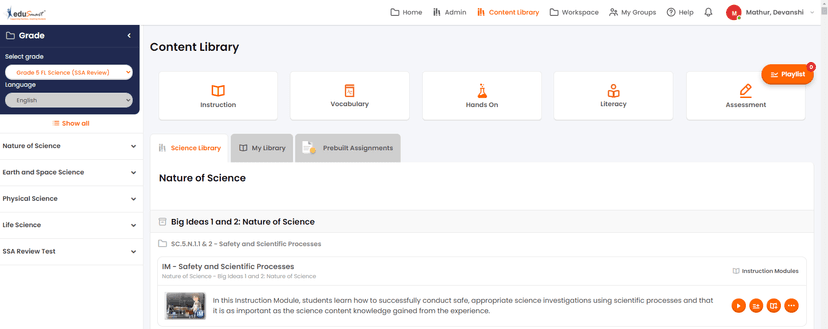
EduSmart Science uses a blended inquiry-based and direct instruction pedagogical approach, combining explicit multimedia presentations with interactive lab simulations. The platform organizes scientific content into distinct instructional modules that teachers assign based on current curriculum goals. Your child begins by watching animated instructional videos that break down complex scientific phenomena into manageable cognitive segments. Following this direct instruction, students engage with interactives and digital simulations that require them to manipulate variables and observe outcomes. This grounds abstract concepts in observable digital models. The platform includes a Word Explorer tool that explicitly teaches domain-specific scientific vocabulary using dual coding techniques, carefully pairing images with text definitions. Formative assessments are embedded at the end of modules to test immediate comprehension. Teachers monitor this progression through a central dashboard, using the resulting data to assign re-teach modules or reading materials leveled specifically to the student's current reading ability.
Strengths and tradeoffs of EduSmart Science
EduSmart Science excels at using multimodal digital simulations to explain abstract scientific concepts, but it struggles to provide adaptive retrieval practice without heavy teacher intervention. The platform relies heavily on dual coding theory, simultaneously presenting visual models and verbal explanations to reduce cognitive load when your child encounters complex topics like cellular respiration or chemical bonding. Its inquiry-based simulations require students to actively manipulate variables, moving them from passive observers to active participants. Furthermore, the inclusion of leveled readers allows educators to scaffold complex scientific texts for diverse reading levels. However, the platform's weakness lies in its rigid assessment structure. Without explicit features driving spaced repetition or interleaved practice, students may pass an end-of-module quiz but fail to retain the knowledge weeks later. Additionally, the feedback provided during independent practice often lacks the worked examples necessary to help struggling students correct their misconceptions in real-time. Because The Learning Standard has not yet evaluated the backend analytics, we cannot confirm if the system automatically adapts difficulty based on performance, meaning teachers must manually intervene to close learning gaps.
Who Might Benefit From EduSmart Science?
EduSmart Science is best for K-12 classroom environments that need a comprehensive, highly visual digital curriculum to supplement teacher-led science instruction. Because it spans from kindergarten through high school, it serves diverse age groups by scaling the complexity of its simulations and reading materials. It is particularly effective for visual learners and students who benefit from manipulating digital labs before attempting physical experiments. However, it is not designed for individual consumer purchase, making it unsuitable for parents seeking an independent tutoring app.
Data Transparency
Does Not Meet Data Transparency Standard
EduSmart Science reaches Level 1 of 3 (Basic protections), below our data transparency standard. Reaching Level 2 needs the policy to document data export and self-service deletion.
17 of 35 checks passed
Evaluated September 2026
EduSmart →Level 1 · Basic protections
Does not sell data or target ads at students, limits sharing, and lets parents see and delete their child's data.
Level 2 · Parent control (meets the standard)
Families can get their data out, know who processes it, and know how long it is kept.
Not documented: data export, self-service deletion
Level 3 · Direct data access
Families or schools can pull their own data through an API, in a stated format.
Not documented: an API for retrieving their own data, a named export format
View all 35 checks
Parent Access6/8
Does the policy mention parents specifically?
“For parents of children who access and use the services of our websites by means of a license for such use purchased by your child’s school, in order to obtain a copy of your child’s student record in relation to such access and use, you must refer such requests directly to your child’s school.”
Can parents view their child's data?
“For parents of children who access and use the services of our websites by means of a license for such use purchased by your child’s school, in order to obtain a copy of your child’s student record in relation to such access and use, you must refer such requests directly to your child’s school.”
Can parents modify their child's data?
“For parents of children who access and use the services of our websites by means of a license for such use purchased by your child’s school, in order to obtain a copy of your child’s student record in relation to such access and use, you must refer such requests directly to your child’s school. If a user wishes to be deleted from the system or have data previously entered into the system deleted or edited, this can only be done by submitting such a request to your school or institution’s teacher or administrator.”
Can parents delete their child's account?
“For parents of children who access and use the services of our websites by means of a license for such use purchased by your child’s school, in order to obtain a copy of your child’s student record in relation to such access and use, you must refer such requests directly to your child’s school. If a user wishes to be deleted from the system or have data previously entered into the system deleted or edited, this can only be done by submitting such a request to your school or institution’s teacher or administrator.”
Is there a dedicated Children's Privacy section?
The policy has a "Policy For Students" section but no section headed for children's privacy or COPPA.
Does it reference COPPA compliance?
“EduSmart complies with FERPA, COPPA, and applicable state and international data privacy laws.”
Does it reference FERPA compliance?
“EduSmart complies with FERPA, COPPA, and applicable state and international data privacy laws.”
Is parental consent required for child accounts?
The policy does not say parental consent is required for child accounts.
Data Portability1/5
Can users access their personal data?
“Authorized school representatives may access, correct, or request deletion of student information at any time by contacting support@edusmart.com.”
Can users download/export their data?
The policy lets parents get a copy of a student record through the school but does not describe a way to download or export data.
Is there a self-service data access tool?
The policy describes access only through requests to the school or support, not a self-service tool.
Is a specific data format mentioned for export?
The policy does not name any export format.
Is there an API for data access?
The policy mentions rostering integrations but no API for users to retrieve their own data.
Data Minimization1/6
Is data collection itemized?
“This information includes name, grade level, class assignment, and other identifying information that subscribers may deem necessary to enable the assessment, assignment, and/or reporting features of the EduSmart product(s) used.”
Can the app be used without a real name?
The policy says students' first and last names are collected, including from subscribers.
Can the app be used without an email?
The policy does not say that student email addresses are never collected, and it lists email among the information users may provide.
Does it state collection is limited to what is necessary?
The policy limits what is shared with service providers to essential information but does not say collection is limited to what is necessary.
Is IP address anonymized or truncated?
The policy says IP addresses are logged and not linked to personal information, but not that they are anonymized or truncated.
Is location tracking explicitly excluded?
The policy does not address location tracking.
Third-Party Protection5/7
Does it explicitly state no selling of data?
The policy does not explicitly state that EduSmart does not sell data.
Are third-party providers named?
“- **Amazon Web Services (AWS)** – Hosting and infrastructure - **ReadSpeaker** – Text-to-speech functionality - **Clever** – SSO and rostering integration”
Are providers contractually restricted?
“EduSmart enters into contracts with such Contractors which contain confidentiality and non-disclosure provisions requiring that such Contractors maintain the confidentiality of any personally identifiable information which may be disclosed by EduSmart to the Contractor in order to utilize such Contractor’s product, and the Contractor promises not to disclose such information to any other party.”
No-targeted-advertising commitment?
“EduSmart does not use any information about students for any marketing or promotional purposes whatsoever, either inside or outside EduSmart.”
Is AI/ML data sharing addressed?
The policy does not address AI or machine learning.
Child-specific sharing restriction?
“We do not share personally identifiable information (PII) about students, with unrelated third parties, except as explicitly stated in this Privacy Policy.”
Cookies/tracking limited or opt-out?
“We use cookies and similar technologies for authentication and to improve user experience. We do not use cookies for advertising or share cookie-derived data with third parties.”
Deletion & Retention3/5
Can users delete their account?
“If a user wishes to be deleted from the system or have data previously entered into the system deleted or edited, this can only be done by submitting such a request to your school or institution’s teacher or administrator.”
Self-service deletion mechanism?
The policy says deletion can only be done by request through the school.
Specific data retention timeline?
“EduSmart will delete customer records within 30 days after the expiration of the contract.”
Auto-deletion of inactive accounts?
The policy does not address deleting inactive accounts automatically.
Post-deletion handling described?
“There are various circumstances when EduSmart may deny the request, including (but not limited to) when EduSmart believes that applicable law or court order requires it to retain the education records, when EduSmart believes that retention of the education records is necessary to protect its rights, or when the request extends to backed-up, electronically stored education records, the destruction of which would be unreasonably burdensome.”
Advertising1/4
Advertising model explicitly disclosed?
The policy does not state whether the product carries advertising or describe any advertising model.
Free from third-party advertisements?
The policy does not say the product is free of third-party ads.
Children excluded from ad targeting?
“EduSmart does not use any information about students for any marketing or promotional purposes whatsoever, either inside or outside EduSmart.”
Ad-free option available?
The policy does not say the product is ad-free or offer an ad-free option.
What This Means
The policy review did not meet our data transparency standard. The checks above show the documented findings and unknowns. A missing statement does not establish how the app handles data in practice.
About this evaluation: Based on automated analysis of EduSmart against 35 policy-disclosure questions, including questions adapted from the Common Sense Privacy Program's published evaluation questions. TLS is not affiliated with Common Sense Media, and this is not a Common Sense rating. Quoted text is copied from the policy; unquoted notes are our summary. Results describe what the policy documents, not the company's actual practices. Privacy policies can change: this review reflects the version we analyzed and does not determine legal compliance.
Sources and review method
TLS combines product information and editorial analysis to explain how EduSmart Science works, its tradeoffs, and the questions to ask before choosing it. Product features, an instructional rationale and evidence of learning outcomes are different kinds of information.
Formal Learning Standard assessment: not yet completed. Data Transparency findings are reported separately and do not establish learning effectiveness. Read our methodology.
Frequently Asked Questions About EduSmart Science
Is EduSmart Science free?
No, EduSmart Science is not free. It uses a subscription-based pricing model aimed primarily at schools and educational districts. The cost ranges from $3 to $10 per student, depending entirely on the specific grade level and the total volume of licenses purchased by the institution. Because it operates on a district-level purchasing model, individual parents cannot simply download it for free from an app store. Your child will only access this platform if their school has paid for the overarching district license.
Is EduSmart Science good for elementary students?
Yes, EduSmart Science is highly effective for elementary students because it uses rich visual animations to introduce foundational science concepts. The platform scales its content appropriately for younger learners, ensuring kindergarten through fifth-grade students are not overwhelmed by complex text. By relying on interactive simulations and explicit vocabulary instruction, it helps younger children build accurate mental models of scientific phenomena before they transition to more advanced, text-heavy middle school science curricula.
What does EduSmart Science teach?
EduSmart Science teaches a comprehensive K-12 science curriculum, alongside applied science and career and technical education (CTE) pathways. The platform covers core foundational subjects including biology, chemistry, physics, and earth science. Every instructional module and digital simulation is aligned directly with state and national educational standards to ensure complete curriculum fidelity. Rather than offering random science facts, it provides structured, sequential lessons designed to replace or heavily supplement traditional classroom science textbooks.
How does EduSmart Science vs Discovery Education compare?
Both platforms offer comprehensive digital science curricula, but EduSmart Science focuses more heavily on targeted, interactive instructional modules and specific vocabulary building. Discovery Education provides a much broader, more exploratory digital video library spanning multiple subjects. EduSmart is typically utilized by teachers for strict standards alignment and direct, step-by-step instruction, whereas Discovery Education is often deployed for supplemental exploration. If your child needs structured practice with scientific simulations, EduSmart provides a more controlled, linear learning path.
Has The Learning Standard evaluated EduSmart Science?
TLS has not yet completed a Learning Standard evaluation of how well EduSmart Science teaches. Its privacy policy has been reviewed for Data Transparency and reaches Level 1, Basic protections.
Is EduSmart Science COPPA compliant?
The reviewed privacy policy references COPPA. A policy reference alone does not establish COPPA compliance. Policy review note: The policy states it complies with COPPA.
Is EduSmart Science FERPA compliant?
The reviewed privacy policy references FERPA. A policy reference alone does not establish FERPA compliance. Policy review note: The policy states it complies with FERPA.
Does EduSmart Science have a children's privacy policy?
No dedicated children's privacy section was found in the reviewed policy. Policy review note: The policy has a "Policy For Students" section but no section headed for children's privacy or COPPA.
Does EduSmart Science sell student data?
A statement ruling out data selling was not found in the reviewed policy. This does not establish that the app sells student data. Policy review note: The policy does not explicitly state that EduSmart does not sell data.
Can you delete your data from EduSmart Science?
The reviewed privacy policy describes account deletion. We have not tested the deletion process. Policy review note: Users can ask for deletion through their school.
Follow TLS Research
Subscribe to future TLS research updates: app reviews, findings, and what the evidence shows.
Screenshots


Take Action
For EduSmart Science
If you represent EduSmart Sciene and have a correction or new evidence, send the relevant source so we can review and update this page.
Submit a correctionDetails
- Pricing
- Subscription pricing ranges from $3/student to $10/student depending on grade level and volume of licenses purchased.
- Platforms
- Web Browser, iPadOS (Apple tablet), Windows (Microsoft), macOS (Apple), Chrome OS (Google)
- Grade Levels
- Kindergarten, 1st Grade, 2nd Grade, 3rd Grade, 4th Grade, 5th Grade, 6th Grade, 7th Grade, 8th Grade, 9th Grade, 10th Grade, 11th Grade, 12th Grade
- Website
- Visit site